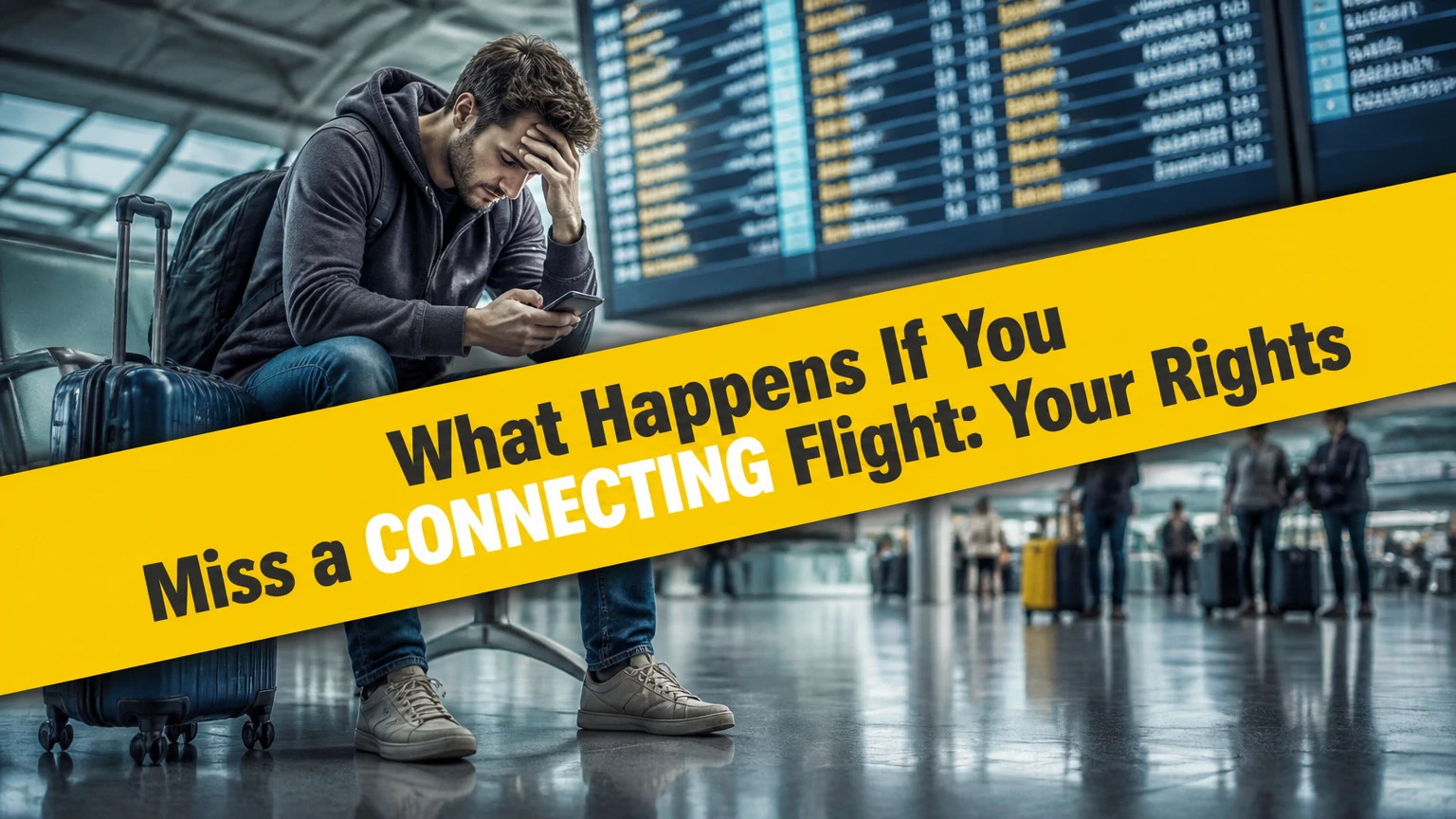
What happens if you miss a connecting flight depends primarily on whether both flights are on one ticket, why the connection failed, and whether you reached the gate before boarding closed. On a single itinerary, the airline usually rebooks you when its delay caused the failure; on separate tickets, the second airline may treat you as a no-show and charge for a new flight.
Key Facts / Quick Answer
A single-ticket connection normally protects the remaining itinerary when the first flight causes the missed connection.
A separate-ticket connection creates a self-transfer: the second airline usually has no duty to honor the missed booking.
Gate closure is often 10-15 minutes before departure, but the published boarding deadline controls.
Minimum Connection Time is a scheduling standard, not a universal promise that a passenger can complete the transfer.
Weather and air traffic restrictions commonly trigger rebooking without cash compensation or a free hotel.
Ask for a confirmed seat, protect later segments, file a baggage report, and save delay evidence before leaving the airport.
What Happens If You Miss a Connecting Flight?
A missed connection triggers one of three outcomes: automatic rebooking, voluntary same-day standby, or a new-ticket purchase. The outcome follows the contract of carriage and the cause of the disruption, not simply the fact that both flights display the same airline brand.
If the first flight arrives late and both segments were sold as one ticket, the operating or marketing carrier generally protects the itinerary. The reservation system may rebook you before landing, or an agent may place you on the next flight with available capacity. That protection does not always mean a nonstop route, a partner airline, a hotel, or a cash payment.


If you missed boarding because you arrived late at the gate, the airline can apply its no-show rules. Later flights on the same reservation may then be canceled automatically. Ask an agent to preserve every remaining segment immediately.
What determines the airline’s responsibility?
The decisive facts are the ticket structure, the recorded cause, the airport’s connection rules, and your conduct during the transfer. A 45-minute connection can be valid for an airport and still fail when immigration, a remote stand, or a terminal transfer consumes the available time.
Airlines use operational records to identify delay codes. Mechanical, crew, aircraft, and many network-control events are generally airline-controlled. Weather, air traffic control, airport closures, and some strikes usually fall outside the carrier’s control. Passenger delay, missed boarding, and failure to meet document requirements usually remain the traveler’s responsibility.
What Should You Do First at the Airport?
The fastest response is to open the airline app, confirm the reservation status, and request a confirmed replacement seat through any available channel. Do not wait passively for the original aircraft or assume that an automatic rebooking has preserved your entire itinerary.
Use this sequence:
- Check the app and email. Look for a new flight number, seat assignment, standby status, or a notice that later segments were canceled.
- Confirm the cause and arrival record. Save screenshots showing the first flight’s actual arrival time, delay code, and gate information.
- Contact the airline while moving. Use the app’s rebooking function, telephone support, airport desk, and accessible social-support channel simultaneously.
- Request a confirmed seat first. Ask for the earliest practical route, including airline partners permitted by the ticket rules.
- Protect the rest of the itinerary. Tell the agent that you intend to travel and ask them to restore any canceled onward segments.
- Resolve the bag plan. Ask whether baggage is tagged to the original destination, the replacement destination, or held at the connecting airport.
- Obtain written proof. Request a delay confirmation, meal or hotel voucher, baggage report number, and the reason for any denied accommodation.
- Escalate with a specific request. State the flight you want, the legal or contract basis for assistance, and the evidence you have.
In practice, the person who reaches an agent with a proposed routing often receives help faster than the person who asks only, “What can you do?” Check both the airline’s app and airport departure boards because automated systems can display different information for several minutes.
Does a Single Ticket Protect a Missed Connection?
A single ticket normally creates one contract of carriage for the complete itinerary, even when two operating airlines fly the segments. The airline can usually reroute a passenger whose first segment caused the failure, subject to its fare rules, interline relationships, and available seats.
A single ticket is identified by one ticket number or one linked itinerary, not merely by a shared booking website. A travel agency can issue separate tickets in one shopping session. Conversely, a codeshare may show one airline’s flight number while another airline operates the aircraft, with both segments still on one ticket.
| Booking structure | Typical rebooking result | Main passenger risk |
|---|---|---|
| One ticket, airline delay | Free rerouting to an available service | Longer route or overnight wait |
| One ticket, weather delay | Usually free rebooking under contract rules | Hotel and meals may be excluded |
| One ticket, passenger missed gate | Fare-rule or same-day change treatment | Later segments may be canceled |
| Two separate tickets | Second airline may require a new purchase | New fare, baggage, and overnight costs |
| One agency booking, two ticket numbers | Separate contracts despite one checkout | Confusing support and limited protection |
The marketing carrier, operating carrier, and ticket issuer can have different roles. Start with the airline that issued the ticket, then speak with the operating airline at the airport. If a codeshare carrier says it cannot change the ticket, ask which carrier controls the ticket stock and request that carrier’s record locator.
What happens to later flights after a no-show?
Later flights on the same ticket may be canceled when the system records a missed segment without an approved rebooking. This is one of the most expensive administrative mistakes because a traveler can lose the return flight while trying to solve only the outbound connection.
Ask the agent to annotate the reservation and confirm that all remaining segments are active. If you purchased a return journey on a separate ticket, the return normally remains independent, but the carrier’s no-show conditions still control that reservation.
What Changes With a Self-Transfer or Separate Ticket?
A self-transfer makes the traveler responsible for connecting two independent contracts. If Flight A arrives late and Flight B departs, Airline B commonly records a no-show, releases the seat, and requires a change fee, fare difference, or entirely new ticket.
Self-transfers also add physical tasks. At many international airports, the traveler must leave the secure area, pass immigration, collect checked bags, clear customs, re-check the bags, pass security, and reach a different terminal before boarding closes.
| Self-transfer task | Typical time range | Failure consequence |
|---|---|---|
| Domestic terminal transfer | 20-60 minutes | Gate closure or missed boarding |
| International arrival immigration | 30-120 minutes | Missed onward departure |
| Bag collection and customs | 30-90 minutes | Missed check-in deadline |
| Re-check and security | 30-100 minutes | New-ticket purchase risk |
| Separate-ticket recovery | 2-24 hours | Fare difference and lodging cost |
A single booking website does not necessarily combine liability. Read the confirmation for separate ticket numbers, separate airline record locators, and phrases such as “self-transfer,” “connection guarantee,” or “protected transfer.” A platform’s guarantee may reimburse defined costs, but it is not the same as airline protection and may require strict evidence and notification deadlines.
Who Pays When the Cause Is Airline-Controlled?
When an airline-controlled delay causes a protected connection to fail, the usual remedy is free rebooking to the destination under the carrier’s contract of carriage. Hotel, meals, ground transport, and cash compensation depend on the country, cause, airline policy, and length of the disruption.
| Cause of missed connection | Free rebooking | Hotel or meals | Cash compensation possibility |
|---|---|---|---|
| Mechanical delay | Usually, one-ticket itinerary | Often policy-dependent | EU261 or UK261 may apply |
| Crew or aircraft shortage | Usually, one-ticket itinerary | Often policy-dependent | EU261 or UK261 may apply |
| Severe weather | Usually, if contract protects route | Often excluded | Usually excluded under EU261 |
| Air traffic control restriction | Usually, if contract protects route | Often excluded | Usually excluded under EU261 |
| Passenger arrived after gate closure | Usually not guaranteed | No standard entitlement | Normally unavailable |
The U.S. Department of Transportation states that passengers are entitled to a refund when an airline cancels or significantly changes a flight and the passenger declines the alternative. Transportation Secretary Pete Buttigieg summarized the agency’s consumer-protection position in a 2024 DOT announcement: “Passengers deserve to get what they pay for.”
That refund rule does not automatically require a cash payment for delay inconvenience. If you accept and take the replacement flight, you generally cannot also demand a refund for the unused transportation.
When do EU261 and UK261 apply?
EU261 can apply when a flight departs from an EU airport, or when it arrives in the EU on an EU carrier, subject to the regulation’s scope. UK261 generally covers departures from the United Kingdom and certain arrivals on UK or qualifying carriers.
For an eligible disruption, compensation is commonly €250, €400, or €600 based on flight distance, with reductions possible when rerouting limits arrival delay. Extraordinary circumstances, including many weather and air traffic events, can remove compensation while leaving rerouting or care obligations intact. The exact claim depends on departure airport, carrier, arrival delay, notice, and causation.
How Do Rebooking, Standby, and Partner Flights Work?
Rebooking gives you a confirmed seat on a replacement service; standby gives you a place in a queue without a guaranteed seat. A full next flight can therefore produce several hours of uncertainty even when the airline accepts responsibility for the original delay.
Agents usually search the airline’s own flights first. Partner-airline rebooking may require an interline agreement, ticket endorsement, or supervisor approval. A cheaper fare class does not necessarily prevent rebooking, but the airline’s contract and inventory rules determine what the agent can issue.
| Replacement option | Seat certainty | Typical timing | Best use |
|---|---|---|---|
| Confirmed same-day flight | High | 1-12 hours | Time-sensitive travel |
| Confirmed next-day flight | High | 12-30 hours | No open same-day seats |
| Standby on earlier flight | Low | 1-8 hours | Flexible travelers |
| Partner-airline routing | High if endorsed | 2-24 hours | Major schedule disruption |
| New independent ticket | High after purchase | 1-24 hours | Separate-ticket emergency |
Request the earliest route that reaches the final destination, not simply the next flight operated by the original carrier. Check nearby airports only after calculating ground transport, baggage handling, and the risk of losing the protected ticket.
The common “flat-tire rule” is not a universal law. Some airlines informally help passengers who arrive within roughly two hours of a missed departure, but the time window, fee waiver, and standby treatment vary by carrier and fare.
What Happens to Checked Bags?
Checked baggage is normally transferred to the replacement flight when the bag remains under the airline’s control and the itinerary is protected. A bag may instead remain at the connection airport, travel on the original flight, or be held for passenger collection when the new route changes the baggage destination.
Do not assume the bag will follow you. Ask four precise questions:
- Is the bag tag printed to the final city or the intermediate airport?
- Has the bag been loaded, held, or removed from the first aircraft?
- Must the passenger collect and re-check it?
- Can the bag be delivered if the traveler reaches the destination first?
International self-transfers commonly require baggage collection because customs authorities may require the owner to present the bag. A protected single-ticket connection does not erase immigration or customs rules.
| Baggage situation | Passenger action | Typical resolution time |
|---|---|---|
| Bag follows replacement flight | Confirm new bag routing | Same day to 24 hours |
| Bag remains at connection | File delayed-bag report | 4-48 hours |
| Bag arrives without passenger | Give delivery address | 12-72 hours |
| Bag is damaged or missing | File report before leaving | Report deadline varies |
| Overnight connection | Ask before retrieving bag | 1-4 hours if retrieval is possible |
If you need medication, work equipment, or clothing, identify those items in the baggage report. Keep the report number, bag-tag receipt, and reasonable receipts for essential purchases. Reimbursement rules differ from the airline’s duty to transport the bag.
How Much Does a Missed Connection Cost?
A protected airline-caused disruption can cost nothing for the replacement flight, while a self-transfer failure can cost hundreds or more than $1,000. The largest price difference comes from buying a walk-up ticket close to departure, not from the original change fee.
| Expense | One-ticket airline disruption | Separate-ticket disruption | Typical amount |
|---|---|---|---|
| Replacement flight | Usually $0 | New fare often required | $150-$1,500+ |
| Fare difference | Usually $0 | Commonly charged | $50-$1,000+ |
| Hotel | Policy or law dependent | Usually passenger-paid | $100-$300 per night |
| Meals | Voucher or reimbursement possible | Usually passenger-paid | $15-$45 per day |
| Ground transport | Sometimes provided | Usually passenger-paid | $20-$150 |
| Baggage delivery | Often no passenger charge | Varies by carrier | $0-$100 |
These figures are typical planning ranges, not guaranteed prices. Airport, season, route, cabin, and remaining inventory can move the replacement fare sharply.
Travel insurance and credit-card coverage may reimburse trip-delay expenses after a qualifying delay, often with a waiting threshold of 6-12 hours and a per-trip limit of $300-$500. Coverage commonly excludes a connection that was too short under the policy’s definition, a self-transfer, or expenses incurred without receipts.
| Payment source | Common covered item | Typical condition |
|---|---|---|
| Airline voucher | Meals or hotel | Covered operational disruption |
| EU261 or UK261 | Fixed compensation and care | Eligible route and causation |
| Travel insurance | Delay expenses | Policy threshold and receipts |
| Premium credit card | Hotel, meals, transport | Covered fare paid by card |
| Passenger funds | New self-transfer ticket | No automatic recovery |
The practical rule is to ask for airline assistance before using insurance. An insurer may deny costs that the carrier should have provided, and duplicate reimbursement is generally prohibited.
How Long Should a Connection Be?
A published Minimum Connection Time is the airport and airline’s scheduling threshold for a legal itinerary, but MCT is not a personal safety margin. The threshold may assume an average passenger, a known terminal, checked-through baggage, and no unusual immigration queue.
| Connection type | Typical minimum range | More practical planning buffer |
|---|---|---|
| Domestic to domestic, same terminal | 30-60 minutes | 90-120 minutes |
| Domestic to international | 60-120 minutes | 2-3 hours |
| International to domestic | 90-180 minutes | 3-4 hours |
| International to international | 60-120 minutes | 2-3 hours |
| Separate-ticket international transfer | 3-5 hours | 4-6 hours |
Gate closure can occur 10-15 minutes before scheduled departure, while boarding may begin 30-50 minutes earlier. The boarding pass deadline, not the aircraft’s eventual takeoff time, determines whether the airline can deny boarding.
Allow extra time for mobility assistance, traveling with children, unfamiliar terminals, security re-screening, visa checks, and airports such as London Heathrow, Paris Charles de Gaulle, Chicago O’Hare, or Dallas Fort Worth. A legal 50-minute connection can be operationally fragile.
What Edge Cases Change the Outcome?
Several situations look like ordinary missed connections but follow different rules. The passenger’s documentation, ticket construction, accessibility needs, and location after landing can change both the remedy and the correct next action.
Immigration or customs caused the missed flight
A delay at immigration or customs is not automatically the airline’s fault. On a single ticket, the airline may still rebook the passenger because the itinerary is protected; on separate tickets, the second carrier can usually apply its no-show terms.
The flight departed early
Airlines generally cannot move a scheduled departure earlier without notice and then treat an uninformed passenger as a normal no-show, but the remedy depends on the notice record and governing law. Save the original itinerary, notifications, and airport timestamps.
The aircraft arrived but the gate was closed
Arrival at the airport or terminal does not equal arrival at the gate. If the first flight reached the stand late and the connection gate closed, request the operational record and have the airline document whether the connection was protected.
You need wheelchair or other accessibility assistance
Tell the airline immediately if a requested assistance service failed or caused the missed boarding. In the United States, the Air Carrier Access Act protects air travelers with disabilities, and complaints can be filed with DOT. Preserve the assistance request and the times staff arrived.
You are denied boarding because of documents
A passport, transit visa, health document, or destination entry requirement can shift responsibility away from the airline. A carrier may refuse transport to avoid penalties from the destination government, even when both segments are on one ticket.
The airline rebooks you through a different country
A new routing can create a transit-visa or baggage problem that did not exist in the original itinerary. Before accepting, verify passport, visa, terminal, and customs requirements. A faster route is not usable if the traveler cannot legally transit.
What Mistakes Make Recovery More Expensive?
The mistake most travelers make is treating the disruption as a queueing problem. Seats disappear while the traveler waits, and an app-generated itinerary can silently cancel a later segment.
Avoid these actions:
- Buying a new ticket before checking whether the original ticket is protected.
- Accepting standby when a confirmed flight is available later the same day.
- Leaving the airport without a baggage report or written rebooking record.
- Assuming a codeshare means two airlines share financial responsibility.
- Asking for a refund before deciding whether to continue the journey.
- Retrieving a checked bag during a short overnight delay without confirming the recheck process.
- Using an unapproved hotel or expensive meal when a voucher was available.
- Ignoring the return itinerary after a missed outbound segment.
Expert insight: An airline’s first automated option is often the easiest inventory for its system, not the fastest arrival. Search the carrier’s timetable, alliance partners, and nearby airports before asking an agent to compare alternatives.
Expert insight: A passenger who requests “protection to the final ticketed destination” uses more precise language than one who asks to be placed on “the next flight.” The wording signals that the entire contract, not only the next segment, needs attention.
Expert insight: MCT is especially unreliable for self-transfers because its calculation assumes the airline controls baggage and the connection. Add customs, bag collection, recheck, and security as separate tasks rather than treating MCT as a guarantee.
What Evidence Should You Keep?
Evidence turns a verbal airport dispute into a documented claim. Keep the original receipt, boarding passes, replacement itinerary, delay notices, baggage tags, receipts, and screenshots showing the times and messages.
| Evidence | What it proves | Keep for |
|---|---|---|
| Original e-ticket receipt | Ticket structure and fare | Refund or rebooking dispute |
| Boarding passes | Check-in and segment status | No-show challenge |
| Delay notification | Carrier-recorded disruption | Insurance or EU261 claim |
| Baggage report number | Reported loss or delay | Delivery and reimbursement |
| Hotel and meal receipts | Actual out-of-pocket loss | Airline or insurer claim |
| Agent chat or email | Promised remedy | Escalation and complaint |
Submit claims to the correct organization. The ticketing airline handles many itinerary issues, the operating airline handles airport and baggage events, the card issuer handles card benefits, and a national enforcement body handles regulatory complaints.
Frequently Asked Questions About what happens if you miss a connecting flight
Can I get a refund instead of taking the replacement flight?
You can usually request a refund for transportation the airline canceled or significantly changed when you decline the alternative, especially under U.S. Department of Transportation rules. Accepting and using the replacement flight normally ends the basis for a refund of that transportation, although unused ancillary fees may follow separate rules.
Will my travel insurance pay for a missed connection?
Travel insurance may cover reasonable delay expenses or a new ticket when a listed cause triggers the policy. Many policies require a 6-12-hour delay, receipts, and payment of the original trip with an eligible method. Separate-ticket failures, insufficient layovers, and missed boarding may be excluded.
Can I leave the airport during an overnight rebooking?
You can leave after confirming the replacement itinerary, baggage instructions, passport requirements, and check-in deadline. Ask whether a hotel voucher requires a specific property and whether your bag will be available. Return early enough for security, document checks, and a possible terminal change.
Does the airline have to pay for a hotel after a missed connection?
The airline may provide lodging when its controllable disruption strands a passenger overnight, depending on its policy and the applicable law. Weather, air traffic control restrictions, and passenger-caused failures often exclude hotel payment. Ask for the written reason if an agent refuses accommodation.
What if my connecting flight is on another airline?
If both segments are on one ticket, the ticketing or operating carriers may coordinate a replacement under their interline or alliance agreement. If the segments are separate tickets, the second airline generally applies its own missed-flight rules. A shared airport or alliance logo does not merge contracts.
Should I book a new flight myself?
Book independently only after confirming that the original airline will not provide a timely protected option, or when the separate-ticket risk makes waiting more expensive. Before paying, ask for written confirmation that the original reservation is canceled or refundable, and check travel-insurance approval requirements.
Conclusion: What Happens If You Miss a Connecting Flight?
What happens if you miss a connecting flight is governed by three questions: are the segments on one ticket, who caused the failure, and have later segments been protected? Confirm your reservation, seek a confirmed replacement, document the delay and baggage status, and check refund, EU261, insurance, and credit-card options before paying for a new journey.