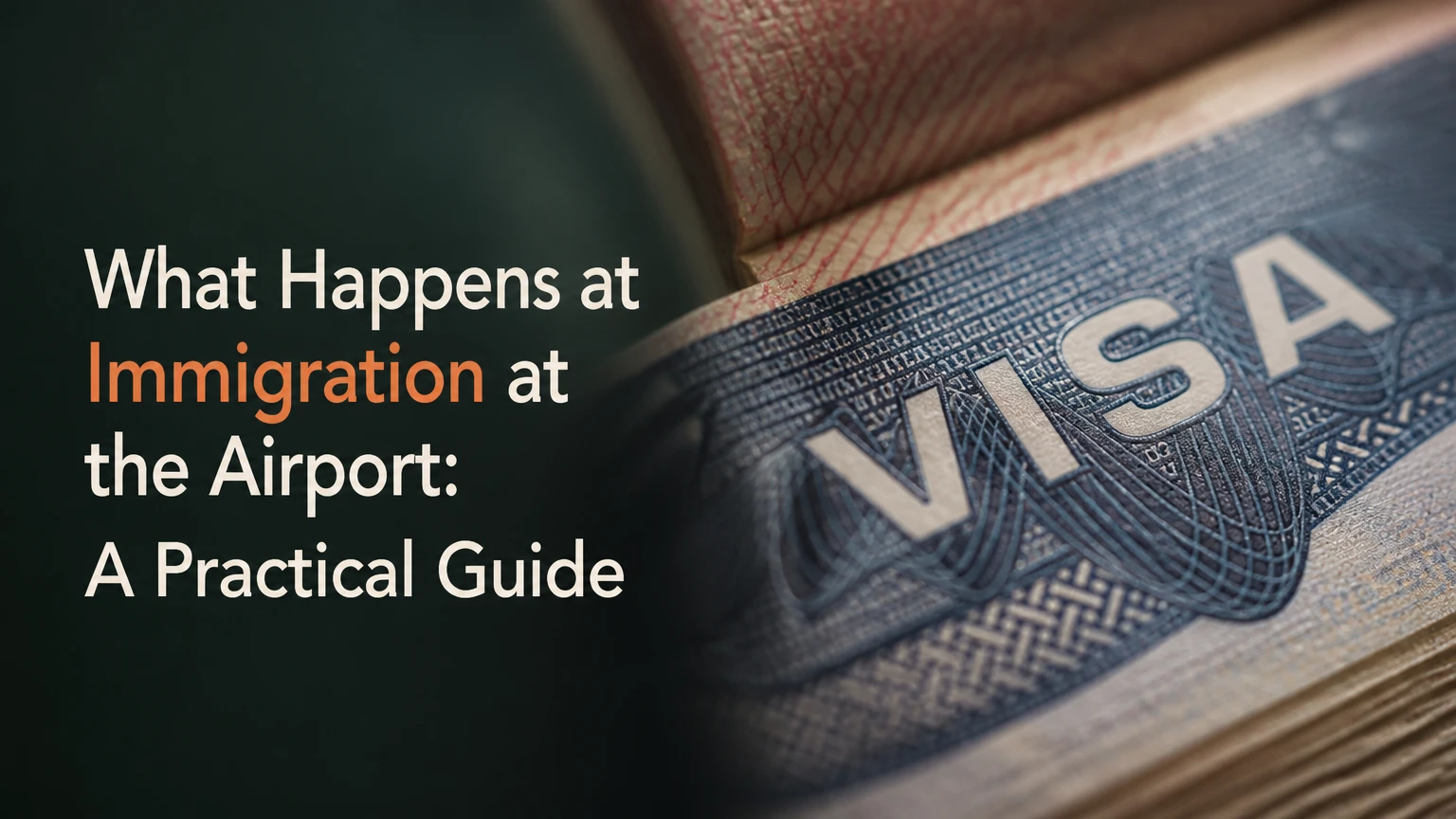
Airport immigration is the border-control process where officers or biometric systems verify your identity, travel documents, visa or entry permission, and eligibility to enter or leave a country. You usually queue, present a passport, answer brief questions, complete biometric checks, and receive an electronic admission record, stamp, or referral for further inspection.
Key Facts / Quick Answer
Immigration usually takes 15-45 minutes in ordinary conditions, while the officer interaction often lasts 1-3 minutes.
The officer decides whether you meet the destination’s entry rules, not whether your trip is personally convincing.
A visa permits travel to a border; it does not guarantee admission or determine your authorized stay.
Immigration is different from customs, which examines goods, baggage, food, currency, and restricted items.
E-gates commonly process eligible travelers in 15-30 seconds, but system errors or document categories can require a manual desk.
Entry refusal, secondary inspection, and overstay consequences depend on the destination country’s law.
What Airport Immigration Checks
Airport immigration checks identity, nationality, travel permission, admissibility, and the conditions attached to a person’s visit. Border agencies compare the traveler’s passport and biographic data with visa records, entry databases, alerts, and sometimes biometric records before recording a decision.
The process is a legal admission assessment rather than a general security conversation. A border officer may verify where you will stay, how long you intend to remain, how you will support yourself, and whether your stated purpose matches your visa or authorization.


The exact procedure depends on nationality, destination, airport, travel history, and whether the traveler uses an automated border-control gate. The International Civil Aviation Organization, or ICAO, establishes machine-readable travel document standards, but each country decides its own admission rules.
What Happens First After Landing?
After landing, international passengers follow signs for passport control, immigration, or border control. Passengers are separated into lanes such as citizens, residents, visa holders, all passports, registered travelers, or e-gate users.
Airline staff have already performed a separate document check before boarding. That check confirms that the carrier can transport you under airline and destination rules. It does not replace the border agency’s admission decision.
| Stage | Typical duration | Traveler action | Possible result |
|---|---|---|---|
| Walk from gate to control hall | 5-20 minutes | Follow international-arrivals signs | Correct immigration queue |
| Queue before inspection | 15-45 minutes | Keep passport and documents accessible | Manual desk or e-gate |
| Automated gate check | 15-30 seconds | Scan passport and face | Admission or officer referral |
| Manual interview | 1-3 minutes | Answer questions directly | Admission, questions, or secondary inspection |
| Baggage and customs after control | 10-40 minutes | Collect bags and declare goods | Exit to arrivals hall or customs examination |
The Arrival Process Step by Step
The standard arrival sequence is queueing, identity verification, document review, questioning, a decision, and then movement to baggage claim or another inspection point. Not every traveler experiences each step in the same way because eligible passengers may use e-gates and some countries combine border-control functions.
- Choose the correct lane. Use the citizens, residents, visa holders, or all-passports lane that matches your status. Follow airport staff instructions if signs conflict with your documents.
- Present the passport. Give the officer the passport used for the booking, visa application, or electronic authorization. A different passport can require an explanation.
- Complete biometric verification. The system or officer may compare your face with the passport chip and request fingerprints, depending on local law and your nationality.
- Answer entry questions. Expect questions about purpose, duration, accommodation, employment, studies, funds, or onward travel when those facts affect admissibility.
- Receive the decision. The agency may grant admission, record a digital stay period, stamp the passport, or send you to secondary inspection.
- Continue to the next control. Baggage claim and customs usually follow immigration. A successful passport check does not automatically clear your luggage.
A practical rule is to keep the passport open and documents arranged before reaching the desk. Searching through a phone gallery or a crowded bag slows the interaction and can make an otherwise simple inspection less clear.
Documents to Keep Ready
The core document is the valid passport, but entry evidence depends on the destination and travel purpose. A tourist may need an electronic travel authorization, visa, accommodation address, return or onward itinerary, and evidence of sufficient funds.
| Document or evidence | When it matters | Typical format | Common problem |
|---|---|---|---|
| Passport | Every international entry | Physical passport with readable chip | Damage, expired validity, wrong passport |
| Visa or eTA | Visa-required or authorization-required travel | Passport-linked approval or visa label | Wrong purpose, expired approval, name mismatch |
| Accommodation proof | Tourism or private visits | Hotel address or host details | Address differs from application |
| Onward or return ticket | Destinations assessing onward travel | Airline booking or reservation | Open-ended itinerary |
| Work, study, or invitation evidence | Non-tourism travel | Letter, enrollment record, contract | Visitor status conflicts with activity |
| Funds or sponsorship proof | Where financial support is assessed | Bank record or sponsor documents | Unclear access to money |
Printed copies are useful when an airport connection is poor or an officer requests a document that cannot be opened quickly. They are not universally mandatory. Check the destination’s official immigration website because requirements differ by passport and visa category.
Biometrics and Identity Checks
Biometric border control uses measurable personal characteristics, commonly a passport photograph, live facial image, and fingerprints, to verify that the traveler is the document holder. The check can also identify a mismatch caused by a damaged chip, changed appearance, poor lighting, or incorrect positioning.
At a manual desk, an officer may inspect the passport chip, compare the photograph, take fingerprints, or photograph the traveler. At an e-gate, the traveler normally places the passport on a reader and looks at a camera while software performs the comparison.
A biometric match does not prove that the traveler qualifies for admission. It confirms identity; the agency still assesses visa conditions, purpose, security alerts, and other legal requirements.
What Questions Border Officers Ask
Border officers usually ask short questions that test the consistency of your documents and stated purpose. Common questions concern destination address, trip length, occupation, companions, previous visits, onward travel, and the activity you will perform.
Answer truthfully and briefly. “Tourism for seven days, staying at the Central Hotel” is more useful than an unprompted explanation of your entire itinerary. Do not guess when you do not know an address or date. Say that you need to check the document.
| Travel purpose | Likely question | Strong factual answer | Evidence that may help |
|---|---|---|---|
| Tourism | How long will you stay? | “Six nights, departing on 14 July.” | Return booking |
| Visiting family | Where will you stay? | “With my sister at her listed address.” | Invitation and address |
| Business meeting | Why are you entering? | “Three-day supplier meetings, no local employment.” | Employer letter |
| Study | What will you do? | “Begin a twelve-week language course.” | Enrollment letter |
| Work | Who is your employer? | “Northshore Ltd., under my approved work permit.” | Permit and contract |
The most serious mistake is describing unauthorized work as tourism. A visitor may attend permitted meetings in some jurisdictions, but paid employment, local services, or long-term study can require a different status.
Why Consistent Answers Matter
An officer compares spoken answers with the visa application, landing card, booking data, previous entries, and supporting documents. A minor date mistake may be correctable, but conflicting answers about employment, accommodation, or purpose can trigger secondary inspection.
Do not joke about weapons, drugs, smuggling, illegal work, or overstaying. Border officers record statements in a legal context, where sarcasm can create an avoidable interpretation problem.
Automated Gates or Officer Desks
Automated gates are faster for eligible travelers with compatible passports and current enrollment, while manual desks handle broader document categories and exceptions. An e-gate can reject a traveler because of a chip, facial image, age rule, visa type, or database issue without indicating that the traveler has done anything wrong.
| Feature | Automated e-gate | Manual border desk | Practical consequence |
|---|---|---|---|
| Typical processing time | 15-30 seconds | 1-3 minutes | E-gates reduce desk interaction |
| Eligible users | Citizens, residents, selected foreign nationals | All passport categories | Eligibility varies by airport |
| Main technology | Chip reader and facial camera | Officer, scanner, database | Manual review handles exceptions |
| Passport stamp | Often absent | Possible, depending on country | Check the digital admission record |
| Failure response | Referral to officer | Additional questions or documents | Allow connection time |
Remove sunglasses and headphones before reaching an automated camera or officer. Hats and face coverings may require removal unless an exemption applies. Parents should follow family-lane instructions because some gates cannot process young children or linked family applications.
When Manual Inspection Is Better
Use a manual desk when an officer directs you there, your passport chip fails, you hold a complex visa, you travel with certain minors, or the e-gate rules exclude your nationality or age group. Choosing a manual desk is not an admission problem.
Frequent travelers may qualify for programs such as U.S. Global Entry, NEXUS for certain United States and Canada crossings, or a national registered-traveler scheme. These programs require advance vetting and do not override visa requirements or admission rules.
Types of Border Control at Airports
Airport immigration differs between arrival, departure, transit, and preclearance because each setting answers a different legal question. Arrival control decides entry, departure control records exit or checks compliance, transit control governs passage through the country, and preclearance moves the destination inspection to the origin airport.
- Inbound immigration: Reviews eligibility to enter and usually establishes an authorized stay.
- Outbound immigration: Records departure and may detect overstays, exit restrictions, or missing permits.
- Transit immigration: Applies when a traveler enters the transit country, changes between secure and public zones, collects baggage, or needs a transit visa.
- Preclearance: Performs destination border checks before departure, as U.S. Customs and Border Protection does at selected airports outside the United States.
Transit and Connections
Airside transit may avoid immigration when the passenger remains in a secure international zone and the itinerary meets local rules. A self-transfer, terminal change, overnight closure, or checked-bag collection can require entry through immigration and possibly a transit visa.
The airline and airport cannot guarantee that a connection is immigration-free. Verify the route against the destination country’s official visa tool, especially when tickets are separate or the connection crosses a border-control area.
Preclearance
U.S. preclearance allows eligible travelers to complete CBP inspection at selected airports such as Dublin, Toronto, Nassau, and Abu Dhabi before boarding a U.S.-bound flight. Travelers who pass inspection generally arrive in the United States through a domestic-style terminal, although baggage and local airport procedures still apply.
Preclearance is not a visa and does not guarantee boarding or admission. CBP officers retain authority to refer travelers for additional inspection, and the airline can apply separate boarding requirements.
Time, Fees, and Overstay Consequences
Immigration itself is normally free, but the trip may require a visa, electronic authorization, visa-on-arrival fee, or overstay payment. A typical queue is 15-45 minutes, while peak periods at major hubs can produce waits of 90 minutes to three hours; the desk conversation often lasts 1-3 minutes.
| Item | Typical amount or time | Who sets it | Planning implication |
|---|---|---|---|
| Ordinary immigration queue | 15-45 minutes | Airport and border agency | Keep documents ready |
| Peak international-arrivals queue | 90-180 minutes | Passenger volume and staffing | Avoid tight onward connections |
| Manual interview | 1-3 minutes | Border officer | Longer if evidence is reviewed |
| Visa-on-arrival fee | USD 25-100 | Destination government | Confirm cash and card rules |
| Immigration processing fee | USD 0 at many borders | Destination government | Separate from visa costs |
| Overstay penalty | USD 10-200 per day in some systems | National law | May include detention or re-entry ban |
The USD 10-200 daily overstay range is only a broad example from differing national systems, not a universal tariff. Some countries impose fixed fines, some calculate daily penalties, and others add removal, detention, or future-entry consequences. The admission record, not merely the visa expiry date, controls the authorized departure date.
Visa Validity Versus Authorized Stay
A visa’s validity period usually identifies when you may seek travel or entry; it does not necessarily state how long you may remain after admission. The border agency may grant a shorter or different stay period according to the visa class and entry rules.
Check the stamp, electronic record, or official admission portal before leaving the control area. Report an apparent error immediately because correcting a record later can be harder than asking for clarification at the airport.
Avoiding Delays and Secondary Inspection
The best preparation is accurate information that can be retrieved quickly. Keep the passport, visa approval, accommodation details, onward itinerary, insurance where required, and relevant financial or employment evidence in one travel wallet.
The most common avoidable delay is not missing paperwork. It is a mismatch between the traveler’s explanation and the declared purpose, such as carrying a visitor visa while describing paid local work.
Practical preparation includes:
- Check passport validity rules for your nationality and destination; six months is common, but not universal.
- Confirm whether the country requires blank pages, a return ticket, health insurance, or an electronic authorization.
- Save hotel addresses and reservation numbers offline.
- Keep medication in original packaging with prescriptions where relevant.
- Do not photograph or record officers unless local rules clearly allow it.
- Follow instructions about phones; device use is restricted in some inspection areas, but a universal ban does not apply everywhere.
- Request an interpreter or accessibility assistance if communication or mobility is difficult.
Expert insight: Border control is a consistency test more than a presentation contest. A neatly organized folder cannot repair an incorrect visa purpose, but a precise answer supported by one matching document often resolves ordinary questions quickly.
What Secondary Inspection Means
Secondary inspection is a separate review after the initial checkpoint, used when officers need more time, documents, biometric checks, or supervisory approval. Referral does not automatically mean detention, refusal, or wrongdoing.
A traveler may be asked to wait without a phone, repeat answers, provide an address, explain travel history, or undergo baggage and identity checks. Time can range from 15 minutes to several hours, depending on staffing and the issue.
Do not sign a statement you do not understand. Ask for clarification, request consular contact when appropriate, and avoid arguing about an officer’s authority at the checkpoint.
Missing Documents, Refusal, and Detention
Missing documents can lead to extra questions, a request for evidence, carrier involvement, secondary inspection, or refusal of entry. The result depends on whether the missing item is optional proof, a mandatory visa, an electronic authorization, or evidence of a required condition.
If admission is refused, the border agency may arrange return on the airline, retain the traveler temporarily, issue written reasons, cancel or annotate permission, or provide a review process. Rights differ substantially by country, visa category, and the reason for refusal.
| Situation | Likely airport action | Immediate traveler step | Longer-term risk |
|---|---|---|---|
| No required visa | Referral or refusal | Contact airline and consulate | Return and future refusal |
| Hotel address unavailable | Additional questioning | Retrieve offline booking | Delay only if facts are consistent |
| Visa purpose conflicts with activity | Secondary inspection | Explain accurately, do not improvise | Cancellation or refusal |
| Damaged passport | Carrier or border referral | Contact issuing authority | Denied boarding or entry |
| Suspected overstay | Exit questioning or fine | Request official calculation | Fine, ban, or future scrutiny |
Consular staff can often help explain nationality, emergency travel documents, or local procedures. They generally cannot order a foreign border agency to admit a traveler.
What Happens After Immigration?
After immigration, international arrivals usually collect checked baggage, pass customs, complete quarantine or agricultural inspection when required, and enter the public arrivals area. Customs clearance remains separate from the decision to admit a person.
Declare food, plants, animal products, large currency amounts, or restricted goods according to local rules. A traveler can be admitted by immigration and still face seizure, a fine, or prosecution for undeclared goods.
For a connecting flight, follow signs for transfer passengers. Some airports require a second security screening even when no second immigration check occurs.
Families, Minors, and Accessibility
Children may need their own passports, visas, consent letters, custody documents, or proof of relationship. Family lanes and e-gate age limits vary, so a parent should keep birth certificates, notarized consent, and custody orders accessible when traveling without the other parent.
Passengers who need mobility support can request airport assistance in advance and should tell the officer about communication or medical needs. An interpreter may be available, but relying on a companion to translate legal answers can create errors.
The family member with the strongest language skills should not answer every question for another adult unless the officer permits it. Each traveler remains responsible for truthful information about their own purpose and documents.
Frequently Asked Questions About what happens at immigration at the airport
Do I need to show a hotel booking at immigration?
A hotel booking is not universally required, but officers may ask where you will stay. Keep the property name, address, telephone number, and reservation confirmation available offline. If staying with a person, carry the host’s address and any invitation evidence required by the destination.
Can immigration officers search my phone?
Phone-search authority varies by country, border zone, and the traveler’s legal status. Some jurisdictions permit border searches with limited or different thresholds from ordinary police searches. Follow local instructions, do not record the inspection, and seek legal advice later if you believe a search violated your rights.
Is immigration the same as customs?
Immigration determines whether a person may enter, remain, or depart under border law. Customs examines goods, baggage, currency, food, and prohibited or taxable items. Travelers normally complete immigration before customs, but airports can combine or reorder checkpoints under local procedures.
What happens if my passport is not stamped?
Many countries record admission electronically and do not provide a physical stamp, particularly after an e-gate inspection. Check the government entry record, receipt, or online status for the authorized stay date. Ask an officer before leaving the inspection area if the record is missing or incorrect.
Can I leave the airport during a long layover?
You can leave only if you are legally admitted to the transit country or qualify for its transit rules. Collecting baggage, changing airports, or passing through public arrivals usually requires immigration clearance. Confirm visa requirements before booking, because a long layover does not itself create entry permission.
What should I do if I miss my connecting flight at immigration?
Tell airport or airline staff that border processing caused the missed connection and keep boarding passes, queue receipts, and written instructions. The airline’s obligations depend on the ticket, route, and cause of delay. Do not leave the controlled area until an officer or airline representative confirms the correct route.
Conclusion
What happens at immigration at the airport is a structured identity and admissibility assessment: you join the correct lane, present the required passport and authorization, complete biometric checks, answer relevant questions, and receive an admission, departure, or referral decision. Prepare accurate evidence, verify your authorized stay, and keep customs requirements separate from immigration.