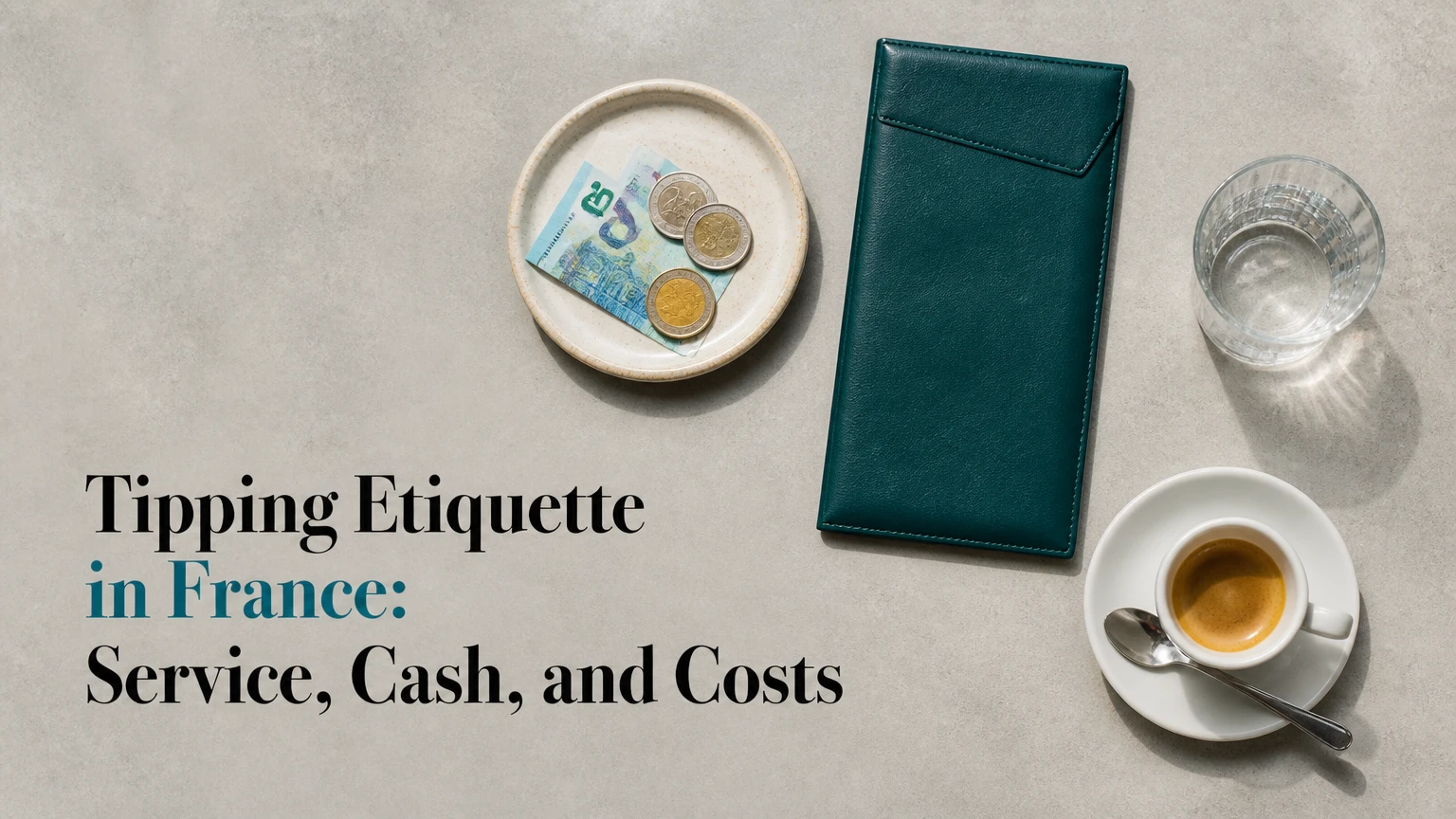
Tipping etiquette in France is a voluntary way to reward service after the bill’s included service component has been accounted for. Restaurants and cafés normally display service compris, so diners do not need to add a United States-style percentage; a small cash amount or convenient rounding is appropriate when service was genuinely good.
Key Facts / Quick Answer
Service compris means the restaurant has included its service charge in the displayed price, but it does not mean every bill contains a separate, mandatory 15% surcharge.
A typical additional restaurant tip is USD 1-5 for ordinary good service, or about 5-10% for exceptional service in fine dining.
Tipping is optional in France. Zero is acceptable when service was poor, incomplete, or already separately charged.
Cash remains the clearest method, although some modern card terminals now accept gratuities.
Say “Merci” while handing over cash only when you want the server to keep the change.
Hotel porters, guides, taxi drivers, and housekeeping have different customary amounts and timing.
What Does Service Compris Mean?
Service compris means the advertised restaurant price includes service, staff remuneration, and applicable taxes as shown on the menu or bill; it does not require the customer to calculate another fixed percentage. French restaurants commonly include a service component often presented as 15%, but that figure is not a universal tip added after every meal.
The distinction matters because the phrase describes the bill’s pricing structure, not a gratuity decision. A menu might show a dish at a listed price with “service compris,” and the receipt may identify service separately for accounting purposes. The final amount is still the amount the establishment expects the customer to pay.


French Labour Code Article L3244-1 states that, in professions where pay is wholly or partly composed of tips, “les pourboires doivent être intégralement versés au personnel”, meaning tips must be paid in full to the staff who serve customers. The rule concerns distribution, not an obligation for every customer to leave an additional tip.
A service charge and a voluntary pourboire are therefore different:
| Bill or payment term | Meaning in France | Customer action | Typical consequence |
|---|---|---|---|
| Service compris | Service component included in listed price | Pay the displayed total | No extra percentage required |
| Service non compris | Service not included in listed price | Check the bill and menu | An additional service amount may apply |
| Pourboire | Voluntary extra payment | Leave only if satisfied | Staff receive a discretionary reward |
| TVA | Value-added tax shown in pricing documents | Included in displayed consumer prices | Not a tip or service reward |
The most reliable habit is to inspect the menu and receipt before paying. If service non compris appears, ask the staff member what amount applies instead of assuming an American-style percentage.
How Much Should You Tip in France?
A typical extra tip in France ranges from USD 1-5 for a casual meal, café visit, or helpful taxi ride, while exceptional fine-dining service may justify approximately 5-10%. The amount should reflect the service and the practical convenience of the payment, not a rigid formula applied automatically.
French diners often leave change, round the bill upward, or place a modest note on the table. A USD 26.40 equivalent café bill might become USD 27 or USD 28 in local cash; a USD 86 restaurant bill might receive USD 3-8 for attentive service. These are planning equivalents, because exchange rates and local prices change.
The following figures are typical USD budgeting equivalents, not mandatory tariffs. France uses euros for payment, and the exchange rate can change the local amount from one day to the next.
| Service situation | Typical additional amount in USD | When it fits | Usual method |
|---|---|---|---|
| Café coffee or drink | USD 0-1 | Pleasant table service or rounding | Leave change or a small coin |
| Casual restaurant | USD 1-5 | Accurate, friendly meal service | Cash on table or to server |
| Upscale restaurant | USD 5-15 | Several attentive courses | Cash, or verified card gratuity |
| Exceptional fine dining | 5-10% of bill | Personalized service beyond expectations | Confirm distribution before card payment |
| Taxi or rideshare | USD 1-3 | Safe, efficient ride or luggage help | Round up or hand cash directly |
| Hotel porter | USD 1-3 per bag | Bags delivered promptly to room | Hand over after delivery |
| Housekeeping | USD 1-3 per night | Consistent room service | Leave a labeled envelope daily |
| Tour guide | USD 3-10 per person | Informative private or small-group tour | Give at tour conclusion |
These ranges are intentionally lower than standard United States expectations. A 20% addition at an ordinary French bistro is not prohibited, but it can look conspicuous and may create confusion about whether the guest mistook the bill’s total.
When Is No Tip the Correct Choice?
No tip is correct when service was poor, a promised item was missing, the bill contains an unexplained service line, or the interaction was counter service with no meaningful personal assistance. French tipping culture treats gratuity as appreciation rather than a wage obligation transferred to the customer.
A complaint and a tip are separate decisions. If food arrives cold, explain the problem before paying; withholding a pourboire does not guarantee that management understands what went wrong. If the response is dismissive, paying the bill without an extra amount is a clear and culturally normal outcome.
Expert insight: The practical threshold is service effort, not emotional warmth. A quiet server who delivers an accurate meal efficiently has performed well, while an enthusiastic server who repeatedly loses orders has not necessarily earned a gratuity.
Tipping by Service and Venue
Tipping customs vary according to whether a worker provides table service, transports luggage, guides an activity, or performs a private task. France has no single percentage that applies equally to restaurants, hotels, taxis, tour operators, delivery workers, and cultural venues.
Restaurants, Cafés, and Bars
Restaurants generally receive the most visible pourboire decisions. Leave approximately USD 1-5 after a casual meal, round up a small café bill, and consider 5-10% only for genuinely outstanding service at an upscale or Michelin-level establishment.
Place cash on the table after the party leaves or hand it directly to the server. Do not assume that a large restaurant adds a gratuity automatically because the receipt uses the word “service.” That line normally identifies included service rather than a new amount you must pay.
At a bar, counter service usually receives no extra payment. Table service, bottle service, complex cocktails, or unusually helpful assistance can justify rounding up or leaving about USD 1-3.
Group dining creates a common problem. If one person pays the bill, agree privately whether the group is rounding up or leaving a percentage; do not force every diner to match United States norms when the bill already includes service.
Taxis, Rideshares, and Delivery
Taxi drivers do not expect a mandatory percentage. Round up to a practical local amount, add about USD 1-3 for luggage help or an especially smooth route, and give the amount when the ride ends.
A driver who takes a longer route, refuses a reasonable destination, or mishandles luggage does not automatically earn a tip. The same principle applies to rideshare apps, although the application may show a gratuity screen after payment.
Food delivery is more variable. A small cash amount, often USD 1-3, is reasonable for difficult weather, stairs, a long walk from the vehicle, or careful handling of a large order. A delivery fee is not necessarily a driver tip, so inspect the application’s payment breakdown before adding money.
Hotels and Housekeeping
Hotel porters commonly receive about USD 1-3 per bag after carrying luggage to the room. A concierge who secures a difficult reservation, arranges urgent transportation, or solves a complex problem may receive USD 5-20, depending on the effort rather than the booking price.
Housekeeping is harder to observe because the worker may change each day. Leave approximately USD 1-3 per night, preferably in a marked envelope saying “housekeeping,” rather than leaving an unmarked banknote that could be mistaken for personal cash.
Leave the housekeeping amount each day when possible. The final morning is acceptable for a short stay, but a daily envelope is fairer when several employees clean the room.
Guides, Drivers, and Cultural Staff
A guide may receive USD 3-10 per person after a strong walking tour, museum visit, food tour, or private excursion. A private guide handling accessibility, children, weather changes, or complicated transportation has provided more work than a standard two-hour group tour.
Give the money directly at the end and pair it with a specific thanks. Tour-company policies sometimes prohibit employees from accepting gratuities, particularly on institutional or educational programs, so follow the guide’s response if they decline.
Theater ushers generally do not require a tip in France. A venue may sell a program, charge a booking fee, or collect a cloakroom fee, but those charges are not evidence that an usher expects a gratuity.
| Worker or venue | Typical amount in USD | Timing | Tip if service is poor? |
|---|---|---|---|
| Bistro server | USD 1-5 | After the meal | No |
| Cocktail bar table service | USD 1-3 | Before leaving | No |
| Taxi driver | USD 1-3 | At destination | No |
| Hotel porter | USD 1-3 per bag | After room delivery | No |
| Housekeeper | USD 1-3 per night | Daily or final morning | No |
| Local guide | USD 3-10 per person | At tour end | No |
| Concierge | USD 5-20 for substantial help | After task is completed | No |
| Theater usher | USD 0 | After seating | Not normally applicable |
How Should You Pay a Pourboire?
Cash is the most transparent way to leave a tip because the customer can place it directly with the server or worker. Card tipping is increasingly available in tourist areas and larger establishments, but the terminal prompt does not prove that the money reaches the person who served you.
A small cash reserve avoids awkwardness. French euro notes and coins are the payment instruments used locally, while the USD figures in this guide help travelers budget before converting money.
Use this four-step process:
- Read the receipt. Check the final total and look for service compris or service non compris.
- Choose a service-based amount. Round up for ordinary good service, or select a modest percentage only for exceptional attention.
- Use clear payment language. If handing over more cash and saying “Merci,” indicate that the worker may keep the difference.
- Verify change and distribution. Ask for change first if needed, then leave the gratuity separately on the table or directly with the employee.
The French phrase “Gardez la monnaie” means “keep the change.” If a bill equivalent to USD 18.20 is paid with the local equivalent of USD 20, saying “Merci” while handing over the note commonly signals that the change is a tip. If you want the change, say “Je voudrais la monnaie, s’il vous plaît”, then decide whether to leave part of it afterward.
| Payment method | Best use | Main advantage | Main limitation |
|---|---|---|---|
| Cash on table | Restaurant service | Direct and discreet | May be missed if left unmarked |
| Cash in hand | Taxi, porter, guide | Worker receives it immediately | Requires suitable denominations |
| Card terminal tip | Modern restaurants and apps | Convenient for travelers | Distribution may be unclear |
| Separate card payment | When no cash is available | Creates a payment record | Staff may not receive it promptly |
| No extra payment | Poor or included service | Fully acceptable in France | Does not communicate a detailed complaint |
Expert insight: Card terminals have changed faster than social expectations. A gratuity screen may display percentages designed for international customers, but the existence of a 20% button does not turn that amount into a French norm.
France Compared With Other Tipping Cultures
France differs from the United States because gratuity is not normally a compulsory substitute for the employer’s wage bill. France also differs from Italy, where a restaurant may add a coperto, and from Japan, where unsolicited tipping can create discomfort or require explanation.
| Country | Restaurant default | Typical extra payment | Distinctive charge or custom |
|---|---|---|---|
| France | Service included | USD 1-5 or 5-10% exceptional | Pourboire remains voluntary |
| United States | Tip often expected | 15-20% or more | Tip commonly supports income |
| Italy | Service varies by venue | USD 0-5 | Coperto may cover table setting |
| Japan | No routine restaurant tip | USD 0 | Staff may politely return cash |
| United Kingdom | Service charge varies | 10-12.5% if not included | Discretionary service charge needs checking |
The comparison with the United States is especially important. A traveler who automatically adds 20% everywhere may spend substantially more than planned and accidentally suggest that a normal French wage structure resembles the American tipped-wage model.
France is not uniformly tip-free. A hotel employee who carries several suitcases, a guide who manages a private itinerary, or a server who corrects a serious dietary problem can receive a meaningful bonus. The cultural rule is proportionality.
Regional and Situational Differences
Paris, Nice, Lyon, Bordeaux, Strasbourg, and rural destinations follow the same national principle: service included means no compulsory extra percentage. Tourist concentration can make staff more familiar with card tips and international habits, but a higher tourist price or luxury setting does not automatically change the gratuity rule.
Paris and Major Tourist Cities
In Paris, staff at heavily visited restaurants may see more foreign tipping behavior than workers in a neighborhood café. That exposure does not make 15-20% mandatory. Round up or leave a modest cash amount when the service deserves recognition.
Restaurants near the Eiffel Tower, Louvre, Promenade des Anglais, or major railway stations may use multilingual receipts and payment terminals. Read the wording carefully, because an English-language tip prompt can appear even when the French bill already includes service.
Small Towns and Rural Areas
Smaller towns may have fewer card-tip facilities and less access to change. Keeping modest local cash is more useful than relying on a terminal prompt, especially after a late dinner, village tour, or countryside taxi ride.
The amount does not need to rise because service was personal or the owner served you directly. A sincere “Merci” and a small rounding amount fit many independent establishments.
Accessibility, Children, and Luggage
Extra assistance can justify a higher amount when a worker lifts mobility equipment, rearranges seating, handles a stroller, translates a complicated request, or transports unusually heavy luggage. The amount should reflect the effort and time, not the traveler’s total hotel or restaurant bill.
For example, a porter who handles four bags and waits while a family checks in has performed more work than someone who carries one light bag. A USD 5-10 total gratuity may be reasonable for the larger task, even though the per-bag baseline is lower.
Common Mistakes and Edge Cases
The most damaging mistakes involve treating an optional French reward as a mandatory American surcharge, confusing a service line with a second charge, and assuming that card-terminal percentages reveal local expectations.
- Adding a fixed 20% everywhere: This ignores service compris and can distort the cost of ordinary meals.
- Tipping before service ends: Pay attention to the completed meal, ride, tour, or room delivery before deciding.
- Leaving an unmarked banknote for housekeeping: Label the envelope so the money is not mistaken for a forgotten personal bill.
- Assuming a delivery fee is a tip: Check whether the application identifies driver compensation separately.
- Treating poor service as a social obligation: France permits a zero gratuity when the experience was unacceptable.
- Using tiny copper change as a pointed message: If you want to leave something, rounding to a useful amount is clearer and more courteous.
- Demanding change solely to create a tip: Carry smaller notes or skip the extra payment; staff are not required to make change for a gratuity.
An unexplained service charge deserves a question, not an automatic second payment. Ask, “Le service est-il compris dans le prix?”, meaning “Is service included in the price?” If the answer conflicts with the menu or receipt, request an itemized explanation before paying.
French consumer pricing rules require restaurants to provide clear price information, and the Directorate-General for Competition, Consumer Affairs and Fraud Prevention, known as DGCCRF, is the relevant national consumer authority. Keep the receipt if the displayed price and charged total differ.
Expert insight: The cleanest complaint is specific and immediate. Saying that the dish was missing, the taxi route was incorrect, or the room was not serviced gives management a remedy; silently changing the tip amount communicates less.
Frequently Asked Questions About tipping etiquette in France
Is tipping expected at a French bakery or food counter?
Tipping is not expected at a bakery, fast-food counter, market stall, or self-service café. Leave a small amount only when an employee provides unusual assistance, such as preparing a complicated order, carrying food to a table, or accommodating a special request.
Should I tip for a complimentary hotel breakfast?
A complimentary breakfast does not require a gratuity. If a staff member provides repeated table service, handles dietary requests, or manages a crowded room with unusual care, leaving about USD 1-3 at the end is a reasonable optional thank-you.
Do I tip a private driver hired for a full day?
A full-day private driver may receive approximately USD 10-30 when the driver is punctual, helpful with luggage, flexible about stops, and careful on difficult roads. The amount is discretionary and should reflect the full day’s effort rather than a mandatory percentage of the vehicle hire.
Can I tip in United States dollars?
Workers may accept United States dollars, but local euros are more practical because foreign cash can be difficult to exchange and coins may be unusable outside the issuing currency area. Convert a small amount before the service, or use a card when the payment terminal clearly supports gratuities.
Should I tip a French tour guide for a free walking tour?
A free walking tour usually relies on voluntary participant payments, so a gratuity is more relevant than it would be for a prepaid standard tour. A typical amount is USD 5-15 per person when the guide provides a useful, well-organized experience, subject to the company’s rules.
What should I do if a restaurant adds an unexpected tip?
Ask for an itemized bill and compare it with the menu. Confirm whether the line is service compris, a stated service non compris charge, or an optional gratuity entered at the terminal. If the amount was added without clear disclosure, request correction before completing payment.
Conclusion: The Practical Rule for Tipping Etiquette in France
Tipping etiquette in France is based on included service and voluntary appreciation, not an automatic 15% or 20% surcharge. Check the bill, reward genuine effort with a small cash amount, use about 5-10% only for exceptional fine dining, and leave nothing when service does not merit it.