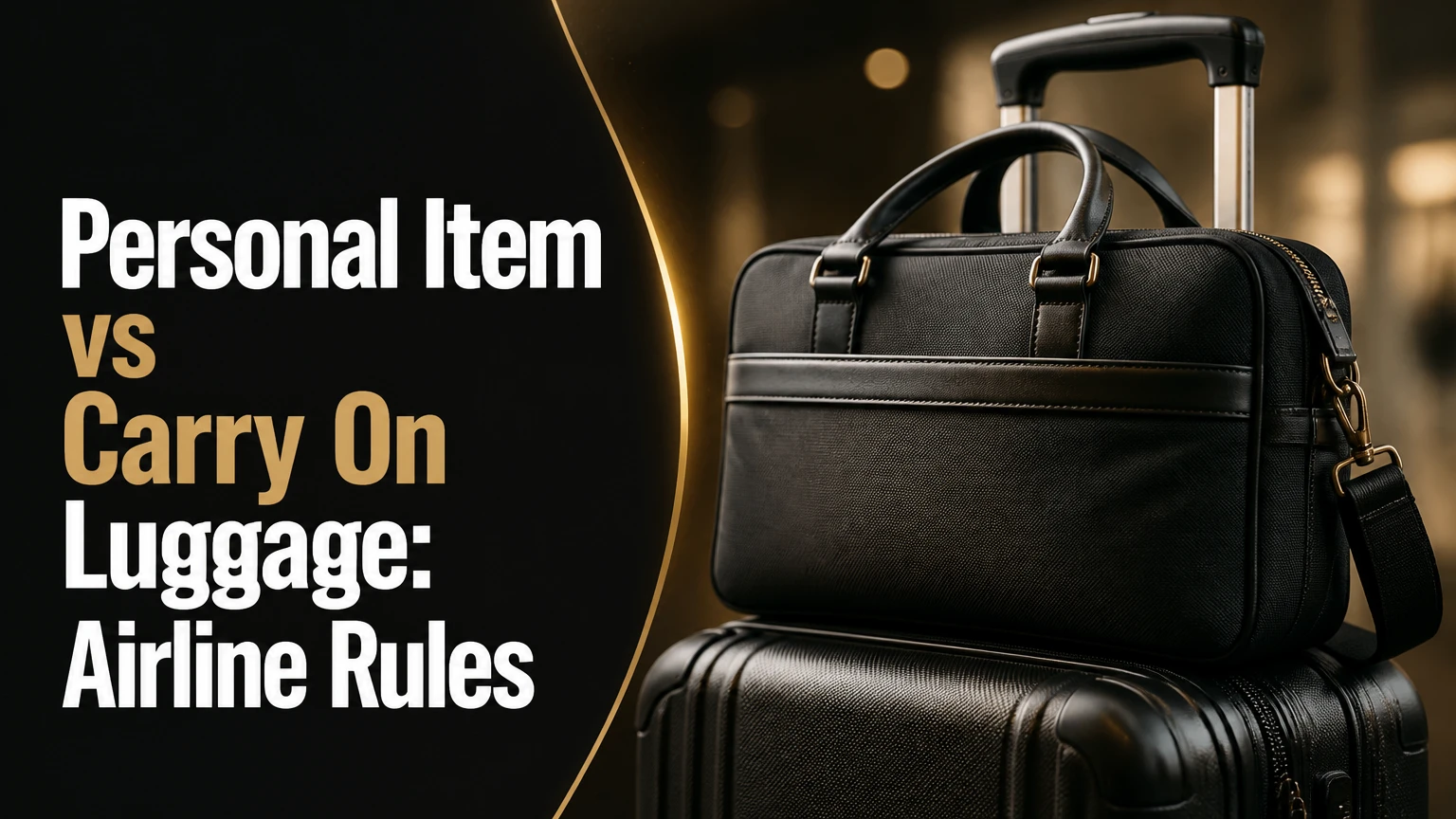
A personal item is a small bag that fits completely under the seat, while carry-on luggage is a larger bag stored in the overhead bin. The personal item keeps essentials accessible during the flight; the carry-on holds most clothing and gear but may be unavailable during taxi, takeoff, and landing.
Key Facts About the Two Bag Types
- A personal item uses the floor space beneath the seat directly ahead of you.
- Carry-on luggage occupies an overhead compartment and may be gate-checked when bins fill.
- A commonly published personal-item limit is 18 x 14 x 8 inches, or 45 x 35 x 20 centimeters.
- A common carry-on limit is 22 x 14 x 9 inches, or 56 x 36 x 23 centimeters.
- Major network airlines often include both bags, but Basic Economy and low-cost fares can remove the overhead allowance.
- Airline rules apply to the bag’s outside dimensions, including wheels, handles, and pockets.
The most important distinction is location, not bag material. A small roller can be a carry-on if it goes overhead, and a backpack can be a personal item if it fits beneath the seat. Airlines judge the bag’s packed dimensions and the ticket allowance, not the manufacturer’s product category.
Personal Item vs Carry On Luggage: What Is the Difference?
Personal item vs carry on luggage is primarily a comparison of storage position, size, access, and fare entitlement. The smaller bag must fit under the seat in front of you, whereas the larger cabin bag goes into an overhead bin and normally cannot be retrieved during critical phases of flight.


| Attribute | Personal Item | Carry-On Luggage | Practical Result |
|---|---|---|---|
| Typical maximum size | 18 x 14 x 8 in | 22 x 14 x 9 in | Carry-on has more external volume |
| Typical capacity | 15-25 L | 35-45 L | Carry-on holds several more outfits |
| Storage location | Under-seat footwell | Overhead compartment | Personal item remains nearby |
| Typical fare inclusion | Free on most fares | Fare-dependent | Basic fares may charge separately |
| Access in flight | Usually available after boarding | Restricted during takeoff and landing | Put medication in the personal item |
A personal item is usually a purse, slim backpack, laptop case, tote, or compact soft-sided duffel. A carry-on is commonly a spinner suitcase, soft roller, travel backpack, or medium duffel designed for the airline sizer.
The distinction has a practical consequence: the personal item is your contingency bag. Keep identification, medication, glasses, headphones, chargers, and valuables there. If a full flight forces the larger cabin bag into the hold, those essentials stay with you.
How Airline Baggage Allowances Work
Airline baggage allowances depend on the carrier, fare family, route, aircraft, frequent-flyer status, and sometimes the operating airline on a codeshare. A standard economy ticket on Delta Air Lines, American Airlines, or many United Airlines routes often includes one personal item and one carry-on, but Basic Economy restrictions can change that result.
The Transportation Security Administration states, “You are allowed to bring one carry-on bag and one personal item,” but TSA describes security screening rather than the commercial contract between you and an airline. The carrier’s fare rules determine whether the overhead bag is included.
Standard, Basic, and Low-Cost Fares
| Fare Situation | Personal Item | Carry-On | Typical Added Cost |
|---|---|---|---|
| Full economy on many US legacy airlines | Included | Included | USD 0 |
| Basic Economy on selected US routes | Included | Restricted or paid | USD 0-75 |
| Spirit or Frontier standard fare | Included | Paid | USD 30-70 online |
| Ryanair basic fare | Included within small-bag limit | Paid | EUR pricing varies |
| International economy on many carriers | Included | Included, weight-limited | USD 0, subject to rule |
A fare may advertise “one bag included” without making clear which bag qualifies. Read the baggage line associated with the exact booking, then check the operating carrier if the itinerary has a connection.
United Basic Economy, for example, has historically applied stricter carry-on rules on selected routes, especially domestic flights, while some international itineraries differ. Policies change, so the airline’s current booking page outranks a general baggage article.
Why the Aircraft and Route Matter
A regional jet may have smaller overhead bins than a Boeing 737 or Airbus A320. A standard carry-on can fit the published sizer but still be tagged at the gate because the aircraft has limited cabin capacity. This is an aircraft-capacity issue, not proof that the suitcase exceeded its dimensions.
For a codeshare, check the carrier operating each flight. The airline selling the ticket may display one policy while the operating airline controls boarding, cabin storage, and gate-check procedures.
What Size and Weight Should You Choose?
A personal item should be selected by measured outside dimensions, while a carry-on should be selected by both dimensions and packed weight. The industry has common size patterns, but there is no single universal global standard, and European or Asian airlines frequently enforce weight more strictly than US carriers.
| Measurement | Personal Item Typical Range | Carry-On Typical Range | Why It Matters |
|---|---|---|---|
| Length | 16-18 in | 20-22 in | Vertical length includes wheels |
| Width | 12-14 in | 13-14 in | Side pockets can exceed limits |
| Depth | 6-8 in | 8-10 in | Expansion zippers create risk |
| Capacity | 15-25 L | 35-45 L | Rated volume is not usable volume |
| Weight limit | Often unstated | 7-10 kg on many international fares | Dense electronics can trigger limits |
Measure a packed bag from its furthest points. Include wheels, fixed handles, compression bulges, front pockets, and side attachments. A suitcase marketed as a “20-inch carry-on” can measure 22-24 inches once its wheels and handle housing are included.
Weight limits may apply to the carry-on alone or to the combined cabin allowance. A 7-kilogram limit is approximately 15.4 pounds. Some carriers weigh the bag at check-in, while others use a sizer or scale at the gate.
The Under-Seat Fit Test
Place the fully packed personal item on a flat surface and measure its widest bulge. Then compare those dimensions with the airline’s published limit. A soft bag that compresses only when empty is not compliant when packed.
The seat itself also affects usable space. Bulkheads may have fixed armrests, emergency-exit rows may restrict under-seat storage, and seats with entertainment hardware can reduce footwell depth. Do not assume every seat on the aircraft provides identical storage.
Which Bag Type Fits Each Travel Situation?
A personal item works best when access and low cost matter more than clothing volume. A carry-on becomes more useful when the trip requires several outfits, shoes, work equipment, or weather-specific layers.
| Trip Profile | Recommended Setup | Typical Clothing Capacity | Main Constraint |
|---|---|---|---|
| Overnight business trip | Laptop bag or compact backpack | 1 change of clothes | Work electronics consume space |
| Weekend, warm weather | 20-25 L personal item | 2-3 outfits | Shoes and toiletries need control |
| Four to seven days, mild weather | 35-45 L carry-on plus personal item | 5-7 outfits | Laundry reduces volume |
| Seven to fourteen days | Carry-on plus personal item | 7-10 outfits with laundry | Weight becomes the limiting factor |
| Winter weekend | Carry-on, sometimes checked bag | 2-3 outfits and layers | Coats and boots consume volume |
A 40-liter carry-on plus a 20-liter personal item does not always provide 60 liters of usable packing space. Wheels, frame structures, laptop compartments, and tapered shells reduce internal capacity. Compression cubes reduce loose volume, but they do not eliminate weight or make an oversized bag compliant.
Expert insight: Weight usually becomes the limiting factor before volume on international flights. A personal item filled with camera equipment, a laptop, and chargers can exceed a 7-kilogram limit even when it fits under the seat.
How Much Does a Carry-On Cost?
A carry-on costs USD 0 on many full-economy fares, approximately USD 30-70 when purchased online from many low-cost carriers, and often USD 65-100 or more when added at the airport or gate. The exact charge depends on the carrier, route, purchase timing, season, and whether the bag is oversized.
| Purchase Point | Typical Carry-On Charge | Typical Personal-Item Charge | Financial Risk |
|---|---|---|---|
| Included fare | USD 0 | USD 0 | Lowest |
| Online during booking | USD 30-70 | USD 0 | Usually cheaper |
| Online after booking | USD 40-85 | USD 0 | Moderate |
| Airport check-in | USD 55-95 | USD 0 if compliant | Higher |
| Boarding gate | USD 65-100+ | USD 65-100+ if oversized | Highest |
The cheapest ticket is not necessarily the cheapest itinerary. If a USD 45 fare excludes an overhead bag and the bag costs USD 60 each way, the round-trip baggage total becomes USD 120 before seat selection or priority boarding.
Calculate the full trip price before choosing the fare:
- Add the base fare and taxes.
- Add the carry-on charge for each flight direction.
- Add seat, priority, and airport charges that the fare requires.
- Compare the total with an economy fare that includes the overhead bag.
- Confirm whether a connection charges the bag per segment or per journey.
How Should You Pack the Two Bags?
Pack the personal item as an access and disruption kit, not as a second suitcase. Pack the carry-on around clothing volume, keeping dense items low and essential items out of the overhead bag.
Personal Item Contents
- Passport, identification, wallet, and travel documents
- Prescription medication and medically necessary equipment
- Phone, laptop, tablet, and charging cables
- Power bank or spare lithium battery
- Glasses, earplugs, and one small comfort item
- A change of underwear and essential toiletries for delays
- Empty reusable water bottle for filling after security
The Federal Aviation Administration advises passengers to carry spare lithium batteries and power banks in carry-on baggage, where crew members can respond to overheating. Airline and battery-capacity restrictions still apply, especially above 100 watt-hours.
Carry-On Contents
Use the overhead bag for clothing, shoes, nonessential toiletries, and equipment that can remain inaccessible for several hours. Keep liquids within the applicable cabin-security limits. In the United States, TSA’s standard rule limits liquid, gel, aerosol, cream, and paste containers in carry-on baggage to 3.4 ounces, or 100 milliliters, placed in a quart-size bag.
Full-size liquids, large aerosols, and many sharp objects generally belong in checked baggage, subject to TSA and airline restrictions. A pocketknife is not a harmless exception because it is small. Check TSA’s prohibited-items database for unusual equipment before packing.
Expert insight: The most useful under-seat bag is often a structured soft backpack, not the largest possible tote. A backpack distributes weight, compresses into the footwell, and leaves both hands available at boarding, while a rigid personal item may waste space around curved seat supports.
Carry-On Versus Checked Baggage
Carry-on baggage reduces carousel waiting and removes the airline’s normal checked-bag handling chain, but checked baggage provides more capacity and fewer cabin restrictions. The better choice depends on the bag fee, connection risk, weight, destination, and contents.
| Factor | Personal Item | Carry-On | Checked Bag |
|---|---|---|---|
| Airport handoff | None | None unless gate-checked | Check-in counter |
| Typical collection time | Immediate | Immediate | 15-45 minutes after landing |
| Typical capacity | 15-25 L | 35-45 L | 60-100 L |
| Cabin liquids | 100 ml containers | 100 ml containers | Larger containers generally allowed |
| Lithium power bank | Allowed in cabin | Allowed in cabin | Not allowed in checked bag |
| Gate-loss exposure | Low | Moderate if forced to hold | Bag unavailable until arrival |
Carry-on bags can save roughly 15-45 minutes at arrival by avoiding baggage-claim collection, although customs, immigration, and airport layout can dominate the total time. A checked bag may be sensible for ski clothing, multiple pairs of shoes, full-size toiletries, or equipment that cannot safely travel in the cabin.
Do not check medication, passports, keys, irreplaceable documents, or spare lithium batteries. If the overhead bag is gate-checked, remove those items before surrendering it.
What Happens If the Bag Is Too Large?
If a personal item does not fit under the seat, an airline may require it to be placed in the overhead bin, checked at the gate, or charged as a larger cabin bag. If the overhead compartment is full, a bag that fits the carry-on sizer can still be gate-checked.
Oversized-bag outcomes differ by carrier and airport. The charge may be a standard carry-on fee, an airport price, an oversized-bag fee, or a combination of charges. A gate agent’s decision can also depend on whether the flight has available bin space.
The Most Common Compliance Errors
| Mistake | Typical Cause | Likely Consequence | Prevention |
|---|---|---|---|
| Personal item bulges | Overfilled backpack | Sizer failure | Pack to measured dimensions |
| Carry-on exceeds height | Wheels excluded from product label | Gate fee or check | Measure assembled bag |
| Weight exceeds 7 kg | Dense electronics or shoes | Mandatory repacking | Weigh before departure |
| Extra shopping bag | Assumed duty-free exemption | Consolidation request | Keep receipt and check policy |
| Medication in roller | Poor access planning | Dangerous delay if checked | Move it to personal item |
Jackets, neck pillows, and duty-free purchases may receive special treatment, but no universal exemption guarantees that every loose item is free. On strict low-cost flights, an agent may require additional articles to fit inside the permitted bags.
How to Measure and Pack Before Departure
Follow the airline’s own allowance page for each flight, then test the packed bags at home. This process catches the two problems that create the most avoidable charges: an expanded personal item and a carry-on that is light enough but physically too large.
- Find the exact fare name in the booking confirmation.
- Identify the operating carrier for every flight segment.
- Record the published personal-item and carry-on dimensions.
- Measure each packed bag, including wheels, handles, and pockets.
- Weigh the carry-on and personal item separately.
- Remove restricted liquids, spare batteries, and sharp objects.
- Put medication, documents, and valuables in the under-seat bag.
- Photograph the packed setup if a connecting carrier applies different rules.
- Recheck the policy 24-48 hours before departure because fees and allowances can change.
- Arrive early enough to repack or pay online before reaching the gate.
Compression packing cubes can reduce loose clothing volume by approximately 20-40% in typical packing tests, but they cannot reduce the mass of the clothing. Use them to organize, not to justify exceeding a weight or depth limit.
Expert insight: The return flight deserves its own baggage test. Souvenirs, airport purchases, and damp clothing commonly add 1-3 kilograms or several centimeters of expansion, turning a compliant outbound bag into a gate problem.
When Should You Use a Personal Item Only?
Choose a personal item only when the trip lasts one to three days, the climate is mild, and the airline’s free-bag rule is restrictive. This setup also works for travelers who prioritize fast connections and can wash clothes at the destination.
A personal item is not a good fit for bulky winter layers, professional camera kits, specialized sports equipment, or trips where replacing medication would be difficult. Its under-seat location also limits legroom, especially when the bag is rigid or fully packed.
For a two-night warm-weather trip, one pair of worn shoes, two lightweight outfits, sleepwear, a small toiletry kit, and a personal electronics kit can fit in 18-25 liters. The same trip may require a carry-on in cold weather because a single coat can occupy 8-15 liters.
Frequently Asked Questions About personal item vs carry on luggage
Can I bring a purse and a personal item?
Usually, a purse must fit inside the permitted personal item or count as the personal item itself. Some airlines allow a small purse in addition to a carry-on and personal item, while low-cost carriers may require all loose articles to be consolidated. Check the carrier’s personal-article wording before boarding.
Does a backpack count as a personal item or carry-on?
A backpack counts as either category based on its packed size and where you store it. A 20-liter backpack that fits beneath the seat is generally a personal item; a 40-liter travel backpack that goes overhead is a carry-on. The backpack’s label does not determine the allowance.
Can I put my personal item in the overhead bin?
A personal item should remain under the seat when the fare requires an under-seat bag. An airline may permit overhead placement after boarding if space remains, but the bag can be moved or consolidated when the cabin fills. Store the personal item under the seat during taxi, takeoff, and landing.
Are personal items measured at the gate?
Airlines can measure a personal item at check-in, security-adjacent bag checks, or the boarding gate. Gate enforcement is more likely when the bag appears full, rigid, or larger than the stated limit. Measure the packed bag at home rather than relying on an empty-bag specification.
Can I bring food in my personal item?
Solid food is generally permitted through US airport security, although liquid or gel foods must follow TSA container limits. International arrivals may impose separate customs restrictions on meat, produce, dairy, and other food. Keep food sealed and verify the destination country’s agricultural rules.
Is a carry-on better than a checked bag for connecting flights?
A carry-on is usually better for short connections, missed-connection protection, and valuable items, provided the airline permits it and the aircraft has room. A checked bag offers more capacity for bulky items but may arrive later, particularly after a tight connection or an airline transfer.
Conclusion
Personal item vs carry on luggage is a decision about under-seat access, overhead capacity, fare rules, and packed dimensions. Use a measured 15-25-liter bag when you can travel for one to three days, choose a 35-45-liter carry-on when clothing volume justifies the fee, and verify the operating airline before every flight.