Public transportation in Italy is a connected system of high-speed and regional trains, city buses, trams, metros, ferries, and water buses. Travelers use it by matching the ticket to the operator, reserving seats on long-distance trains, validating eligible paper or digital tickets, and checking local schedules before departure.
Key Facts / Quick Answer
Trenitalia and Italo operate reserved high-speed trains between major cities; buy early when low fares matter.
Regional train tickets usually have fixed prices, no reserved seats, and flexible same-day use, but paper tickets require validation before boarding.
City bus, tram, and metro tickets are usually time-based or zone-based, with typical single fares of $1.50-$2.40.
Venice ACTV water buses cost about $10 for a single 75-minute ticket, while a 24-hour pass typically costs about $27.
Italy’s transport strikes are announced in advance, but travelers should verify the specific operator and route because service levels vary.
A contactless card is convenient on participating urban networks, but it does not replace every regional or ferry ticket.
How the Network Fits Together
Italy’s transport network works through national operators, regional companies, and municipal agencies. Major rail stations connect airports and city centers to regional lines, while local buses, trams, and metros handle the final kilometers.
A useful trip model is airport to central station, central station to the destination city, then city transit or walking to the accommodation. The model works well in Rome, Milan, Florence, Bologna, Naples, Turin, and Venice, but it becomes less predictable in rural Puglia, inland Sicily, Sardinia, and parts of the Dolomites.


Italy does not have one universal public-transit ticket. A Trenitalia regional ticket, a Rome bus ticket, and a Venice vaporetto pass belong to different fare systems, even when one journey uses all three.
The three rules that prevent most problems
- Check the operator. Trenitalia, Italo, ATAC, ATM, TPER, ANM, and ACTV each publish separate fares and conditions.
- Identify the ticket type. A reserved train ticket behaves differently from an open regional ticket or a timed city ticket.
- Validate or activate when required. Buying a ticket does not always make it ready for travel.
Station names also matter. Milan Centrale, Roma Termini, Firenze Santa Maria Novella, Venezia Santa Lucia, and Napoli Centrale are central destinations, while some airports use separate stations or shuttle buses. Always compare the station shown on the ticket with the station you intend to use.
How to Use Public Transportation in Italy
To use public transportation in Italy, plan the route in an official operator app or a reliable journey planner, purchase the correct ticket, validate or activate it when required, and board from the platform or stop shown in the instructions. Keep the ticket available until leaving the network because inspectors can check it onboard or at exits.
The practical sequence is simple, but each transport type changes one step. High-speed rail requires a named train and seat reservation; regional rail normally does not. Urban tickets often permit transfers within a time window, while a ferry pass may be limited to specific routes or zones.
How to buy and validate tickets
Use these steps for most journeys:
- Search the route and operator. Confirm departure station, arrival station, train category, and any replacement bus.
- Buy from an official channel. Use Trenitalia, Italo, the city transport authority, a station ticket machine, or an authorized retailer.
- Check the travel date and passenger details. Reserved tickets may become unusable after a missed departure.
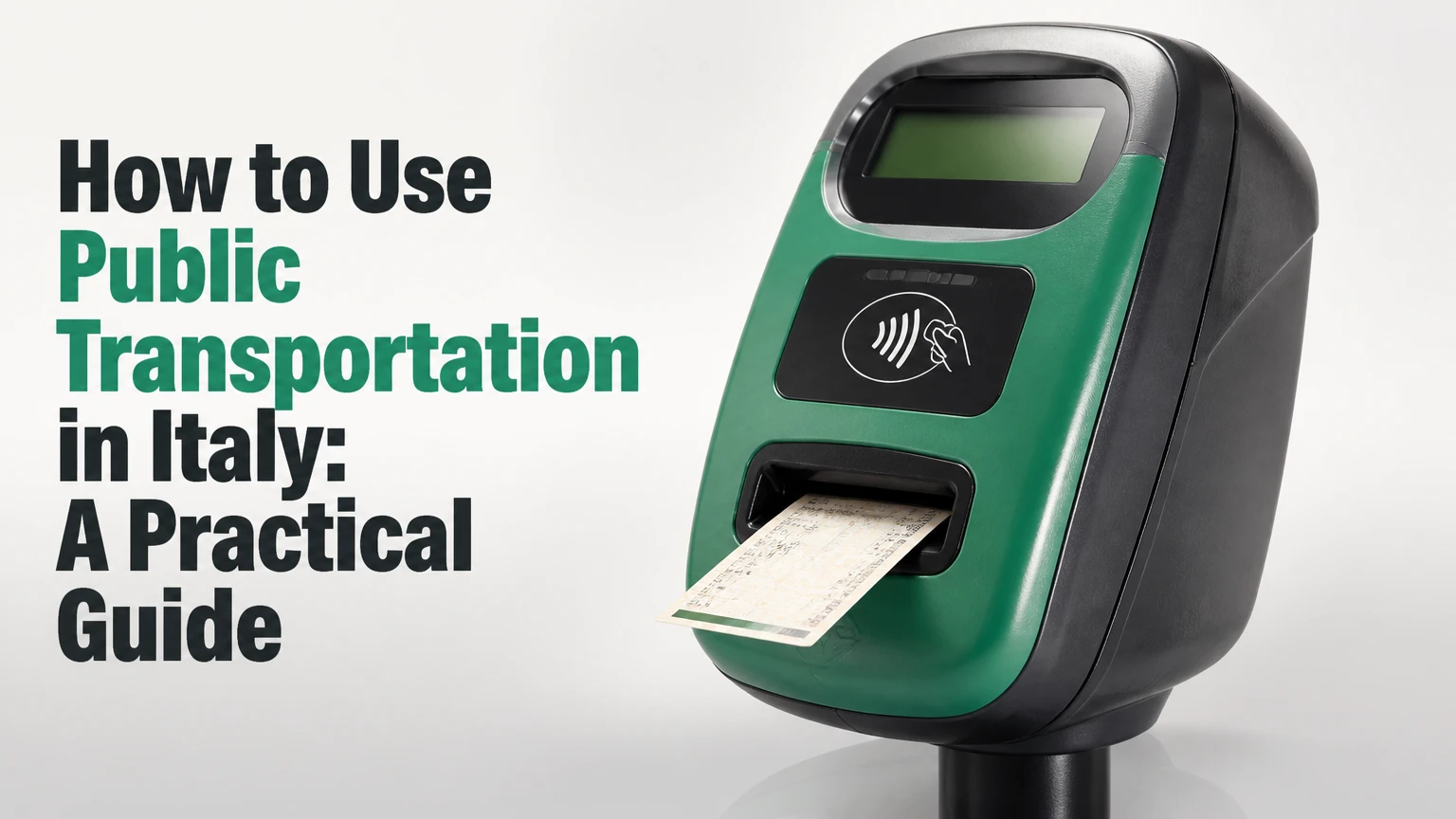
- Validate a paper ticket if required. Insert it into the machine near the platform entrance or onboard the bus or tram.
- Activate a digital regional ticket. Follow the app’s check-in or activation instruction before the scheduled departure.
- Keep proof of payment. Store the QR code, booking reference, and payment record until the journey ends.
A paper regional ticket is not automatically valid merely because it was purchased at a kiosk. The usual validation machine is green, yellow, or marked with a ticket symbol, though equipment differs by station. If a machine is broken, photograph the machine and ask railway staff before boarding rather than assuming the ticket is valid.
A digital ticket rule depends on the operator. Trenitalia digital regional tickets commonly require activation before departure, while a reserved Frecciarossa or Italo booking is already tied to a specific service. Read the ticket screen instead of applying one rule to every journey.
What happens if a ticket is not validated?
An unvalidated ticket can be treated as an unauthorized journey, even when the traveler paid the correct fare. The inspector may issue a surcharge and record identification details; the amount and payment process depend on the operator, location, and circumstances.
If you discover the problem immediately, speak to staff before boarding or contact the conductor as soon as possible. Do not alter, stamp, or purchase a second ticket after the fact without asking for instructions, because the corrective procedure differs between networks.
Choosing the Right Train
Italy’s rail system has three practical levels: high-speed trains for major-city travel, Intercity trains for longer conventional routes, and regional trains for local and medium-distance journeys. High-speed services are fastest, but regional trains provide access to smaller cities and usually offer more flexible ticket timing.
| Train category | Main operators | Reservation rule | Typical use |
|---|---|---|---|
| Frecciarossa high-speed | Trenitalia | Mandatory seat and train reservation | Rome to Florence, Milan to Rome, Naples to Rome |
| Italo high-speed | Italo | Mandatory seat and train reservation | Milan, Bologna, Florence, Rome, Naples, Salerno |
| Intercity | Trenitalia | Usually a reserved seat | Rome to Bari, Milan to Genoa, Rome to Sicily routes |
| Regionale or Regionale Veloce | Trenitalia and regional partners | No seat reservation | Florence to Pisa, Venice to Padua, Rome to Orvieto |
When should you book each train?
Book high-speed rail as soon as your schedule is stable, often 2-4 months ahead for popular departure times. Discounted fares can begin around $35 for a long corridor and rise beyond $130 as low-price inventory disappears; the exact amount depends on demand, class, restrictions, and booking date.
Regional trains generally use fixed or semi-fixed fares and do not sell out in the same way. Buying shortly before travel is usually reasonable, especially when weather, luggage, or a delayed flight could change your plan.
The main exception is a regional route with limited departures, such as a connection to a ferry or airport. In that case, the fare may remain flexible while the operational risk increases, so check the next available service before committing.
Which train is best for common routes?
| Route example | High-speed time | Regional or conventional alternative | Planning advice |
|---|---|---|---|
| Rome to Florence | About 1 hour 30 minutes | More than 3 hours | High-speed is usually worth the premium |
| Milan to Rome | About 3 hours | About 7 hours or longer | Reserve early for daytime departures |
| Florence to Pisa | Not normally necessary | About 1 hour | Regional ticket offers useful flexibility |
| Venice to Padua | About 15-30 minutes | About 30-55 minutes | Compare station location and fare |
| Naples to Pompeii | Not normally necessary | About 35-45 minutes | Check whether you need Trenitalia or Circumvesuviana |
An important distinction is between a through-ticket and separate tickets. If you buy two independent bookings and the first train is late, the second operator may not protect the connection. Leave at least 45-60 minutes between separately ticketed services, and more when changing from an airport transfer.
Using Buses, Trams, and Metros
Italian city transit normally combines buses, trams, and metros under a local or regional fare authority. A time-based ticket often permits transfers between these modes for 75-100 minutes, but the ticket must be valid for the zones and services used.
| City | Main authority | Typical single fare | Main urban modes |
|---|---|---|---|
| Rome | ATAC | About $1.70-$2.00 | Metro, bus, tram, suburban rail |
| Milan | ATM | About $2.40 | Metro, tram, bus, suburban rail |
| Florence | Autolinee Toscane | About $1.70-$2.00 | Bus and tram |
| Naples | ANM and integrated partners | About $1.40-$2.00 | Metro, bus, tram, funicular |
| Turin | GTT | About $1.90-$2.20 | Metro, bus, tram |
Prices change, and integrated tickets can have different conditions from single-operator tickets. Check the current authority fare page before budgeting.
How to board local transit
Buy a ticket at a metro machine, tobacco shop marked Tabacchi, transport kiosk, official app, or participating contactless gate. On a bus or tram, board through the permitted door, validate a paper ticket immediately, and move away from the entrance so other passengers can board.
Metro systems usually require a ticket at the entry barrier and sometimes at the exit barrier. Keep the same card or device available if the system uses tap-in and tap-out. Do not tap a second bank card when transferring, because the network may interpret the action as a separate journey.
Buses are less predictable than rail because traffic affects running time. Google Maps, Moovit, and local apps can help with routing, but the operator’s service alert is the better source for cancellations, diversions, and strikes.
What do urban day passes cost?
| Pass type | Typical USD cost | Validity | Best value when |
|---|---|---|---|
| Single integrated ticket | $1.50-$2.40 | 75-100 minutes | One or two transfers |
| 24-hour city pass | $7-$10 | 24 hours from activation or calendar period | Four or more rides |
| 48-hour city pass | $13-$18 | 48 hours | Dense sightseeing itinerary |
| Weekly urban pass | $20-$35 | Authority-defined week | Frequent local travel |
A day pass is not automatically cheaper. Four single rides at $2 each cost about $8, so a $10 pass becomes worthwhile only when its validity and included zones cover additional journeys.
Water Transport and Coastal Routes
Venice’s ACTV vaporetti are scheduled water buses, not sightseeing cruises, and they use route numbers, floating stops, and timed or multi-day tickets. Regional ferries connect mainland ports with Capri, Ischia, Sicily, Sardinia, Lake Como, and coastal towns such as Amalfi and Positano.
| Water service | Typical single price | Typical day or return option | Main limitation |
|---|---|---|---|
| Venice vaporetto | About $10 for 75 minutes | About $27 for 24 hours | Crowding and luggage space |
| Capri fast ferry | About $25-$40 one way | Return depends on operator | Weather can cancel sailings |
| Amalfi Coast ferry | About $10-$25 one way | Seasonal route combinations | Reduced winter service |
| Lake Como boat | About $5-$15 per ride | Zone or day ticket varies | Timetables change by lake sector |
| Sicily or Sardinia vehicle ferry | About $50-$180 per passenger and vehicle | Return booking varies | Advance reservation is prudent |
Ferry operators charge in euros, while the table shows approximate USD planning figures at roughly $1.09 per euro. Actual card charges fluctuate with exchange rates and foreign transaction fees.
Buy ferry tickets early for fixed summer departures, vehicles, cabins, and popular Capri or Sardinia crossings. Arrive 30-60 minutes before departure when boarding involves luggage or a vehicle. A ferry ticket usually does not guarantee a weather-proof schedule, and strong wind can suspend service with little practical alternative.
The Venice 24-hour pass becomes economical after roughly three single rides, depending on the current fare. It does not automatically include every airport transfer or private boat service, so verify route coverage before purchase.
Planning Airport Transfers
Airport transport is a separate planning problem because arrival delays, late operating hours, and luggage change the best option. Rome Fiumicino has rail and bus links to the city, Milan has several airport rail and coach options, and Venice Marco Polo combines land buses with a separate water-taxi network.
| Airport situation | Usually suitable option | Typical time | Typical USD cost |
|---|---|---|---|
| Fiumicino to Roma Termini | Leonardo Express | About 32 minutes | About $16 |
| Milan Malpensa to central Milan | Malpensa Express | About 40-55 minutes | About $15 |
| Venice Marco Polo to Piazzale Roma | Airport bus | About 20-30 minutes | About $11-$12 |
| Venice Marco Polo to central Venice | Alilaguna water bus | About 60-90 minutes | About $18-$20 |
| Late arrival with heavy luggage | Official taxi | About 30-60 minutes | Fixed or metered fare |
The fastest airport route is not always the cheapest or easiest. A train to a central station can be excellent for travelers staying near that station, while a bus or taxi may reduce walking when accommodation lies far from the rail terminal.
For a flight connection, allow the operator’s stated journey time plus 60-90 minutes for ticketing, walking, and disruption. Italy’s airport rail services can stop during strikes or engineering works, so identify a bus or taxi fallback before landing.
Typical Costs and How to Budget
A realistic public-transit budget depends more on intercity distance and travel speed than on the number of cities. A traveler using regional trains and city tickets may spend $15-$30 per day, while frequent high-speed journeys can exceed $80 per day.
| Journey type | Typical USD range | Price behavior | Buy when |
|---|---|---|---|
| Short regional train | $2.50-$16 | Usually fixed | Same day is normally fine |
| High-speed city pair | $35-$130 or more | Dynamic | Early, once plans are stable |
| City single ticket | $1.50-$2.40 | Local tariff | Before boarding or at entry |
| City 24-hour pass | $7-$10 | Fixed validity rules | When four or more rides fit |
| Venice 24-hour water pass | About $27 | Zone and route conditions | Before multiple island trips |
| Intercity train | $20-$90 | Advance and fare dependent | Earlier for peak departures |
These are typical planning ranges, not guaranteed prices. Operators publish fares in euros, and USD equivalents vary with the exchange rate.
A rail pass can be convenient for a broad itinerary, but convenience does not ensure savings. Compare the pass price with point-to-point high-speed fares, because regional trains and local transit may require separate reservations or supplements.
Timetables, Delays, and Strikes
Italy’s high-speed trains commonly operate from early morning to late evening, with the busiest corridors sometimes offering departures every 15-30 minutes. Metro systems often begin around 5:30 a.m. and finish between 11:30 p.m. and 12:30 a.m., while night buses replace some services after closing.
Schedules vary by city, weekday, holiday, and season. Coastal ferries, Amalfi buses, Cinque Terre connections, and rural routes often reduce service from November through March.
Check these sources on the day of travel:
- Trenitalia and Italo service pages for train status
- The municipal operator for urban disruptions
- The Italian Ministry of Infrastructure and Transport strike calendar
- Station departure boards for platform changes
- Ferry operator alerts for wind and sea conditions
Transport strikes, called scioperi, may affect trains, buses, metros, or only selected operators. Italian law generally protects essential commuter windows, commonly around 6:00-9:00 a.m. and 6:00-9:00 p.m., but protected service is not the same as normal service.
Expert insight: On a strike day, the first and last protected service can be more crowded than the middle of the window. If a train matters for a flight or prepaid ferry, travel one service earlier and avoid relying on the final guaranteed departure.
When Public Transit Is Not Enough
Public transportation is strongest between major cities and inside historic centers where parking is restricted. A rental car becomes more useful for dispersed villages, mountain roads, agriturismo stays, and itineraries with several rural stops.
| Situation | Public transit | Rental car | Taxi or private transfer |
|---|---|---|---|
| Rome historic center | Strong, $2-$10 daily | Poor due to ZTL and parking | Useful after midnight |
| Tuscany hill towns | Limited between villages | Strong, with parking planning | Expensive for multiple stops |
| Amalfi Coast | Strong in season, crowded | Difficult roads and parking | Useful for groups with luggage |
| Sardinia beaches | Limited outside towns | Strong | Useful for one airport transfer |
| Venice islands | Essential, no car access | Park on mainland only | Water taxi is fast but costly |
Italy’s Zona a Traffico Limitato, or ZTL, restricts unauthorized vehicles in historic centers. Camera enforcement can produce fines of approximately $60-$120 or more per entry after administrative charges, and a rental company may add a processing fee.
Standard UberX is not broadly available across Italy. Uber Black and Uber Taxi operate in selected cities, while licensed municipal taxis remain the more common option. Use an official taxi stand or the local dispatch system, confirm the meter or posted airport fare, and request a receipt.
What Goes Wrong and How to Fix It
Most transit problems come from confusing a valid purchase with a valid journey. The following mistakes have predictable consequences.
| Mistake | Likely consequence | Better action |
|---|---|---|
| Boarding a regional train without validation | Surcharge or inspection dispute | Stamp paper tickets before boarding |
| Missing a reserved high-speed train | Ticket may lose validity | Check fare conditions before rebooking |
| Using the wrong city zone | Fine or forced fare correction | Confirm destination zone before tapping |
| Entering a ZTL with a rental car | Camera-recorded fine | Park outside the restricted center |
| Relying on one ferry departure | Missed connection after weather delay | Keep a later sailing or land backup |
| Buying from an unofficial reseller | Extra fees or unclear refund rules | Use the operator or authorized seller |
If an inspector issues a notice, keep the document and follow its payment or appeal instructions. Arguing that the ticket was purchased usually does not replace the validation requirement.
Expert insight: Travelers often over-optimize the fare and under-budget the transfer. Saving $10 on a late regional connection can create a missed high-speed train, a new ticket, and several hours of delay.
Accessibility requires route-level checking. Italian stations may have elevators, ramps, or staff assistance, but platform gaps, historic paving, crowded buses, and broken lifts can change the journey. Trenitalia’s assistance service, Sala Blu, can arrange support at participating stations when requested within the operator’s stated lead time.
Families should check age rules rather than assume every child rides free. Some long-distance operators offer child discounts, while urban authorities use their own age thresholds and ticket products. A stroller may need to be folded on crowded buses or water buses.
A Practical Decision Guide
Choose the transport combination using these rules:
- Use high-speed rail when the route links major cities and time has higher value than flexibility.
- Use regional rail for Florence, Pisa, Padua, Verona, Orvieto, Pompeii-area, and other short or medium routes.
- Use metro and trams for predictable movement across large cities.
- Use buses when the route lacks rail, but add traffic time during weekday peaks.
- Use ferries for islands and scenic coastal links when weather and seasonal schedules cooperate.
- Use taxis for late arrivals, mobility limitations, multiple bags, or a final connection after transit closes.
- Rent a car only when rural access outweighs fuel, parking, insurance, and ZTL exposure.
In practice, a mixed strategy works best. Book the two or three long high-speed legs, leave regional journeys flexible, and use local day passes only after estimating the number of rides.
Frequently Asked Questions About how to use public transportation in Italy
Can I use a credit card on Italian buses and metros?
Contactless payment is available on many metro systems and selected bus networks, including major parts of Milan and Rome. Acceptance is route-specific, and contactless payment may not cover regional trains, ferries, or every transfer. Carry a backup card and a small amount of cash for kiosks or older machines.
Is public transportation in Italy safe at night?
Major rail and metro networks are generally practical at night, but service becomes less frequent after closing hours and some stations have limited staffing. Keep bags closed in crowded areas, confirm the last departure, and use an official taxi for an isolated destination or an arrival after night buses stop.
Do Italian trains have luggage limits?
Most Italian trains do not apply an airline-style weight limit to ordinary personal luggage, but passengers must store bags without blocking aisles, doors, or emergency equipment. Large suitcases are easiest on high-speed trains when placed in the designated racks near the carriage entrance.
Should I use a rail pass or individual tickets?
Individual tickets usually suit travelers with a few fixed high-speed journeys and flexible regional trips. A rail pass can simplify a long itinerary with frequent reserved trains, but reservations and local transit costs may remain separate. Compare the pass price with current point-to-point fares before buying.
How early should I arrive at an Italian train station?
Arrive 15-20 minutes before a normal train and 30 minutes before a major station departure when luggage, unfamiliar platforms, or an airport connection is involved. High-speed trains can board quickly, and the platform may be announced shortly before departure, especially at busy terminals.
What should I do if the train or bus is canceled?
Check the operator’s official alert, station board, or app for replacement transport and rebooking instructions. Do not automatically buy a new ticket. Reserved-train passengers may have rerouting or refund rights, while separate tickets and third-party bookings can follow different conditions.
Conclusion
Public transportation in Italy is usually the most efficient way to connect major cities and reach historic centers without parking or ZTL problems. Reserve high-speed trains early, buy regional tickets later, validate paper and eligible digital fares correctly, monitor strikes and ferry weather, and use taxis or rental cars only where the network’s limitations justify the added cost. This is the reliable way to use public transportation in Italy without turning a low fare into an expensive delay.