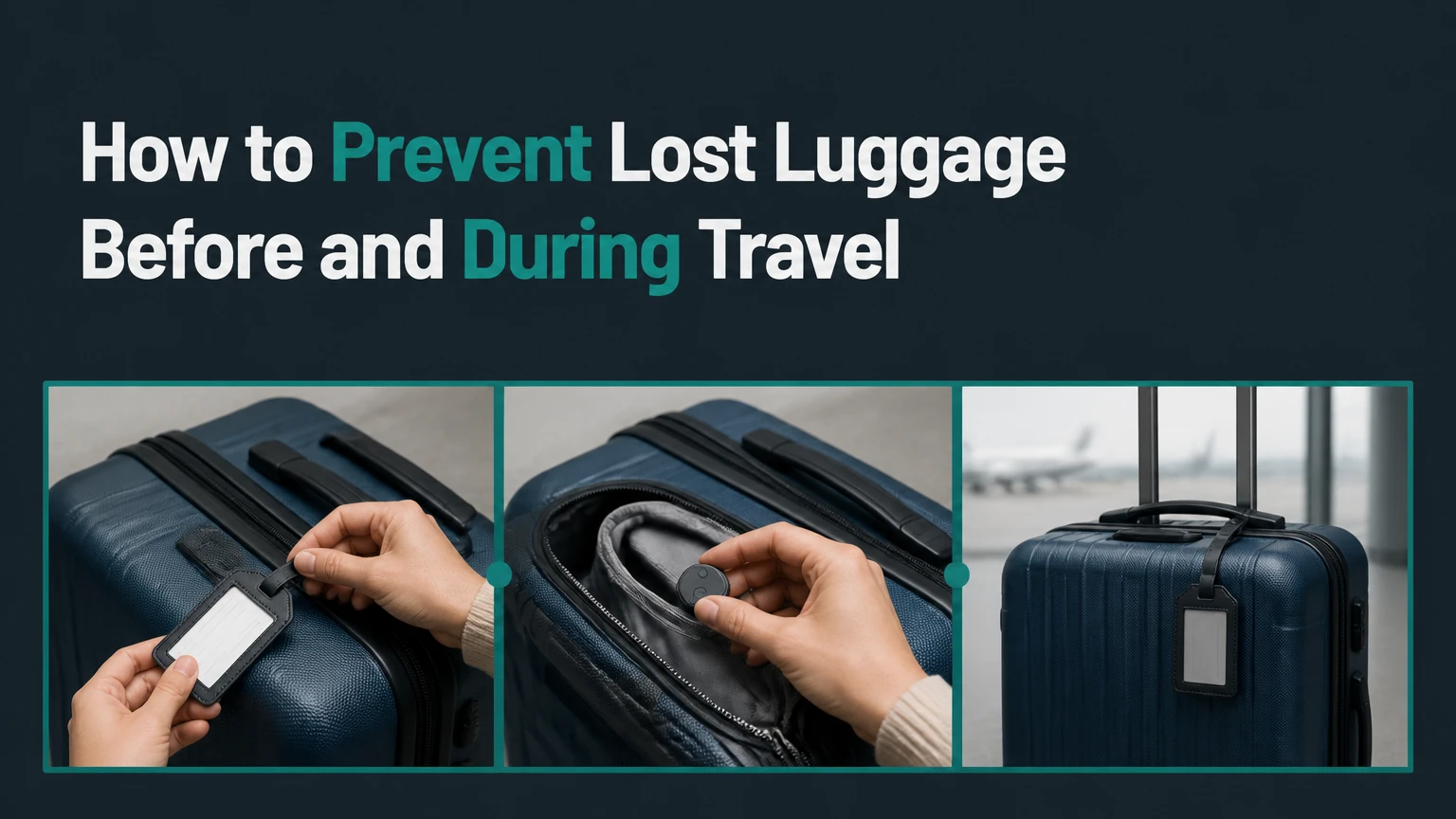
How to prevent lost luggage starts with reducing handling opportunities, protecting the airline barcode, and creating an independent way to locate the bag. Check luggage early, remove old labels, use a durable identification system, place essentials in your carry-on, and verify the bag’s scan status in the airline app. No method guarantees arrival, but layered preparation makes misrouting less likely and recovery faster.
Key Facts / Quick Answer
Check bags at least 60-90 minutes before departure, and allow more time for international or busy-hub flights.
Remove every old routing sticker and receipt tag before leaving for the airport.
Put medication, identity documents, keys, valuables, electronics, and one change of clothes in cabin baggage.
Bluetooth trackers typically cost $25-$40 and need a battery replacement about once a year.
Use a 90-minute minimum connection target for checked bags, with more time for international transfers or separate tickets.
Photograph the suitcase, its contents, and the baggage receipt before boarding.
The 2024 SITA Baggage IT Insights report recorded 6.9 mishandled bags per 1,000 passengers in 2023. SITA classified 77% of mishandled bags as delayed, 18% as damaged or pilfered, and 5% as lost or stolen. Most problems are therefore temporary, but a temporary delay becomes expensive when the passenger has packed everything essential in the hold.
How Airline Baggage Tracking Works
Airline baggage tracking links a physical bag to a passenger record through a barcode, but the chain contains several handoffs where a bag can be delayed or misrouted. The airline’s system can confirm scans at particular points, yet it cannot provide continuous location data inside every baggage area.


The Four Main Tracking Stages
A checked suitcase normally moves through these stages:
- Acceptance: The check-in agent weighs the bag, attaches a license plate number, and links that number to the passenger name record.
- Sortation: Conveyor scanners read the barcode and direct the suitcase toward a flight, transfer belt, or manual handling point.
- Loading: Ramp staff move the bag into a container or aircraft hold, where the bag may receive another scan.
- Arrival and reclaim: The destination system records unloading and sends the suitcase to the carousel or an onward-transfer area.
A barcode identifies the bag in the airline network, but a barcode does not locate it continuously. A bag can remain visible as “accepted” even when it is sitting in a transfer room, awaiting a later flight, or undergoing a security inspection.
Where the Chain Commonly Fails
| Failure point | Typical trigger | Passenger action |
|---|---|---|
| Check-in acceptance | Late bag drop or unreadable label | Arrive 60-90 minutes early and inspect the printed tag |
| Automated sortation | Torn barcode, old label, loose strap | Remove old stickers and secure external attachments |
| Transfer loading | Short connection or terminal change | Prefer 90-120 minutes for connecting itineraries |
| Arrival delivery | Wrong carousel, delayed container, customs hold | Check the app, ask the baggage desk, and retain the receipt |
A second bag tag is useful only when both tags remain attached and readable. It does not replace the primary license plate number, so a traveler should inspect the official airline label before leaving the counter.
Which Preparations Reduce the Risk Most?
The most effective prevention measures are operational rather than technological: reduce tight transfers, protect the routing label, and keep important belongings with you. A tracker improves visibility after a problem occurs, but it cannot make a late bag load onto a departing aircraft.
Before Leaving Home
Use this preparation sequence:
- Empty the suitcase and remove old airline stickers, destination tags, and security inspection notices.
- Photograph the exterior, including color, brand, size, wheels, handles, and distinctive marks.
- Photograph the open contents, with valuable items and serial numbers recorded separately.
- Put a contact card inside the bag, above the clothing, with your name, mobile number, email, and destination hotel.
- Add an exterior tag that shows a phone number or email without displaying a home address.
- Install or replace the tracker battery and confirm that the device appears in its app.
- Move medication, passports, identification, keys, cash, electronics, jewelry, and essential documents into cabin baggage.
- Check the airline’s rules for spare lithium batteries and tracker devices.
In practice, the contact card should include the first destination rather than only a permanent home address. A handler opening a bag needs a usable delivery location for the next 24-48 hours.
At the Check-In Counter
Check the printed baggage receipt before walking away. The three-letter airport code should match the intended destination or the airline’s documented transfer point, and the bag description should match the suitcase you handed over.
Ask whether the bag is tagged through to the final destination. This question matters when an itinerary includes separate tickets, a codeshare, a self-transfer, or a country where passengers must collect baggage for customs inspection.
| Check-in item | Correct result | Why it matters |
|---|---|---|
| Destination code | Matches the final ticketed airport | Prevents an incorrect routing label |
| Passenger name | Matches the reservation record | Helps airline staff reconcile ownership |
| Bag receipt | Retained in phone or wallet | Supplies the tracking number for a claim |
| Through-check status | Confirmed verbally when relevant | Clarifies customs and transfer responsibility |
| Tag attachment | Flat, tight, and readable | Protects the barcode during conveyor handling |
At the Gate
Gate-checking changes the timing and documentation. A cabin bag accepted at the gate may receive a new short tag, travel in a different container, or be delivered at the aircraft door rather than the normal carousel.
Take a photo of the gate-check receipt and ask where the bag will be returned. If the aircraft is full, gate agents may load the bag into the hold after the normal baggage process has closed, which makes an independent tracker particularly useful.
Which Tracking Tool Fits Your Trip?
A Bluetooth tracker is the best value for most checked bags because it is small, inexpensive, and supported by a large nearby-device network. A cellular tracker provides more direct location reporting but costs more, requires charging, and may be restricted by airline or national battery rules. A passive QR tag remains useful when electronics are unsuitable.
Tracker Comparison
| Tool type | Typical USD cost | Power interval | Location method | Best fit |
|---|---|---|---|---|
| Apple AirTag | $25-$35 | About 12 months | Nearby Apple devices | iPhone travelers and major airports |
| Tile Mate or Pro | $25-$35 | About 12 months, model dependent | Tile network and Bluetooth | Android or mixed-device households |
| Samsung Galaxy SmartTag2 | $25-$30 | Up to about 500 days, settings dependent | Galaxy device network | Samsung Galaxy users |
| GPS/cellular tracker | $40-$150 plus $5-$20 monthly | About 2-7 days, typical | Cellular network and GPS | High-value equipment and remote travel |
| QR or NFC luggage tag | $5-$25 | No battery | Finder scans a web profile | Backup identification for any traveler |
Bluetooth trackers usually provide an approximate last-known location rather than a continuous GPS trail. Their performance depends on nearby compatible phones, network coverage, Bluetooth settings, and the traveler’s ability to receive an update.
GPS/cellular units can report their own coordinates, but metal aircraft holds, indoor baggage rooms, cellular roaming, and battery-saving modes can interrupt reporting. A GPS device that has been switched off or placed in an airline-restricted position provides no practical advantage.
How to Use a Bluetooth Tracker Correctly
Place the tracker inside the suitcase, near the top, inside a zipped pocket or protective holder. An exterior tracker can be removed, damaged by conveyor equipment, or exposed to weather.
Turn on the device before leaving home and check it again after bag drop. A useful routine is to confirm the last location 10 minutes before boarding, then check for a new airport or destination update after landing. Do not open a secured baggage area or confront staff because a tracker shows a bag in a restricted location.
Apple, Google, Samsung, and Tile have introduced unwanted-tracking alerts that can notify people when an unknown tracker appears to travel with them. That privacy feature is useful for public safety, but it means a tracker should never be treated as a covert surveillance device.
Tracker Limitations That Matter
Trackers cannot:
- Prevent a suitcase from being loaded onto the wrong aircraft.
- Force an airline to release a bag from a restricted facility.
- Prove the contents or monetary value of a claim.
- Replace the baggage receipt or property irregularity report.
- Guarantee a signal inside a metal cargo container or underground room.
- Satisfy every country’s rules for batteries and transmitting devices.
An independent signal is evidence of location, not proof of ownership or liability. Airline staff still need the bag tag number and claim file to reunite the suitcase with its passenger.
How Should You Pack a Checked Bag?
The safest packing strategy keeps survival items in the cabin and makes the checked suitcase easy to identify without creating snag hazards. A distinct appearance, internal contact sheet, and organized contents reduce handling time when a bag is separated from its tag.
Keep These Items Out of the Hold
| Item | Cabin-bag reason | Practical quantity |
|---|---|---|
| Prescription medication | Replacement may be difficult abroad | Full trip supply plus 2-3 days |
| Passport and identity documents | Required at border and hotel checkpoints | 1 document wallet |
| Keys and access cards | Needed immediately after arrival | 1 complete set |
| Electronics and chargers | Theft, damage, and battery concerns | Essential devices only |
| Basic clothing and toiletries | Covers a 24-48 hour delay | 1 change of clothes and travel kit |
Airlines and regulators restrict many dangerous goods in checked baggage. The U.S. Federal Aviation Administration and the Transportation Security Administration publish current rules for lithium batteries, power banks, fuel, aerosols, and other articles, so check the relevant authority before packing unusual equipment.
Make the Suitcase Distinctive
A bright luggage strap, patterned cover, or large color panel helps a passenger identify the correct bag at a crowded carousel. Identification should not rely on a small black tag, because many suitcases have the same shape and color.
Avoid long straps, ribbons, or decorative cords. Conveyor belts can catch loose material and tear away both the decoration and the routing label. Keep straps tight, use approved luggage covers, and secure zippers with a simple lock accepted by the destination’s security system.
When Are Connections Most Dangerous?
A connection under 90 minutes gives baggage and passengers little recovery time when the first flight arrives late, changes gates, or requires a terminal transfer. The right buffer depends on the airport, itinerary, customs process, and whether one airline controls the complete booking.
| Itinerary type | Sensible connection target | Main additional risk |
|---|---|---|
| Domestic, same terminal | 60-90 minutes | Late inbound aircraft |
| Domestic, large hub | 90-120 minutes | Long ramp and belt transfers |
| International to domestic | 2-3 hours | Immigration, customs, and bag recheck |
| Separate tickets | 3-4 hours | No protected onward connection |
| Self-transfer with checked bag | 4 hours or overnight | Passenger must reclaim and recheck luggage |
The published minimum connection time is an airport planning threshold, not a guarantee of successful baggage transfer. It often assumes normal operations and may not account for a distant gate, wheelchair assistance, passport control, or a security queue.
Direct flights remove one major handoff, so they are usually preferable when the fare difference is reasonable and the route is available. A direct itinerary still has check-in, loading, unloading, and carousel risks, so the bag should retain its identification and the traveler should keep essentials nearby.
What Should You Do When a Bag Does Not Arrive?
When a suitcase is missing, report it at the airline’s baggage desk before leaving the airport. The passenger should provide the baggage receipt number, describe the bag precisely, show a tracker location if available, and obtain a written file or reference number.
Airport Recovery Process
- Check nearby carousels, oversized-baggage areas, and the airline app before assuming permanent loss.
- Visit the operating airline’s baggage service office, even when the ticket was sold by a partner carrier.
- Complete a baggage irregularity report with the tag number, itinerary, address, phone number, and delivery instructions.
- Give a detailed description, including brand, dimensions, color, stickers, straps, and contents that distinguish the bag.
- Save the report number, desk name, time, and every email or text message from the carrier.
- Buy only reasonable emergency items and retain itemized receipts.
- Update the delivery address if the trip moves between hotels.
- Escalate through the airline’s baggage claim channel when the promised update time passes.
A tracker location can help staff search, but passengers should not enter an airport ramp, baggage room, or customs area. Security personnel may treat unauthorized access as a serious violation.
Delayed, Damaged, and Permanently Lost Are Different
A delayed bag has not arrived when the passenger reaches the destination but may still be in the airline network. A damaged bag arrives with physical harm, while a permanently lost bag remains unrecovered after the carrier’s investigation period, which varies by airline and governing law.
| Situation | Immediate evidence | Typical passenger request |
|---|---|---|
| Delayed bag | Receipt, report number, delivery address | Status update and delivery |
| Damaged bag | Photos before leaving airport | Inspection and repair or compensation |
| Missing contents | Photos, receipts, serial numbers | Property claim |
| Permanently lost bag | Claim file and inventory | Settlement under applicable liability rules |
For flights covered by U.S. Department of Transportation rules, airlines generally must reimburse reasonable, verifiable, and actual incidental expenses caused by delayed baggage, subject to the applicable conditions. International journeys may fall under the Montreal Convention, which uses a liability limit measured in Special Drawing Rights and periodically revised.
Airline policies, route jurisdiction, ticket type, and insurance terms determine the final claim. A traveler should read the carrier’s written deadline instead of relying on a general internet timetable.
Which Mistakes Cause Preventable Baggage Problems?
The most common avoidable errors involve labels, timing, and poor handoff information. Travelers also create unnecessary exposure by checking a bag for a short trip or placing irreplaceable items in luggage that may spend 24 hours away from them.
| Mistake | Likely consequence | Better practice |
|---|---|---|
| Leaving old barcode stickers | Scanner reads an obsolete route | Remove all previous labels |
| Arriving at the last minute | Bag misses the loading cutoff | Use a 60-90 minute buffer |
| Checking fragile valuables | Damage or claim disputes | Carry them in the cabin |
| Using a blank exterior tag | Handler cannot identify the owner | Add phone and email |
| Booking separate tickets | First carrier has limited duty onward | Allow 3-4 hours or travel carry-on only |
| Ignoring app alerts | Missed request for information | Enable airline notifications |
An unusual suitcase color improves visual identification but does not improve barcode scanning. The operational priority is a flat, readable airline tag, followed by a secondary identity system.
What Are the Best Alternatives to Checking a Bag?
The most reliable way to avoid checked-baggage loss is to travel with a cabin-size bag when the airline permits it. Carry-on travel removes the baggage-sortation and transfer chain, although overhead-bin shortages can still lead to gate checking.
Choose checked baggage when the trip requires medical equipment, large clothing quantities, sports gear, or items prohibited in the cabin. When checking is necessary, use one medium suitcase rather than several small pieces if consolidating keeps the total weight within the airline limit.
For high-value professional equipment, compare airline checked-bag limits with specialist shipping insurance. A dedicated shipment may provide better packaging, tracking, and declared-value options, but it introduces a separate carrier and delivery schedule.
A Trip-Specific Prevention Plan
Different itineraries require different layers of protection. The following matrix prioritizes the action that usually produces the largest reduction in practical risk.
| Trip profile | Highest-risk event | Recommended layer |
|---|---|---|
| One direct domestic flight | Misread or damaged tag | Early check-in, internal card, exterior tag |
| Two-flight domestic itinerary | Short transfer | 90-120 minute connection and Bluetooth tracker |
| International arrival | Customs recheck | Confirm through-check rules and pack essentials |
| Separate-ticket journey | Missed recheck deadline | Carry-on only or 3-4 hour buffer |
| Camera or work equipment | Damage or theft | Cabin transport, inventory, insurance |
| Remote destination | Limited network coverage | Passive tag plus charged cellular tracker |
Expert insight: the tracker is most valuable during a transfer, not after a direct flight has arrived. A direct flight reduces handoffs, while a connection creates a narrow period when the passenger may reach the next gate before the bag has even left the first aircraft.
Expert insight: a distinctive bag without an internal contact card remains vulnerable. Airline tags can tear away, and a handler may have no safe way to connect an untagged suitcase with a passenger unless the owner’s details are inside.
Expert insight: checking in earlier does not always mean the bag travels earlier. Early acceptance gives the airline more processing time, but a late gate change, aircraft swap, security intervention, or transfer backlog can still break the chain.
Frequently Asked Questions About how to prevent lost luggage
Should I put my home address on a luggage tag?
A home address is unnecessary and exposes personal information. Use your name, mobile number, email address, and the first hotel or destination address instead. Put a second contact card inside the suitcase, because the external tag can detach during handling or be removed during a security inspection.
Is an AirTag allowed in checked luggage?
Most major aviation authorities permit small button-cell Bluetooth trackers in checked luggage when the device meets applicable power limits and remains protected from accidental activation. Rules can differ by airline and country, especially for cellular GPS devices. Check the operating airline’s dangerous-goods page before departure, and keep spare lithium batteries in cabin baggage when required.
How early should I check a bag?
A practical target is 60-90 minutes before domestic departure and at least 90 minutes before international departure, subject to the airline’s published cutoff. Large airports, holiday traffic, mobility assistance, special equipment, and customs transfers require more time. The bag must be accepted before the carrier’s loading deadline, not merely before passenger boarding.
Does travel insurance cover lost luggage?
Many policies cover baggage delay, theft, or permanent loss after exclusions, deductibles, documentation requirements, and carrier reimbursement are considered. Coverage may exclude unattended property, electronics, cash, or late reporting. Compare the policy’s per-item and total limits with the value of the contents, then file with both the airline and insurer when permitted.
Can an airline deliver a delayed suitcase to my hotel?
Airlines commonly arrange delivery after a delayed-baggage report, but delivery timing depends on customs release, local courier capacity, address accuracy, and the carrier’s procedure. Give a staffed hotel address, reservation name, room contact, and reachable phone number. Update the delivery location immediately if you leave the city.
When is a suitcase officially considered lost?
There is no single worldwide deadline. The operating airline and applicable law determine when a delayed-baggage file becomes a permanent-loss claim, and international conventions impose specific notice and liability rules. Keep the report active, submit requested information promptly, and ask the carrier in writing for the date and process used to classify the bag.
Conclusion
How to prevent lost luggage is a layered process: limit transfers, allow 60-90 minutes for bag acceptance, target 90-120 minutes for major connections, remove old labels, secure the official barcode, and keep essential possessions in cabin baggage. Add a Bluetooth tracker, internal contact card, exterior identification, photographs, and a retained receipt so a delay becomes a manageable logistics problem rather than a trip-ending emergency.