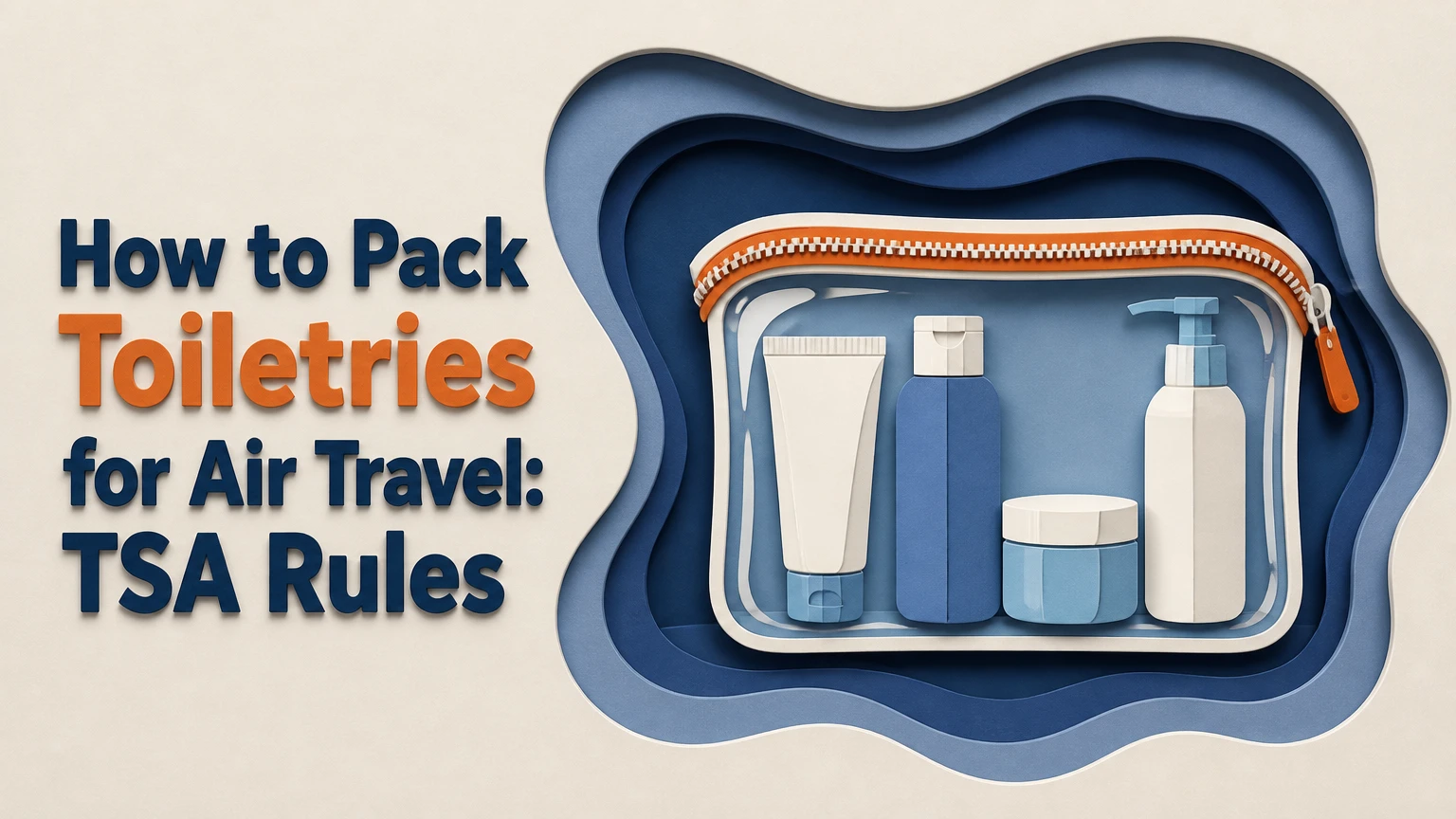
How to pack toiletries for air travel is the process of selecting, sizing, separating, and sealing personal-care products for airport screening and baggage transport. The safest method places liquids, aerosols, gels, creams, and pastes in carry-on containers of 3.4 ounces (100 ml) or less, while solids and properly protected larger products travel separately.
Key Facts and Quick Answer
- The TSA 3-1-1 rule allows containers holding 3.4 ounces (100 ml) or less in one quart-size clear bag.
- One passenger generally gets one liquids bag at U.S. Transportation Security Administration checkpoints.
- The container’s stated capacity matters, so a half-full 6-ounce bottle can still be rejected.
- Solid shampoo, bar soap, toothpaste tablets, powder deodorant, and stick sunscreen avoid the carry-on liquid limit.
- Checked toiletries need leak protection and must follow Federal Aviation Administration hazardous-material limits for aerosols and certain products.
- Typical reusable travel bottles cost $10-$30, while freezer bags, tape, and plastic wrap usually cost $0-$5.
What Counts as a Toiletry Liquid?
Toiletry liquids include more than free-flowing water. The TSA includes liquids, aerosols, gels, creams, and pastes because these products can spread, be squeezed, sprayed, or poured during screening.
Examples include shampoo, conditioner, liquid foundation, sunscreen, shaving cream, toothpaste, mouthwash, perfume, contact-lens solution, hair gel, mascara, petroleum jelly, spray deodorant, and liquid soap. A product that feels thick still falls within the carry-on rule when it is a cream, paste, gel, or spreadable substance.


The TSA’s public guidance uses the phrase, “When in doubt, leave it out.” That rule is practical for unfamiliar products, but travelers can check a specific item with the TSA’s What Can I Bring database before packing.
Solids, powders, and borderline products
Solid toiletries usually do not need to enter the quart bag. A deodorant stick, bar soap, solid shampoo, toothbrush, comb, razor cartridge, and powder blush can remain in a dry toiletry pouch.
Powders are permitted in carry-on baggage, although the TSA may inspect powder-like substances. The U.S. Department of Homeland Security advises that powders above 12 ounces (350 ml) may receive additional screening, and officers can refuse an item that cannot be cleared.
| Product | Carry-on classification | Practical packing location | Typical replacement |
|---|---|---|---|
| Toothpaste | Paste, liquid rule applies | Quart bag, container 100 ml or less | 20-50 ml tube |
| Shampoo bar | Solid | Dry pouch | One 50-80 g bar |
| Stick deodorant | Solid | Dry pouch | One 50-75 g stick |
| Spray deodorant | Aerosol | Quart bag, 100 ml or less | 50-75 ml can |
| Powder foundation | Powder | Makeup pouch | 5-15 g compact |
How to Pack Toiletries for Air Travel in a Carry-On
For carry-on travel, place every liquid, aerosol, gel, cream, and paste in a container with a capacity of 3.4 ounces (100 ml) or less, then put those containers in one transparent quart-size bag. The TSA rule concerns the container’s maximum capacity, not the amount remaining inside it.
A clear bag that is roughly 1 quart, or 1 liter in many non-U.S. systems, must close without force. The bag should be removable from the carry-on because the TSA commonly asks passengers to place it separately in a screening bin, although checkpoint procedures can vary.
The carry-on packing sequence
- Inventory the products. Remove duplicates and estimate the amount needed for each day.
- Convert large packages. Transfer only the required quantity into marked travel containers, or buy factory-sealed travel sizes.
- Choose solid alternatives. Replace liquid shampoo, shower gel, toothpaste, and deodorant where the substitution works for your routine.
- Seal each container. Tighten caps, lock pump heads, and wipe threads before closing.
- Load the liquids bag. Keep bottles upright and place the bag near the top of the carry-on.
- Pack the dry pouch. Add toothbrushes, brushes, combs, razors, cotton swabs, and solid products separately.
- Inspect at home. Remove any container above 100 ml, any unmarked substance, and anything that cannot close securely.
In practice, the most common failure is not an overfilled bottle. It is a compliant-looking travel bottle whose molded capacity exceeds 100 ml. A 150 ml bottle containing 30 ml of shampoo can still fail the rule because screening officers evaluate the container’s labeled or apparent capacity.
Carry-on limits at a glance
| Rule or item | U.S. TSA baseline | Typical international baseline | Consequence |
|---|---|---|---|
| Maximum container capacity | 3.4 oz, 100 ml | 100 ml | Larger containers may be rejected |
| Liquids bag | 1 quart, clear, resealable | Often 1 liter, clear, resealable | Oversized bags may require repacking |
| Passenger allowance | One bag | Commonly one bag | Extra bags may not pass screening |
| Screening position | Remove when requested | Airport-specific | Keep bag accessible |
| Duty-free liquid | Sealed security bag with receipt | Sealed bag and receipt commonly required | Breaking the seal can trigger screening |
Checked Baggage Packing for Full-Size Products
Checked baggage is better for full-size shampoo, large sunscreen, perfume, and products needed for trips longer than one week, but checked luggage is not exempt from every transport rule. The FAA limits many toiletry aerosols and medicinal articles to a total of 2 kg or 2 L per passenger, with each individual container limited to 0.5 kg or 0.5 L, or approximately 17 fluid ounces.
Aerosol caps must be protected from accidental release. Airline weight limits still apply, so a 23 kg checked-bag allowance can become the real constraint even when security permits a product.
Checked-bag leak protection
Use a three-layer system for liquid toiletries: a sealed product container, a separate leak-resistant bag, and a central position surrounded by clothing. Pump bottles deserve extra attention because pressure on the pump during baggage handling can release product even when the threaded cap remains tight.
| Checked item | Recommended protection | Typical space or weight | Main risk |
|---|---|---|---|
| 500 ml shampoo | Original cap plus secondary bag | 500 g, 500 ml | Cap loosening |
| Glass perfume bottle | Bubble wrap plus rigid shoe or case | 50-100 ml | Impact breakage |
| Aerosol deodorant | Cap secured, separated from heat | 100-200 ml | Accidental spray |
| Liquid foundation | Tape around closure plus bag | 30-50 ml | Cracked pump |
| Electric trimmer | Protective case, battery installed or protected | 250-500 g | Switch activation |
The FAA and airline rules can differ by product category, route, and aircraft operation. Check the airline’s restricted-items page for aerosol quantities before packing several cans, especially on international itineraries with multiple carriers.
Which Toiletry Containers Prevent Leaks?
Silicone squeeze bottles are usually the best choice for shampoo, conditioner, lotion, and other thick products because flexible walls tolerate handling and let travelers remove most of the contents. Hard PET bottles work well for watery toner or mouthwash but can crack under impact. Solid bars remove liquid leakage entirely, although they need ventilation between uses.
| Container type | Best product | Typical price | Limitation |
|---|---|---|---|
| Silicone squeeze bottle | Shampoo or lotion | $2-$6 each | Can retain fragrance or color |
| Hard PET bottle | Toner or mouthwash | $1-$4 each | Rigid plastic can split |
| Aluminum bottle | Liquid soap or spray-free product | $4-$10 each | Contents are harder to see |
| Screw-top jar | Cream or balm | $1-$3 each | Wide opening can spill |
| Solid bar tin | Shampoo or soap bar | $5-$15 | Traps moisture if closed wet |
Leave modest headspace in a sealed bottle rather than filling it to the rim. Cabin pressure changes are less likely to force product out when the closure is sound and the container has room for expansion, but headspace does not correct a weak cap or an unsuitable bottle.
The plastic-wrap method adds a useful secondary seal: remove the cap, place a small piece of food wrap over the opening, and replace the cap tightly. Do not use plastic wrap as the only closure, because it can shift and does not protect a pump from activation.
What Should Go in a Solid Toiletry Kit?
A solid toiletry kit replaces products that are chemically or physically stable without water. Solid products reduce the number of containers in the liquids bag, create fewer leak points, and preserve quart-bag capacity for items that have no convenient solid equivalent.
Useful candidates include:
- Shampoo and conditioner bars
- Toothpaste tablets or tooth powder
- Stick deodorant
- Bar soap and facial cleansing bars
- Sunscreen sticks
- Solid perfume
- Powdered laundry detergent sheets
- Dry makeup and pressed powder
- Dental floss, toothbrush, comb, and nail clippers
Solid products have limits. Shampoo bars may leave residue on hair that is accustomed to liquid formulas, toothpaste tablets may contain less fluoride than a user’s prescribed toothpaste, and sunscreen sticks can apply unevenly over large areas. Travelers with eczema, allergies, acne treatment, or prescription skin products should preserve the products that control their condition rather than optimize for bag space.
A dry pouch should allow used bars to dry before the container closes. A ventilated soap dish is more useful than a fully sealed tin during a humid trip, while a sealed container becomes preferable after the bar is dry and packed beside clothing.
How Much Toiletry Product Should You Pack?
The right quantity depends on product use, trip length, climate, and whether the accommodation supplies basics. A practical estimate starts with daily consumption, then adds a small reserve instead of transferring every product into a maximum-size bottle.
| Product | Typical daily use | Seven-day amount | Fourteen-day amount |
|---|---|---|---|
| Shampoo | 5-10 ml | 35-70 ml | 70-140 ml |
| Conditioner | 5-10 ml | 35-70 ml | 70-140 ml |
| Toothpaste | 1-2 g | 7-14 g | 14-28 g |
| Facial cleanser | 1-3 ml | 7-21 ml | 14-42 ml |
| Sunscreen | 15-30 ml for exposed body areas | 105-210 ml | 210-420 ml |
These are typical planning figures, not medical dosing instructions. Hair length, handwashing frequency, sun exposure, and shared use can change the total sharply. For sunscreen, a full-size supply may exceed the carry-on liquids allowance, so travelers can check it, buy more after arrival, or combine a small liquid bottle with a sunscreen stick.
A two-day business trip often fits in a single 100 ml shampoo bottle, a 30 ml cleanser, a 15 ml moisturizer, a travel toothpaste tube, and a deodorant stick. A two-week beach holiday usually requires a separate sunscreen plan rather than trying to force all protection into one quart bag.
A practical budget
| Packing purchase | Typical U.S. price | Useful quantity | Best use |
|---|---|---|---|
| Silicone bottle set | $10-$30 | 3-8 bottles | Repeated carry-on travel |
| Travel toothpaste | $1-$4 | 20-50 ml | Short trips |
| Shampoo bar | $8-$18 | 50-80 g | Liquid reduction |
| Quart freezer bag | $0.25-$1 | 1-3 bags | Low-cost liquid containment |
| Leak-resistant pouch | $8-$25 | 1 pouch | Checked or carry-on backup |
Medication, Contact Solution, and Family Exceptions
Medically necessary liquids, aerosols, gels, creams, and pastes can exceed the 3.4-ounce limit in the United States, but travelers should declare them to the TSA officer before screening. Prescription labels, a pharmacy printout, or a doctor’s note can clarify the product, although the TSA does not require a prescription for every medically necessary liquid.
Keep essential medication in carry-on baggage rather than checked luggage. Temperature extremes, delayed bags, and missed connections can make checked storage unsafe for insulin, injectable medicine, or temperature-sensitive biologics.
Contact-lens solution is treated as a medically necessary liquid when carried in a reasonable quantity, but it should be removed from the bag and declared. Ordinary saline intended for convenience may receive different treatment from a clearly identified medical supply.
Infant formula, breast milk, toddler drinks, and baby food can exceed 100 ml in the United States when brought for the child. Inform the officer at the beginning of screening, and expect additional inspection. Rules differ outside the United States, so families should verify the departure airport’s authority.
International and Connecting Flights
International airports often use a 100 ml container limit and a clear 1-liter bag, but the implementation varies. The European Commission applies a 100 ml limit for liquids in cabin baggage, and airport security may require the bag to be presented separately.
A connection can create a second screening event. A duty-free bottle accepted at the first airport may be confiscated at a transfer checkpoint if the security bag is opened, the receipt is missing, or the transfer airport applies a different procedure.
| Itinerary | Main screening concern | Best preparation | Typical outcome if noncompliant |
|---|---|---|---|
| U.S. domestic | TSA 3-1-1 rule | One clear quart bag | Repack, surrender, or checked transfer |
| U.S. to Europe | Departure and transfer rules | Keep receipts and seals intact | Transfer screening may confiscate item |
| Europe to U.S. | EU departure procedure | Use 100 ml containers | Bag inspection or disposal |
| Multiple airlines | Carrier baggage restrictions | Check every operating carrier | Aerosol or weight restriction may differ |
| Remote or small airport | Limited screening equipment | Minimize borderline items | Longer inspection or removal |
Airport security rules govern access to the aircraft. Customs rules govern what may enter a country. A toiletry can pass security and still violate import, medication, or agricultural rules at the destination.
What Happens When a Toiletry Bag Fails Screening?
When a liquids bag fails screening, the usual options are repacking an oversized item into checked baggage, discarding it, returning to the check-in counter, or missing the opportunity to carry it through security. The available option depends on the airport layout and whether the passenger has already entered the secure area.
A security officer may remove one questionable product rather than reject the entire bag. An unlabeled cream, a container above 100 ml, or a quart bag that cannot close gives the officer a reason to inspect the contents more closely.
Mistakes that cause avoidable delays
- Packing a 120 ml bottle that contains only 20 ml
- Using multiple small clear bags instead of one permitted liquids bag
- Forgetting mascara, lip gloss, or toothpaste in a dry pouch
- Placing the liquids bag underneath a laptop and clothing
- Carrying a medication bottle without a readable label
- Leaving a razor blade loose in a toiletry pouch
- Packing wet shampoo bars in an airtight container
- Assuming checked baggage has no aerosol restrictions
- Relying on plastic wrap without testing the original cap
Expert insight: airport repacking takes longer than home repacking because the traveler is balancing an open suitcase, a line behind them, and a security officer’s instructions. Put the liquid bag at the top and pre-sort questionable products before leaving home.
When Should You Pack Toiletries for a Flight?
Start one week before departure by listing products, checking medication supplies, and buying missing travel sizes or solid substitutes. Decant liquids two days before departure, because an overnight leak reveals a weak closure while there is still time to replace the container.
| Timing | Task | Typical duration | Result |
|---|---|---|---|
| Seven days before | Inventory and buy replacements | 20-30 minutes | Missing products identified |
| Two days before | Decant and label liquids | 25-40 minutes | Containers tested before packing |
| One day before | Seal and organize pouches | 15-20 minutes | Checked and carry-on kits complete |
| Flight morning | Confirm accessible liquids bag | 5 minutes | Faster checkpoint presentation |
| After arrival | Dry solid bars and inspect seals | 5-10 minutes | Prevents mold and repeat leaks |
Label decanted containers with the product name and, for medication, the original pharmacy information. A label helps the traveler use the right product and gives a screening officer useful context, but labeling does not make an oversized container compliant.
Frequently Asked Questions About how to pack toiletries for air travel
Can I bring a full-size shampoo bottle in my carry-on?
A full-size shampoo bottle can travel in carry-on baggage only when its container holds 100 ml or less. A half-empty 250 ml bottle remains oversized under the TSA rule. Check the full-size bottle, replace it with a solid shampoo bar, or buy shampoo after security.
Does toothpaste need to go in the liquids bag?
Toothpaste is a paste and must go in the liquids bag when carried through a U.S. TSA checkpoint. Choose a tube marked 100 ml or less, place it with other liquids, and keep larger tubes in checked baggage. Toothpaste tablets avoid the paste classification.
Can toiletries go in a personal item?
Toiletries can go in a personal item if the item meets the airline’s size rules and the products meet security requirements. The personal item does not create a second liquids allowance, so liquids still generally belong in one permitted clear bag per passenger.
Should I pack toiletries in checked luggage or carry-on baggage?
Pack essential medication, one toothbrush, basic skincare, and enough hygiene supplies for a delay in carry-on baggage. Put large shampoo, extra sunscreen, glass bottles, and duplicate products in checked luggage after sealing them against leaks and checking aerosol restrictions.
Are electric toothbrushes allowed on a plane?
An electric toothbrush is generally allowed in carry-on baggage and may be allowed in checked baggage when its battery is installed and protected from damage or accidental activation. Spare lithium batteries and power banks belong in carry-on baggage under common airline and FAA rules.
Can airport security open my toiletry containers?
Airport security can inspect or open toiletry containers when an image, label, quantity, or substance requires clarification. Use recognizable packaging, keep medication labels available, and avoid transferring critical medicine into an unmarked bottle. Security staff make the final screening decision at the checkpoint.
Conclusion
How to pack toiletries for air travel becomes straightforward when products are sorted by state, container capacity, and baggage destination. Use one accessible quart bag for carry-on liquids under 100 ml, choose solid substitutes selectively, and protect full-size checked products with tested closures, secondary bags, and clothing around breakable containers.