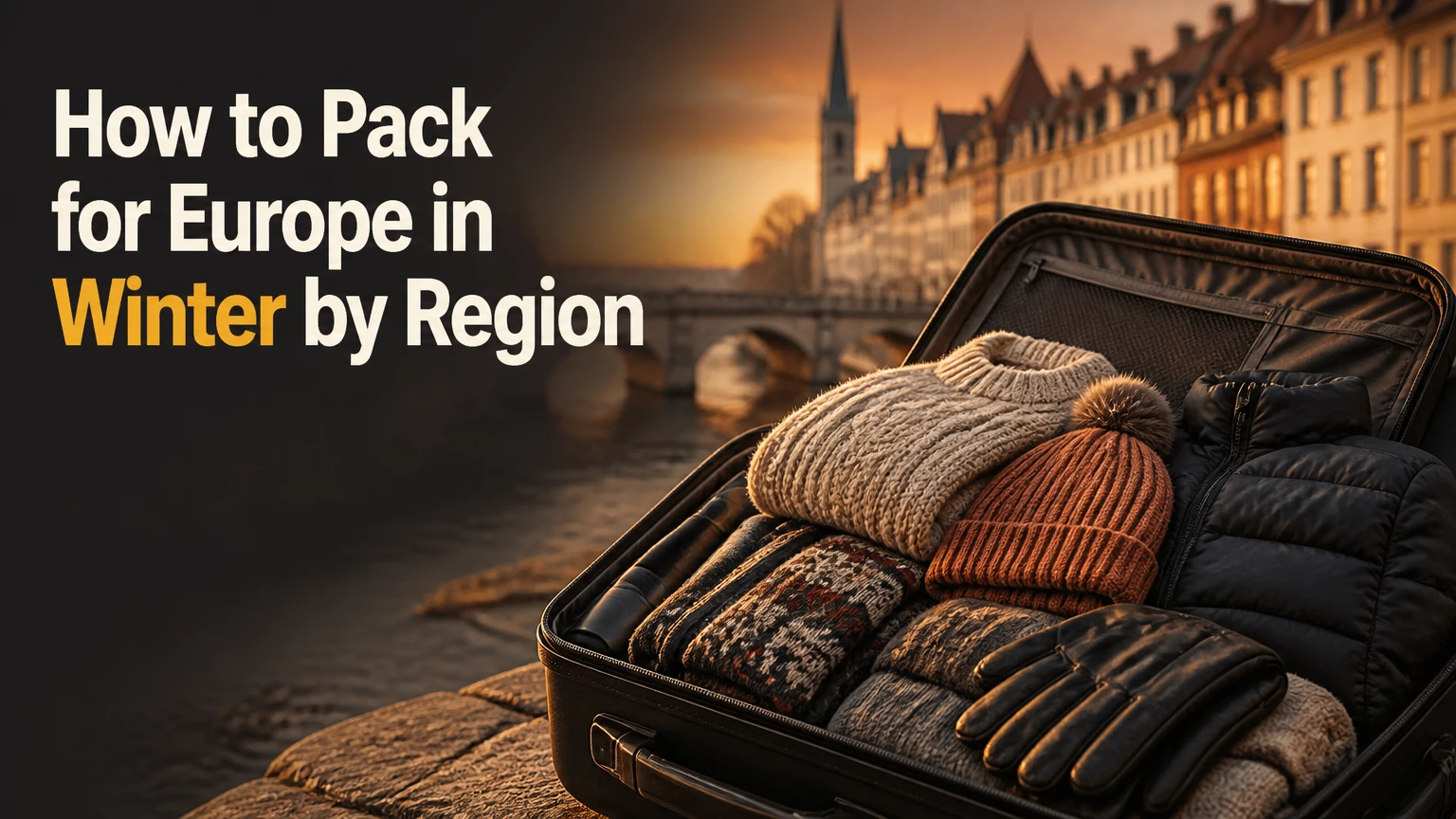
How to pack for Europe in winter means building a small, washable wardrobe that manages cold, rain, wind, snow, and overheated interiors without exceeding your luggage limit. Use a moisture-wicking base layer, a flexible insulating layer, and a weatherproof outer layer, then adjust footwear, insulation, and quantities to the destination and forecast.
Key Facts / Quick Answer
Pack for a rolling 5- to 7-day laundry cycle, even on a 30-day trip.
A practical carry-on wardrobe uses 3 base tops, 2 mid-layers, 2 bottoms, 5 pairs of socks, and 1 weatherproof outer layer.
Wear your heaviest boots and coat in transit, but remove layers before security or on heated trains.
Waterproof boots need both sealed construction and reliable traction; a waterproof membrane alone does not prevent slips.
London, Rome, Berlin, and Tromsø require different insulation strategies, despite all being described as European winter destinations.
Typical specialty gear costs range from $250 for a basic city kit to more than $900 for severe cold or ski use.
What Strategic Winter Packing Needs to Solve
Strategic winter packing is a climate-and-mobility system, not a contest to fit the most clothes into one suitcase. The system must regulate body heat outdoors, release excess heat indoors, keep feet dry, survive frequent walking, and remain manageable on stairs, platforms, buses, and cobbled streets.
European winter travel creates conflicting conditions. A January morning in Stockholm may be below freezing, while a Paris museum may feel warm enough for a shirt. Rain in Dublin can soak an unprotected coat, and polished stone in Prague can become slippery after freezing temperatures.


The National Weather Service defines wind chill as “the rate of heat loss from exposed skin caused by combined effects of wind and cold.” That distinction matters because a windy 2°C day can feel more punishing than a still day at the same air temperature.
The three-layer clothing system
The three-layer system assigns one job to each garment:
- Base layer: Moves perspiration away from skin and reduces chilling during rest stops.
- Middle layer: Traps warm air and supplies adjustable insulation.
- Outer layer: Blocks wind and precipitation while allowing excess moisture to escape.
A merino wool or synthetic base top around 150-250 g/m² suits most city travel. A lightweight fleece, wool sweater, or packable down jacket provides the middle layer. The outer layer may be a waterproof shell, insulated parka, or water-resistant coat, depending on temperature and precipitation.
The system works because travelers can remove one layer inside instead of carrying a different indoor outfit. Cotton is comfortable when dry, but cotton absorbs moisture and dries slowly, which makes cotton socks and undershirts poor choices for long, cold walking days.
How to Match Clothing to European Regions
European winter climates vary more by latitude, altitude, wind exposure, and precipitation than by country name. Use the coldest expected outdoor conditions and the amount of daily walking to choose insulation, rather than assuming every European capital needs a heavy parka.
| Region and examples | Typical winter conditions | Core outerwear | Footwear priority |
|---|---|---|---|
| Southern Europe, Rome, Athens, Lisbon | 5-16°C, rain, limited snow | Waterproof shell over light insulation | Water-resistant walking shoes or boots |
| Western Europe, London, Paris, Amsterdam | 2-12°C, wind, frequent rain | Hooded waterproof shell and fleece | Sealed walking boots with flexible tread |
| Central Europe, Berlin, Prague, Vienna | -5-6°C, frost, occasional snow | Insulated coat or shell with down layer | Waterproof boots with firm traction |
| Northern Europe, Oslo, Helsinki, Stockholm | -12-2°C, snow, wind, long outdoor exposure | Insulated parka, thermal base, windproof shell | Insulated boots, wool socks, deep tread |
| Alpine areas, Alps, Dolomites, Carpathians | -15-5°C, snow, altitude, ice | Ski or alpine insulation system | Snow-ready boots or rented technical footwear |
These ranges are typical planning bands, not forecasts. Check the official national weather service, such as the Met Office for the United Kingdom, Météo-France, Deutscher Wetterdienst, or Yr from the Norwegian Meteorological Institute, seven days before departure.
Northern and alpine trips
Northern Europe and mountain destinations justify warmer insulation, but travelers often overpack by bringing multiple thick sweaters. One midweight merino or synthetic base, one fleece, one packable down jacket, and one windproof insulated shell usually provide more flexibility than three bulky knits.
For skiing, snowshoeing, or extended time below -10°C, ordinary city clothing is insufficient. Add a dedicated thermal bottom, insulated trousers or shell pants, neck protection, waterproof mittens, and goggles. Renting skis and technical outerwear at the resort may reduce luggage volume, but rental availability and hygiene preferences vary.
Western, Central, and Southern city trips
Mild, wet cities reward waterproofing and ventilation more than maximum insulation. A breathable shell worn over a fleece or thin down jacket handles changing conditions better than a thick parka that becomes uncomfortable on heated public transport.
Southern destinations still need a rain plan. Winter rain in Barcelona, Naples, or Porto can make thin sneakers unusable for a full day, while marble streets and uneven paving increase the value of stable soles.
What Should Go in a Seven-Day Winter Bag?
A seven-day winter wardrobe should contain enough clothing for five to seven days between washes, not seven complete cold-weather outfits. The following list suits a mixed city itinerary with daily walking, restaurant meals, and one laundry session.
Clothing quantity checklist
- 3 long-sleeve merino or synthetic base tops
- 1 thermal top for colder destinations
- 2 thermal bottoms for sub-zero or alpine trips
- 2 insulating mid-layers, such as fleece, wool, or packable down
- 2 pairs of trousers, preferably quick-drying or wool-blend
- 1 sleep outfit
- 5 pairs of merino or synthetic socks
- 7 pairs of underwear
- 1 weatherproof coat or shell
- 1 beanie, 1 scarf or neck gaiter, and 1 pair of gloves
- 1 pair of waterproof walking boots
- 1 lightweight second pair of shoes when luggage space permits
A second pair of footwear is optional for a short carry-on trip. It becomes useful for drying rotation, formal occasions, foot comfort, or destinations where boots are too warm indoors.
| Trip length | Base tops | Bottoms | Socks | Laundry plan |
|---|---|---|---|---|
| 3-4 days | 2 | 2 | 4 pairs | Sink wash on arrival |
| 7 days | 3 | 2 | 5 pairs | One full wash on days 4-5 |
| 14 days | 4 | 3 | 6 pairs | Two laundry sessions |
| 30 days | 5 | 3-4 | 7 pairs | Weekly laundromat or accommodation wash |
The trip-length rule is simple: add laundry events, not clothing. A 30-day itinerary can use the same core wardrobe as a seven-day itinerary if the traveler has reliable access to washing and drying.
The indoor temperature problem
Overheated interiors change the best packing strategy. Trains, hotels, cafés, and museums may be warm enough to make a heavy sweater uncomfortable, so pack layers that open fully or remove quickly.
Choose a zip fleece, cardigan, or thin down jacket instead of relying only on pullovers. Keep the base layer breathable, because sweating during a train journey can make the next outdoor transition colder.
Which Gear Specifications Matter Most?
Gear specifications help travelers compare products without treating brand names as performance guarantees. Fill power measures down loft, waterproof ratings measure fabric resistance under laboratory pressure, and tread design affects grip on wet or icy surfaces.
| Gear | Practical target | Typical USD price | Limitation |
|---|---|---|---|
| Merino base top | 150-250 g/m² | $60-$120 | Dries slower than lightweight polyester |
| Lightweight down jacket | 650-800 fill power | $120-$350 | Loses insulation when wet |
| Waterproof shell | 10,000-20,000 mm rating | $100-$300 | Rating does not guarantee breathability |
| City winter boots | Sealed upper and lugged rubber sole | $100-$250 | Heavy boots increase luggage weight |
| Insulated parka | Hood, wind protection, mid-thigh coverage | $180-$600 | Bulky and excessive for mild climates |
| Merino hiking socks | Midweight, cushioned heel and toe | $15-$30 per pair | More expensive than synthetic socks |
A 10,000 mm waterproof rating is a reasonable baseline for prolonged city rain. A 20,000 mm fabric offers a larger margin in sustained precipitation, but seam sealing, zipper construction, and hood design also determine real-world performance.
Down fill power describes efficiency, not total warmth. A 700-fill jacket with little down may be colder than a 600-fill jacket with more fill. For severe cold, compare total fill weight, garment length, cuff design, and hood coverage.
Footwear and traction
Waterproof boots should be broken in before departure. Wear them on at least three walks of 30 minutes or more, then inspect heel rubbing, toe pressure, and sock bunching.
Deep lugs help in soft snow, but they do not make every sole safe on polished ice. On icy streets, shorten your stride, keep your center of gravity over your feet, and consider removable traction devices where local conditions justify them. Do not wear metal traction aids inside museums or on delicate floors.
Expert insight: The most common footwear mistake is packing waterproof boots that are too rigid for urban walking. Stiff ski-oriented boots protect against cold but can create blisters during 15,000-step sightseeing days. City travelers usually need moderate insulation, a flexible forefoot, heel stability, and a sole that grips wet pavement.
Carry-On or Checked Luggage for Winter Travel?
Carry-on luggage is usually better for multi-city Europe trips because travelers frequently encounter stairs, train platforms, cobblestones, and small hotel elevators. Checked luggage becomes more practical for ski equipment, medical supplies, multiple travelers sharing one bag, or a long single-destination stay.
Airline rules vary by carrier, fare, aircraft, and route. A 55 x 40 x 20 cm cabin bag and a 7-10 kg weight limit are common European planning assumptions, but travelers must verify the operating airline’s current policy. A 23 kg checked-bag allowance is also common, though fees can apply on every leg.
| Luggage approach | Typical capacity | Typical weight rule | Best use |
|---|---|---|---|
| Personal item backpack | 20-30 L | 5-8 kg, carrier-specific | Minimalist 3-4 day trip |
| Cabin roller or backpack | 35-45 L | 7-10 kg | Multi-city train itinerary |
| Medium checked suitcase | 60-75 L | Up to 23 kg | One base city or family travel |
| Large checked suitcase | 90-110 L | 20-32 kg, carrier-specific | Ski gear or extensive shopping |
The wear-on-the-plane rule saves space but does not eliminate weight. Wear the heaviest boots, trousers, and coat while traveling, then remove the coat before boarding if the cabin becomes warm.
A better luggage-volume audit
Pack the complete wardrobe on the floor before choosing the bag. Compress clothing only after removing duplicates, because compression can hide an overweight suitcase rather than solve the underlying problem.
Leave approximately 15-20% of the bag empty for food, souvenirs, or clothing expansion. A full suitcase is difficult to close after a damp coat or loosely folded knitwear enters the packing system.
How to Organize and Compress Winter Clothing
Packing cubes organize categories, while compression bags reduce volume. Neither method reduces the actual mass of clothing, and vacuum compression can damage down loft if the item remains compressed for extended periods.
| Method | Volume effect | Best contents | Typical setup time |
|---|---|---|---|
| Mesh packing cubes | Low to moderate compression | Underwear, socks, base layers | 5 minutes |
| Compression cubes | Moderate compression | Fleece, trousers, synthetic knits | 5-10 minutes |
| Vacuum bags | Up to roughly 30-50% volume reduction | Bulky non-down sweaters | 10 minutes |
| Rolling without tools | Minimal compression | Wrinkle-resistant shirts and trousers | 3-5 minutes |
Avoid vacuum-sealing a down jacket for the entire trip. Short compression during transit is usually less concerning than storing down tightly for days, but restoring loft requires shaking the garment and leaving it uncompressed.
Pack a damp-item bag separately from clean clothing. A simple waterproof stuff sack prevents a wet shell or socks from transferring moisture to merino layers.
The five-step packing sequence
- Check the forecast: Record the coldest temperature, rainfall probability, wind, and snow risk for each destination.
- Select the outer layer: Choose a shell or parka based on the worst realistic outdoor conditions.
- Build two outfits: Confirm that every base, mid-layer, and bottom works with the selected coat and footwear.
- Remove duplicates: Keep the warmer or more versatile version when two items perform the same function.
- Pack by access order: Place travel-day clothing and first-night essentials near the top, with spare socks in the personal item.
How to Handle Rain, Snow, and Wet Footwear
Rain protection depends on keeping water out while allowing perspiration to escape. A hooded waterproof shell, treated trousers, and sealed boots provide more dependable protection than an umbrella alone in windy streets.
Umbrellas remain useful in calm rain, especially in southern and western cities. A small umbrella is a supplement, not a substitute for a hood, because wind can invert it and leave the coat exposed.
Use this drying protocol when footwear becomes wet:
- Remove insoles immediately.
- Stuff boots with newspaper or absorbent paper for 30-60 minutes.
- Replace saturated paper and move the boots to room-temperature airflow.
- Keep boots away from radiators and hair dryers, which can damage adhesives and leather.
- Allow 12-24 hours before demanding another long walking day.
Expert insight: Travelers often protect coats better than socks, although wet socks create the faster comfort and blister problem. Carry one dry spare pair in the day bag, not buried in the main suitcase.
What Winter Packing Alternatives Actually Work?
Travelers who dislike heavy luggage have three realistic alternatives: rent specialized equipment, buy inexpensive consumables locally, or build a lighter wardrobe around frequent laundry. Each alternative has limits and should match the itinerary.
| Alternative | Typical cost in USD | Space saved | Main limitation |
|---|---|---|---|
| Resort ski rental | $40-$90 per day | 8-15 L | Availability and fit vary |
| Hotel or laundromat wash | $8-$30 per load | 2-4 clothing days | Drying may take overnight |
| Local basic clothing purchase | $20-$100 per item | Variable | Fit, quality, and shopping time |
| Merino and synthetic rotation | $150-$350 wardrobe premium | 20-35% clothing volume | Higher purchase price |
| Coat rental in select cities | $20-$60 per day | 5-12 L | Limited providers and sizes |
Buying a coat after arrival is rarely the cheapest plan if the trip begins in a mild city and ends in a cold one. Pack a versatile shell and add an inexpensive fleece or thermal layer locally only if the forecast changes.
Laundromats are efficient for a 14-day or longer trip, but sink washing works for underwear, socks, and base layers. Merino resists odor, yet it still needs washing when salt, skin oils, or visible dirt accumulate.
Common Mistakes and Special Situations
Winter clothing fails when travelers plan for an imagined average day instead of the transitions that dominate real itineraries. Airport queues, wet platforms, windy bridges, restaurant dress codes, and late hotel check-ins each expose different weaknesses.
Mistakes that create avoidable problems
- Packing five heavy sweaters: Two adaptable mid-layers provide more combinations at a fraction of the volume.
- Using cotton socks: Cotton retains moisture and increases cold discomfort during long walks.
- Choosing smooth soles: Fashion boots may be waterproof but unsafe on frost-covered paving.
- Skipping a hood: Sideways rain makes a hood more useful than a small umbrella.
- Packing only black clothing: Dark colors hide dirt, but one visible scarf or accessory improves outfit variation without much volume.
- Ignoring drying time: A wet boot may need a full day before it is comfortable again.
- Forgetting formal clothing: One wrinkle-resistant shirt, blouse, or dark knit can cover restaurant requirements without a second outfit.
- Taking medication out of original packaging: Keep prescription medicine in labeled containers and carry documentation when regulations or controlled substances may apply.
Children and travelers with sensitive feet
Children need more spare socks and gloves because snow play and puddles create rapid wetness. Add one complete dry change of base layers to the day bag, not only to checked luggage.
Travelers with bunions, plantar discomfort, or prior blistering should prioritize fit over insulation ratings. Wear tested boots with the same socks planned for the trip, and carry blister pads, foot lubricant, and a spare insole.
Formal dinners and religious sites
A compact formal layer can replace a second pair of shoes. Dark trousers, a merino sweater, and a lightweight scarf work in many restaurants, while some religious sites require covered shoulders or legs regardless of the temperature.
How Much Does a European Winter Packing Kit Cost?
A basic city winter kit typically costs $250-$500 if the traveler already owns a coat and walking shoes. A new technical kit with merino layers, waterproof footwear, a shell, and insulation commonly reaches $600-$1,200, while alpine equipment can exceed $1,500.
| Budget level | Included equipment | Typical total in USD | Suitable conditions |
|---|---|---|---|
| Existing wardrobe | Synthetic layers, rain shell, walking shoes | $0-$250 | Southern and mild western cities |
| Practical city kit | Merino top, fleece, shell, boots | $250-$600 | London, Paris, Berlin |
| Cold-weather kit | Down jacket, parka, thermal bottoms, boots | $600-$1,200 | Scandinavia and Central Europe |
| Alpine kit | Snow pants, goggles, mittens, technical boots | $1,000-$1,800+ | Ski resorts and prolonged snow exposure |
Prices are typical retail ranges in the United States and vary by sales, country, and brand. Buying a high fill-power jacket is not financially sensible for a mild itinerary if a fleece and rain shell already meet the forecast.
Frequently Asked Questions About how to pack for Europe in winter
Can I pack for two weeks in Europe with only a carry-on?
Yes, a two-week trip can fit in a 35-45 liter carry-on when you pack three base tops, two bottoms, two insulating layers, five pairs of socks, and one coat. Plan one laundry session every five to seven days, and wear the bulkiest footwear during transit.
Do I need snow boots for European cities?
Most European cities do not require dedicated snow boots. Waterproof walking boots with moderate insulation and grippy rubber soles are enough for typical rain, frost, and occasional snow, while alpine resorts and persistently icy northern destinations justify warmer, taller boots.
Should I bring jeans during winter travel?
Jeans are acceptable for dry city sightseeing but perform poorly when wet because denim absorbs water and dries slowly. Bring one pair if you prefer the fit, then pair it with thermal tights or leggings in colder destinations and keep a quick-drying alternative available.
How do I wash clothes in a hotel room?
Wash underwear, socks, and base layers in a sink with a small amount of detergent, rinse thoroughly, and press garments inside a towel to remove water. Hang items with airflow around them, then allow 8-24 hours for drying depending on fabric and room humidity.
Is merino wool worth the price for a winter trip?
Merino wool is worth considering when odor control, comfort, and repeated wear reduce laundry needs. Synthetic fabric usually dries faster and costs less, while merino can be more expensive and vulnerable to abrasion, so a mixed wardrobe often provides the best trade-off.
What should I pack for Europe in winter if I hate bulky coats?
Use a modular system with a thermal or moisture-wicking base, a fleece or light down layer, and a waterproof shell. This combination packs smaller than a heavy parka and allows you to remove insulation quickly inside heated trains, museums, and restaurants.
Conclusion
The most reliable way to pack for Europe in winter is to plan around layers, laundry, footwear traction, and the actual climate of each destination. Start with one weatherproof outer layer, add flexible insulation, limit the wardrobe to a 5- to 7-day cycle, and verify airline dimensions before departure. That method makes how to pack for Europe in winter a manageable logistics problem rather than a suitcase-size gamble.