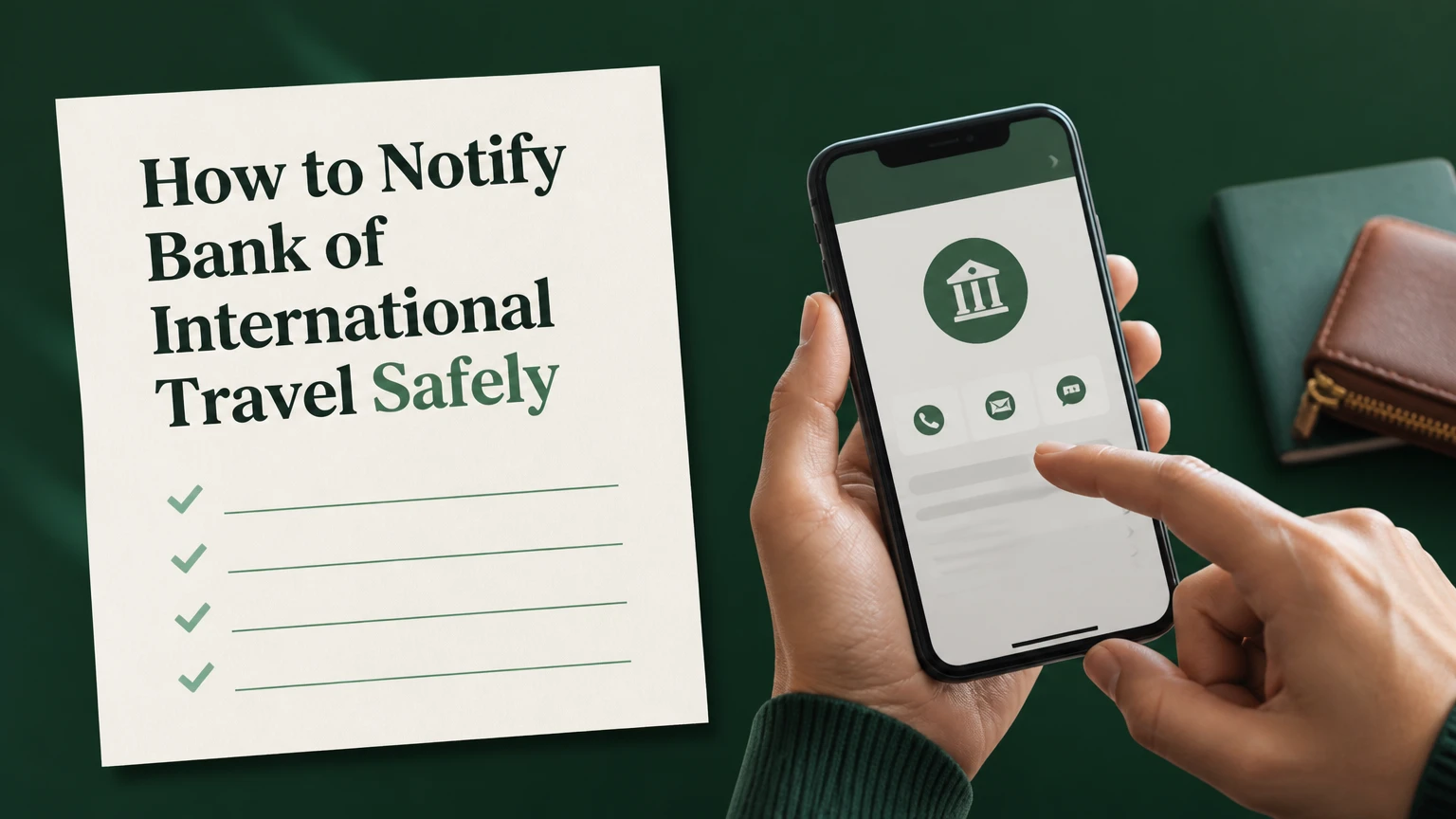
To notify your bank of international travel, use the mobile app or online banking portal to select the card, destination countries, and travel dates, then submit the notice. If no travel-notice option appears, call the international support number on the card. Check every issuer’s policy because some banks no longer require notices, while others still recommend them for debit cards.
Key Facts / Quick Answer
A travel notice is usually free and can often be submitted in 2-5 minutes.
App or website notices are commonly active immediately, while phone requests may take up to 24 hours.
List every country where you will use the card, including countries visited during a layover or cruise stop.
A travel notice does not waive foreign transaction fees, ATM charges, merchant deposits, or declined transactions.
Carry two cards from different networks, keep them separately, and test both before departure.
Never give a caller your one-time verification code, full online-banking password, or card PIN.
What Is a Bank Travel Notice?
A bank travel notice is a temporary account instruction that tells a financial institution a specific cardholder expects transactions from named countries during stated dates. The notice helps the issuer interpret foreign activity alongside its fraud models, but it does not pre-authorize every purchase or guarantee approval.
Banks do not treat geography as a complete identity check. A transaction in another country may be evaluated using the merchant category, purchase amount, device data, card-present status, previous spending patterns, and whether the physical card was used.


A travel notice is also not the same as telling a bank that you are moving abroad. A vacation notice normally has a start date, an end date, and a limited country list. A relocation may require a new address, tax information, residency documentation, or a different account agreement.
How Travel Notices Affect Fraud Detection
A travel notice gives the issuer additional context for foreign card activity. It can reduce a location-based warning, but automated systems may still decline a purchase when the transaction has other risk indicators, such as an unusual amount, repeated attempts, a counterfeit-card signal, or an incompatible merchant location.
Visa explains that issuers use multiple data points in authorization decisions, including transaction details and issuer risk controls. The practical implication is simple: a notice improves context, not certainty.
Merchant location can also differ from your physical location. An online purchase made in Spain may be processed by a company in Ireland, while a hotel in France may use a payment processor located elsewhere. That mismatch can produce a decline even when the trip notice is accurate.
How to Notify Your Bank Before an International Trip
The fastest method is usually the card issuer’s mobile app. Online banking and telephone support are reliable alternatives when the digital option is missing or the trip involves unusual circumstances.
1. Submit the Notice in the Mobile App
Use this sequence when the issuer supports travel notifications:
- Open the official banking app and sign in before leaving home.
- Select Cards, Card Services, Manage Card, or a similar menu.
- Choose the exact debit or credit card you will use.
- Select Travel Notice, Travel Plans, or Set Travel Dates.
- Enter the departure date, return date, and every destination country.
- Add a cruise itinerary or transit country if the app provides that field.
- Review the selected card and submit the request.
- Save the confirmation screen or reference number.
The menu names vary by issuer, and some apps have removed travel notices entirely. If the feature is absent, do not assume the bank has recorded a notice. Check the issuer’s help center or call the number printed on the card.
2. Use Online Banking
The website often exposes settings that are difficult to find in the phone app. After signing in, look under Profile, Security, Card Management, Services, or Account Alerts.
Select each card separately unless the bank clearly states that the notice applies to all eligible cards. A notice attached to a Bank of America Visa card may not automatically cover a co-branded Mastercard, business card, or card issued by a separate partner bank.
3. Call the Card Issuer
Call the customer-service number on the back of the card, not a number supplied in an unsolicited text message or email. Ask the representative to confirm whether a travel notice is required, recommended, or unavailable for that card.
Have these details ready:
- Card name and last four digits
- Departure and return dates
- Countries and territories you expect to visit
- Expected ATM use
- International phone number or email for alerts
- Whether another authorized user will use the account
A manual request often takes several minutes and may be active immediately or within 24 hours. Toll-free United States numbers may not work overseas, so record the issuer’s international number before departure.
4. Visit a Branch for Complex Accounts
A branch visit can help with linked checking accounts, business cards, foreign-currency accounts, unusually long travel, or account restrictions. Branch employees may not control card authorization directly, so confirm that the request was sent to the card issuer rather than merely noted in your customer profile.
| Notification method | Typical time | Typical cost | Best use |
|---|---|---|---|
| Mobile app | 2-5 minutes | USD 0 | Standard vacation with several destinations |
| Online banking | 3-10 minutes | USD 0 | Multiple cards or hard-to-find settings |
| Phone support | 5-30 minutes | Usually USD 0, carrier charges possible | Missing app option or long trip |
| Branch appointment | 20-60 minutes | Usually USD 0 | Complex account or identity issue |
What Information Should You Include?
A useful travel notice identifies the card, dates, and places where legitimate activity is likely. Enter the actual countries where transactions can occur, not only the country where you will spend most nights.
Include:
- Final destinations
- Airport layover countries if you will buy food or services there
- Cruise ports and countries visited by ship
- Separate dates for multiple travel periods
- Expected ATM withdrawals
- A return date that includes the day you arrive home
Do not place sensitive credentials in a free-text travel field. A bank will not need your online-banking password, full debit-card PIN, one-time authentication code, or complete Social Security number to record a travel plan.
| Trip detail | Example entry | Why it matters |
|---|---|---|
| Main destination | Italy, May 10-22 | Matches hotel, restaurant, and transport activity |
| Flight connection | Qatar, May 10 | Covers an airport purchase during the connection |
| Cruise stop | Greece, May 16 | Accounts for port transactions |
| ATM use | Spain, up to EUR 300 equivalent | Prepares support staff for cash withdrawals |
| Return date | May 23, not May 22 | Covers late purchases and travel delays |
Expert Insight: Include the Card’s Processing Countries
A country list cannot predict every payment processor. Online merchants, hotel booking platforms, and rental-car companies may process charges in a different country from the service location. Keep transaction alerts enabled and tell the issuer about expected large bookings before travel, because a hotel deposit can look more suspicious than several small meals.
Do Major Banks Require Travel Notifications?
Major issuers have different policies, and the requirement can vary between credit cards, debit cards, business cards, and regional products. Chase, Capital One, and American Express commonly state that customers do not need to submit traditional travel notices for many cards, but their fraud systems can still decline unusual transactions.
Bank of America, Wells Fargo, and Citibank may offer travel-related card controls or recommend updating travel information, particularly for debit cards and ATM use. Local credit unions may rely more heavily on travel notices or geographic controls. Confirm the current rule for the specific card before departure.
| Issuer or card type | Typical current approach | Practical action | Important limitation |
|---|---|---|---|
| Chase credit card | Often no notice required | Enable alerts and verify contact details | Declines can still occur |
| Capital One card | Often no notice required | Check foreign transaction fee for the product | Card benefits differ by account |
| American Express card | Often no notice required | Keep the app and contact details current | Acceptance varies by country |
| Bank of America card | Notice may be optional or recommended | Check each card in Card Settings | Debit and credit policies can differ |
| Wells Fargo card | Notice may be optional or recommended | Review card controls before travel | Individual card selection may apply |
| Citibank card | Policy varies by product and region | Confirm with the issuer before departure | ATM and fee rules require separate checking |
| Local credit union card | Notice may be required | Call at least 24 hours ahead | Limited overseas support is possible |
Policies change as issuers update fraud systems. A statement that a bank never requires notices should not override the instructions displayed in your account or given by the number on the card.
How Much Does International Card Use Cost?
Submitting a travel notice generally costs USD 0. The trip itself can create foreign transaction fees, currency-conversion costs, ATM charges, cash-advance fees, and temporary merchant holds.
Foreign transaction fees are commonly 1%-3% of the purchase amount when the card does not waive them. Foreign ATM withdrawals may combine an issuer fee, an ATM-owner fee, a network fee, and the card’s foreign exchange charge. These are typical ranges, not universal prices.
| Charge | Typical amount | When it applies | How to reduce it |
|---|---|---|---|
| Travel notice | USD 0 | Usually never charged | Use official app or phone number |
| Foreign transaction fee | 1%-3% | Eligible purchases abroad | Use a card with a 0% fee |
| Foreign ATM issuer fee | USD 0-5 | Cash withdrawal | Use a fee-friendly account |
| Local ATM-owner fee | USD 0-10 | Out-of-network withdrawal | Review the ATM screen before approval |
| Dynamic currency conversion | Often 3%-12% embedded in rate | Merchant or ATM converts to USD | Choose local currency |
| Credit-card cash advance | Fee plus interest from transaction date | Credit card used for cash | Use debit or planned cash instead |
Dynamic currency conversion is a frequent hidden cost. If a terminal asks whether to pay in USD or the local currency, choosing USD may allow the merchant or ATM operator to set the exchange rate. Paying in the local currency usually lets the card network and issuer determine the conversion, although your issuer’s own fee still applies.
The Consumer Financial Protection Bureau advises consumers to check their card agreement for foreign transaction fees and currency-conversion terms. The Federal Trade Commission states, “The law limits your responsibility for unauthorized credit card charges to $50,” but debit-card protections and reporting deadlines operate differently, so prompt reporting remains important.
Which Cards Should You Take Abroad?
A credit card is usually better for hotels, rental cars, and disputes because it does not immediately remove money from a checking account. A debit card remains useful for cash withdrawals, but unauthorized debit activity can restrict access to funds while the bank investigates.
Prepaid and multi-currency products can limit the balance exposed to theft, yet they may have loading, conversion, inactivity, ATM, or weekend pricing charges. Cash works where electronic payments fail, but loss is usually irreversible.
| Payment option | Main strength | Main risk | Sensible travel role |
|---|---|---|---|
| Credit card | Dispute process and merchant-deposit capacity | Interest and foreign fees | Primary purchases |
| Debit card | Direct ATM access and cash withdrawal | Checking-account exposure | Controlled cash access |
| Prepaid card | Limited stored balance | Fees and weaker recovery options | Spending cap or backup |
| Mobile wallet | Tokenized device payment | Battery, device, or acceptance failure | Convenient secondary method |
| Local cash | Works during network outages | Theft and poor exchange rates | Small emergency reserve |
Use at least two cards from different payment networks, such as Visa and Mastercard, and keep them in separate places. A replacement card, network outage, merchant acceptance gap, or fraud block can make one-card travel impractical.
Expert Insight: Test the Backup Card
A backup card that has never been used may trigger an authentication block when first presented overseas. Make a small purchase with it before leaving, confirm its PIN if relevant, and verify that the issuer has your current phone number and email address.
What Should You Do Before Departure?
Travel preparation should happen in stages because some controls require access to your home phone, a physical card, or a bank employee.
- Check the expiration date on every card, including cards expiring during the trip.
- Confirm the foreign transaction fee and ATM reimbursement terms for each product.
- Add the cards to Apple Pay or Google Wallet while still at home.
- Sign in to the banking app and confirm that two-factor authentication works.
- Record the international support number and card-network emergency number.
- Submit the travel notice when required or recommended.
- Review daily purchase, ATM, and contactless limits.
- Notify the issuer about unusually large hotel, rental-car, or airline transactions.
- Carry a small amount of local currency from a reputable exchange source.
- Store cards, cash, and identity documents separately.
| Preparation item | Recommended timing | Typical target | Consequence of skipping it |
|---|---|---|---|
| Install and sign into app | 3-7 days before | Successful login at home | Locked account overseas |
| Check card expiry | 7-30 days before | Valid through return date | Emergency replacement abroad |
| Submit travel notice | 1-14 days before | Confirmation saved | Location-related decline |
| Test backup card | 2-7 days before | One successful purchase | Unusable emergency card |
| Save support number | 1-7 days before | International number recorded | Delayed fraud resolution |
| Review limits and fees | 1-14 days before | Known USD and local limits | Unexpected decline or cost |
What If Your Card Is Declined Abroad?
A declined international transaction does not prove that the travel notice failed. The decline may result from an incorrect PIN, an offline terminal, a merchant category restriction, an exceeded limit, insufficient available credit, a hotel authorization hold, or a network outage.
Use this sequence:
- Stop repeated attempts, because several rapid retries can increase the fraud score.
- Check the banking app for a fraud alert, lock, or verification request.
- Confirm that the card is unlocked and the account has available funds or credit.
- Try chip insertion instead of contactless payment.
- Ask the merchant to process the charge in local currency.
- Try a different terminal or reputable merchant.
- Call the issuer using the saved international number.
- Ask whether the decline involves fraud, the merchant category, a daily limit, or insufficient available credit.
- Use the backup card only after confirming that the first card is secure.
Hotels and rental-car agencies often place authorization holds. A USD 400 room may temporarily reserve USD 600 or more when taxes, incidentals, or vehicle deposits are included. Debit cards are particularly vulnerable to these holds because the reserved amount reduces immediately available checking-account funds.
Special Situations That Need Extra Planning
Certain trips do not fit a simple home-country-to-destination pattern. Add context before departure and keep a larger payment reserve.
Cruises and Ships
A cruise terminal may process purchases through the ship’s country of registration or through a port merchant. Cellular connectivity can be intermittent, and shipboard terminals may store transactions for later authorization. Carry a backup payment method and do not rely on real-time app alerts at sea.
Long Stays and Remote Work
A 90-day notice limit is common in some systems, but not universal. Contact the issuer for stays beyond the app’s maximum dates, especially when recurring subscriptions, payroll deposits, or business purchases will continue from the home country.
Layovers and Transit Airports
A coffee purchase in a connecting country creates a real transaction there. Include the country when the itinerary involves a long connection, checked-bag purchase, lounge fee, hotel night, or airport transfer.
Mobile Wallets
A mobile wallet uses a device-specific payment token rather than exposing the physical card number to the merchant. The issuer still authorizes the underlying account, so adding a card to Apple Pay does not bypass travel controls, spending limits, or foreign transaction fees.
Lost or Stolen Cards
Lock the card in the banking app immediately, then call the issuer. Ask about emergency cash, replacement delivery, digital-card access, and whether the replacement number will preserve recurring payments. Keep a written record of the report time and case number.
What a Travel Notice Cannot Do
A travel notice cannot guarantee approval, remove fees, increase available credit, or protect cash after a debit-card compromise. It also cannot correct an expired card, an unpaid balance, a blocked merchant category, an incorrect billing address, or a damaged magnetic stripe.
The notice does not replace basic account security. Use transaction alerts, avoid public Wi-Fi for banking when possible, inspect ATMs for tampering, shield the PIN, and decline suspicious card-reader instructions.
The most important limitation is issuer scope. A notice applies only to the account or card selected, and it may not cover authorized users, replacement cards, business accounts, or cards issued by another institution.
Frequently Asked Questions About how to notify bank of international travel
Do I need to notify my bank if I use Apple Pay abroad?
A mobile wallet does not automatically eliminate the need to check the issuer’s travel policy. The wallet token still connects to the underlying credit or debit account, so foreign transaction fees, fraud screening, card locks, and spending limits remain applicable. Enable the wallet at home and carry a physical backup card.
Should I notify the bank about a foreign ATM withdrawal?
Notify the issuer when its policy requires or recommends travel information for ATM use. Debit-card withdrawals can trigger geographic fraud controls even when retail purchases succeed. Confirm the daily withdrawal limit, issuer fee, local ATM fee, and whether the account reimburses any charges before relying on cash abroad.
Can I use a travel notice for a trip longer than 90 days?
Some banking systems limit online travel notices to approximately 90 days, while others accept longer dates. Call the issuer for an extended stay rather than entering inaccurate dates. Ask how recurring domestic transactions, replacement cards, and periodic fraud reviews will be handled during the longer trip.
What happens if I forget to file a travel notice?
The issuer may approve the transaction, request verification, or decline it based on its fraud controls. A missing notice does not automatically freeze every card. Use the banking app or call the number on the card, verify the transaction, and avoid repeated attempts until the issuer explains the decline.
Should I notify the bank about every country on a multi-country trip?
Yes, list every country where you may make a purchase or ATM withdrawal, including likely layover and cruise-port countries. A country omitted from the notice can create a location mismatch. Also remember that an online merchant’s processing country may differ from the country where its service is delivered.
Is it safer to use a credit card or debit card overseas?
A credit card generally limits direct access to checking funds and is useful for hotel deposits, rental cars, and disputed purchases. A debit card is practical for controlled ATM withdrawals but exposes available cash. Travelers should carry both, use account alerts, and keep the cards physically separate.
Conclusion
To notify your bank of international travel, submit the card-specific trip dates and destination countries in the official app or website, or call the number on the card when no digital option exists. Confirm foreign transaction fees, ATM limits, authentication access, and issuer policy before departure. A travel notice improves fraud context, but two tested cards, local-currency payment, alerts, and a documented emergency contact plan provide stronger protection.