How to keep money safe while traveling means separating spending funds, backup access, and emergency reserves across different locations and payment systems. A reliable plan combines a low-balance daily wallet, concealed backup funds, protected account credentials, and enough local cash to operate for 24-72 hours after theft, loss, a declined card, or an outage.
Key Facts / Quick Answer
Carry one primary credit card and daily cash, while storing a separate backup card and emergency cash elsewhere.
Use credit for purchases and deposits when possible. Debit transactions draw directly from checking funds and can create larger recovery problems.
Choose the local currency at terminals and ATMs. Dynamic currency conversion commonly adds a typical 5%-12% markup.
Keep two payment networks if practical, such as Visa and Mastercard, because acceptance and outages vary by country and merchant.
Enable transaction alerts, card-freeze controls, multifactor authentication, and offline bank contact details before departure.
Test the entire plan by leaving one card at home and confirming that the remaining funds cover at least 72 hours.
How to Keep Money Safe While Traveling
The safest travel-money arrangement is a compartmentalized system, not a single wallet or card. Divide accessible funds among a daily payment layer, a concealed backup layer, and a protected reserve so one theft, loss, or account lockout does not remove every way to pay.
A practical traveler carries only the money needed for the day. A second card stays physically separate from the first, while emergency cash and a third access method remain in secure storage. The locations must also be independent. Two cards in the same purse are one point of failure.


Travel money security covers four risks:
- Theft: someone physically takes cash, cards, or a phone.
- Loss: belongings disappear without a known offender.
- Fraud: card credentials or account information are copied.
- Access failure: a bank blocks a transaction, a network fails, or a phone becomes unusable.
The right allocation depends on destination, trip length, and lodging. A weekend in Singapore has different cash needs from a three-week rural trip through Morocco, but both require redundancy.
What Should Each Layer Contain?
The daily layer should contain one primary credit card, a small debit or cash amount if needed, and approximately one day of local spending. The concealed layer should contain a separate card and enough cash for transportation, food, and one night of lodging. The protected reserve should contain a third payment method, emergency cash, and written recovery information.
| Layer | Typical contents | Suggested access | Main purpose |
|---|---|---|---|
| Daily wallet | 1 credit card, USD 20-80 equivalent, transit card | Front pocket or closed bag | Purchases for 12-24 hours |
| Concealed backup | 1 different-network card, USD 50-150 equivalent | Under-clothing pouch or secure inner compartment | Continued access after wallet theft |
| Secure reserve | Third card, USD 100-300 equivalent, recovery numbers | Hotel safe or locked luggage | 24-72-hour emergency continuity |
| Online reserve | Bank and card accounts with alerts and freeze controls | Authenticated device plus backup method | Remote payment and fraud response |
These figures are typical starting points, not universal requirements. Increase cash for rural transport, border crossings, small guesthouses, or destinations where cards frequently fail. Decrease visible cash in places where pickpocketing is common.
Expert insight: A hotel safe is useful but not invulnerable. Housekeeping access, forgotten belongings, and poorly anchored safes create residual risk, so the reserve should be divided when the trip or destination warrants it.
Which Payment Methods Should You Carry?
A travel payment portfolio should include at least two independent payment methods and a modest amount of local currency. Credit cards usually offer the best purchase-fraud position, mobile wallets reduce exposed card numbers, and cash remains essential when power, connectivity, or merchant infrastructure fails.
Credit Cards for Purchases and Deposits
Credit cards are generally preferable for retail transactions because unauthorized charges do not immediately remove money from a checking account. Many cards offer zero foreign transaction fees, but the benefit depends on the issuer and product terms, not merely the Visa, Mastercard, or American Express network.
Use a credit card for hotels, rental cars, and large purchases when the merchant accepts it. Deposit holds can still reduce available credit. A hotel authorization might remain pending for several days, and rental companies may require a larger hold than the final charge.
Before departure, verify:
- Foreign transaction fee, commonly 0% to 3%.
- Cash-advance fee and interest rate.
- Available credit after expected hotel and rental holds.
- Card-network acceptance in the destination.
- Emergency replacement and emergency cash policies.
- Whether travel insurance has exclusions for unattended belongings.
Debit Cards for Cash Withdrawals
A debit card is valuable for ATM access, but it is a poor default for hotel deposits and everyday purchases. A fraudulent debit transaction can reduce the checking balance immediately, and recovery may take longer than a credit-card dispute.
Use a travel-specific checking account when possible. Keep only the expected withdrawal amount plus a modest buffer in that account, and avoid linking it to the account that holds rent, payroll, or emergency savings.
Multicurrency Accounts and Prepaid Cards
Multicurrency services such as Wise and Revolut can hold balances in several currencies and display conversion costs before an exchange. They can reduce uncertainty, but their exchange rate, weekend markup, ATM allowance, card-delivery policy, and country availability vary by account type.
Prepaid cards limit exposure to the loaded balance. That limit is also their weakness. A frozen account, unsupported merchant category, verification request, or insufficient balance may leave the traveler unable to pay even when money exists elsewhere.
| Method | Typical cost | Fraud or loss exposure | Best use | Important limitation |
|---|---|---|---|---|
| No-FX-fee credit card | 0% foreign transaction fee; interest varies | Issuer dispute process; card can be frozen | Hotels, restaurants, retail | Requires available credit and acceptance |
| Standard credit card | 1%-3% foreign transaction fee | Issuer dispute process | Backup purchases | Conversion cost compounds across purchases |
| Debit card at ATM | USD 2-10 operator fee; 1%-2% issuer markup is typical | Checking balance exposed | Controlled cash withdrawals | Holds and fraud affect actual bank funds |
| Multicurrency card | Interbank or provider rate plus fixed fee | Loaded balance and account access exposed | Planned currency spending | Limits, verification, or weekend pricing may apply |
| Physical cash | Exchange spread commonly 3%-10% at poor counters | Theft is usually unrecoverable | Small merchants and outages | Cannot be frozen or replaced remotely |
| Mobile wallet | Underlying card fee; often 0% tokenization fee | Device authentication and issuer controls | Contactless purchases | Requires charged, supported device and terminal |
How Do Fees and Currency Choices Affect Safety?
The cheapest payment method is not always the safest, and the safest method can become expensive when a traveler accepts poor currency conversion. Compare the full transaction cost, including issuer fees, ATM charges, exchange-rate spreads, and temporary holds.
Dynamic currency conversion, or DCC, occurs when a merchant or ATM offers to charge your home currency instead of the local currency. The displayed home-currency amount may look convenient, but the merchant or ATM operator controls the conversion rate. A typical DCC markup is 5%-12%, although the exact amount varies.
Select local currency at the terminal. If a cashier asks, “USD or local currency?” say, “Local currency, please.” A USD charge is not automatically safer or more transparent.
A Simple Cost Example
Suppose a traveler spends the equivalent of USD 500 abroad. A card with a 3% foreign transaction fee adds USD 15 before any exchange-rate difference. A DCC conversion at a typical 8% markup adds about USD 40. An ATM withdrawal with a USD 5 operator fee and a 1.5% issuer markup costs about USD 12.50 on a USD 500 withdrawal.
| Transaction choice | Assumed rate or fee | Cost on USD 500 equivalent | Better decision |
|---|---|---|---|
| No-FX credit card, local currency | 0% FX fee | USD 0 issuer fee | Preferred for purchases |
| Standard credit card, local currency | 3% FX fee | USD 15 | Use only if alternatives are unavailable |
| ATM, local currency | USD 5 fee plus 1.5% markup | USD 12.50 | Withdraw less often, from a bank ATM |
| Merchant DCC | 8% typical markup | USD 40 | Decline and choose local currency |
| Airport exchange counter | 8%-15% spread is typical | USD 40-75 | Use only for a small arrival amount |
| Independent exchange counter | 3%-10% spread is typical | USD 15-50 | Compare the posted buy and sell rates |
The ATM screen can combine several costs. Read the final amount, decline conversion if offered, and cancel if the fee appears excessive. A bank-owned ATM inside a branch is generally easier to identify and report than an isolated machine in a nightlife district.
Expert insight: ATM fee minimization should not become a safety failure. Withdrawing USD 500 equivalent to avoid four small fees creates a larger theft loss and may breach local cash-declaration rules. A moderate withdrawal from a controlled location is usually the better trade-off.
How Should You Prepare Before Departure?
Travel money protection begins before the airport because many recovery options depend on settings, contact details, and spare access configured at home. Complete the following sequence at least 48 hours before departure, then keep the records offline.
- Check every card’s foreign transaction, cash-advance, replacement, and emergency-service terms.
- Confirm the destination supports each card network and mobile-wallet service.
- Notify the issuer if it uses travel notices or verify that its app has location controls.
- Set push or SMS alerts for every purchase, withdrawal, transfer, and login.
- Lower ATM withdrawal limits and online purchase limits where the bank permits it.
- Create a travel-only spending account with a controlled balance.
- Add cards to Apple Pay or Google Pay, then test one contactless payment.
- Record international bank numbers, card numbers, policy numbers, and account instructions offline.
- Photograph documents for encrypted storage, but do not leave unprotected card numbers in a general photo folder.
- Tell a trusted person how to contact you and which institutions must be called after an incident.
A travel notice can reduce false declines, but it does not guarantee approval. Fraud systems also assess transaction location, merchant type, purchase velocity, device identity, and unusual cash withdrawals.
Keep one payment method at home. That card cannot help with a lost wallet during the trip unless the issuer can deliver a replacement, but it provides a separate account path after a larger compromise.
How Can You Protect Cards, Cash, and a Phone?
Physical placement should make opportunistic theft difficult without making emergency access impossible. Carry the daily wallet in a front or zipped pocket, keep straps closed in crowded areas, and avoid displaying a large cash roll at a counter.
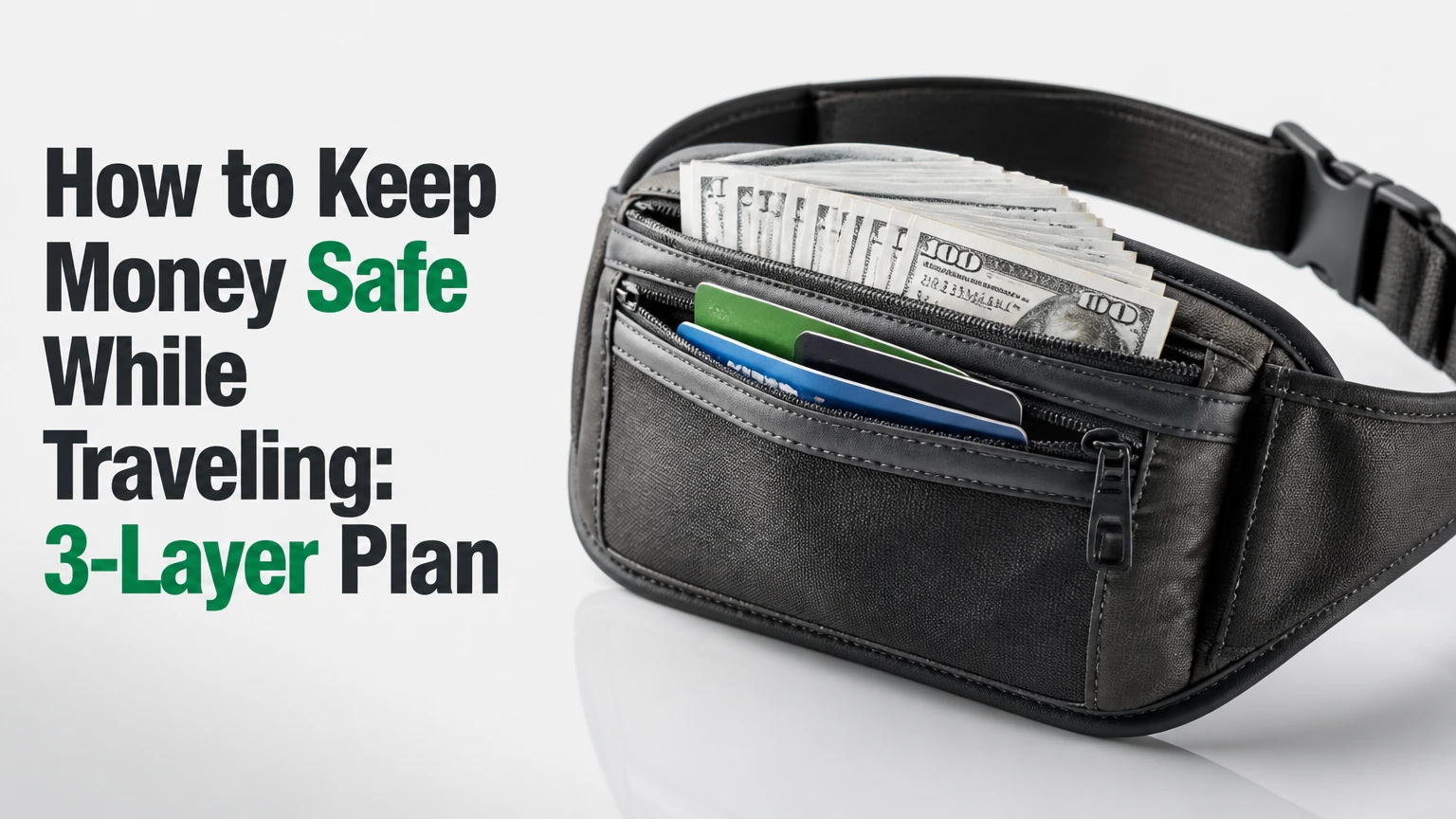
A concealed money belt or neck pouch works best for backup resources that do not need frequent access. Repeatedly opening it in public defeats the concealment. A dummy wallet may reduce pressure during a robbery, but it should never encourage resistance or create a dangerous confrontation.
Cash should be divided by function:
- Arrival cash for transport and the first meal.
- Daily cash for ordinary purchases and tips.
- Emergency cash for lodging, transport, or communications after card failure.
- Reserve cash kept away from the daily wallet.
Do not mark the emergency reserve with an obvious label. Store it in a sealed envelope or another ordinary-looking container, and check local rules before carrying large amounts across a border.
A phone is a financial credential, not merely a communication device. Use a strong passcode rather than a short personal identification number, enable biometric unlocking, activate Find My iPhone or Find My Device, and keep remote-lock and erase capabilities enabled.
| Control | Configuration | Failure it reduces | Typical setup time |
|---|---|---|---|
| Transaction alerts | Every card purchase, ATM event, and transfer | Delayed fraud detection | 5-10 minutes |
| Device lock | Six-digit or longer passcode plus biometrics | Wallet and banking access after phone theft | 3-5 minutes |
| Remote location | Apple Find My or Google Find My Device | Unrecoverable device loss | 5 minutes |
| Authentication backup | Authenticator backup codes stored offline | Account lockout after SIM or phone loss | 10-20 minutes |
| Card freeze | Issuer app control tested before departure | Continued charges after loss | 2-5 minutes |
| Offline contacts | International and collect-call numbers written down | No-internet recovery failure | 10 minutes |
Public Wi-Fi is not automatically unsafe, and a VPN does not make every banking session secure. The stronger controls are HTTPS, updated devices, multifactor authentication, app-based access, and avoiding sensitive transactions on unknown networks or shared computers.
Security technologist Bruce Schneier wrote, “Security is a process, not a product.” The travel implication is practical: a wallet, VPN, or hotel safe cannot compensate for weak account recovery and delayed monitoring.
Where Should You Carry Money by Destination?
Destination conditions determine the balance between cash and electronic payments. Urban areas with widespread contactless acceptance support a smaller daily cash amount, while rural regions, transport hubs, markets, and power-constrained areas require more physical redundancy.
| Destination condition | Daily cash starting point | Cards to carry | Extra preparation |
|---|---|---|---|
| Major urban center | USD 20-60 equivalent | 2 cards on separate networks | Test contactless and transit payment |
| Cash-heavy town | USD 50-120 equivalent | 2 cards plus debit ATM card | Identify bank ATMs before arrival |
| Rural or remote route | USD 100-250 equivalent | 2 cards plus emergency reserve | Carry offline directions and lodging details |
| Border crossing itinerary | USD 50-150 in permitted currency | 2 cards and small notes | Check declaration and currency rules |
| High-pickpocket transit route | USD 20-50 in daily wallet | Backup concealed separately | Avoid opening reserve in public |
| Disaster or outage risk area | USD 100-300 equivalent | 3 access methods | Keep funds for 72 hours and charge devices |
These are planning ranges in USD equivalents, not recommendations to carry a fixed amount everywhere. Local regulations can restrict cash export, import, or reporting thresholds, and some merchants refuse damaged, large-denomination, or unfamiliar notes.
Before arrival, ask the accommodation which nearby ATMs belong to established banks. A destination may have excellent card acceptance in hotels but weak acceptance at taxis, small restaurants, ferries, or local markets.
What Happens If Your Wallet, Card, or Phone Disappears?
A lost payment item requires containment first, investigation second. Freeze the missing card immediately, protect the remaining accounts, and preserve evidence before attempting replacement or recovery.
Use this incident sequence:
- Move to a secure public or staffed location.
- Freeze the missing card and mobile-wallet tokens through the issuer app.
- Lock the phone remotely if the device is missing.
- Review recent transactions and record unauthorized amounts, times, and merchants.
- Call the issuer using the offline number or an official website reached through a trusted device.
- Ask about emergency cash, replacement delivery, temporary digital credentials, and claim documentation.
- Contact the police if theft occurred or an insurer requires a report.
- Tell the accommodation or transport provider if identification, keys, or reservations were also lost.
- Change passwords beginning with email, banking, cloud storage, and mobile-carrier accounts.
- Rebuild the daily layer from the concealed layer and preserve the reserve.
For US-issued cards, federal rules differ by product. Regulation E generally limits consumer liability for an unauthorized electronic fund transfer when reported promptly, with important timing rules for debit-card loss and statement errors. Credit-card protections arise mainly under the Fair Credit Billing Act and issuer policies. The common two-day and 60-day figures are not a universal guarantee, so report immediately and follow the issuer’s written process.
Request a case number, replacement timeline, and written confirmation. Standard replacement can take 7-14 business days, while premium issuers may arrange emergency delivery in approximately 24-72 hours, depending on country, courier access, identity verification, and the card product.
Expert insight: The first unauthorized transaction is not always the first compromise. A small test charge can precede a larger purchase, so alerts should cover low-value transactions rather than only large payments.
Which Mistakes Create the Greatest Exposure?
The most damaging travel-money mistakes combine concentration with delayed detection. A traveler who carries every card, all cash, and the only phone in one bag can lose the entire financial system in one incident.
Avoid these patterns:
- Keeping the primary card, backup card, passport, and complete cash supply together.
- Using a debit card for hotel or rental-car deposits when a credit card is available.
- Accepting DCC because the home-currency amount looks familiar.
- Withdrawing from an isolated ATM without inspecting the card slot or keypad.
- Leaving cards stored in an unlocked phone case or exterior backpack pocket.
- Saving passwords, card images, and recovery codes in an unencrypted note.
- Assuming a travel notice prevents every fraud decline.
- Relying on a hotel safe without a backup location or written recovery plan.
- Carrying only one card network in a country where acceptance is uneven.
- Waiting until the next statement to inspect foreign transactions.
ATM skimming equipment can be difficult to identify visually, so favor machines attached to banks, inspect the reader for looseness, cover the keypad, and refuse assistance from strangers. If the machine retains a card, contact the bank through its official number rather than accepting a replacement card offered nearby.
A dummy wallet can be a useful de-escalation tool, but it is not a security guarantee. Never display it as a challenge, and comply with an immediate threat rather than protecting cash or cards.
How Much Money Should You Carry?
Carry enough accessible cash for one day, then place separate reserves according to the destination’s cash dependence and your ability to reach an ATM. A useful baseline is the cost of transportation, food, communication, and one night of basic lodging, plus a small margin.
For example, a traveler arriving late in a cash-heavy city might carry USD 60 equivalent in the daily layer, USD 120 concealed, and USD 200 in a secure reserve. A contactless urban trip might require USD 30, USD 80, and USD 150 respectively.
Do not convert the entire trip budget into cash. Cash cannot be frozen, disputed, or tracked after theft, and a large amount increases loss severity. Keep the main funds in protected accounts and replenish the daily layer in modest amounts.
A 72-hour resilience test is a strong planning measure. Ask whether you could pay for food, transport, lodging, and communication for three days if every item in your daily wallet vanished and one card issuer became unreachable.
Frequently Asked Questions About how to keep money safe while traveling
Is cash or a card safer when traveling?
A card is generally safer for larger purchases because it can be frozen and disputed, while stolen cash usually cannot be recovered. Cash remains safer operationally when merchants lack terminals, networks fail, or a card is declined. Carry modest local currency for immediate needs and keep the remainder distributed across cards and accounts.
Should I exchange money before leaving the United States?
Exchange a small arrival amount before departure if you will need transport, food, or a local payment immediately. Airport counters often apply typical spreads of 8%-15%, so they are poor locations for a full trip budget. Bank ATMs at the destination commonly provide better rates, subject to card and operator fees.
Can someone use my contactless card if it is stolen?
A thief may attempt contactless transactions, but transaction limits, issuer monitoring, and card controls can reduce the exposure. Mobile wallets add device authentication and tokenization, which means merchants generally receive a payment token rather than the physical card number. Freeze the card immediately and review alerts after loss.
What should I do if an ATM keeps my card?
Cancel the transaction, record the ATM location and time, and contact the owning bank through an official number. Do not surrender your card details to a stranger offering help. Freeze the card if retrieval is uncertain, then use the concealed backup card or request emergency cash from the issuer.
Is a money belt better than a hidden wallet?
A money belt is useful for low-frequency access to backup funds, while a hidden wallet or secure inner pocket can work better for frequent access. Neither protects money from every threat. Keep only backup resources in concealed storage, avoid opening it publicly, and retain a separate reserve elsewhere.
How many cards should I take abroad?
Two cards are a practical minimum for most trips, and three provide stronger resilience for long, remote, or high-cost travel. Store them separately and, when possible, use different networks. Carrying three cards in one wallet provides less protection than carrying two cards in independent locations.
Conclusion
How to keep money safe while traveling is a problem of redundancy, controlled access, and rapid detection. Carry one credit card and modest cash for the day, separate a second card and reserve funds, use local currency at payment terminals, and prepare offline recovery contacts before departure. A distributed 72-hour plan keeps one lost wallet from becoming a financial emergency.