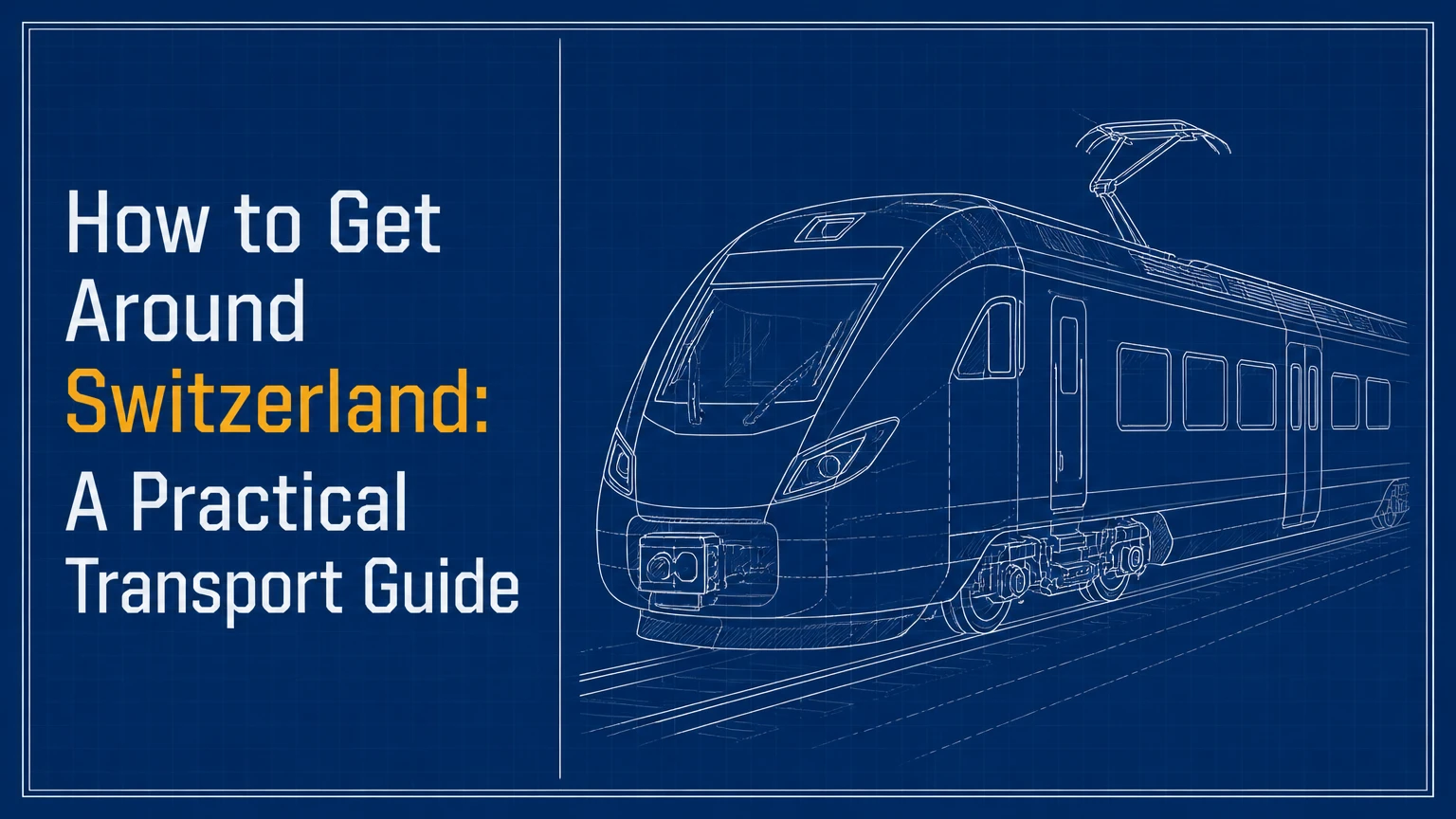
Switzerland is a highly integrated travel network that connects cities, lakes, alpine villages, and mountain stations through trains, buses, boats, trams, and cableways. The Swiss Travel System makes public transport the default choice for most visitors because one timetable coordinates frequent connections, while a car adds parking costs and mountain-road restrictions.
Key Facts / Quick Answer
SBB Mobile plans door-to-door journeys across trains, buses, boats, trams, and many mountain connections.
Major routes generally operate every 30 or 60 minutes, with more frequent urban service.
A rental car is usually unnecessary for Zurich, Lucerne, Bern, Geneva, Interlaken, and Zermatt.
Typical public transport passes cost about 250-900 USD, depending on duration, class, and exchange rate.
The Swiss Travel Pass covers much national transport, but premium mountain railways usually require a supplement.
A 5-10 minute connection is common, but travelers with luggage should choose a longer interchange when possible.
How does Switzerland’s transport network work?
Switzerland’s transport network links long-distance rail, regional buses, urban systems, lake boats, and mountain transport through coordinated timetables. SBB, also called CFF or FFS depending on language region, operates the national railway, while PostBus reaches many places where rail lines do not.
The system uses an integrated timetable rather than one single vehicle operator. A journey from Zurich Airport to Grindelwald may involve an InterCity train, a regional train, and a mountain railway, all found in one SBB itinerary. In practice, the displayed departure time, platform, walking route, and connection margin matter more than the transport company name.


The Swiss Federal Railways timetable is the authoritative source for current departure times, platform changes, disruptions, and ticket conditions. Swiss tourism bodies often describe the country as having one of the densest public transport networks in the world, but density varies sharply: Zurich has frequent service, while a high-alpine valley may have one bus each hour.
Main transport modes
- InterCity and InterRegio trains: Fast links between Zurich, Bern, Basel, Geneva, Lausanne, Lucerne, and major regional hubs.
- RegioExpress and regional trains: Local services with more intermediate stops and access to smaller communities.
- PostBus: Yellow buses connecting rail stations with mountain villages, passes, and rural valleys.
- Trams and city buses: Frequent urban transport in Zurich, Geneva, Basel, Bern, Lausanne, and Lucerne.
- S-Bahn trains: Suburban rail around metropolitan areas and airport corridors.
- Passenger boats: Scheduled services on Lakes Geneva, Lucerne, Thun, Brienz, Zurich, and Constance.
- Funiculars, cable cars, and mountain railways: Paid uplifts to destinations such as Gornergrat, Pilatus, Titlis, and Jungfraujoch.
What do the train categories mean?
The category predicts stopping pattern, not necessarily comfort. An InterCity train usually makes fewer stops than a regional train, but both can be clean, punctual, and reservable through the same booking system.
| Service | Typical role | Typical frequency | Example corridor |
|---|---|---|---|
| InterCity, IC | National city connection | Every 30 minutes | Zurich-Bern-Geneva |
| InterRegio, IR | Regional express | Every 30-60 minutes | Lucerne-Interlaken |
| RegioExpress, RE | Regional fast service | Every 30-60 minutes | Montreux-Sion-Brig |
| Regional, R | Short local route | Every 30-60 minutes | Interlaken-Lauterbrunnen |
| S-Bahn | Suburban commuting | Every 10-30 minutes | Zurich Airport-Zurich |
How should you plan a journey with SBB Mobile?
SBB Mobile is the practical control center for Swiss travel because it combines route search, live disruption information, tickets, platform details, and many local transport options. Search the complete journey from origin to final destination instead of booking each train separately, especially when a bus or mountain railway follows the main rail trip.
Use the official SBB timetable shortly before departure and again on the travel day. The itinerary may change because of engineering work, weather, a platform alteration, or a bus replacement service. SBB’s door-to-door search can include walking segments, but travelers should still verify the final cable-car station and the operating hours of privately run lifts.
- Enter the exact starting point, such as “Zurich Airport” rather than “Zurich.”
- Enter the final destination, including the village or mountain station.
- Set the date and a departure or arrival preference.
- Compare standard, supersaver, and day-pass options before paying.
- Check whether the ticket is tied to a specific train.
- Save the ticket offline and record the train number and platform.
- Recheck service alerts before leaving the hotel.
EasyRide can calculate a fare when the traveler checks in before boarding and checks out after the final ride, where the service and local network support it. It is convenient for flexible days, but a prebooked supersaver ticket or a pass can cost less. Do not activate EasyRide while already on a vehicle.
How reliable are Swiss connections?
Swiss rail connections are designed around clock-face scheduling, with many major routes repeating at the same minutes each hour. A published 5-10 minute interchange can work when trains use adjacent platforms, but it becomes risky with large bags, children, mobility limitations, or a platform change.
The Federal Statistical Office and SBB publish performance data, but punctuality definitions vary by threshold and service type. A train arriving within a few minutes may count as punctual under one measurement and late under another. Travelers should treat the timetable as dependable, not invulnerable.
Expert insight: A short connection is often safer at a major Swiss station than an apparently generous connection at a small mountain stop. Large stations provide clear platform signage and frequent alternatives, while a missed rural bus may create a one-hour or two-hour wait.
Which transport option fits each Swiss itinerary?
Public transport is best for rail-connected cities, scenic corridors, and car-free mountain resorts. A rental car becomes more useful when the itinerary concentrates on small villages, remote farm stays, multiple rural stops, or luggage-heavy travel outside the main timetable.
| Trip pattern | Best primary mode | Typical journey example | Main limitation |
|---|---|---|---|
| Airport to major city | Train | Zurich Airport-Zurich, 10-15 minutes | Busy commuter periods |
| City-to-city route | InterCity train | Zurich-Bern, about 55-60 minutes | Ticket price without a pass |
| Alpine resort | Train plus bus or lift | Zurich-Zermatt, about 3.5-4 hours | Multiple transfers |
| Lake district | Train plus boat | Lucerne to Weggis, about 45-60 minutes | Seasonal boat schedule |
| Remote rural loop | Rental car or PostBus | Ticino valley villages | Parking or infrequent buses |
| Winter mountain route | Train plus lift | Interlaken-Jungfrau region | Snow and lift closures |
When is renting a car worthwhile?
Rent a car when the route requires repeated stops beyond rail stations and the value of flexibility exceeds parking, fuel, toll, and rental charges. Typical compact-car rental costs range from 60-150 USD per day before fuel and insurance, while hotel parking commonly adds 20-50 USD per night in popular destinations.
A car is poorly matched to Zermatt, Mürren, Wengen, and parts of Saas-Fee because private vehicles cannot reach the village center or are prohibited entirely. Travelers park in a nearby terminal town and continue by train or cableway. Driving also creates extra work on narrow roads, steep switchbacks, and mountain passes that can close after snowfall.
| Driving factor | Typical public transport result | Typical car result |
|---|---|---|
| Zurich to Lucerne | About 45-50 minutes by train | About 45-60 minutes, parking extra |
| Interlaken to Lauterbrunnen | About 20 minutes by train | About 20 minutes, limited parking |
| Zurich to Zermatt | About 3.5-4 hours by rail | Drive to Täsch, then shuttle train |
| Bern to Gruyères | Train and local connection | Flexible village access |
| Alpine winter pass | Timetable and railway maintenance | Snow chains, closures, congestion |
| Scenic multi-stop route | No driving responsibility | More stops, higher total cost |
Expert insight: Travelers often rent a car to “save time” in the Alps, then lose that advantage finding parking and transferring to a restricted village train. Compare hotel-to-hotel time, not road distance alone.
Which Swiss ticket or travel pass should you buy?
The best fare depends on travel days, route length, mountain excursions, age, and how far ahead the itinerary is fixed. A Swiss Travel Pass favors concentrated sightseeing over consecutive days, while a Swiss Half Fare Card favors longer stays or several expensive mountain and intercity journeys.
Prices change with validity period, class, exchange rates, and seller policy. The figures below are approximate adult prices in USD, using rounded conversions for budgeting rather than a guaranteed checkout price.
| Product | Approximate adult cost | Validity or rule | Best use |
|---|---|---|---|
| Swiss Travel Pass, 3 days | 270-300 USD | Consecutive travel days | Compact city and lake itinerary |
| Swiss Travel Pass, 4 days | 315-350 USD | Consecutive travel days | Four intensive travel days |
| Swiss Travel Pass, 8 days | 480-540 USD | Consecutive travel days | Broad national itinerary |
| Swiss Half Fare Card | 130-150 USD | One month | Several full-price journeys |
| Saver Day Pass | 40-80 USD | One calendar day, advance pricing | Fixed long-distance day |
| Point-to-point ticket | 10-180 USD | Selected route and date rules | One short or flexible journey |
The Swiss Travel Pass generally includes national trains, PostBus routes, scheduled boats, and local city transport in participating areas. It often grants discounts rather than full coverage on mountain railways. The Swiss Half Fare Card reduces eligible fares by roughly half, but the reduction does not automatically apply to every private excursion or promotional product.
Children under age 6 normally travel free when accompanied under the applicable fare rules. Children ages 6-15 may travel free with a parent using a Swiss Family Card linked to an eligible travel product. Confirm the current family conditions at purchase, especially for international journeys and independently traveling teenagers.
How can you calculate the cheaper option?
Add the estimated full fares for each long journey, then include the planned mountain lifts and local transit. Compare that total with the pass price, remembering that a Half Fare Card adds its own purchase cost before reducing eligible fares.
A simple example illustrates the method. Suppose a traveler has six substantial rail days with estimated full fares of 95, 80, 70, 55, 45, and 35 USD, plus two eligible mountain journeys at 75 USD each. The full total is 530 USD. A Half Fare Card costing about 140 USD plus half of 680 USD produces an estimated total of 480 USD, before exclusions and local tickets.
A pass is not automatically cheaper because the headline route is expensive. A day spent walking around one city may produce little transport value, while a single long crossing can make an advance day pass attractive.
Expert insight: The most common budgeting error is counting a mountain excursion as fully covered when the pass only grants a discount. Check the fare detail for each uplift, especially Jungfraujoch, Gornergrat, Titlis, and Pilatus.
What are the best ways to reach Switzerland’s main destinations?
Switzerland’s principal destinations are easiest to compare by their nearest transport hub and final connection. Airport rail stations connect directly to national routes, while alpine resorts usually require a train followed by a regional line, bus, or cableway.
| Destination | Main arrival hub | Typical route from Zurich Airport | Car-free status |
|---|---|---|---|
| Zurich | Zurich main station | 10-15 minutes by train | No |
| Lucerne | Lucerne station | About 1 hour by direct train | No |
| Bern | Bern station | About 1 hour by train | No |
| Interlaken | Interlaken Ost | About 2-2.5 hours by train | No |
| Zermatt | Täsch, then Zermatt | About 3.5-4 hours by rail | Yes |
| Wengen | Lauterbrunnen, then mountain train | About 2.5-3 hours from Zurich | Yes |
| Mürren | Lauterbrunnen or Grütschalp route | About 3-3.5 hours from Zurich | Yes |
| St. Moritz | Chur or Landquart connection | About 3.5-4.5 hours by rail | No |
Zurich, Geneva, Bern, and Lucerne
Zurich Airport has a railway station below the terminal, with frequent trains to Zurich main station and onward InterCity connections. Geneva Airport links directly with Geneva and the western rail corridor. Bern is a central interchange for western and eastern routes, while Lucerne is the practical gateway for Lake Lucerne, Mount Pilatus, and parts of central Switzerland.
City transport usually uses an integrated zone fare rather than a national ticket alone. Hotel guests may receive a local visitor pass in some cities, but inclusions vary by canton and accommodation. Ask before buying a separate tram ticket.
Interlaken, Jungfrau, and the Bernese Oberland
Interlaken Ost is the main transfer point for Grindelwald, Lauterbrunnen, and Jungfrau-region journeys. Interlaken West is convenient for the town center and some lake services, but travelers heading into the mountains commonly need Ost.
The route to Jungfraujoch involves several mountain sections and a premium fare. The Swiss Travel Pass or Half Fare Card may reduce the price, but travelers should reserve a timed seat or departure where required during busy periods. Weather can erase the value of an expensive summit trip, so check visibility before committing to a nonrefundable upgrade.
Zermatt and car-free villages
Zermatt is reached by rail from Täsch because the resort restricts private vehicle access. The Täsch shuttle is frequent, and parking is available near the terminal, but the combined parking and transfer expense can exceed the price of staying on the train from a larger city.
Wengen and Mürren also require mountain connections after reaching the Lauterbrunnen valley. Carrying large luggage through several lifts is inconvenient, so use hotel transfer services or ship bags ahead when available.
Are scenic trains worth the reservation cost?
Scenic trains are worth considering when the reserved panoramic carriage, narration, and large windows are part of the experience, but the underlying route often remains accessible on ordinary regional trains. The Glacier Express and Bernina Express are named products, not the only way to travel through the same landscapes.
| Scenic route | Approximate full travel time | Reservation consideration | Lower-cost alternative |
|---|---|---|---|
| Glacier Express | About 8 hours | Seat reservation usually required | Regional trains with changes |
| Bernina Express | About 4-4.5 hours | Panoramic reservation recommended | Regional trains on the same corridor |
| GoldenPass route | About 5-6 hours by sections | Reservation varies by segment | Standard regional services |
| Gotthard panorama route | About 5-6 hours | Boat and train coordination | Regular rail via the base tunnel |
The local-train alternative usually requires one or more changes and may use ordinary windows instead of panoramic cars. It can provide greater flexibility, easier meal stops, and lower reservation costs. The Bernina corridor between Chur and Tirano is especially suitable for comparing the branded service with regional trains.
Book a reservation when the journey itself is the attraction and the date is fixed. Choose ordinary trains when weather is uncertain, the traveler has a tight onward connection, or the route matters more than the carriage branding.
What happens with luggage, bicycles, and accessibility?
Swiss trains accommodate ordinary luggage without a universal checked-bag process, so travelers normally carry bags aboard and store them in designated racks or above seats. Large suitcases can obstruct narrow aisles and make a 5-minute transfer stressful, particularly at stations with stairs.
SBB offers luggage transport services on selected routes, including station-to-station forwarding. Typical prices are approximately 15-25 USD per item, with collection deadlines and delivery windows that vary by service. Hotels may also arrange forwarding, but the traveler must retain essentials for the intervening night.
| Traveler need | Practical choice | Typical constraint | Planning action |
|---|---|---|---|
| Large suitcase | Luggage forwarding | Same-day or next-day cutoff | Ask station or hotel in advance |
| Bicycle | Bicycle ticket or reservation | Space limits on some trains | Check route-specific bicycle rules |
| Stroller | Foldable stroller | Busy carriage storage | Board early and avoid peak times |
| Wheelchair | Assistance reservation | Platform and vehicle compatibility | Request help in advance |
| Ski equipment | Dedicated storage or bag | Seasonal capacity limits | Verify train and lift rules |
| Child under 6 | Free travel under conditions | Adult supervision required | Confirm family entitlement |
Mobility assistance is available, but the traveler should request it before departure because not every platform has level boarding. The shortest route in the app may not be the most accessible route. Ask for step-free alternatives when a journey includes a regional train or mountain station.
What common mistakes increase transport costs?
The most expensive mistakes involve buying the wrong fare, misunderstanding pass coverage, or treating a mountain connection like a normal urban train. Switzerland’s open platforms do not mean travel is free or informal: a valid ticket must exist before boarding when the fare rules require it.
- Buying a flexible full fare when a fixed-date supersaver ticket would work.
- Assuming a Swiss Travel Pass pays the entire Jungfraujoch or Gornergrat fare.
- Missing the final mountain train because the city itinerary ran late.
- Booking a hotel far from the station without pricing local taxis or buses.
- Choosing a 4-minute transfer while carrying multiple large bags.
- Forgetting that a boat timetable can be less frequent outside peak season.
- Driving into a car-free resort and discovering the legal parking point is another town.
- Treating an international ticket as a domestic ticket with unrestricted changes.
Supersaver tickets can offer significant discounts, but they are normally tied to a particular connection. A flexible ticket costs more because it protects the traveler from changing departure times. The cheapest fare is unsuitable when an incoming flight, border train, or weather-sensitive activity could cause delay.
Fare inspections occur on trains and city vehicles even where no gates exist. Fines and administrative charges vary by network and circumstance, so do not rely on the absence of barriers as permission to board without activation.
How should you travel in winter or at night?
Winter travel requires timetable and weather checks because mountain lifts, passes, and high-altitude railways can close or reduce service. Mainline trains generally continue operating during snow, but delays can affect the final bus or cable-car connection.
Night services exist in larger cities and on selected weekend corridors, but rural alpine transport usually ends earlier than metropolitan transport. Confirm the last connection from Interlaken, Täsch, Lauterbrunnen, or a lake village before starting an evening activity.
| Situation | Typical risk | Safer planning margin | Backup |
|---|---|---|---|
| Airport arrival | Flight delay | 60-90 minutes after landing | Flexible ticket |
| Mountain day trip | Cloud or wind closure | Check forecast morning-of | Lower-altitude town visit |
| Alpine transfer | Missed hourly bus | 20-30 minutes at interchange | Later regional service |
| Winter driving | Snow and pass closure | 1-2 hours extra | Train via valley route |
| Evening arrival | Last lift departure | Reach terminal 30-45 minutes early | Overnight in valley town |
A Swiss timetable can be precise without guaranteeing every connection under severe weather. Build flexibility into the final mountain segment, not necessarily the high-frequency city segment.
What is the most efficient booking strategy?
The most efficient strategy is to map the complete route first, identify fixed and flexible travel days, and then compare individual tickets with passes. Travelers should purchase only after checking whether mountain transport, urban zones, and reservations are included or discounted.
- List every overnight location and major day trip.
- Mark long rail journeys, boat trips, and mountain excursions.
- Use SBB Mobile to estimate individual fares.
- Compare the total with the Swiss Travel Pass and Half Fare Card.
- Check Saver Day Pass availability for fixed long-distance days.
- Reserve branded scenic trains only if the panoramic carriage matters.
- Buy premium mountain tickets after checking weather and cancellation rules.
- Download tickets, route details, and hotel addresses before departure.
In practice, a mixed strategy often works best. One traveler may use a pass for four intensive rail days, individual city tickets for walking days, and a separate discounted mountain ticket. Another may save more with a Half Fare Card during a two-week itinerary containing repeated lifts and regional trains.
Frequently Asked Questions About how to get around Switzerland
Can I use public transport from Zurich Airport to the Alps?
Yes. Zurich Airport connects to Zurich main station by frequent trains, and the main station provides direct or one-change routes toward Lucerne, Interlaken, Bern, Chur, and other regions. For Zermatt, travelers continue by rail to Täsch. For Jungfrau villages, the final route uses regional or mountain rail from Interlaken Ost.
Do I need to reserve Swiss train seats?
Most ordinary Swiss domestic trains do not require seat reservations, so a valid ticket usually permits boarding any eligible service under its fare conditions. Reservations are more relevant for Glacier Express, Bernina Express panoramic carriages, busy international trains, and some premium mountain services. Check the product page before assuming a reservation is included.
Can I bring large luggage on Swiss trains?
Yes, passengers normally carry suitcases aboard Swiss trains and place them in luggage racks or other designated areas. A large bag can make short transfers difficult, especially on mountain routes. Travelers with heavy luggage can use station-to-station forwarding, hotel delivery, or a longer connection at major hubs.
Is Switzerland expensive to travel by train?
Switzerland can be expensive when every journey is bought at a flexible full fare, but passes and advance day tickets reduce the average cost. A practical budget is about 40-100 USD per person for an active intercity day before premium mountain excursions. Compare the complete itinerary rather than judging one ticket in isolation.
Can I travel around Switzerland without speaking German, French, or Italian?
Yes. Major stations use clear signage, transport apps, and symbols, and staff in tourist corridors commonly assist in English. Learn the destination’s local spelling because place names change by language, such as Genève for Geneva and Luzern for Lucerne. Keep the written station name available when asking for help.
Is a car useful for a Switzerland road trip?
A car is useful for remote valleys, scattered villages, and rural accommodation with limited rail access. It is less useful in city centers and car-free resorts, where parking can cost 20-50 USD nightly and mountain roads may close. Compare door-to-door travel time, parking, fuel, and final village transfers before renting.
Conclusion: how to get around Switzerland efficiently
The best way to get around Switzerland is usually a combination of SBB trains, PostBus, city transit, boats, and selected mountain railways. Start with the official timetable, compare a Swiss Travel Pass or Half Fare Card against individual fares, reserve only the services that require it, and build extra time into rural and high-alpine connections.