
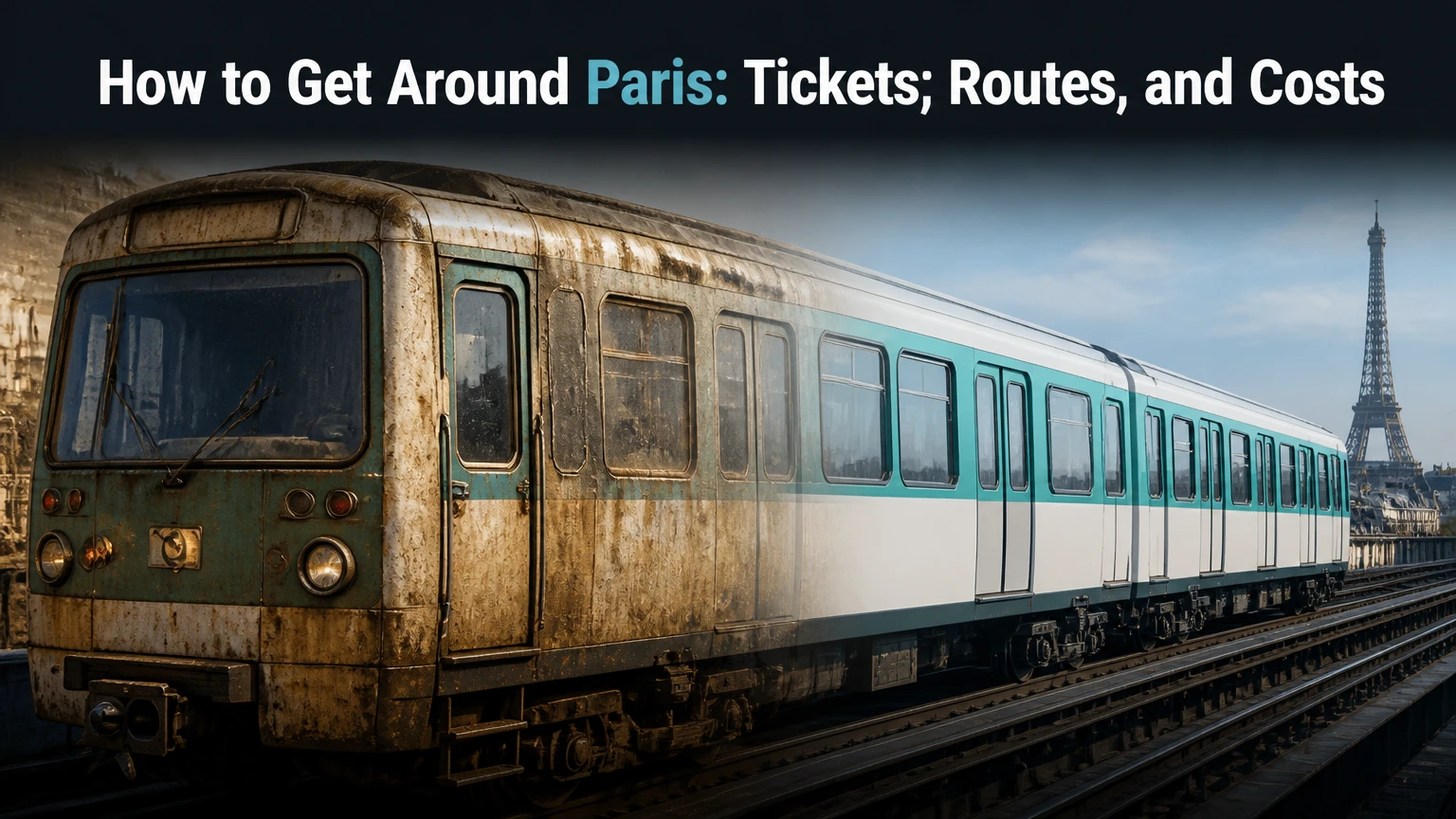
Paris is a compact capital with an integrated network of Métro trains, RER lines, buses, trams, bicycles, and taxis. The fastest choice is usually the Métro within central Paris, while buses suit accessible sightseeing, the RER reaches airports and suburbs, and walking often wins between nearby landmarks. Ticket rules change by mode and destination.
Key Facts / Quick Answer
Central Paris lies in Zone 1, where the Métro, buses, and walking cover most visitor itineraries.
Use a single Metro-Train-RER ticket for a rail journey within the permitted area, but buy a specific point-to-point ticket for destinations such as Versailles or Disneyland Paris.
Typical 2025-2026 urban fares are about $2.30 per rail ride or $1.90 per bus or tram ride, using an exchange rate of approximately $1.08 to 1 euro.
RER B connects Paris with Charles de Gaulle Airport, while Orly is best reached by Metro line 14 or the Orlyval connection.
A weekly Navigo pass runs from Monday through Sunday, not for seven consecutive days.
Keep the same payment device or travel card through transfers, and retain the ticket until leaving the station.
How the Paris Transport Network Works
Paris public transport combines separate-looking services under the Île-de-France Mobilités fare system. The Métro handles dense central travel, the RER crosses the city quickly with fewer stops, buses fill neighborhood gaps, and trams mainly connect the outer city and suburbs.
The five-zone map matters most when leaving central Paris. Paris itself is Zone 1, while Charles de Gaulle Airport and Disneyland Paris are in Zone 5, Orly Airport is in Zone 4, and Versailles is generally in Zone 4. A zone number does not automatically tell you which ticket to buy, because newer fares are increasingly based on the mode and origin-destination journey.


Choosing the right mode
| Mode | Typical central speed | Best distance | Main limitation |
|---|---|---|---|
| Métro | 15-30 minutes across districts | 2-8 kilometers | Stairs, crowded platforms, confusing exits |
| Bus | 25-60 minutes | 2-7 kilometers | Road traffic and diverted routes |
| RER | 10-35 minutes across Paris | 5-30 kilometers | Fewer stations and stricter destination fares |
| Walking | 15-45 minutes | 1-3 kilometers | Weather, luggage, hills in Montmartre |
| Vélib’ | 15-35 minutes | 3-10 kilometers | Traffic, docking availability, road confidence |
The practical rule is simple: use rail for distance, walking for detail, and buses when stairs or sightseeing matter more than speed. A route that appears to require two Métro changes may be easier as one bus ride plus a ten-minute walk.
What Is the Best Way to Travel Around Central Paris?
The Métro is usually the best all-purpose option for central Paris because stations are commonly within a five-minute walk and trains avoid surface traffic. Walking becomes more efficient for neighboring attractions, while buses are preferable for wheelchair users, large strollers, and travelers who want to watch the city rather than pass beneath it.
Paris has 16 numbered Métro lines: lines 1 through 14, plus 3bis and 7bis. Follow the line number and the terminus, or final station, shown on signs. The same line travels in both directions, so “line 4” alone is incomplete information; “line 4 toward Bagneux” identifies the direction.
Line 1 connects La Défense, the Champs-Élysées, the Louvre area, Châtelet, and the east of Paris. Line 14 links Saint-Denis Pleyel, Gare de Lyon, Châtelet, and Orly Airport, although the exact service pattern can change during engineering work. Automated trains on lines 1 and 14 generally recover from minor delays efficiently, but no line is immune to closures, strikes, or crowding.
How to read a Métro route
- Enter the station entrance displaying the correct line number.
- Check the platform direction by terminus.
- Confirm the next station and the transfer station on the platform display.
- Leave through the exit marked for your street, landmark, or avenue.
- Validate the same ticket or phone used for the journey and keep it until departure.
A major Paris mistake is choosing the correct station but the wrong exit. Châtelet and Gare du Nord have long underground corridors, so an incorrect exit can add 10-15 minutes above ground. Navigation apps often identify exits by street name; use that detail.
When should you take a bus instead?
Take a bus when the journey is short, the route is scenic, or the group includes someone who cannot manage repeated stairs. Bus stops display route numbers, destinations, and real-time arrival information, but traffic can make a scheduled 25-minute ride take 45 minutes during weekday peaks.
Bus 69 is a useful sightseeing route between the Eiffel Tower area, Invalides, the Louvre vicinity, and Père-Lachaise Cemetery. It is a normal local bus, not a hop-on, hop-off service, so passengers must pay the ordinary fare and exit at designated stops.
How Do RER Trains, Airports, and Day Trips Work?
The RER is a regional rail network with lines A, B, C, D, and E. Inside central Paris, the RER functions like a faster Métro with wider station spacing; beyond the city, it operates under destination-based or regional fare rules that require a valid ticket for the complete journey.
RER A reaches destinations including La Défense and Disneyland Paris. RER B serves Charles de Gaulle Airport through the airport branch and connects with major stations such as Gare du Nord and Châtelet-Les Halles. RER C serves Versailles Château Rive Gauche, the usual station for the Palace of Versailles, although the line has frequent works and branch-specific disruptions.
Airport and day-trip options
| Destination | Common public transport | Typical one-way cost | Typical journey time |
|---|---|---|---|
| Charles de Gaulle Airport | RER B or airport rail connection | $13-$16 | 35-50 minutes |
| Orly Airport | Métro line 14 or Orlyval plus rail | $11-$14 | 25-40 minutes |
| Versailles Château Rive Gauche | RER C | $5-$7 | 35-55 minutes |
| Disneyland Paris | RER A to Marne-la-Vallée-Chessy | $7-$10 | 40-60 minutes |
| Gare du Nord to central Paris | Métro lines 4 or 5, or local rail | $2-$3 | 10-25 minutes |
Fares and routes are typical planning estimates in US dollars, not guaranteed prices. Verify the destination and current fare in the Île-de-France Mobilités app before departure, especially when airport supplements or rail works apply.
For airports, luggage changes the calculation. RER stations may involve stairs, narrow corridors, and platform transfers. A taxi becomes more competitive for three or four passengers with several suitcases, particularly when the destination is distant from a central rail station.
Expert insight: A ticket that opens the departure gate may still fail at the destination gate if it does not cover the full RER journey. The system checks the destination boundary at exit, which is why using a central urban ticket for Versailles or an airport often creates a problem.
What Tickets and Passes Should Visitors Buy?
Most visitors should choose between a single-journey ticket, a Navigo Easy card or phone ticket, a daily pass, and a weekly pass. Paris Visite is convenient for some visitors, but its higher price means it often loses to individual fares unless the itinerary includes heavy travel and the convenience has real value.
Urban fares have recently been reorganized, so older advice about “Ticket t+” and separate paper carnets can be outdated. The following are typical planning figures converted to US dollars at approximately $1.08 per euro.
| Product or fare | Typical USD price | Coverage or validity | Best use |
|---|---|---|---|
| Metro-Train-RER single ticket | About $2.30 | One permitted rail journey | One Métro or central rail trip |
| Bus-Tram single ticket | About $1.90 | Bus and tram transfer window | Surface travel without rail |
| Navigo Easy card | About $2.20 card fee | Reloadable transport card | Visitors without phone ticketing |
| Daily Navigo pass | About $9-$10 | Selected or broad regional coverage | Several rail and surface journeys |
| Weekly Navigo pass | About $33 plus card setup | Monday through Sunday | Four or more heavy travel days |
| Paris Visite pass | About $16-$82 | One, two, three, or five days | Convenience and selected visitor benefits |
A phone ticket is convenient, but battery failure is a transport problem. Carry a power bank, and use a physical Navigo Easy card if your group includes someone whose phone may be unavailable. Do not assume one phone can provide independent access for multiple travelers at every gate.
Ticket decision rules
- Buy single fares for one or two urban journeys on a day.
- Compare a daily pass when the day includes at least four or five paid trips.
- Consider weekly Navigo when arrival occurs early in the week and travel continues through Sunday.
- Price airport, Versailles, and Disneyland journeys separately before choosing a pass.
- Use Paris Visite when simplicity, airport inclusion, or visitor discounts outweigh the higher price.
- Avoid a weekly pass purchased late in the week unless the remaining days still justify its cost.
The weekly pass is calendar-based. A pass activated on Thursday expires Sunday night, so it is not a rolling seven-day product.
How Much Does It Cost to Get Around Paris?
A low-movement visitor can spend about $5-$8 per person daily on urban transport, while a traveler crossing the city repeatedly may spend $9-$14 before airport or day-trip fares. Walking between nearby districts can reduce both cost and transfer time.
| Sample itinerary | Transport pattern | Typical transport cost per person |
|---|---|---|
| Two central trips | Two urban rail fares | $5 |
| Four urban trips | Daily pass or four single fares | $8-$10 |
| CDG arrival plus two central trips | Airport rail plus urban fares | $18-$22 |
| Versailles day | Return regional rail plus two urban trips | $14-$18 |
| Five days with airport and heavy travel | Weekly pass plus airport fares | $45-$55 |
These are budget estimates, not fixed quotations. The final amount depends on the current fare schedule, airport route, ticket medium, and whether a journey uses rail, bus, or tram.
Expert insight: The cheapest theoretical fare is not always the cheapest usable fare. A traveler who buys a weekly pass for a Wednesday-to-Sunday stay may pay more than someone using individual tickets, while a Monday-to-Sunday itinerary can make the same pass excellent value.
Is Walking or Cycling Better for Paris Sightseeing?
Walking is best for distances of roughly one to three kilometers when the route crosses attractive streets or connects landmarks in the same district. Cycling is faster for longer surface journeys, but visitors must understand Paris traffic, protected lanes, pedestrian crossings, and the difference between a cycle lane and a fully separated track.
Vélib’ Métropole offers mechanical bikes, commonly identified by green markings, and electric bikes, commonly identified by blue markings. Users unlock a bike through the service app or an approved access method, then return it to an available docking station. A ride is not complete until the lock confirms the return.
| Activity | Typical route distance | Typical time | Main planning issue |
|---|---|---|---|
| Louvre to Notre-Dame | 2-3 km | 25-40 minutes walking | Crowds along the Seine |
| Eiffel Tower to Invalides | 2 km | 25-30 minutes walking | Crossings and security queues |
| Marais to Bastille | 2-3 km | 10-20 minutes by bike | Pedestrians and one-way streets |
| Montmartre to Opéra | 3-4 km | 35-50 minutes walking | Inclines and crowded sidewalks |
| Canal Saint-Martin to République | 2 km | 8-15 minutes by bike | Dock availability |
Do not leave a Vélib’ at a full station and assume the rental has ended. Check the confirmation in the app or kiosk. An open-ended rental can create extra charges and may leave the bike unavailable for the next user.
Walking is also the most reliable fallback during a transport strike or a short disruption. It is less suitable after a late flight, with heavy luggage, or on steep Montmartre streets.
When Are Taxis, Ride-Hailing, and Night Buses Better?
Taxis and ride-hailing services are most useful for airport luggage, late arrivals, mobility limitations, and groups of three or more. They are usually slower than rail across central Paris during weekday congestion, but door-to-door access can outweigh the higher fare.
| Option | Typical central fare | Typical airport fare | Best situation |
|---|---|---|---|
| G7 or licensed taxi | $15-$35 | $35-$75 | Regulated pickup and luggage |
| Uber or Bolt | $12-$35 | $35-$80 | App booking and price estimate |
| Noctilien bus | About $2-$3 | Varies by route | Low-cost overnight travel |
| Métro line 1 or 14 | About $2-$3 | Not available to every airport | Fast central travel |
| RER airport route | Not applicable | $13-$16 from CDG | Daytime airport transfers |
Official airport taxi fares are commonly fixed by destination zone, but the exact amount can change by airport, left-bank or right-bank destination, time, and regulation. Use the marked taxi rank rather than accepting an unsolicited offer inside an arrival hall.
The Noctilien network operates after many Métro services end, generally from around 12:30 a.m. to 5:30 a.m. Routes are less frequent than daytime buses, and a map route may require waiting 20-60 minutes. For an unfamiliar neighborhood after midnight, a licensed taxi is often the simpler choice.
What Operating Hours and Disruptions Should You Expect?
The Métro generally runs from about 5:30 a.m. until 1:15 a.m. on Sunday through Thursday, with service often extending to approximately 2:15 a.m. on Friday, Saturday, and nights before public holidays. RER and bus timetables vary by line, branch, and engineering work.
Weekday peaks commonly fall around 8:00-9:30 a.m. and 5:00-7:00 p.m. Crowding is strongest on interchange lines and at stations such as Châtelet-Les Halles, Gare du Nord, and Gare de Lyon.
Check the official Île-de-France Mobilités or RATP journey planner immediately before airport trips. Planned works can close an entire branch while the central portion of a line remains open, a detail that general map apps may not explain clearly.
A useful disruption plan has three layers:
- Check the route 30-60 minutes before leaving.
- Save one alternative using a different rail line or bus.
- Add 20-30 minutes for a major interchange, airport connection, or event crowd.
Expert insight: During a disruption, changing at a large central station is often worse than walking to a nearby parallel line. Châtelet may offer many theoretical connections, but a 12-minute walk to Hôtel de Ville, Saint-Michel, or another smaller station can produce a faster real journey.
How Can Travelers Avoid Ticket and Navigation Problems?
The most expensive mistakes usually involve destination boundaries, not the price of a single urban ride. Travelers also lose time by entering the wrong station entrance, following the wrong RER branch, or failing to confirm that a bike rental has ended.
The official transport guidance tells passengers to retain their ticket through the journey and inspection process. In practice, inspectors can request proof inside stations or on vehicles, and a traveler without a valid validated ticket may face an immediate penalty that can exceed $50.
Avoid these failures:
- Do not use a central urban ticket for Versailles, CDG, Orly, or Disneyland unless the current fare rules explicitly permit it.
- Do not confuse an RER station name with the correct branch or destination.
- Do not throw away a paper or electronic ticket before exiting.
- Do not follow only the landmark name when several station exits serve it.
- Do not board a bus or tram without validating the fare.
- Do not rely on a phone ticket with a nearly empty battery.
- Do not assume a pass covers every airport supplement or regional trip.
- Do not accept a ride from an unmarked vehicle outside an airport taxi rank.
For navigation, Citymapper and the official Île-de-France Mobilités app are useful for live disruptions, platform changes, walking legs, and station entrances. Google Maps is helpful for orientation, but compare its result with the official service alert when a trip involves an airport, RER branch, or late-night connection.
Is Paris Public Transport Accessible?
Paris buses and trams generally provide better step-free access than the historic Métro, whose stations often have stairs and limited elevators. Travelers using wheelchairs, large strollers, or heavy luggage should plan around accessible bus corridors and confirm elevator status before departing.
The entire Métro network is not step-free. Some newer or renovated stations have lifts, and line 14 is among the most accessible rail options, but accessibility can fail temporarily because of elevator maintenance or crowd control.
| Traveler need | Usually better option | Common barrier | Practical adjustment |
|---|---|---|---|
| Wheelchair user | Accessible bus or tram | Broken lift or narrow stop | Check accessibility status first |
| Large stroller | Bus, tram, or line 14 | Métro stairs and crowds | Travel outside peak periods |
| Heavy luggage | Taxi or direct rail route | Long interchange corridors | Avoid Châtelet when possible |
| Young children | Short Métro ride or bus | Platform edge and crowding | Keep children beside an adult |
| Reduced walking tolerance | Direct bus or taxi | Multiple station corridors | Compare total walking distance |
Accessibility also affects station transfers. A route with one rail change may require 15 minutes of corridors and stairs, while a direct bus may take 20 minutes longer but eliminate physical strain.
A Practical Three-Day Transport Plan
A three-day Paris visit usually works best with a mixed strategy rather than one expensive unlimited pass. Use rail for long cross-city journeys, walk within each sightseeing cluster, and reserve taxis for airport luggage or late-night returns.
| Day pattern | Suggested transport | Typical paid rides | Planning priority |
|---|---|---|---|
| Louvre, Marais, Notre-Dame | Walk plus two Métro rides | 2-4 | Keep landmarks within one district |
| Eiffel Tower, Invalides, Montmartre | Métro plus walking | 3-5 | Avoid peak interchange stations |
| Versailles day trip | RER C plus local travel | 3-5 | Buy the complete regional fare |
For a five-day stay beginning Monday, compare a weekly Navigo pass with separate airport fares. For a Thursday arrival, compare individual tickets and a daily pass instead, because the weekly product expires Sunday night.
A reliable arrival sequence is:
- At the airport, identify the official rail platform or taxi rank.
- Buy the fare for the actual destination, not merely “Paris.”
- Save the hotel address and nearest station exit offline.
- Avoid a complicated interchange while carrying luggage.
- Recheck the route after leaving the terminal, when live disruptions are visible.
- Keep the payment card, phone, or ticket accessible until the final exit.
Frequently Asked Questions About how to get around Paris
Can I use a contactless bank card on Paris public transport?
Contactless bank-card acceptance is not universal across every Paris transport mode and station. A visitor should not assume that tapping a bank card works like London’s system. Use the official Île-de-France Mobilités app, a compatible phone ticket, or a Navigo Easy card, and verify the current payment method before boarding.
Is the Paris Metro safe at night?
The Métro is commonly used at night, but passengers should expect fewer services, quieter platforms, and occasional closures. Keep valuables secure, avoid empty carriages when possible, and use a licensed taxi or well-planned Noctilien route after late arrivals, especially when carrying luggage.
Can I take luggage on the Metro?
Passengers can take luggage on the Métro, but large bags create difficulties on stairs, narrow corridors, and crowded trains. Choose a direct route, avoid rush hour, and consider a taxi from the airport when several travelers share multiple suitcases.
How do I get from Charles de Gaulle Airport to the Eiffel Tower?
The RER B usually provides the fastest public transport start, followed by a transfer toward the Eiffel Tower area, while a taxi offers direct access with luggage. Allow roughly 50-75 minutes by rail after walking and transfers, or about 45-90 minutes by road depending on traffic.
Is Versailles included in a Paris Metro ticket?
A standard central urban ticket does not automatically cover the complete journey to Versailles. Use the official journey planner to select the correct origin-destination fare, and choose the RER C station serving Versailles Château Rive Gauche rather than assuming every Versailles station is equally convenient for the palace.
Should I rent a car in Paris?
Most visitors should not rent a car for central Paris. The Métro and RER avoid much road congestion, parking is expensive and limited, and restricted or pedestrianized streets complicate driving. A car becomes more practical for rural trips outside the Île-de-France region, not for museum and monument sightseeing.
Conclusion
The best way to get around Paris is a deliberate mix of Métro, RER, buses, walking, and occasional taxis. Use the Métro for fast central travel, the RER for airports and regional destinations, buses for accessible sightseeing, and walking for nearby landmarks. Before each trip, verify the fare, destination boundary, station exit, and live service status.