Common tourist scams in Europe are fraudulent schemes that use distraction, manufactured urgency, inflated prices, or forced social contact to make travelers surrender money, valuables, or payment details. The most frequent patterns include fake gifts, spill theft, unauthorized taxis, counterfeit tickets, petitions, dishonest restaurants, and deceptive currency services near busy tourist routes.
Key Facts / Quick Answer
Small street scams typically cost about $5-$35, while taxi, dining, ticket, and nightlife fraud can reach $60-$400.
The highest-risk setting is a crowded place where a stranger creates urgency and touches your belongings.
Official websites, marked taxi ranks, transparent menus, and bank-operated ATMs are safer than unsolicited alternatives.
Most distraction theft is over within 30-45 seconds, so immediate distance matters more than politeness.
Never reveal a card PIN, hand over your phone, or let an unknown person move your luggage.
If approached, use a firm “No,” protect your valuables, walk toward staff or a staffed business, and call local police if threatened.
How Common Tourist Scams in Europe Work
Tourist fraud succeeds when a target is unfamiliar with local prices, language, routes, and procedures. A scammer then combines an unexpected approach with a social obligation, such as accepting a gift, signing a petition, helping with a dropped object, or responding to an apparent emergency.
The operating pattern is usually predictable:


- Approach: A person enters your personal space or blocks your route.
- Cognitive load: The person creates noise, physical contact, urgency, or multiple instructions.
- Commitment: You accept an object, open a wallet, follow someone, or hand over a phone.
- Extraction: The scammer demands payment, changes the price, steals an item, or records card details.
- Pressure: Embarrassment, anger, intimidation, or a crowd discourages resistance.
A useful practitioner rule is that two warning signals together deserve an immediate exit. An unsolicited approach plus touching, an unusual payment request plus urgency, or a low advertised price plus missing written terms indicates a higher-risk interaction.
Tourists are not targeted because they are careless. They are targeted because a foreign visitor is less able to verify a price, identify an official employee, or report misconduct in the local language.
Which Tourist Scams Are Most Common?
The most common street-level schemes fall into five categories: forced gifts, distraction theft, unauthorized transport, fake access services, and donation or petition pressure. The table below compares the trigger, extraction method, and typical exposure.
| Scam type | Initial trigger | Typical loss in USD | Common setting |
|---|---|---|---|
| Rose or bracelet | “Free” item placed on you | $5-$35 | Monument entrances and plazas |
| Spill distraction | Coffee, sauce, or dropped objects | $50-$1,000 in valuables | Metro entrances and stations |
| Unauthorized taxi | Driver offers a special fare | $60-$400 | Airports and train stations |
| Fake attraction ticket | “Closed” or “sold out” claim | $25-$250 | Monument approaches |
| Petition or charity | Clipboard and emotional appeal | $10-$75 | Museums and shopping streets |
| Menu or bar overcharge | Verbal price or unclear menu | $40-$500 | Nightlife districts |
These are typical practitioner ranges, not official Europe-wide averages. Loss depends on the city, the item taken, the number of accomplices, the payment method, and whether the traveler challenges the transaction.
The “Free” Rose, Bracelet, or Rosemary Trick
The free-gift scam begins when a stranger presses a rose, herb bundle, bracelet, or religious token into a traveler’s hand. The seller then claims the object was a gift before demanding payment, sometimes raising the price after the traveler has stopped walking.
Known examples have been reported around Sacré-Cœur and the Eiffel Tower in Paris, Piazza del Duomo in Milan, and the Spanish Steps in Rome. The method works because holding the item creates a false sense that a transaction has already begun.
Do not accept, hold, wear, or return the item while standing still. Raise one hand to protect your space, say “No,” and continue toward a staffed location. If a bracelet has been tied tightly, ask nearby police or venue security for assistance rather than negotiating with a group.
The Spill and Distraction Theft
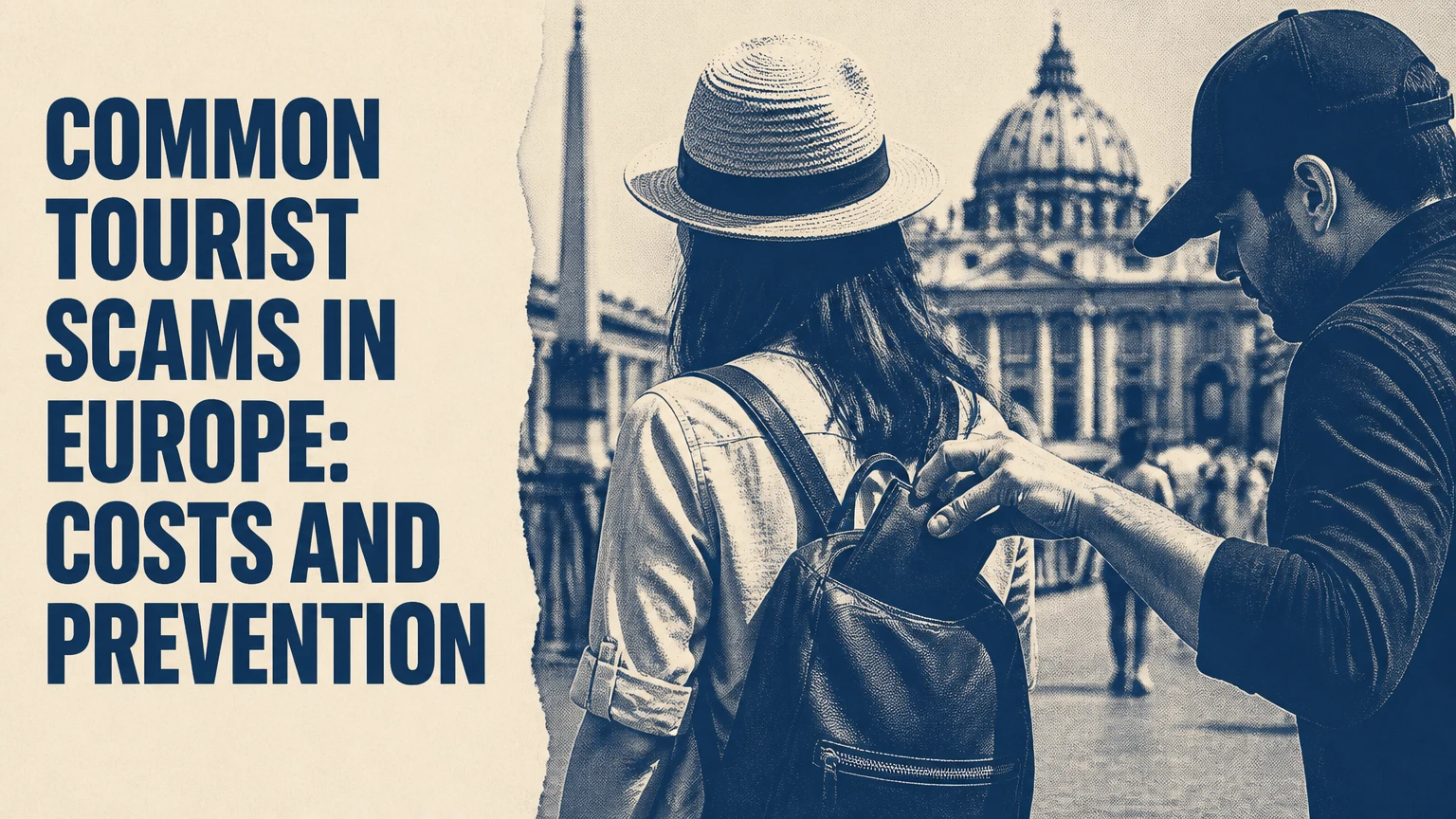
A spill scam uses a liquid, food, dropped keys, coins, or an apparent stumble to move your attention from your pockets. One person creates the event, a second person wipes clothing or asks questions, and a third person may take a phone, passport, wallet, or unattended bag.
The theft often happens in less than 45 seconds. The critical mistake is placing a bag on the floor or removing a wallet to inspect damage.
Use this sequence:
- Step away from the group before checking clothing.
- Keep one hand on your phone and the other on your bag.
- Say “I will handle it” and refuse unsolicited wiping.
- Move into a shop, hotel lobby, station office, or police post.
- Check passport, cards, phone, and luggage before continuing.
A counterintuitive point from field practice is that apologetic behavior can be part of the technique. Excessive concern about your clothes is not proof of fraud, but it should not override physical control of your valuables.
The Unauthorized Taxi and Rigged Meter
An unauthorized taxi scam begins when a driver approaches inside an airport or station and offers a “special” flat fare. Other versions involve a broken meter, a rapidly increasing meter, a route detour, or a cash-change switch in which a genuine high-value banknote is replaced with a lower-value note.
A legitimate taxi process varies by city, but the safest pattern is consistent: follow signs to the official rank, confirm the vehicle identification, ask whether the meter is required, and record the plate or booking number before departure.
| Transport choice | Verification step | Typical price exposure in USD | Safer use case |
|---|---|---|---|
| Official taxi rank | Dispatcher, plate, visible tariff | $25-$100 city transfer | Airport arrival |
| Licensed app ride | App fare and vehicle match | $20-$90 city transfer | Late arrival |
| Pre-booked transfer | Written confirmation and name board | $35-$150 | Families or large luggage |
| Unsolicited terminal driver | No independent booking | $60-$400 | Avoid |
| Public rail or metro | Official machine or app | $2-$25 | Daytime city travel |
Keep the payment visible and count change slowly. If a driver claims a $50 note was a $5 note, do not produce another note immediately. Ask for the receipt, photograph the vehicle information, and contact the taxi authority or police from a safe public place.
How to Avoid Fake Tickets and Closed-Attraction Scams
Fake ticket helpers tell travelers that a museum, monument, train counter, or ticket machine is closed, sold out, or broken. They then redirect the traveler to a reseller who supplies a counterfeit, restricted, nonrefundable, or heavily marked-up ticket.
The reliable alternative is to verify the claim through the attraction’s official website, an official app, or uniformed staff inside the venue. A stranger outside the Colosseum, Charles Bridge, Louvre, or a central train station cannot establish that an official ticket office is closed.
| Ticket signal | Likely risk | Verification method | Typical consequence |
|---|---|---|---|
| Cash-only street pass | Counterfeit or inflated price | Official website | Denied entry |
| “Last ticket” pressure | Manufactured urgency | Venue ticket calendar | Overpayment |
| No named attraction | Undefined reseller | Written ticket terms | Wrong venue |
| QR code sent by stranger | Reused or invalid code | Official booking account | Gate rejection |
| Guide bundled without terms | Hidden service charge | Itemized invoice | $50-$250 extra |
Buy directly when possible, especially for timed attractions. If an authorized reseller is necessary, verify that the attraction lists the reseller by name. A genuine ticket can still be a poor purchase if it has a fixed entry time, a nontransferable name, or a separate reservation requirement.
Petition, Charity, and Fake Helper Approaches
Petition scams use clipboards, disability claims, children’s charities, or public-interest causes to start a forced interaction. The person may point to a donation amount after you sign, surround you while you open your wallet, or watch your PIN at a nearby payment terminal.
A petition is not a legal mechanism that obliges a visitor to donate. You can decline without explaining your nationality, income, or political position. Keep your wallet closed and do not place a phone on the clipboard.
If you want to donate while traveling, use a charity’s official website or a recognized donation box inside a staffed venue. The UK charity regulator, the Charity Commission for England and Wales, advises donors to check an organization’s registration and identity before giving. That verification principle is safer than relying on an emotional street pitch.
Where and When Is Risk Highest?
Scam risk rises where people must navigate, queue, exchange money, or make decisions quickly. Busy tourist attractions create anonymity for offenders, while transit hubs provide luggage, jet lag, and unfamiliar ticket procedures.
Summer increases opportunity because June through August brings larger crowds and longer operating hours, but fraud occurs throughout the year. Street approaches often increase from roughly 11:00 a.m. to 4:00 p.m.; bars, restaurants, and taxi disputes become more common from about 8:00 p.m. to 2:00 a.m.
| Situation | Primary vulnerability | Typical timing | First defensive action |
|---|---|---|---|
| Airport arrival | Fatigue and luggage | First 60 minutes | Use marked transport |
| Museum district | Crowds and approaches | 11:00 a.m.-4:00 p.m. | Keep moving |
| Metro boarding | Body contact and distraction | Rush hour | Secure front pockets |
| Restaurant dinner | Unpriced items | 7:00 p.m.-10:00 p.m. | Photograph menu |
| Nightlife exit | Intoxication and cash | 10:00 p.m.-2:00 a.m. | Use booked ride |
| ATM withdrawal | Shoulder surfing | Any hour, especially dark | Use a bank lobby |
Location warnings should be treated as patterns, not accusations about an entire city. Most residents, drivers, charities, and vendors are legitimate. The relevant question is whether the individual is using a verifiable process.
Restaurant, Bar, Currency, and ATM Traps
Dining fraud usually depends on an unclear price rather than a sophisticated theft. A host may pull travelers inside, a menu may omit prices, or a server may describe a special verbally and charge a much higher amount. Seafood can be priced by weight, and a “cover” or service fee may appear separately.
Before ordering, confirm the price, serving size, currency, service charge, and payment method. If a menu lists an item as $X per 100 grams, ask for the approximate weight before cooking.
Currency exchange scams advertise zero commission while applying an unfavorable rate or adding a fixed handling fee. Compare the final amount, not the headline commission. At an ATM, reject dynamic currency conversion when the machine offers to charge your home currency, because your card issuer may provide a better exchange rate.
| Financial service | Red flag | Safer verification | Typical avoidable loss |
|---|---|---|---|
| Exchange kiosk | “0% commission” only | Compare final rate | $10-$80 |
| Independent ATM | Added access fee | Bank-owned ATM | $5-$25 |
| Dynamic conversion | Home-currency prompt | Choose local currency | 3%-12% |
| Restaurant special | No written price | Itemized confirmation | $30-$300 |
| Nightclub bill | Unrequested drinks | Confirm order and receipt | $80-$500 |
Use a card with instant freeze controls, enable transaction alerts, and carry only the cash needed for the next part of the day. Digital wallets reduce exposure of the physical card, but they do not prevent a traveler from authorizing an inflated payment.
What Should Travelers Carry and How Should They React?
Travelers should divide essential assets rather than storing every document and payment method in one wallet. Keep the passport and emergency reserve in a concealed pouch, while carrying a small daily wallet with one card and limited cash.
The strongest prevention routine is mechanical, not verbal. A locked zipper, a hand over a phone, and a bag positioned in front of the body prevent more losses than recognizing a scam after contact has begun.
Use this setup:
- Store passport copies in encrypted cloud storage and offline form.
- Keep emergency funds separate from the daily wallet.
- Put phones and wallets in closed front or interior pockets.
- Never hang a camera or handbag on a chair back.
- Keep luggage between your feet or in direct sight.
- Enable card alerts, remote lock, and device tracking.
- Save local emergency numbers and your accommodation address.
The “stiff arm and silent walkaway” works because it denies engagement. A brief hand gesture and continued movement are usually better than a polite conversation that gives the approach more time.
The 30-Second Verification Routine
When a stranger offers transport, tickets, money exchange, or assistance, pause for 30 seconds and ask four questions:
- Who is the provider? Is the person identifiable through a uniform, license, app, or official website?
- What is the total price? Is it written, itemized, and stated in the local currency?
- What happens if I refuse? Anger, blocking, touching, or urgency indicates coercion.
- Can I verify independently? Walk away and check with venue staff, a bank, or the official app.
If the answer to the final question is no, do not proceed. Legitimate services tolerate verification.
Scam Prevention by Traveler Situation
Different travelers face different exposure. A solo traveler must create distance without a companion, while families need to prevent distraction from splitting attention between children, luggage, and payment.
| Traveler situation | Main exposure | Specific safeguard | Backup measure |
|---|---|---|---|
| Solo traveler | No second observer | Use staffed venues | Share live location |
| Family with children | Divided attention | Assign one adult to bags | Set a meeting point |
| Older traveler | Pressure and payment confusion | Pre-book transfers | Carry printed details |
| Mobility-limited traveler | Forced “assistance” | Request official staff | Keep service number |
| Nightlife visitor | Intoxication and unclear bills | Set spending limit | Leave with a booked ride |
| Backpacker | Visible luggage and loose pockets | Use locker or front pack | Keep passport concealed |
Accessibility needs can increase dependence on strangers, particularly at stations and large attractions. Ask employees wearing identifiable badges for help, and have the accommodation write essential destinations in the local language.
What to Do After a Tourist Scam
Act quickly because payment reversals, device tracking, and evidence collection become harder with delay. First reach a safe staffed location, then secure accounts and document the event.
- Create distance: Enter a hotel, bank, station office, pharmacy, or police facility.
- Freeze payment tools: Lock cards and mobile wallets through the issuer’s app.
- Protect accounts: Change passwords if a phone or payment device was exposed.
- Track devices: Use Apple Find My or Google Find My Device, but do not confront a suspected thief.
- Record evidence: Save receipts, screenshots, plate numbers, names, times, and exact location.
- Report locally: Contact police for theft, threats, assault, or identity documents.
- Notify insurers and issuers: Follow their deadlines for claims and replacement documents.
- Replace travel documents: Contact your embassy or consulate if a passport is missing.
A card payment dispute is not guaranteed. Banks may distinguish between an unauthorized transaction and a payment the traveler approved under pressure, so a precise factual report matters.
Legitimate Alternatives Compared With Scam Traps
The safest choice is usually the one with an independent verification path. Official does not always mean cheapest, but it provides a responsible operator, published conditions, and a route for complaints.
| Need | Scam trap | Legitimate alternative | Verification evidence |
|---|---|---|---|
| Airport ride | Unsolicited terminal driver | Official rank or booked app | Plate and booking record |
| Monument entry | Street seller near gate | Official attraction website | Confirmation number |
| Currency | “No commission” kiosk | Bank ATM or regulated exchange | Displayed final rate |
| City transit | Helper requesting cash | Official machine or transit app | Printed or digital ticket |
| Restaurant | Host and verbal special | Posted menu with prices | Itemized receipt |
| Nightlife | Stranger offering venue access | Venue website or hotel recommendation | Published address |
Rideshare availability, taxi licensing, and ticket policies vary by country. Verify local rules rather than assuming Uber, Bolt, FreeNow, or another app operates in every destination.
Edge Cases Generic Scam Lists Miss
Online booking fraud can occur before departure. A fake accommodation host may request a bank transfer outside a booking platform, while a counterfeit apartment listing may use copied photographs and urgent claims about competing guests.
Use platform payment, verify the property address, compare reviews across dates, and refuse requests to move communication or payment outside the platform. A low price is not evidence of fraud, but a low price combined with urgency, off-platform payment, and an unverifiable address is a strong exit signal.
Travelers should also distinguish a scam from a legitimate dispute. A delayed train, a legal service fee, a strict attraction policy, or a poor exchange rate is not automatically fraud. The practical test is whether the provider disclosed the condition clearly and whether an official complaint route exists.
Generic warnings also have limits. They identify recurring techniques, not the current status of every street, business, or neighborhood. Check destination-specific police, transport authority, attraction, and embassy guidance before departure.
Frequently Asked Questions About common tourist scams in Europe
Are tourist scams worse in certain European countries?
Risk varies more by setting than by nationality. Crowded attractions, major stations, airports, nightlife areas, and public transport create opportunity in nearly every European destination. Paris, Rome, Barcelona, Madrid, Prague, Athens, London, Berlin, and Milan are often discussed because they receive many visitors, not because legitimate residents are unsafe.
Should I pay a scammer to avoid a confrontation?
Personal safety comes before recovering a small payment. If a person threatens, blocks, surrounds, or touches you, move toward staff and call police; do not physically fight over a bracelet or disputed bill. For a nonviolent low-value demand, leaving may be the safest choice, followed by a report and card dispute.
How much cash should I carry while sightseeing?
Carry only enough for the next few hours, typically $30-$80 in local spending equivalent, plus a separate emergency reserve secured elsewhere. The amount depends on transport, admission, and card acceptance. Keeping all cash, cards, and identification together increases the impact of one distraction theft.
Can a tourist scam happen through a payment terminal?
Yes. A dishonest merchant can present an inflated amount, add an unrequested service, or ask for a PIN while watching the entry. Check the displayed total before approving, keep the card or phone in your possession, and request a printed or digital receipt.
What is the safest way to respond to an unsolicited helper?
Decline briefly, protect your belongings, and keep walking toward an official employee or staffed business. Do not hand over your phone, passport, luggage, or payment card. If the person continues, use a firm boundary and attract attention rather than arguing about the person’s story.
Is pickpocketing the same as a tourist scam?
Pickpocketing is theft through concealment, while a tourist scam usually uses deception, interaction, or pressure to obtain money or access. The methods can overlap: a staged spill may be a scam at the approach stage and pickpocketing during the distraction. The same response applies, secure valuables and create distance.
Conclusion
Common tourist scams in Europe are manageable when travelers recognize the operating sequence: unsolicited approach, distraction or urgency, loss of control, and pressured payment. Use official transport and ticket channels, verify every price in writing, keep valuables mechanically secured, freeze exposed cards immediately, and leave interactions that cannot withstand independent verification.