
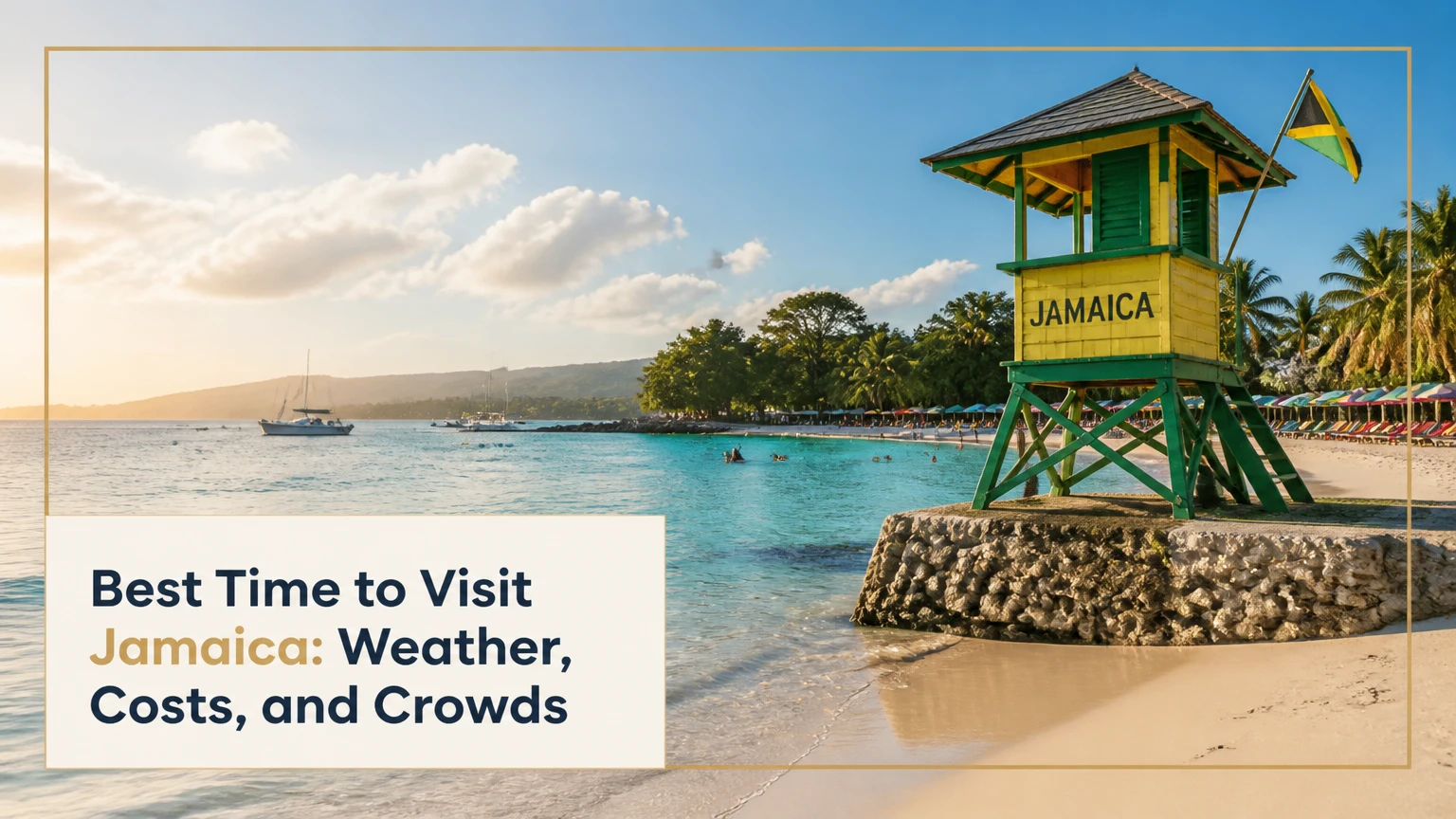
The best time to visit Jamaica is usually mid-April to May or late November to early December, when warm beach weather, lower visitor numbers, and moderate prices overlap. January through March offers the most dependable dry-season conditions, while June through November can reduce costs but brings higher humidity, rain variability, and tropical-storm exposure.
Quick answer
Best overall balance: Late November to early December.
Best beach-weather odds: January through March, especially on the south and west coasts.
Best value with reasonable weather: Mid-April to May and late November.
Lowest typical prices: September and October, with the greatest weather uncertainty.
Official Atlantic hurricane season: June 1 through November 30.
Warmth year-round: Sea-level temperatures commonly range from 24-32°C, or 75-90°F.
When Is the Best Time to Visit Jamaica?
Late November through early December is the strongest all-purpose window for Jamaica because fall rains have usually eased, holiday demand has not fully arrived, and accommodation rates often remain below Christmas levels. Travelers who prioritize almost-daily beach conditions over price should choose January through March instead.
Jamaica does not have four sharply defined temperate seasons. The island’s travel pattern depends on rainfall, humidity, Atlantic tropical-cyclone activity, school holidays, Easter, and the Christmas travel period. Sea-level temperatures remain consistently warm, but conditions differ substantially between Negril, Montego Bay, Kingston, Ocho Rios, and Port Antonio.


A practical distinction matters: the wet season does not mean continuous rain, and the dry season does not guarantee uninterrupted sunshine. Jamaica’s mountains produce local rain patterns, so a forecast for Port Antonio cannot reliably describe Negril on the same day.
Jamaica’s Climate, Rainfall, and Hurricane Risk
Jamaica has a warm tropical climate with relatively stable sea-level temperatures, but rainfall changes by month and location. The Atlantic hurricane season runs from June 1 to November 30, according to the National Hurricane Center, although tropical systems can occur outside those dates.
The island generally experiences wetter periods in May and from September into November, with a relatively drier interval from December through April. October is often among the wettest months, but monthly totals vary by station and coast. Rain commonly arrives as a short, heavy shower rather than a full day of precipitation, particularly during summer.
| Climate factor | Typical Jamaica range or timing | Planning consequence |
|---|---|---|
| Sea-level daytime temperature | 27-32°C, 81-90°F | Light clothing works year-round |
| Sea temperature | 27-29°C, 81-84°F | Swimming is comfortable in every season |
| Drier travel period | December to April | Higher rates and larger crowds |
| Wetter periods | May and September-November | Flexible outdoor scheduling helps |
| Atlantic hurricane season | June 1-November 30 | Check warnings and cancellation terms |
| Daylight near the year’s extremes | About 11-13 hours | Early starts improve excursions |
Rainfall and storm risk are separate variables. A September trip can have ordinary showers and no cyclone, while a dry-season trip can still encounter a strong weather system. Travelers should check the National Hurricane Center, Jamaica Meteorological Service, airline notices, and their accommodation’s operating updates rather than treating a seasonal label as a forecast.
Expert insight: The most useful weather decision is often geographic, not monthly. A traveler who moves a January trip from the wetter eastern side to Negril may gain more reliable beach time than a traveler who changes January to February without changing location.
Jamaica Travel Seasons by Price and Crowds
Jamaica’s high season normally runs from mid-December through mid-April, shoulder periods cluster around late April to May and late November to mid-December, and the least expensive period usually falls between June and early November. These labels describe demand as much as weather.
| Travel period | Typical weather pattern | Typical lodging position in USD | Crowd pattern |
|---|---|---|---|
| Mid-December-April | Drier, lower humidity, warm seas | $250-$700+ per night at upscale properties | Highest demand |
| Mid-April-May | Warm, mixed showers, improving value | $175-$450 per night | Moderate |
| June-August | Hot, humid, short heavy showers | $150-$375 per night | Mixed, with family demand |
| September-October | Wetter, storm uncertainty | $125-$325 per night | Lowest demand |
| November-mid-December | Rain often easing, lush scenery | $175-$425 per night | Low before holidays |
The rates above are typical planning ranges for double occupancy and vary by board basis, resort category, airport, room type, and booking date. A premium all-inclusive room can exceed $700 per night during Christmas or New Year, while a simple guesthouse may cost far less than the table’s lower range.
Cruise calls can temporarily increase daytime congestion in Montego Bay, Ocho Rios, and Falmouth. Resort occupancy can also rise around United States spring break, Jamaican school holidays, Easter, and major music events. A quiet month does not guarantee a quiet beach if a particular resort is hosting a large group.
How Far Ahead Should You Book?
Book Christmas, New Year, and Easter travel 9-12 months ahead when room choice and fixed flight times matter. January through March usually deserves at least 3 months of lead time, while low-season travelers can often find availability 4-8 weeks before arrival, provided they accept fewer room and flight options.
Use this sequence:
- Check the school, Easter, and festival calendar for your origin market.
- Compare airfares with the resort’s full cancellation deadline.
- Price the same room on a refundable and nonrefundable basis.
- Confirm airport transfer time before selecting a property.
- Recheck rates 30-45 days before arrival if the booking can be changed without penalty.
- Keep a weather contingency fund for one extra hotel night or a rebooked flight.
What Each Month Is Like in Jamaica
Jamaica’s months differ more in rainfall probability, demand, and event schedules than in temperature. The following calendar is a planning guide, not a guarantee, because mountains and coastlines create local variation.
| Month | Conditions and activities | Typical demand and price | Best fit |
|---|---|---|---|
| January | Dry-season beach weather; mild trade winds | High, often $250-$700+ nightly | Beach holidays |
| February | Warm, relatively dry, good visibility | High | Swimming and couples |
| March | Dry conditions; spring-break pressure | High to very high | Early booking required |
| April | Warm; Easter can raise demand | Moderate to high | Beaches and culture |
| May | More showers; green landscapes | Moderate | Value seekers |
| June | Hot and humid; early hurricane season | Moderate to low | Budget and flexible trips |
| July | Hot; Reggae Sumfest in Montego Bay | Festival-driven spikes | Music travelers |
| August | Humid; showers and storm monitoring | Low to moderate | Families with flexibility |
| September | Wet-season exposure; quiet resorts | Low | Lowest-price travelers |
| October | Frequently wet; storm risk needs monitoring | Lowest typical demand | Flexible itineraries |
| November | Rain often decreases later in month | Low to moderate | Strong value window |
| December | Pleasant; holiday rush after mid-month | Moderate, then very high | Early festive travel |
January to March is the safest recommendation for travelers with only one week and a strict beach-weather priority. March and early April require special attention to spring-break occupancy, particularly in Negril and Montego Bay.
April and May provide a useful compromise, although Easter can erase the usual shoulder-season savings. Late November and the first week of December often outperform early November for travelers who want greener scenery without accepting the highest autumn rainfall pattern.
June through August works well for visitors who can move excursions around showers. July adds Reggae Sumfest, which can be an advantage for music travelers and a disadvantage for anyone seeking the lowest rates near Montego Bay.
September and October offer the greatest savings but the weakest weather certainty. A traveler choosing these months should value price, privacy, and flexibility more than a fixed schedule of boat trips and waterfall visits.
Where Does Location Change the Recommendation?
Location can change Jamaica’s weather experience as much as a calendar shift. Negril and parts of the south and west coast are commonly drier than the mountainous northeast, while Port Antonio and Portland Parish receive more frequent or prolonged rainfall because of eastern exposure and terrain.
| Destination | Geographic character | Typical weather planning | Best travel use |
|---|---|---|---|
| Negril | Flat west coast, famous sunsets | Often favorable for beach time | Swimming and sunsets |
| Montego Bay | Northwest coast, major resort hub | Generally practical for first visits | Resorts and excursions |
| Ocho Rios | North coast near waterfalls | Mixed rain, convenient attractions | Families and cruise access |
| Port Antonio | Eastern, mountainous, lush | Wetter and less predictable | Hiking and nature |
| Kingston | Southeast urban basin | Warmer, often drier than east | Food, music, history |
| South Coast | Lower-density coastal communities | Often good value and quieter | Scenic road trips |
The rain-shadow effect is useful but not absolute. Negril can receive a heavy shower, and Port Antonio can have a sunny morning. Regional averages should guide hotel selection, not replace a short-range forecast.
Travel time also affects the value of a location choice. Montego Bay to Negril commonly takes about 1.5-2.5 hours by road, depending on traffic and transfer type; Montego Bay to Ocho Rios often takes about 1.5-2 hours. A cheaper room can lose its financial advantage if daily excursions require long transfers.
Expert insight: Avoid planning a west-coast beach holiday around an eastern-coast forecast. Jamaica’s Blue Mountains and interior ridges interrupt weather patterns, so a rainy forecast for Portland does not automatically cancel a Negril beach day.
Which Season Fits Your Travel Goal?
The best month depends on the activity that matters most. Divers, hikers, families, festival visitors, and budget travelers should not use the same ranking because each group has a different tolerance for rain, crowds, and schedule changes.
- Best beaches: January-March, with April and late November as value alternatives.
- Best hiking and waterfalls: December-April for easier trail conditions, or May-November for greener scenery.
- Best snorkeling and diving: December-April usually offers favorable visibility, but local sea conditions determine each boat departure.
- Best music and nightlife: July for Reggae Sumfest, with event-specific demand around Montego Bay.
- Best family value: May, June, or late August, outside major school-holiday peaks.
- Best honeymoon privacy: Late April-May or late November, avoiding Easter and holiday weeks.
- Best budget: September-October, only with flexible reservations and weather protection.
Beach, Hiking, and Waterfall Priorities
Beach-focused visitors should choose a west or south coast base during the drier months. Hikers may accept May or November because vegetation is greener, but wet trails can slow travel and make steep surfaces slippery.
Boat excursions are more sensitive to wind and swell than to rainfall alone. A sunny day can still produce a canceled snorkeling trip if marine conditions are unsafe, so travelers should avoid scheduling their only water excursion on the final day.
Festivals and Events
Reggae Sumfest generally takes place in July in Montego Bay, but exact dates and venues change by year. Festival visitors should verify the official event schedule before booking flights, because room prices and minimum-stay requirements can rise around headline performances.
Easter and Christmas affect the entire island. Restaurants, attractions, domestic transport, and beaches can feel busier even when the weather is excellent.
Jamaica Compared With Other Caribbean Options
Jamaica is a strong choice for travelers who want beaches combined with mountains, music, food, waterfalls, and a large range of accommodation. It is less suitable than Aruba for someone whose only requirement is the lowest possible rainfall during the Atlantic hurricane season.
| Destination | Hurricane exposure | Typical climate advantage | Best for |
|---|---|---|---|
| Jamaica | Seasonal Atlantic risk | Diverse coast and mountain microclimates | Mixed beach and culture trips |
| Aruba | Usually outside the main hurricane belt | Arid, windy, low-rain environment | Reliable low-season sun |
| Barbados | Atlantic tropical-storm exposure | Strong beaches and cultural events | Resort and heritage travel |
| Dominican Republic | Seasonal Atlantic risk | Large resort inventory and varied regions | Broad price selection |
| Curaçao | Usually outside the main hurricane belt | Dry climate and diving | Diving and low-rain trips |
Aruba and Curaçao may provide more consistent dry weather in September and October, but they do not reproduce Jamaica’s Blue Mountain landscapes, jerk cuisine traditions, reggae history, or waterfall excursions. Barbados offers strong cultural programming and generally dependable beach conditions, yet its travel geography and accommodation market differ from Jamaica’s.
The right comparison is therefore risk-adjusted, not simply weather-based. A traveler who wants a varied two-week itinerary may prefer Jamaica’s regional diversity, while a traveler with a nonnegotiable beach-weather threshold may prefer a drier island.
What Can Go Wrong During the Wet Season?
Wet-season travel becomes difficult when visitors treat a lower room rate as the full cost. Rain can delay boat trips, flood short road sections, close trails, reduce restaurant staffing, and create extra transfer nights when flights change.
A storm threat does not mean every trip will be canceled. It does mean travelers need flexible terms, reliable alerts, and enough time to change plans.
A Practical Storm-Response Process
- Monitor the National Hurricane Center and Jamaica Meteorological Service, not social-media rumors.
- Check whether the system is a watch, warning, or broad disturbance.
- Ask the airline and accommodation about rebooking, evacuation, and closure policies.
- Move inland or postpone exposed boat activities when local authorities advise it.
- Keep passports, medication, chargers, and insurance details accessible.
- Do not travel through flooded roads or enter rough water for a scheduled excursion.
- Document cancellations and additional expenses for an eligible insurance claim.
Travel insurance should cover medical treatment, interruption, delay, and weather-related disruption. “Cancel For Any Reason” coverage has stricter purchase deadlines and reimbursement limits than standard cancellation cover, so travelers should read the policy rather than assume that buying insurance automatically protects a storm-affected trip.
Other Seasonal Planning Issues
Sargassum levels vary by coastline and year. A hotel may clear seaweed from its swimming area, but no property can guarantee a completely clear natural beach. Ask for recent beach conditions if swimming is the central reason for booking.
Mosquitoes remain present year-round, with standing water after rain increasing exposure in some areas. Pack repellent, use accommodation screens or air conditioning, and consult a clinician about destination-specific health advice before departure.
The Jamaican dollar is the local currency, while US dollars are widely accepted in tourist areas. When a card terminal offers dynamic currency conversion, select Jamaican dollars or the local-currency option when available, because the merchant or terminal exchange rate may be worse than the card issuer’s rate.
How to Build a Weather-Resilient Itinerary
A resilient Jamaica itinerary places weather-sensitive activities early and leaves recovery time between long transfers. The following structure works for a seven-night trip:
| Trip element | Recommended timing | Reason |
|---|---|---|
| Arrival and resort check-in | Day 1 | Avoids a rushed first excursion |
| Main boat or snorkeling trip | Day 2 or 3 | Leaves backup days |
| Waterfall or mountain excursion | Day 3 or 4 | Uses flexible daylight |
| Cultural or food-focused day | Day 5 | Less weather-dependent |
| Second beach or boat attempt | Day 6 | Protects against cancellation |
| Departure buffer | Final day | Reduces missed-flight risk |
Start outdoor activities early. Showers often develop later in the day, and early departures also reduce heat exposure and traffic delays. For a road trip, limit the number of hotel changes because a two-hour transfer can consume much of a usable weather window.
Use a refundable room when the price difference is reasonable. A nonrefundable discount is poor value if a storm, flight delay, or medical issue would eliminate the trip.
Expert insight: The most resilient booking is not always the cheapest refundable room. A slightly more expensive property near the airport or primary activity can save a full transfer day, which matters more than a modest nightly discount on a short vacation.
Frequently Asked Questions About best time to visit Jamaica
Is October a bad month for a Jamaica vacation?
October is not automatically a bad month, but it carries higher rainfall and tropical-storm uncertainty than January through March. October suits travelers who prioritize low prices and can change excursions. Choose flexible lodging, avoid a tightly timed boat itinerary, and consider Negril or the South Coast rather than wetter eastern areas.
Can I swim in Jamaica during the rainy season?
Yes. Jamaica’s sea temperature commonly remains about 27-29°C, or 81-84°F, throughout the year. Rainfall does not make swimming impossible, but lightning, rough surf, runoff, or a local beach advisory can close the water temporarily. Check conditions before entering, especially after heavy rain.
When are Jamaica’s beaches least crowded?
Beaches are often quieter from September through early December, excluding event weekends and local holidays. Weekdays usually have fewer visitors than weekends, while cruise-ship calls can make Ocho Rios and Montego Bay noticeably busier during limited daytime periods.
Is Jamaica expensive during Christmas?
Christmas and New Year are among Jamaica’s most expensive travel periods because demand rises sharply and some resorts impose minimum stays. Premium rooms can exceed $700 per night in peak weeks, while flights and transfers also become less flexible. Book 9-12 months ahead for the widest selection.
What should I pack for Jamaica in August?
Pack breathable clothing, swimwear, reef-appropriate footwear, sunscreen, insect repellent, a compact rain jacket, and a dry bag for electronics. August is hot and humid, so quick-drying fabrics are more useful than heavy layers. Include prescription medication and a small power bank for weather-related delays.
Which Jamaican airport is best for a beach holiday?
Sangster International Airport in Montego Bay is usually the practical arrival point for Negril and northwest-coast resorts. Norman Manley International Airport in Kingston suits Kingston, the southeast, and some South Coast itineraries. Airport choice should reflect transfer time, because a lower airfare can be outweighed by a long ground journey.
Final Recommendation
For most travelers, late November to early December is the best time to visit Jamaica because weather conditions are improving, landscapes remain lush, crowds are limited, and holiday pricing has not fully taken effect. Choose January through March for the strongest beach-weather odds, April-May for balanced value, and September-October only when low prices outweigh storm and rain uncertainty.