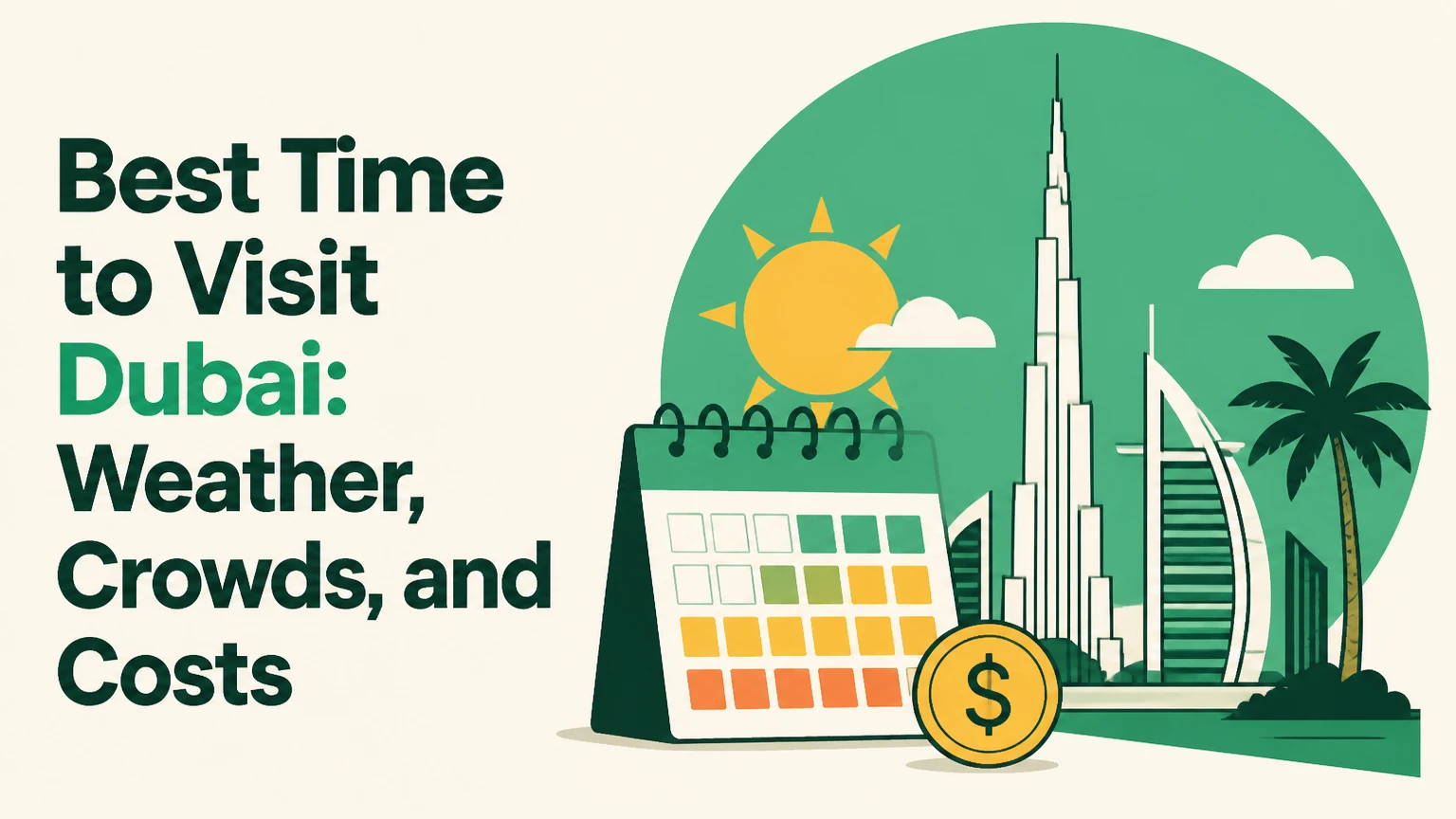
The best time to visit Dubai is generally November through February, when daytime temperatures usually sit around 24-30°C and outdoor sightseeing is most comfortable. Dubai is a subtropical desert destination with a hot, humid summer, a mild winter, and short shoulder periods in which prices, humidity, and attraction access change quickly.
Quick answer
Best overall: late November through February for walking, beaches, desert trips, and open-air attractions.
Best weather: December and January, with typical highs of 24-26°C and cooler evenings.
Best value with usable outdoor time: late April or early October, subject to heat tolerance.
Cheapest hotels: usually May through August, when typical rates can fall 50%-70% below peak pricing.
Best shopping: January during the Dubai Shopping Festival, although malls and hotels become busy.
Main booking warning: reserve Burj Khalifa, desert safaris, and popular restaurants several weeks ahead for December and January.
What Defines Dubai’s Travel Seasons?
Dubai’s travel seasons are defined by outdoor comfort rather than four traditional seasons. The city has a hot desert climate, very little rainfall, and a sharp difference between winter conditions that support long walks and summer conditions that push most itineraries indoors.
Dubai’s coolest period usually runs from December through February. Typical daytime highs range from 24-26°C, while nighttime temperatures commonly fall to 14-18°C, especially away from the coast. November and March remain highly usable, but temperatures begin moving toward the low 30s.


Humidity changes the practical experience. Coastal humidity can make a 35°C afternoon feel substantially more oppressive than a dry reading suggests, while air-conditioned malls, hotels, museums, and metro stations remain comfortable year-round. The UAE’s National Center of Meteorology describes the country’s climate as “arid to hyper-arid,” a useful explanation for why rain does not define Dubai’s calendar.
How Do Temperature and Humidity Affect Activities?
Temperature determines whether Dubai activities are enjoyable, while humidity determines how quickly heat becomes tiring. A forecast of 33°C may be manageable for a shaded beach resort, but uncomfortable for an unshaded walking route through Al Fahidi Historical Neighbourhood.
Winter weather supports outdoor plans from approximately 9:00 a.m. to 10:00 p.m. Summer requires a narrower schedule: outdoor activities should usually occur before 8:00 a.m. or after sunset, with indoor attractions placed between those windows.
| Condition | Typical Dubai range | Practical consequence | Better activity choice |
|---|---|---|---|
| Cool winter day | 20-26°C | Comfortable for several hours outside | Old Dubai, souks, walking tours |
| Warm shoulder day | 28-35°C | Outdoor plans need shade and breaks | Beach resort, short desert trip |
| Humid hot day | 35-40°C | Exertion becomes uncomfortable quickly | Mall, aquarium, museum |
| Summer extreme | 40-45°C+ | Midday outdoor sightseeing is unsuitable | Indoor attractions after early morning |
Beach conditions require a separate judgment. Gulf water often remains around 23-25°C in winter and can reach roughly 30-33°C in summer. Summer sea water is warm, but the sand, pavement, and air around the beach can make the journey and time between swims unpleasant.
Expert insight: Visitors often choose summer because the hotel pool is air-conditioned or shaded, then underestimate airport transfers, restaurant walks, and outdoor queues. Evaluate the entire door-to-door itinerary, not only the resort facilities.
Which Season Fits Your Trip?
November through February is peak travel season because it combines the broadest activity access with the least heat stress. March, April, September, and October are shoulder periods, although April and October can feel more like summer than winter by the afternoon.
May through August is the off-peak period for outdoor tourism. Dubai does not shut down, but the activity mix changes toward malls, aquariums, indoor theme parks, spas, restaurants, and hotel facilities.
| Season | Typical high | Hotel pricing pattern | Crowd pattern | Best for |
|---|---|---|---|---|
| November-February | 24-30°C | Highest, often full price | High, especially holidays | First visits and sightseeing |
| March-April | 28-36°C | Moderate to high | Moderate | Resorts and shorter outdoor plans |
| May-August | 38-45°C+ | Lowest, often 50%-70% less | Low at outdoor sites | Indoor luxury and budget stays |
| September-October | 33-39°C | Moderate, often discounted | Moderate | Value trips with evening plans |
Hotel discounts vary by neighborhood, event calendar, and school holidays, so the percentages are typical market patterns rather than guaranteed rates. Dubai Marina, Downtown Dubai, Palm Jumeirah, and Deira can follow different pricing curves during conventions and major sporting events.
When Is the Best Month for Sightseeing?
January is usually the strongest month for sightseeing because temperatures are mild, rainfall remains limited, and outdoor venues operate at full capacity. December offers similar conditions but can carry higher rates around Christmas, New Year’s Eve, and international school holidays.
February is a strong alternative when you want winter weather with slightly less festive pressure. November often provides the best reopening period for seasonal attractions, while March offers warm beach conditions before the hottest part of the year.
| Month | Typical daytime high | Planning profile | Main limitation |
|---|---|---|---|
| January | 24-25°C | Coolest sightseeing period | Peak prices and reservations |
| February | 25-26°C | Excellent all-round month | Some school-holiday demand |
| March | 28-30°C | Good beaches and tours | Afternoon warmth increases |
| April | 32-36°C | Value before summer peak | Humidity and heat arrive early |
| May | 37-40°C | Discounted indoor itinerary | Midday outdoor plans suffer |
| June-August | 40-45°C+ | Lowest rates and indoor comfort | Beach and walking discomfort |
| September | 38-40°C | Gradual improvement after summer | Humidity remains high |
| October | 35-38°C | Better evenings and shoulder rates | Daytime remains hot |
| November | 30-32°C | Seasonal attractions reopen | Demand rises quickly |
| December | 25-27°C | Festive, cool, and busy | Highest holiday pricing |
Temperatures vary by station and year. Rain is infrequent, but occasional winter showers can affect open-air venues and desert tracks without turning the whole trip into a washout.
When Are Dubai’s Attractions and Events Open?
Most major indoor attractions operate throughout the year, but seasonal outdoor venues follow cooler weather. Global Village and Dubai Miracle Garden typically operate during the cooler season, with exact opening and closing dates changing annually.
Dubai Shopping Festival generally runs across December and January, but its exact dates and promotions change each edition. Global Village, Miracle Garden, Dubai Garden Glow, concerts, conventions, and sporting events also publish annual schedules rather than fixed permanent calendars.
Plan around these categories:
- Seasonal outdoor venues: Global Village, Miracle Garden, Dubai Garden Glow, and some pop-up markets.
- Permanent indoor venues: Dubai Mall Aquarium, Museum of the Future, Ski Dubai, IMG Worlds of Adventure, and indoor observation decks.
- Weather-sensitive excursions: desert safaris, dhow cruises, walking tours, and mountain day trips.
- Calendar-sensitive events: Dubai Shopping Festival, Art Dubai, major conventions, Eid holidays, and New Year’s Eve.
Expert insight: New Year’s Eve is a special case. Downtown Dubai can have spectacular celebrations, but road closures, crowd-control zones, and minimum-stay hotel rules can make a short central-Dubai booking harder than the headline event suggests.
Book high-demand experiences after confirming the annual calendar. A venue can be open while a specific garden zone, fountain show, safari route, or restaurant operates on a reduced timetable.
When Are Hotels and Flights Cheapest?
Dubai accommodation is usually cheapest from May through August, when extreme heat suppresses leisure demand. Typical room reductions can reach 50%-70% compared with peak winter rates, but the lowest price may come with fewer outdoor hours and higher spending on taxis or indoor entertainment.
Late April and early October are useful compromise windows. They can offer lower room rates than winter while preserving comfortable mornings, evenings, and resort time. Flight prices depend more on departure market, school holidays, airline capacity, and booking lead time than on temperature alone.
| Travel window | Typical room-rate position | Typical booking lead | Value assessment |
|---|---|---|---|
| December 20-January 7 | Highest | 8-16 weeks | Expensive but weather-friendly |
| January-February | High | 6-12 weeks | Strongest sightseeing value |
| Late April | Moderate | 4-8 weeks | Good shoulder compromise |
| May-August | Lowest | 2-6 weeks | Best rates, restricted outdoors |
| Early October | Moderate-low | 4-8 weeks | Better evenings, hot afternoons |
| November | Rising | 6-10 weeks | Good weather before peak demand |
These are planning ranges, not guaranteed prices. Compare the total trip cost, including flights, room taxes, attraction tickets, transfers, and air-conditioned alternatives.
How Far Ahead Should You Book?
Use a staged booking process rather than reserving every activity immediately:
- Choose the month first. Check Ramadan, Eid, school holidays, conventions, and New Year’s restrictions.
- Book flights and accommodation. Secure peak-season rooms 8-16 weeks ahead, especially on Palm Jumeirah or near Downtown.
- Reserve fixed-capacity attractions. Book Burj Khalifa sunset slots, desert safaris, and Michelin-listed restaurants 2-6 weeks ahead.
- Build around heat. Put walking tours and outdoor markets in the morning during shoulder months.
- Keep flexible time. Leave one afternoon for weather, shopping, or a delayed transfer.
Burj Khalifa tickets often sell out at preferred sunset times before other times disappear. A morning entry may cost less or be easier to obtain, and it gives travelers more flexibility for the rest of the day.
What Is the Best Time for Beaches, Desert Safaris, and Walking?
The best beach and desert-safari conditions usually occur from November through March. Beaches remain usable beyond that period, but direct sun, hot surfaces, and warm Gulf water reduce comfort by late spring and summer.
Desert safaris are often scheduled in the late afternoon, yet summer heat still affects dune boarding, photography, and time outside the vehicle. Winter evening safaris can feel cool after sunset, particularly in open camps, so a light layer is practical.
| Activity | Best window | Acceptable alternative | Least comfortable period |
|---|---|---|---|
| Beach swimming | November-April | May and October mornings | June-August midday |
| Desert safari | November-March | April and October sunset tours | June-August before sunset |
| Old Dubai walking tour | December-February | November and March mornings | May-September midday |
| Outdoor dining | November-March | October and April after sunset | June-August exposed terraces |
| Burj Khalifa visit | Year-round | Morning in peak season | No major weather limit indoors |
A heat-aware itinerary should alternate exposure and recovery. For example, schedule Al Fahidi and the souks before lunch, then move to Dubai Mall or the Museum of the Future during the hottest hours.
How Does Ramadan Affect a Dubai Visit?
Ramadan changes daytime dining, public behavior, attraction schedules, and the rhythm of the city, but it does not make Dubai inaccessible. Dates move approximately 10-11 days earlier each Gregorian year because Ramadan follows the Islamic lunar calendar.
Restaurants may close or screen daytime service, while many reopen for evening meals and offer iftar menus after sunset. Alcohol service, entertainment, mall hours, and public performances can operate under special rules that vary by venue and year.
| Ramadan planning issue | What may change | Practical response |
|---|---|---|
| Daytime meals | Some restaurants restrict visible service | Confirm hotel and mall dining options |
| Malls | Later evening hours are common | Shop after iftar when transport is available |
| Attractions | Hours may shorten or shift | Check official schedules before visiting |
| Public conduct | Eating and drinking in public require care | Use designated private areas |
| Traffic | Evening congestion can increase | Allow 30-60 extra minutes after sunset |
Ramadan can be rewarding for travelers interested in food and culture, particularly when they plan around iftar and avoid rushed daytime schedules. Travelers seeking uninterrupted daytime dining should choose dates outside the holy month.
Dubai, Abu Dhabi, or Oman: Which Is Better?
Dubai is the strongest choice for dense urban entertainment, shopping, indoor attractions, and easy first-time logistics. Abu Dhabi follows a similar climate pattern but offers a quieter pace, while Oman provides mountains, wadis, and more varied natural terrain.
| Destination | Dubai travel time from airport hub | Signature experience | Summer advantage |
|---|---|---|---|
| Dubai | 15-45 minutes to central districts | Burj Khalifa, malls, beaches | Extensive indoor infrastructure |
| Abu Dhabi | 90-120 minutes by road from Dubai | Louvre Abu Dhabi, Sheikh Zayed Grand Mosque | Quieter resorts and museums |
| Muscat, Oman | Approximately 1 hour from Muscat airport | Mountains, forts, wadis | Natural landscapes and road trips |
| Salalah, Oman | Approximately 25 minutes to central Salalah | Khareef greenery and waterfalls | Monsoon-season landscapes |
Travel time depends on the airport, traffic, border procedures, and hotel location. Oman is not automatically cooler in every region, but mountain elevation and Salalah’s khareef season can provide a different summer experience from Dubai’s urban heat.
Choose Abu Dhabi for a slower cultural itinerary. Choose Oman when landscape matters more than malls, nightlife, and air-conditioned attractions.
What Should You Pack for Dubai Weather?
Pack breathable clothing for the day, a light layer for winter evenings, and clothing that covers shoulders and knees for religious or traditional settings. Desert camps, strongly air-conditioned malls, and mosque visits create different clothing requirements within the same day.
A practical packing list includes:
- Lightweight trousers, shirts, and sun-protective layers.
- Comfortable closed shoes for old-city pavements and desert excursions.
- A light sweater or overshirt from November through February.
- Sunglasses, high-SPF sunscreen, and a reusable water bottle.
- Swimwear for hotel pools and beaches.
- A scarf or shawl for mosque visits and stronger air conditioning.
- A universal travel adapter and medication kept in original packaging.
Winter nights rarely feel arctic, but 14-18°C can feel cool after a warm afternoon, especially on a dhow cruise or desert outing. Pack for the activity, not the average high alone.
Which Travel Window Fits Your Priorities?
The best travel window depends on whether your priority is comfort, price, beaches, shopping, or cultural timing. No month maximizes all five, because the coolest weather brings the highest demand and the lowest hotel rates coincide with the least comfortable outdoor conditions.
| Traveler priority | Recommended period | Avoid or reconsider | Reason |
|---|---|---|---|
| First-time sightseeing | January-February | July-August | Maximum outdoor access |
| Beach resort holiday | November-April | Peak summer afternoons | Better air and surface comfort |
| Budget luxury stay | May-August | December 20-January 7 | Deepest room discounts |
| Family with young children | November-February | June-August | Safer, easier outdoor transitions |
| Shopping and events | January | Quiet summer periods | Dubai Shopping Festival activity |
| Desert and photography | November-March | Humid summer evenings | Clearer, cooler conditions |
Families should value transfer times and stroller-friendly indoor routes as much as temperature. Couples can accept a hotter afternoon if a resort, spa, and restaurant-led itinerary is intentional. Solo travelers often gain more from winter because walking, public transport, and spontaneous neighborhood exploration are easier.
Common Planning Mistakes in Dubai
The most damaging mistake is treating a low hotel price as a complete bargain. Summer savings can be offset by indoor attraction tickets, frequent taxis, resort fees, and an itinerary that requires air-conditioned transport between every stop.
Other mistakes have predictable consequences:
- Booking a beach trip for July. The pool may be comfortable, but sand, loungers, and outdoor restaurant seating can become unpleasant by midday.
- Ignoring seasonal venue dates. Global Village and Miracle Garden do not necessarily operate during the hottest months.
- Choosing only summer clothing. Winter evenings and desert camps can feel cool.
- Leaving fixed attractions unbooked. Preferred Burj Khalifa times and popular safaris can disappear during January.
- Assuming Ramadan dates are fixed. Check the annual Islamic calendar and venue notices.
- Planning long walks without shade. Dubai’s connected roads and wide districts can create much more exposure than a map suggests.
Expert insight: Put outdoor attractions beside indoor ones geographically. A morning in Al Fahidi followed by Dubai Mall is more resilient than crossing the city repeatedly as heat rises.
Frequently Asked Questions About best time to visit Dubai
Is Dubai too hot to visit in July?
Dubai is usually too hot for extended midday sightseeing in July, when typical daytime highs reach 40-45°C or more and humidity can intensify discomfort. The city remains suitable for malls, museums, indoor theme parks, pools, spas, and evening dining, but desert and beach activities need early or late scheduling.
Can I swim in Dubai during winter?
You can swim in Dubai during winter, although Gulf water commonly sits around 23-25°C and may feel cool to some travelers. Hotel pools are often temperature-controlled, while air temperatures of 24-26°C support comfortable beach visits during sunny afternoons.
What is the rainiest month in Dubai?
Dubai’s rainfall is sparse and irregular, so one rainy month rarely disrupts an entire itinerary. Winter, particularly December through March, has the greatest chance of showers. Rain can briefly affect desert tracks, outdoor events, and driving, but most attractions remain accessible.
Is October a good month for a Dubai holiday?
October is a useful shoulder-season month for travelers who want lower rates than peak winter and improving evening conditions. Daytime highs commonly remain around 35-38°C, so schedule beaches, walks, and desert activities near sunrise or sunset and use indoor attractions during the afternoon.
How many days are enough for Dubai?
Four to five full days cover major districts, one desert excursion, a beach or resort day, and two indoor attractions without excessive transfers. Add two days for Abu Dhabi or a slower pace, especially when traveling with children or visiting during Ramadan.
Are Dubai attractions open during summer?
Most indoor Dubai attractions remain open during summer, including Dubai Mall Aquarium, Ski Dubai, the Museum of the Future, and indoor theme parks. Seasonal outdoor venues may close or publish shorter calendars, so verify Global Village, Miracle Garden, and temporary events before booking.
Conclusion
The best time to visit Dubai is November through February for reliable outdoor comfort, with January and February offering the strongest sightseeing conditions. Choose late April or early October for a warmer shoulder-season compromise, or May through August for the lowest hotel rates when an indoor-focused itinerary is acceptable. Check Ramadan, seasonal attraction dates, school holidays, and event schedules before paying for flights or fixed-time tickets.