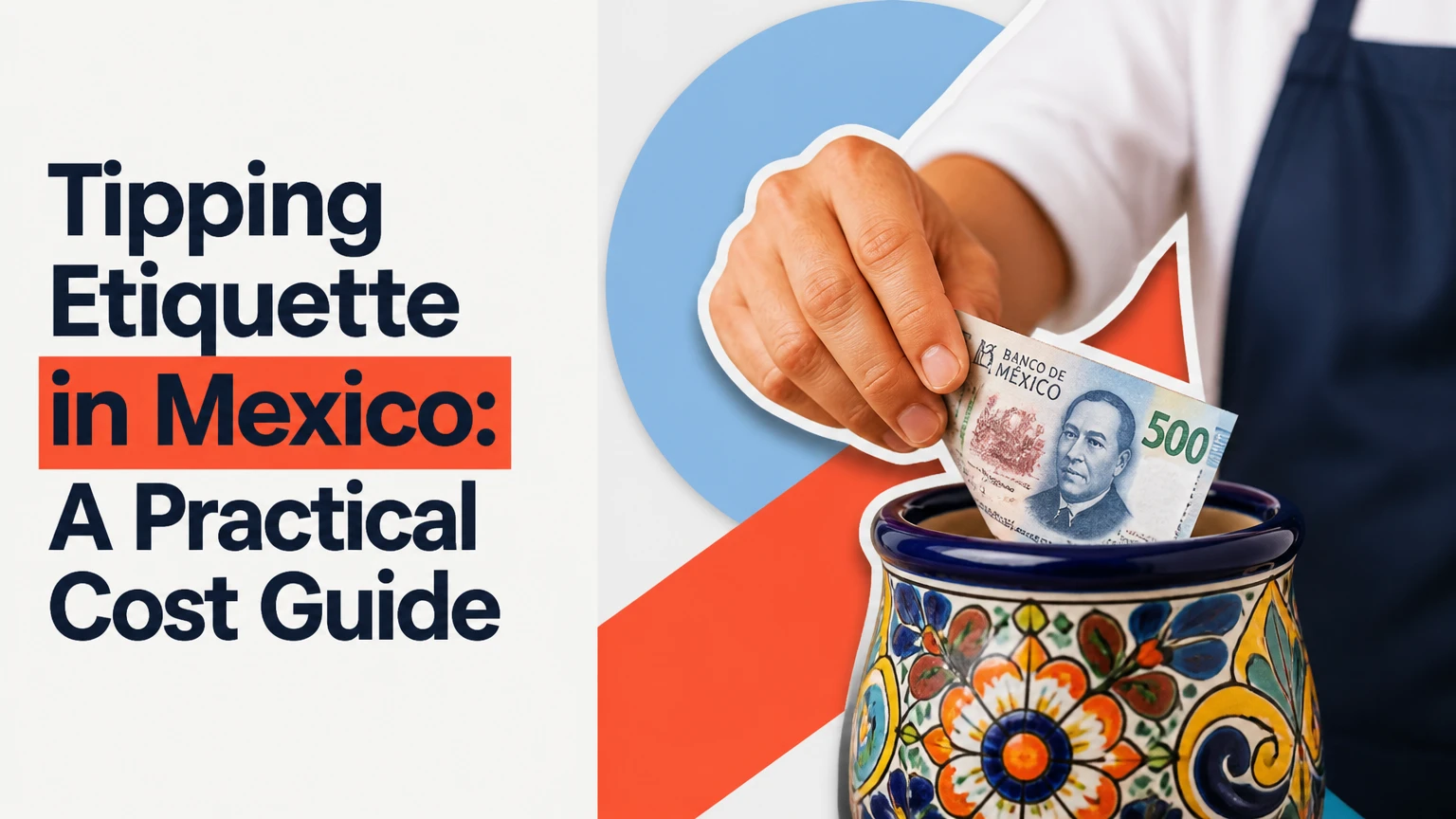
Tipping etiquette in Mexico is a voluntary payment custom that supports restaurant, hotel, transport, and tourism workers whose wages may not cover ordinary living costs. A restaurant tip of 10-15% is customary for satisfactory service, while 20% recognizes excellent service; smaller cash tips usually fit informal and personal services better.
Key Facts About Tipping in Mexico
- Leave 10-15% at a sit-down restaurant when service is satisfactory, and up to 20% for unusually good service.
- Check the bill for propina, servicio, or servicio incluido before adding anything.
- A 16% IVA line is value-added tax, not gratuity.
- Cash in Mexican pesos is the most reliable method, even when the main bill goes on a card.
- Housekeeping usually receives about $1.50-$5 per room per night, left daily rather than at checkout.
- Traditional taxis generally do not require a percentage tip; rounding up or adding about $1-$3 is enough when service merits it.
The amounts above are practical traveler ranges converted into approximate US dollars. Exchange rates change, so use the local peso equivalent at the time of payment rather than treating the dollar figures as fixed prices.
What Does Tipping Mean in Mexico?
Tipping in Mexico is called propina, and the custom applies most consistently to workers who provide personal service. Mexican consumer guidance commonly describes the gratuity as voluntary, while social expectations make a modest tip customary for restaurant servers, hotel staff, guides, and other service workers.


The legal and social questions are different. A customer can decline a gratuity, but refusing to recognize ordinary restaurant service may be perceived as inconsiderate because many hospitality workers depend on tips. A business also should not quietly convert a discretionary tip into an undisclosed mandatory charge.
The Procuraduría Federal del Consumidor, or PROFECO, has repeatedly communicated the short rule “La propina es voluntaria”, meaning “The tip is voluntary,” in consumer guidance. That principle does not mean every service is tip-free. It means the customer should be able to choose the amount after seeing the bill and assessing the service.
Mexico is not one uniform tipping market. A polished restaurant in Polanco, a family-run fonda in Oaxaca, and an all-inclusive resort in Riviera Maya may use different expectations. The safest approach is to combine the service type, the displayed bill, the location, and the quality of assistance.
How Much Should You Tip for Common Services?
A typical traveler can use the following table as a starting point. The dollar figures are approximate equivalents of commonly used peso amounts, calculated at roughly 17-18 pesos per US dollar; percentage recommendations are more stable than small cash denominations.
| Service | Typical amount in USD | When to give it | Practical benchmark |
|---|---|---|---|
| Sit-down restaurant | 10-20% of bill | After payment is checked | 10% acceptable, 15% customary, 20% excellent |
| Bar or lounge | $1-$3 per round | Each drink or final tab | 10-20% for an open account |
| Taquería or street-food counter | $0.25-$1.25 | At the counter | Round up or use the tip jar |
| Housekeeping | $1.50-$5 per night | Each morning or daily | Label it for housekeeping |
| Bellhop | $1-$3 per bag | When luggage reaches the room | Add more for heavy or numerous bags |
| Concierge | $3-$9 per substantial task | After the reservation or arrangement | Optional for simple directions |
| Grocery bagger | $0.25-$1.25 | After bags are packed | Amount depends on the number of bags |
| Gas attendant | $0.25-$1.25 | After fueling or windshield cleaning | More for extra assistance |
| Group tour guide | $6-$12 per person | At the tour’s end | About 10-15% of tour price |
| Private guide | $12-$35 per day | At the final handoff | About 15-20% for excellent work |
| Spa or salon | 10-20% of bill | After the treatment | Confirm whether staff share tips |
| Traditional taxi | $0-$3 | At the destination | Round up for convenience or luggage help |
| Uber or DiDi | $0-$3 | Through the app or in cash | Optional, especially for short rides |
These are not mandatory tariffs. A $2 tip can be generous for a short, simple service and inadequate for a long private transfer involving luggage, waiting, or itinerary changes. Tip the person who performed the work when possible, and ask whether a restaurant or hotel pools gratuities among staff.
Restaurant and Bar Gratuity
Mexican restaurants commonly receive 10-15% for satisfactory service, with 20% reserved for attentive service, difficult requests, or an especially good overall experience. A 5% tip is not a normal substitute for 10% when service was ordinary, although a serious service failure can justify reducing or withholding it.
Calculate the percentage on the final food and beverage subtotal, unless the establishment clearly presents another convention. Because IVA is generally 16%, a bill showing subtotal, IVA, and total can make the calculation confusing. The tax is not a service payment.
For example, on a $60 restaurant bill before tax, 10% is $6, 15% is $9, and 20% is $12. If the printed total already includes a clearly disclosed service charge, do not automatically add another full percentage.
At bars, leave about $1-$3 per round when paying separately. For an open tab, 10-20% of the beverage total is simpler. Cash helps when several bartenders share shifts, but ask whether the establishment adds card tips to the staff pool.
Informal Food, Retail, and Fuel Services
Street-food vendors and taquerías do not follow the same rule as full-service restaurants. A visible tip jar may receive a few coins or about $0.25-$1.25, while a simple purchase with no table service requires no percentage tip.
Grocery baggers, called cerillos in many Mexican stores, may receive small cash amounts after packing purchases. The practice varies by chain and city. At some stores the workers are older adults; at others they are young people or individuals participating in a store-supported program. Ask at the checkout if you are unsure.
Gas stations in Mexico commonly use attendants rather than self-service pumps. A small tip of about $0.25-$1.25 is customary when the attendant fills the tank, checks fluids, or cleans the windshield. The tip does not replace checking the pump display and counting change.
When Should You Tip Hotels, Guides, and Drivers?
Hotel and tourism tips should match time, physical effort, and responsibility rather than a single universal percentage. Housekeepers, porters, drivers, and guides often perform work that the guest does not see, so the payment method and timing affect whether the intended worker receives it.
| Hotel or tourism service | Typical USD amount | Timing | Adjustment |
|---|---|---|---|
| Housekeeping | $1.50-$5 per night | Daily, before leaving | Increase for a suite, children, or heavy cleaning |
| Bellhop | $1-$3 per bag | On room delivery | Increase for stairs, oversized luggage, or long waits |
| Room service delivery | $1-$5 | When food arrives | Check whether a service charge appears |
| Concierge | $3-$9 per major task | After completion | No tip required for ordinary directions |
| Group guide | $6-$12 per traveler | End of excursion | Increase for exceptional interpretation or logistics |
| Private guide | $12-$35 per day | End of assignment | Base on duration, preparation, and group size |
| Private driver | $5-$15 per transfer | At destination | Increase for waiting, luggage, or multiple stops |
| Airport shuttle | $1-$3 per bag or passenger | After unloading | Follow the company’s stated policy if provided |
Leave housekeeping money in a marked envelope or beside a note that says propina para limpieza. Daily payment matters because room attendants can rotate by floor, shift, or day. A lump sum left at checkout may reach a different employee or remain undistributed.
A concierge does not need payment for every recommendation. Tip for arranging a difficult restaurant reservation, solving a transport problem, organizing a private excursion, or handling a complex request. A bellhop’s amount should reflect the number and weight of bags, not the room rate.
Tour guides and private drivers deserve a larger absolute amount when they spend an entire day with a small group. A 15% tip on a $300 private tour is $45, but a $12-$20 personal gratuity may be reasonable for a short, basic excursion with little additional planning.
How Do You Pay a Tip in Mexico?
Cash in Mexican pesos is the most dependable form of gratuity because small service providers may not have a card terminal or may receive card distributions later. Travelers can pay the main bill by card and leave the tip in cash, provided the establishment does not already include a service charge.
| Payment method | Best use | Typical processing issue | Recommended action |
|---|---|---|---|
| Peso cash | Small services and housekeeping | Requires small denominations | Carry $1, $2, and $3 equivalents |
| Card terminal | Restaurants and formal businesses | Tip can be entered before authorization | Inspect percentage and total before paying |
| In-app tip | Uber, DiDi, delivery apps | Availability varies by account and city | Add it after the ride or delivery |
| US dollar cash | Resort-heavy tourist areas | Exchange and acceptance vary | Use only when the worker agrees |
| Foreign coins | Almost nowhere | Often impossible to exchange | Do not leave coins as gratuity |
When a server brings a terminal, ask for the tip percentage before entering a PIN or approving contactless payment. Review the displayed total, because percentage buttons can produce a different amount from the number discussed verbally. Request a printed or electronic receipt.
Some terminals display 10%, 15%, and 20% buttons; others ask for a peso amount. A customer may say “Quince por ciento, por favor” for 15% or “Sin propina, gracias” when declining. If a tip appears without consent, ask the server or manager to remove it before authorization.
Keep cash private and organized. Large notes can be difficult for a small vendor to change, and showing a full wallet creates an unnecessary security risk. Break larger notes at a supermarket, hotel reception, or established café, then carry only the amount needed for the next few interactions.
Should You Tip in Pesos or US Dollars?
Pesos are the preferred currency for gratuities because workers can spend them immediately without exchange costs. US dollars may be accepted in resort corridors, but dollar bills can create inconvenience, uncertain conversion rates, and difficulty making change.
Foreign coins are particularly poor tips. Banks and exchange houses generally do not treat small foreign coins as practical currency, so a handful of leftover coins may have no usable value to the recipient. US dollar bills are more useful than coins, but they still do not guarantee fair conversion.
| Currency choice | Worker’s likely convenience | Traveler’s risk | Best decision |
|---|---|---|---|
| Mexican peso notes | High | Requires planning small bills | Preferred in every region |
| Mexican peso coins | High for small tips | Can accumulate in pockets | Useful at counters and parking areas |
| US dollar bills | Medium in resorts | Exchange rate and change problems | Backup only when requested |
| US dollar coins | Very low | Usually unusable | Do not leave them |
| Canadian or euro coins | Very low | Usually unusable | Exchange before traveling or keep them |
The practical limitation is that many travelers do not know the current peso conversion. Use a phone calculator, round modestly upward, and confirm the note before handing it over. A slightly imperfect conversion is less harmful than giving a foreign coin with no local spending value.
How Does Location Change the Expected Tip?
Tourist destinations usually expose workers to stronger foreign tipping habits and higher operating costs, so 15% is more firmly expected in resort restaurants and upscale venues. Interior cities retain the same basic customs, but informal venues may accept smaller cash amounts and may not present percentage buttons.
| Location | Restaurant norm | Small-service norm | Planning note |
|---|---|---|---|
| Cancún hotel zone | 15-20% | $1-$3 per service | Confirm included resort charges |
| Riviera Maya | 15-20% | $1-$5 for resort staff | Keep daily cash available |
| Los Cabos | 15-20% | $1-$5 for luggage and drivers | Private transfers cost more |
| Mexico City | 10-15% | Round up or $1-$3 | Card payment is common in formal venues |
| Oaxaca City | 10-15% | Coins or $0.25-$2 | Informal food often uses tip jars |
| Puebla | 10-15% | Small cash amounts | Ask before tipping unusual services |
| Rural or small-town areas | 10-15% where service is provided | $0.25-$2 | Carry change and do not assume terminals exist |
Location changes the amount less than the setting does. A high-end restaurant in Puebla can have the same expectations as one in Mexico City, while a casual market stall in Cancún may not require a tip. Price level, formality, and personal service remain the better predictors.
Mexico City restaurants may add a suggested percentage to the terminal screen, but suggestions are not automatically obligations. In Oaxaca and Puebla, travelers often encounter smaller independent businesses where a tip jar, cash rounding, or direct verbal thanks is more appropriate.
What Changes at an All-Inclusive Resort?
An all-inclusive resort may advertise that gratuities are included, which generally means the room package funds a shared compensation system rather than prohibiting additional tips. Guests do not need to tip every interaction, but small voluntary payments can recognize unusually attentive service.
The resort’s written policy controls. Some properties discourage cash because they distribute service charges through payroll; others permit or quietly expect individual gratuities. Ask the front desk whether cash tips are allowed and whether a service charge is pooled.
A reasonable daily plan for two adults is:
- Carry about $10-$20 in small peso-equivalent cash.
- Leave $1-$3 for breakfast or lunch table service when attentive.
- Give about $1-$3 per round to a pool or beach server when service is personalized.
- Leave $2-$5 for housekeeping each day in a marked envelope.
- Tip $3-$10 for substantial luggage, concierge, or transport assistance.
That plan is optional and should not become a pay-to-play requirement. A worker who withholds ordinary service because a guest did not tip is behaving improperly, while a guest who offers a modest gratuity after attentive work is following local hospitality practice.
What Happens If a Tip Is Already on the Bill?
A customer should inspect every restaurant bill before paying because a suggested gratuity, disclosed service charge, and tax have different meanings. If propina incluida or servicio incluido appears, ask whether the amount is already included and whether it goes to staff.
| Bill line | Meaning | Example on a $50 subtotal | Customer response |
|---|---|---|---|
| Subtotal | Food and drinks before tax | $50 | Use it to calculate a voluntary tip |
| IVA | Value-added tax | $8 at 16% | Do not treat it as gratuity |
| Servicio incluido | Disclosed service charge | Varies by venue | Ask who receives it |
| Propina sugerida | Suggested tip | 10%, 15%, or 20% | Accept, change, or decline |
| Total | Amount charged | $58 before any tip | Verify against the terminal |
A 16% IVA on a $50 subtotal equals $8, producing a $58 total before gratuity. A 15% tip calculated on the subtotal equals $7.50. If the terminal calculates the tip on the post-tax total, the result is $8.70, so check which base the machine uses.
PROFECO is the relevant Mexican consumer agency for complaints about misleading or coercive charges. Start with a calm request for an itemized bill and removal of any unauthorized amount. If the business refuses, document the receipt, date, location, and payment record before contacting consumer authorities or your card issuer.
Do not confuse a suggested tip with fraud. A printed recommendation can be legitimate when it is clearly labeled and optional. The problem is an undisclosed charge, a falsely mandatory gratuity, or a terminal amount that differs from the customer’s authorization.
How Should You Handle Poor or Exceptional Service?
Tipping is feedback as well as money, so the amount should reflect the actual service rather than guilt, nationality, or the low conversion value of a dollar. Speak to a manager when a serious problem needs correction, because silently changing the tip may not resolve a billing error or safety issue.
Use this decision process:
- Check whether a service charge or tip is already included.
- Identify the person or team who performed the service.
- Rate the work: inadequate, satisfactory, very good, or exceptional.
- Apply the relevant range, usually 10%, 15%, or 20% for restaurants.
- Subtract unauthorized charges rather than paying twice.
- Give cash directly when the intended recipient may not control card distributions.
- Request a receipt and confirm the final total.
A 10% restaurant tip can acknowledge acceptable service with delays or minor mistakes. About 15% fits competent, attentive service. Up to 20% suits excellent service, complex accommodations, or a staff member who solved a significant problem.
The most common traveler error is over-tipping because a 20% amount looks inexpensive after currency conversion. Large gratuities can alter local price expectations and create unfair differences between foreign and domestic customers. Generosity is welcome, but predictable and proportionate payment is more respectful.
Expert Rules That Prevent Tipping Problems
Expert insight 1: Daily payment beats a large final payment for housekeeping. Room assignments change, and a checkout envelope may not reach the people who cleaned the room on earlier nights. A labeled daily envelope creates a clearer link between work and payment.
Expert insight 2: The payment terminal is part of the bill. Travelers often watch the printed receipt but ignore the terminal screen, even though the terminal may calculate a percentage from a different base or retain a preselected tip. Inspect the amount before authorizing.
Expert insight 3: Service intensity predicts the tip better than the venue’s tourist status. A private driver waiting two hours, carrying luggage, and making several stops has performed more work than a short taxi ride, regardless of whether the trip occurred in Cancún or a smaller city.
Other small interactions may arise during a trip:
- Parking attendants, or viene-vienes: about $0.25-$1 for directing a difficult parking maneuver or watching a vehicle.
- Public restroom attendants: about $0.25-$1 where an attendant supplies paper or maintains the facility.
- Food delivery couriers: about $1-$3 for ordinary delivery, with more for distance, rain, stairs, or a large order.
- Coat checks: about $0.50-$2 when a staffed venue provides the service.
- Musicians or performers: optional, with the amount based on enjoyment rather than a fixed percentage.
- Airport porters: about $1-$3 per bag when the worker handles luggage.
No tip is owed for a cashier who only processes a normal purchase, a taxi driver who provides an ordinary ride without extra assistance, or a self-service transaction with no personal labor.
Mexico Compared With the United States and Europe
Mexico combines a service-sector tipping expectation with lower cash denominations and more variable payment systems. The United States often presents 18-25% restaurant suggestions, while many European destinations include service in prices or treat gratuity as a smaller rounding gesture.
| Feature | Mexico | United States | Much of Europe |
|---|---|---|---|
| Restaurant baseline | 10-15% | 18-25% commonly displayed | Often 0-10% or rounding |
| Legal character | Voluntary gratuity | Voluntary, local rules vary | Voluntary, service may be included |
| Common payment issue | Tip terminal and cash availability | Suggested terminal percentages | Service charge wording |
| Currency concern | Peso notes and coins | US dollars | Local euro or national currency |
| Housekeeping practice | Daily cash is practical | Daily or final, hotel-dependent | Often optional or modest |
| Taxi expectation | Round up or optional | 10-20% common | Round up or small percentage |
The comparison is a planning tool, not a rule that overrides the Mexican venue. A US traveler should not automatically transfer a 20-25% habit to every purchase, while a European traveler should not assume restaurant service is always bundled into the price.
Frequently Asked Questions About tipping etiquette in Mexico
Is 10% a good tip in Mexico?
A 10% restaurant tip is generally appropriate for satisfactory service, especially in a casual venue or interior city. About 15% better matches attentive service, while 20% fits exceptional work. Check for an existing service charge first, because adding 10% to an already disclosed gratuity may pay twice.
Can I refuse to pay a tip in Mexico?
Yes, a discretionary tip can be refused because Mexican consumer guidance treats propina as voluntary. Refusal may still be socially uncomfortable after ordinary restaurant service, particularly where workers depend on gratuities. If a business adds an undisclosed mandatory amount, request an itemized bill and ask for correction.
Do I tip taxi drivers in Mexico City?
Traditional taxi drivers in Mexico City do not normally require a percentage gratuity. Round up a small fare or add about $1-$3 when the driver handles luggage, waits during a stop, navigates difficult traffic, or provides unusually helpful assistance. App-based tipping remains optional.
Should I tip Uber drivers in Mexico?
Uber tipping in Mexico is optional and may be available through the application after the trip. About $1-$3 suits a clean, punctual ride, airport luggage help, or difficult navigation. A short ordinary trip does not require a tip, and the fare itself remains the required payment.
How much should I tip a private chef or villa staff?
A private chef or villa team can receive about 10-20% of the food or service fee when the contract does not include gratuity. Confirm whether staff share the payment, whether a management fee is separate, and whether the amount should go to the agency or directly to workers.
Is it better to tip at the beginning of a hotel stay?
An early tip may help establish a friendly relationship, but it does not guarantee better service and should never be necessary for ordinary treatment. Daily housekeeping payment, a bellhop tip after delivery, and a final guide or driver tip after completed work create clearer links between service and recognition.
Conclusion: A Simple Rule for Tipping Etiquette in Mexico
Tipping etiquette in Mexico is easiest when you check the bill, use Mexican pesos, and match the amount to the work performed. Plan on 10-15% for satisfactory restaurant service, 20% for exceptional service, $1.50-$5 per night for housekeeping, and modest cash amounts for porters, guides, drivers, and informal services. Gratuity is voluntary, but thoughtful payment remains an important part of the country’s service economy.