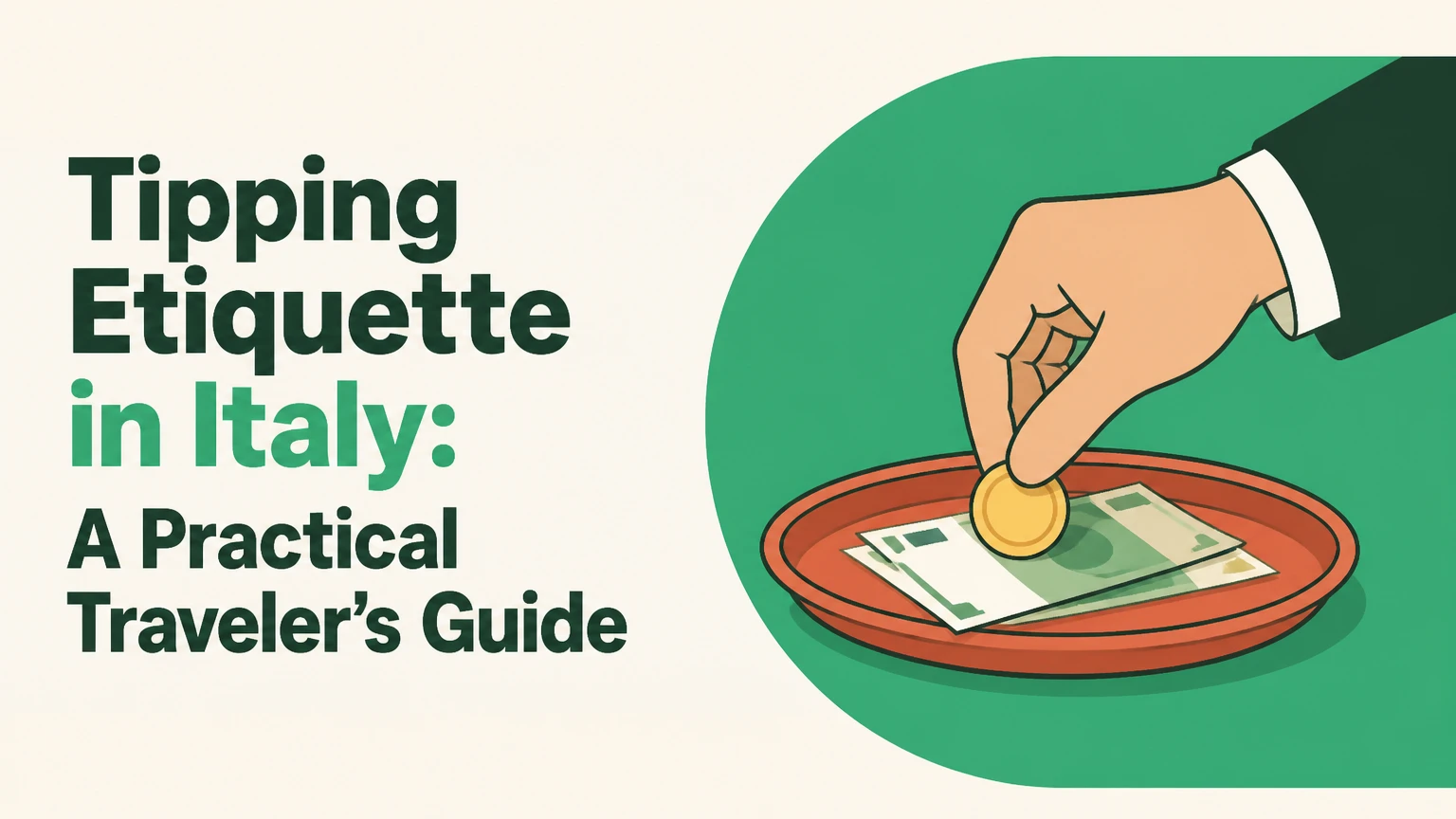
Tipping etiquette in Italy is a voluntary way to reward service, not a required percentage added to every purchase. In restaurants, cafés, taxis, hotels, and tours, the appropriate amount ranges from nothing to about 10% in exceptional cases, while listed charges such as coperto and servizio must be treated separately.
Key Facts / Quick Answer
Italian restaurants do not require a tip when service is ordinary; rounding up or leaving the local equivalent of $1-$2 per person is a generous response to good service.
A coperto is a per-person cover charge, commonly about $1-$4, and is not money paid directly to the server.
A listed servizio charge, often 10%-20% for large parties or tourist-oriented restaurants, is already a service payment.
Counter-service espresso normally receives no tip. Rounding up by about $0.10-$0.50 is optional.
Taxi drivers do not expect a percentage. Rounding a $18.50 fare to $20 is a practical gesture.
Cash remains the clearest method, although some Italian card terminals now display optional tipping prompts.
What Is Tipping Etiquette in Italy?
Tipping etiquette in Italy is a low-pressure custom shaped by local wages, inclusive menu pricing, and a cultural preference for appreciation over obligation. Italian National Tourist Board visitor guidance summarizes the norm as “tipping is not compulsory,” although restaurants, guides, and hotel staff may welcome a modest amount for unusually helpful service.
The phrase “fair wages” needs context. Italy has no single national minimum wage, pay varies by collective labor agreement and region, and hospitality workers can still earn modest incomes. The practical conclusion is not that every worker is highly paid. The conclusion is that travelers are generally not expected to calculate a North American-style wage replacement on every bill.


Service may also look different. A waiter might allow a table to remain occupied after the meal, avoid repeated check-ins, or bring the check only after a request. Those behaviors usually indicate Italian dining norms rather than neglect. Judge the complete interaction, including accuracy, courtesy, problem-solving, and extra effort.
Italy Versus North American Tipping
Italy and the United States use different default assumptions about gratuity. A 15%-25% restaurant tip is common in the United States, while the same percentage in Italy can look conspicuously generous and may cause confusion when a service charge already appears.
| Situation | Typical Italian response | Typical North American response | Practical consequence |
|---|---|---|---|
| Standard restaurant meal | $0 | 15%-20% | Check the bill before adding anything |
| Very good casual service | $1-$2 per person | 18%-22% | Cash rounding is sufficient in Italy |
| Exceptional fine dining | 5%-10% | 20%-25% | Italian percentage is an upper-end gesture |
| Taxi fare | Round to next $1-$2 | 10%-20% | Percentage tipping is unnecessary |
| Hotel porter | $1-$2 per bag | $2-$5 per bag | Amount depends on luggage and assistance |
Italy’s lower tipping expectation does not mean service lacks value. It means the price structure, employment system, and social convention place less responsibility on the customer to determine a worker’s income after service has been delivered.
How Much Should You Tip at Italian Restaurants?
For a normal restaurant or trattoria meal, leaving no tip is acceptable. When service is warm, efficient, or especially helpful, round up the bill or leave the local equivalent of $1-$2 per person; reserve 5%-10% for genuinely exceptional service, particularly when no service charge is listed.
A $47 bill could become $50 after excellent service. A $92 bill for two people might justify $4-$6 in cash. A flawless tasting menu with thoughtful explanations and careful accommodation of dietary needs could merit 5%, while 10% is already unusually generous.
Italian dining bills often contain charges that travelers mistake for gratuities. Read the receipt and the menu before deciding.
| Bill item | Common basis | Typical amount in USD | What the charge means |
|---|---|---|---|
| Coperto | Per diner | $1-$4 each | Table setting, bread, or seating charge |
| Servizio | Percentage | 10%-20% | Listed service charge retained under restaurant policy |
| Bread charge | Per diner or table | $1-$4 each | Separate bread or basket charge |
| Voluntary gratuity | Customer choice | $0-$10 typical | Extra appreciation for staff |
| Tasting-menu supplement | Fixed menu item | $20-$80 | Food or beverage price, not a tip |
Coperto and Servizio Are Not the Same
A coperto is usually a per-person table or cover charge. It may help cover bread, linens, cutlery, or the cost of occupying a table, and its treatment varies by municipality and regional rules. It is not a payment handed directly to the server.
Servizio is a service charge, normally shown as a percentage or fixed amount. A restaurant should disclose required charges in its menu or pricing information, especially when the fee applies to a particular group size or dining area. If the bill includes servizio incluso, an additional tip is optional rather than required.
The most useful distinction is simple: coperto answers “what does sitting at this table cost?” Servizio answers “what listed service charge has this restaurant added?” Neither automatically tells you whether staff receive a voluntary gratuity.
What If Service Is Poor?
Poor service does not require a tip in Italy. Pay the correct listed bill, ask for an explanation of any unexpected charge, and speak to the manager if the problem involves a serious error, discrimination, unsafe food, or an undisclosed fee.
A slow meal is not automatically poor service because long meals and delayed courses can be normal. A missing reservation, repeated incorrect dishes, or dismissive treatment is more relevant. If a restaurant has already included servizio, request clarification before disputing the charge, because the fee may be an advertised condition rather than a discretionary tip.
How Do You Tip at Italian Cafés and Bars?
At an Italian café, counter service does not require a gratuity. Customers who drink espresso al banco often pay the posted price, collect the receipt, and leave; rounding up by the local equivalent of $0.10-$0.50 is a small optional gesture, not a social obligation.
Table service is different in price but not necessarily in tipping expectation. A coffee or pastry consumed al tavolo may cost substantially more because seating and table service are built into the menu price. The higher price is not evidence that an additional percentage tip is due.
| Café setting | Typical purchase price in USD | Normal tip | Payment action |
|---|---|---|---|
| Counter espresso | $1-$3 | $0 | Pay at register or counter |
| Counter pastry and coffee | $3-$7 | $0-$0.50 | Leave small change if desired |
| Seated coffee | $4-$10 | $0 | Pay listed table-service price |
| Aperitivo at a table | $8-$20 | $0-$2 | Round up for attentive service |
The word bar often means café in Italy, not a place focused only on alcoholic drinks. At a crowded counter, move away after collecting your order so other customers can reach the serving area. Courtesy and speed matter more than leaving coins.
Should You Tip Italian Taxi Drivers?
Italian taxi drivers do not expect a percentage tip. The customary response is to pay the metered or quoted fare and, if convenient, round up by the local equivalent of $1-$2, especially when the driver handles luggage, navigates a difficult address, or waits briefly for a passenger.
For an $18.50 fare, handing over $20 and saying “tenga il resto,” meaning “keep the change,” is clear. For a $36 fare, paying $40 is optional and more generous than ordinary rounding. Do not feel compelled to tip because a payment application displays a percentage prompt.
| Taxi situation | Fare example in USD | Appropriate action | Extra amount |
|---|---|---|---|
| Short city ride | $12.40 | Pay exact fare or round | $0-$1 |
| Airport ride with luggage | $34.80 | Round for assistance | $1-$3 |
| Long ride with traffic delays | $68.00 | Pay fare; tip only for extra effort | $0-$5 |
| Private car transfer | $92.00 | Follow booked-service policy | $0-$10 |
| App-based ride | $22.60 | Use cash or optional app function | $0-$2 |
Licensed taxis, private transfers, and app-based rides can follow different payment systems. A prebooked chauffeur service may already include a driver fee, airport supplement, tolls, or booking charge. Ask what the quoted price includes before deciding whether additional cash is appropriate.
What Should You Tip at Italian Hotels?
Hotel tipping in Italy is optional and task-based. A porter who carries luggage commonly receives the local equivalent of $1-$2 per bag, housekeeping may receive $1-$2 per occupied day, and a concierge merits about $5-$15 only after arranging a difficult or unusually valuable request.
Leave housekeeping money daily rather than only at checkout. Staff schedules can change, and a lump sum may not reach the people who cleaned the room. Put cash in a marked envelope or beside a brief note labeled “housekeeping,” because loose money can be mistaken for personal funds.
| Hotel service | Typical amount in USD | When to give it | Useful note |
|---|---|---|---|
| Porter, one light bag | $1-$2 per bag | After delivery | Increase for stairs or distant rooms |
| Porter, several heavy bags | $3-$10 total | After the task | Consider mobility or family assistance |
| Housekeeping | $1-$2 per day | Each morning or daily | Mark the envelope clearly |
| Room service delivery | $1-$3 | At delivery | Check whether a service fee appears |
| Concierge reservation | $5-$15 | After completion | Reserve for difficult requests |
| Valet or parking attendant | $1-$5 | At vehicle return | Follow the hotel’s stated process |
A concierge who prints a museum address has performed a normal duty. A concierge who secures a fully booked restaurant, replaces lost travel documents, or coordinates urgent medical transportation has provided a stronger reason for a gratuity. Monetary appreciation should follow effort and outcome.
How Much Should You Tip Tour Guides?
Tour guides in Italy receive optional gratuities based on the tour’s length, personalization, language, and group size. A free walking tour commonly receives the local equivalent of $5-$15 per person, while a private or paid tour may receive $10-$25 total for a standard outing when the guide delivered excellent service.
“Free” walking tours are usually pay-what-you-think arrangements rather than genuinely cost-free businesses. The guide may rely on end-of-tour contributions, so $5 is modest, $10 is common for a strong two-hour experience, and $15 or more reflects exceptional storytelling or unusually small groups.
| Tour type | Duration | Typical gratuity in USD | Main deciding factor |
|---|---|---|---|
| Free city walk | 1.5-2.5 hours | $5-$15 per person | Quality and group size |
| Paid group tour | 2-4 hours | $0-$10 per person | Whether service is already premium-priced |
| Private city guide | 3-4 hours | $10-$25 total | Customization and expertise |
| Full-day private tour | 7-9 hours | $25-$75 total | Planning, transport, and problem-solving |
| Specialist guide | 2-5 hours | $15-$50 total | Access, language, or technical knowledge |
Before tipping, check whether a booking platform adds a guide fee, gratuity, or “service charge.” A platform’s fee may support the company rather than the guide. Ask directly, “Is the guide fee included?” The answer helps you avoid both underpayment and accidental duplication.
When and How Should You Pay a Tip?
The easiest way to tip in Italy is to carry small cash, wait until the service ends, and state clearly whether the amount is a voluntary gratuity or simply rounded payment. Restaurants generally receive cash on the table or at the cashier, while taxis, porters, and guides receive payment immediately after the service.
- Check the menu and receipt for coperto, servizio, bread, and room-service charges.
- Assess the service against the setting, group size, complexity, and outcome.
- Choose an amount in whole local denominations, usually the equivalent of $1-$2 for ordinary appreciation.
- Pay the bill first and make the gratuity clear, either in cash or through the terminal’s optional function.
- Say “grazie” and, for a meal, “era buonissimo,” meaning “it was delicious.”
- Keep the receipt until you confirm that the charged amount matches the displayed total.
Cash is still the least ambiguous option, but card tipping is becoming more available. Some terminals now display “tip,” “mancia,” or percentage buttons, particularly in hotels, organized tours, and restaurants serving international visitors. A prompt is not proof that a tip is expected.
How Do You Tip by Card?
If an Italian terminal offers a gratuity screen, select zero when you do not wish to tip, or choose a fixed amount that matches your intention. If no prompt appears, ask whether the business can add a specific tip, but do not assume the server can alter a completed card transaction.
Never hand over your card or disclose a PIN merely to leave a gratuity. If the terminal presents 10%, 15%, and 20% options, look for a custom amount or decline the screen. A percentage interface often reflects payment software, not Italian social expectations.
What Changes by City, Region, or Restaurant Type?
The national norm is consistent, but tourist concentration and venue type change how often staff encounter tipping. Venice, Rome, Florence, Milan, and the Amalfi Coast may have more optional prompts, English-language menus, and service charges than a small neighborhood restaurant in Umbria or Puglia.
Regional law and local business practice also affect coperto. Some municipalities or historic centers apply specific restrictions or disclosure requirements, while restaurants elsewhere use the charge routinely. The traveler should rely on the current menu and receipt rather than an absolute rule about every part of Italy.
| Setting | Typical gratuity in USD | Charge to inspect | Practical approach |
|---|---|---|---|
| Neighborhood trattoria | $0-$4 per table | Coperto | Round up after good service |
| Tourist-center restaurant | $0-$10 per table | Servizio incluso | Confirm percentage before paying |
| Michelin-style dining | $0-$10% | Tasting-menu service policy | Reward exceptional attention only |
| Beach club or resort | $0-$5 | Seat, umbrella, or service fee | Follow posted policy |
| Wine bar or enoteca | $0-$2 | Table-service price | Small rounding is enough |
Luxury restaurants may have stronger internal compensation systems and formal service charges. A high bill does not automatically produce a higher expected tip. A $300 meal with a 10% listed service charge does not need another $30 unless you deliberately want to recognize extraordinary service.
What Are the Most Common Tipping Mistakes?
The most common mistakes are importing a 20% default, confusing a cover charge with a gratuity, and treating a card-terminal prompt as a local requirement. These errors increase travel costs and can create awkward conversations, whereas a modest cash gesture communicates appreciation without changing the transaction’s meaning.
Practical Situations Travelers Misread
- A waiter does not repeatedly check the table: Italian dining often prioritizes privacy and an unhurried meal.
- Bread appears automatically: The receipt may list a bread charge or include it within coperto.
- A terminal requests 15%: The software may target international customers; declining is acceptable.
- A driver refuses extra money: Pay the fare and thank the driver without insisting.
- A tour is advertised as free: The guide may depend on voluntary end-of-tour contributions.
- A restaurant says service is included: Ask whether that means servizio appears as a separate line or is built into prices.
Expert insight: A large percentage tip can be less culturally precise than a small fixed amount. Leaving the local equivalent of $4 after a $160 meal may communicate thoughtful appreciation, while an automatic $32 payment suggests the traveler followed a foreign template without reading the bill.
Expert insight: Housekeeping is the hotel role most likely to be missed because the worker is invisible. Daily labeling matters more than leaving a larger amount at departure, especially in properties with rotating shifts or outsourced cleaning teams.
Expert insight: “No tip expected” does not mean “never tip.” Italian workers commonly accept sincere, proportionate appreciation when they solve a problem, accommodate a disability, manage a complicated group, or provide expertise beyond the advertised service.
Frequently Asked Questions About tipping etiquette in Italy
Is it rude to leave no tip in Italy?
No. Leaving no tip is socially acceptable after ordinary service, particularly when the bill includes servizio or the venue is a counter-service café. A customer who leaves nothing but says “grazie” has followed local practice. A small cash amount is appropriate when service was notably attentive or helpful.
Can restaurants in Italy force customers to pay a service charge?
A restaurant may apply a required service charge when the charge and conditions are disclosed in its menu or pricing information. Ask the staff to explain an unexpected line. A voluntary gratuity is different from servizio, and the two should not be presented as identical charges.
Should I tip for food delivery in Italy?
Food-delivery tipping is optional. Round up by the local equivalent of $1-$3 when a courier handles bad weather, a difficult building, heavy items, or a long wait. Check the application first because a delivery fee, small-order fee, and platform fee pay for logistics rather than necessarily going to the courier.
Do I tip at Italian museums or churches?
Museum employees, ticket clerks, and church attendants do not normally receive personal tips. A donation box supports the institution or religious site rather than an individual employee. Tip a private art historian or licensed guide only when the person provided a separate guided service.
Should I tip a hairdresser or barber in Italy?
A tip at an Italian salon or barbershop is optional. Rounding up by the local equivalent of $1-$5 can recognize careful work, a last-minute appointment, or an unusually helpful stylist. Regular clients may instead give a small seasonal gift, but neither practice is required.
What Italian phrase should I use when giving a tip?
Say “tenga il resto” when you want a taxi driver or cashier to keep the change, or “grazie mille” when handing over a separate gratuity. At a restaurant, leaving cash on the table is usually enough. “Era buonissimo” means “it was delicious” and expresses appreciation for the meal.
Final Rule for Tipping Etiquette in Italy
Tipping etiquette in Italy is best handled as deliberate appreciation rather than an automatic percentage. Pay every listed charge, distinguish coperto from servizio, use cash when the card system is unclear, and leave roughly $1-$2 per person for genuinely good restaurant service, with 5%-10% reserved for exceptional dining.