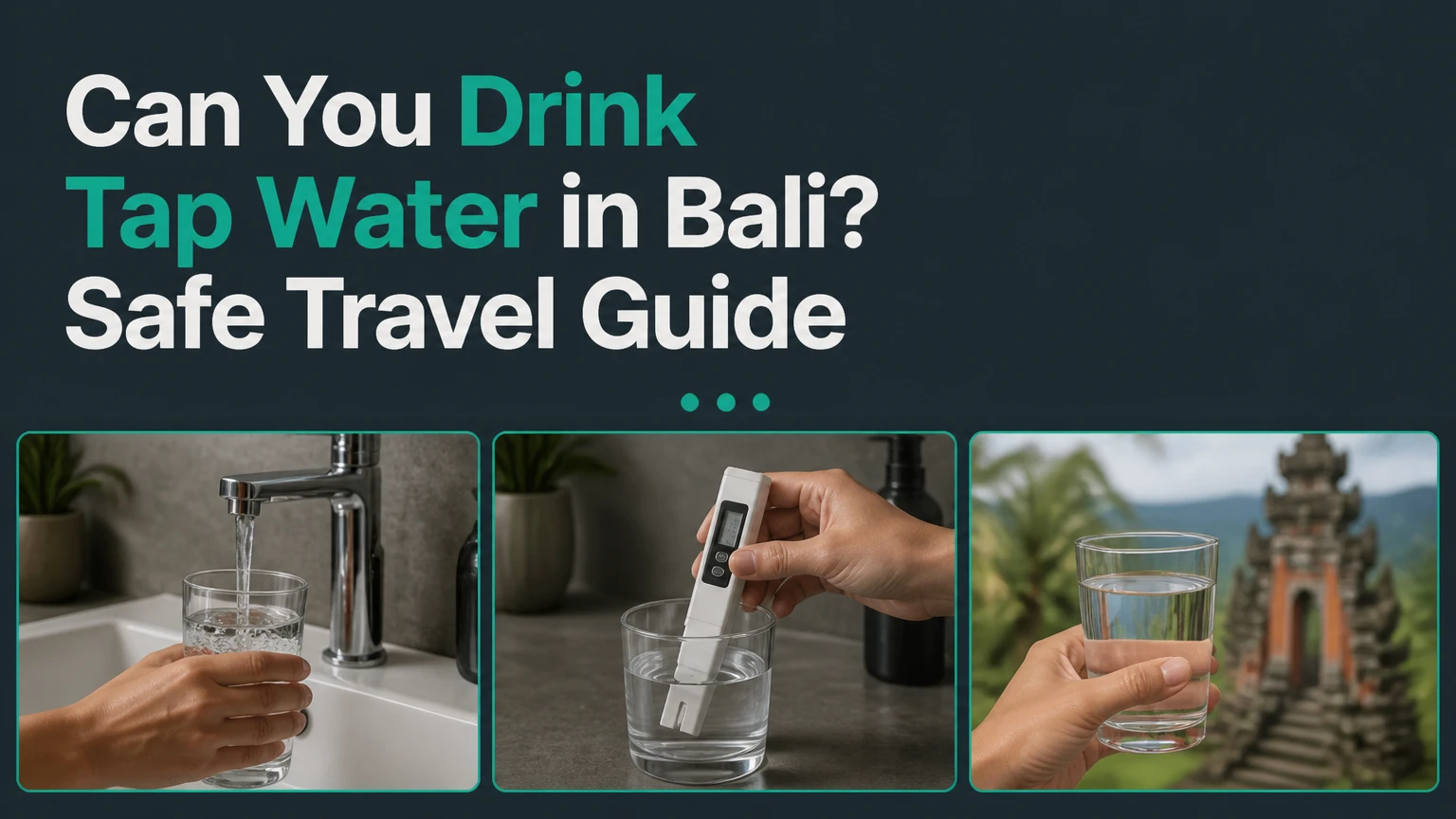
Bali tap water is municipal or groundwater supplied to homes, hotels, villas, and businesses, but untreated water is not reliably potable at the faucet. Visitors should use sealed bottled water, verified treated refills, or water boiled for at least one minute for drinking and tooth brushing, because contamination can cause travelers’ diarrhea, commonly called Bali Belly.
Key Facts and Quick Answer
- Do not drink untreated tap water in Bali, including water from an unfamiliar villa, homestay, restaurant sink, or private well.
- Use sealed bottled water or a documented filtration system for drinking, brushing teeth, making ice, and rinsing food eaten raw.
- Boil questionable water at a rolling boil for one minute before drinking. At elevations above approximately 2,000 meters, boil for three minutes.
- A clear appearance does not prove safety. Bacteria, viruses, and parasites can be present without changing the water’s smell, color, or taste.
- Typical drinking-water costs are low: approximately $0.20-$0.80 for small or 1.5-liter bottles and $1-$2 for a 19-liter refill, depending on the supplier.
- Seek medical care for blood in stool, persistent vomiting, confusion, severe dehydration, or diarrhea lasting more than three days.
For most visitors, the practical answer is simple: avoid swallowing untreated faucet water and choose a verified alternative. That rule applies even when the water looks clean, because contamination can enter through supply lines, groundwater, storage tanks, filters, or internal plumbing.
Where Does Bali Tap Water Come From?
Bali tap water comes from two main systems: regional municipal suppliers, commonly associated with PDAM, and private groundwater wells known locally as sumur bor. A property may use one source, switch between sources, or blend supply with water stored in tanks.


Municipal water quality is not identical across the island. Treatment, pressure, pipe condition, storage practices, and local infrastructure determine what reaches a particular tap. Private wells add a separate set of variables, including nearby septic systems, agricultural runoff, saline intrusion, iron, and naturally occurring minerals.
| Water source | Typical property type | Main variable | Visitor decision |
|---|---|---|---|
| PDAM municipal supply | Urban hotel or apartment | Distribution and storage condition | Drink only if the property confirms treatment |
| Private bore well | Villa, homestay, rural building | Groundwater depth and local contamination | Treat before drinking |
| Rainwater tank | Eco-lodge or remote property | Collection surface and tank hygiene | Treat before drinking |
| Commercial refill delivery | Villa, café, coworking space | Supplier and container sanitation | Confirm sealed or documented treatment |
| In-house filtered supply | Resort, restaurant, refill station | Filter type and maintenance date | Ask what treatment is used |
A property manager may describe water as “filtered,” but that word has no consistent safety meaning by itself. A sediment cartridge can remove visible particles while leaving microorganisms unaffected. Carbon can improve taste and reduce some chemicals, but it does not automatically disinfect water.
Why Is Untreated Faucet Water Risky?
Untreated faucet water is risky because biological contamination can enter before, during, or after distribution. The relevant hazard is not a single island-wide contaminant level. It is the uncertainty surrounding a specific source and plumbing system.
Common hazards include bacteria such as Escherichia coli, Campylobacter, and other fecal coliforms. Protozoa such as Giardia and Cryptosporidium can also cause gastrointestinal illness, while contaminated water or food can transmit viral hepatitis A and other enteric infections.
The World Health Organization identifies E. coli as a key indicator of recent fecal contamination in drinking water. A positive indicator does not identify every pathogen, but it signals that the water should not be consumed without appropriate treatment.
What Can Contaminate the Supply?
The most important contamination routes are:
- Cracked or poorly sealed distribution pipes
- Floodwater entering damaged infrastructure
- Fecal contamination near shallow wells
- Unclean rooftop or ground-level storage tanks
- Biofilm or sediment inside building plumbing
- Improperly maintained filters and ultraviolet systems
- Cross-connections between wastewater and drinking-water lines
Water can also carry non-biological problems. Iron may create a metallic taste or orange staining, while sediment can indicate disturbance in a well or tank. Salinity is more relevant in some coastal areas. Boiling kills many pathogens, but it does not remove salt, metals, pesticides, or other dissolved chemicals.
Expert insight: The highest-risk point is often not the treatment plant. It is the last storage tank, filter housing, or internal pipe that nobody has inspected recently.
Does Safety Vary by Bali Location and Accommodation?
Safety varies by property more than by tourist district. A maintained resort in Uluwatu may have safer drinking water than an older building in central Denpasar, while a rural north Bali guesthouse may have a well system that requires treatment.
Coastal locations can face saltwater intrusion and limited supply during dry periods. Areas with heavy construction, flooding, or intermittent pressure may experience more sediment or intrusion. Ubud properties may use municipal water, wells, or mixed systems, so the town name alone cannot establish potability.
| Situation | Likely water arrangement | Primary concern | Safe default |
|---|---|---|---|
| Luxury resort | Municipal or mixed supply with treatment | Filter maintenance and plumbing coverage | Ask whether every guest tap is treated |
| Private villa | Well, tank, refill delivery, or mixed supply | Unknown source and storage | Drink sealed or verified treated water |
| Local homestay | Municipal or well water | Variable maintenance | Use bottled or boiled water |
| Remote north or east Bali stay | Well, spring, or rainwater system | Limited testing and service access | Bring treatment supplies and ORS |
| Café or restaurant | Bottled, refill, or filtered supply | Ice and food-washing practices | Ask staff when uncertain |
A hotel’s star rating does not certify that bathroom faucets provide potable water. Ask a specific question: “Can guests safely drink from every tap, and what treatment system covers the building?” A vague answer means the water should be treated as non-potable.
Can You Drink Tap Water in Bali After Boiling It?
Boiling makes biologically contaminated water substantially safer when performed correctly. Bring the water to a vigorous rolling boil for at least one minute, cool it in a covered container, and use it within a reasonable storage period.
The U.S. Centers for Disease Control and Prevention gives travelers the memorable rule, “Boil it, cook it, peel it, or leave it.” Boiling is especially useful for remote accommodation, emergencies, cooking, and reducing single-use bottle consumption.
| Boiling step | Minimum specification | Why it matters |
|---|---|---|
| Bring water to boil | Full rolling boil | Confirms the entire volume reaches high heat |
| Standard elevation | 1 minute | Recommended pathogen-control duration |
| High elevation | 3 minutes above approximately 2,000 m | Compensates for lower boiling temperature |
| Cooling | Covered container | Prevents recontamination from hands and surfaces |
| Storage | Use within 24 hours when possible | Limits post-treatment contamination |
Boiling does not make every source chemically safe. Do not rely on boiling if the water has a fuel, solvent, pesticide, sewage, or strong chemical odor. Use a safer source instead, particularly after flooding or when a local authority issues a water warning.
How Should You Boil Water for Drinking?
- Use the clearest available water and let visible sediment settle.
- Pour it through a clean cloth or suitable sediment filter if particles remain.
- Heat the water until the entire surface reaches a rolling boil.
- Maintain the boil for one minute, or three minutes at high elevation.
- Cool the water in a clean, covered container.
- Pour it without touching the rim, cap, or inside surface.
- Use boiled water for drinking, ice, brushing teeth, and food preparation.
Electric kettles can work, but many switch off shortly after boiling begins. If the kettle does not maintain a rolling boil, use a saucepan or repeat the process with a known method.
Which Drinking-Water Alternatives Are Safest?
Sealed commercial water is the simplest choice for short trips. Verified refill stations and maintained reverse-osmosis systems can reduce plastic use, while boiling provides a dependable backup when electricity or fuel is available.
No treatment method is universally best. The correct option depends on pathogen coverage, maintenance, chemical risks, volume, and whether the traveler can verify the system.
| Option | Pathogen coverage | Typical Bali cost | Best use | Main limitation |
|---|---|---|---|---|
| Sealed 600 ml bottle | High when seal is intact | $0.20-$0.45 | Day trips | Plastic waste |
| Sealed 1.5-liter bottle | High when properly stored | $0.40-$0.80 | Hotel and daily use | Heat and storage damage |
| 19-liter refill jug | Depends on supplier sanitation | $1-$2 | Villas and long stays | Container hygiene |
| Boiling | Strong biological control | $0.05-$0.30 per liter, typical fuel cost | Cooking and emergencies | Does not remove chemicals |
| RO plus UV station | Strong when designed and maintained correctly | $0.05-$0.20 per refill, typical | Reusable bottles | Maintenance may be unknown |
| Purifier bottle | Product-specific bacteria, protozoa, and virus performance | $25-$150 equipment cost | Hiking and backup | Limited capacity and cartridge life |
Are Water Filters and UV Bottles Enough?
A travel filter is safe only when its specifications match the hazard. A hollow-fiber filter may remove bacteria and protozoa but allow viruses through. Activated carbon may improve taste, yet it is not a complete disinfection method. UV devices require clear water, charged batteries, and correct exposure time.
For Bali, choose a purifier with a manufacturer-documented claim for bacteria, protozoa, and viruses if you intend to treat untreated water. Follow the cartridge capacity exactly. A filter used beyond its rated liters can create false confidence.
How Can Travelers Reduce Plastic Waste?
Long-stay visitors can combine a reusable bottle with verified refill water rather than buying many small bottles. Ask the accommodation for the refill supplier, treatment method, and filter-service schedule.
| Sustainability choice | Typical daily output | Typical cost | Practical trade-off |
|---|---|---|---|
| Six 600 ml bottles | 3.6 liters | $1.20-$2.70 | Convenient, high plastic use |
| Two 1.5-liter bottles | 3 liters | $0.80-$1.60 | Fewer containers |
| One refill from 19-liter jug | 3 liters | $0.15-$0.35 | Requires trusted supplier |
| Boiled tap water | 3 liters | $0.15-$0.60 | Needs heat, fuel, and clean storage |
Never refill a disposable bottle indefinitely in tropical heat. Wash a durable bottle daily with detergent, dry it fully, and keep the mouthpiece off shared surfaces.
Is Bottled Water Safe in Bali?
Factory-sealed bottled water is generally the easiest low-risk option, provided the cap and neck seal are intact. Inspect bottles stored in direct sun, damaged packaging, cloudy liquid, loose caps, or unusual odors before opening.
Recognized Indonesian brands include Aqua, Le Minerale, Club, and Cleo, but brand recognition alone does not replace checking the seal. Counterfeit or refilled bottles are uncommon in reputable retail channels yet remain a reason to buy from established supermarkets, hotels, and restaurants.
A large bottle may be cheaper and create less waste than multiple small bottles. For a two-week trip, a typical visitor spending $0.80-$1.60 per day on 1.5-liter bottles would budget approximately $11-$22 for drinking water, excluding restaurant drinks.
Can You Use Tap Water for Teeth, Food, Ice, and Showers?
Untreated tap water should not be used for brushing teeth, rinsing a toothbrush, washing food eaten raw, or making ice. Showering is normally acceptable if you keep the water out of your mouth and avoid swallowing spray.
The quantity accidentally swallowed while brushing is small, so one exposure does not guarantee illness. The risk rises through repeated exposure, especially when a traveler rinses with faucet water twice daily for a week.
| Activity | Untreated tap water? | Safer practice | Reason |
|---|---|---|---|
| Drinking | No | Sealed, treated, or boiled water | Direct ingestion |
| Tooth brushing | Avoid | Use bottled or boiled water | Repeated small exposures |
| Showering | Usually acceptable | Keep mouth closed | Accidental ingestion risk |
| Washing dishes | Prefer treated water | Use hot detergent wash | Reduces surface contamination |
| Washing salad | No | Use treated water or avoid raw salad | Pathogens remain on leaves |
| Making ice | Only if treated | Use commercial or verified ice | Freezing does not reliably disinfect |
| Coffee or tea | Yes if fully boiled | Confirm water reached a boil | Heat controls biological hazards |
Commercial ice from an established restaurant or hotel is usually a better choice than hand-made ice from an unknown vendor, but there is no universal rule that every ice supplier is certified or safe. Ask for packaged ice or skip ice when the source cannot be established.
What Happens If You Drink Contaminated Water?
Contaminated water can cause travelers’ diarrhea, vomiting, cramps, fever, or more specific infections such as giardiasis or hepatitis A. Symptoms may begin within several hours, but many bacterial and protozoal illnesses take longer, so illness is not proof of the last thing eaten.
| Condition or pattern | Typical onset | Common duration | Action |
|---|---|---|---|
| Toxin-related food illness | 1-12 hours | 1-2 days | Fluids and monitoring |
| Bacterial travelers’ diarrhea | 6 hours-3 days | 2-5 days | ORS, medical advice if severe |
| Viral gastroenteritis | 12-48 hours | 1-3 days | Fluids and rest |
| Giardia-type illness | 1-2 weeks | Often longer without treatment | Clinical assessment |
| Hepatitis A pattern | 2-6 weeks | Weeks | Urgent medical evaluation |
The term “Bali Belly” describes a symptom pattern, not one diagnosis. Water, ice, raw food, contaminated hands, and shared utensils can all contribute, so blaming a single drink is medically unreliable.
How Should You Treat Mild Diarrhea?
Prioritize oral rehydration solution, small frequent sips, and food that is easy to tolerate. Indonesian pharmacies commonly sell Oralit, but travelers should mix packets exactly according to the package instructions and use safe water.
Avoid alcohol while dehydrated. Loperamide may reduce diarrhea for some adults, but it should not be used alone when there is high fever or blood in the stool. Antibiotics require clinical judgment because the cause, resistance pattern, and traveler’s medical history matter.
Seek care promptly for:
- Inability to keep fluids down
- Very little urine, fainting, confusion, or severe weakness
- Blood or black stool
- Fever around 39°C or higher
- Severe abdominal pain
- Symptoms lasting more than three days
- Illness in an infant, older adult, pregnant traveler, or immunocompromised person
Typical private-clinic costs vary widely, but a consultation may cost approximately $25-$75, while IV fluids, tests, or prescribed treatment can raise the visit to $75-$200 or more. Travel insurance terms determine reimbursement.
What Should High-Risk Travelers Do?
Pregnant travelers, young children, older adults, and people with immune suppression should use the strictest water precautions. Dehydration and infection can become serious faster in these groups.
People with kidney disease, diabetes, or fluid restrictions should follow their clinician’s advice rather than improvising electrolyte intake. Travelers taking preventive medicines or carrying antibiotics should also confirm when those medicines are appropriate before departure.
A Practical Arrival Protocol
- Buy or obtain sealed drinking water before unpacking.
- Place one bottle beside the bathroom sink for tooth brushing.
- Ask accommodation staff whether every tap is potable or only selected refill points.
- Identify the nearest pharmacy and clinic.
- Carry one ORS packet during day trips.
- Use treated water for ice, raw produce, and medication.
- Report unusual odor, sewage smell, brown water, or sudden pressure changes.
- Switch sources immediately after flooding or plumbing work.
Expert insight: The “two-bottle rule” works because travelers often drink safely at dinner, then unconsciously rinse a toothbrush with faucet water. Separating bathroom and bedside supplies removes that predictable failure point.
Frequently Asked Questions About can you drink tap water in Bali
Can I drink water from a Bali hotel bathroom tap?
Do not drink from a hotel bathroom tap unless hotel staff clearly confirm that the entire building has treated potable water. A luxury property may provide filtered drinking stations while leaving bathroom faucets on a non-potable supply. Use sealed or verified treated water for drinking and brushing teeth.
Is Bali tap water safe for cooking rice and pasta?
Bali tap water is suitable for cooking only after it reaches a full rolling boil for at least one minute. Use treated or bottled water for foods that absorb water without prolonged heating, such as ice, salad rinses, cold sauces, and reconstituted drinks.
Can I drink water from a refill station?
A refill station can be a good low-waste option when the operator identifies the treatment process and maintains equipment. Ask whether the station uses RO, ultraviolet disinfection, or another validated process, and check that dispensing nozzles and reusable containers are clean.
Does freezing kill bacteria in Bali ice?
Freezing does not reliably kill all bacteria, viruses, or parasites. Choose ice from a reputable hotel, restaurant, or packaged supplier, and avoid ice of unknown origin when traveling with infants, during pregnancy, or with a weakened immune system.
How much drinking water should I carry in Bali?
Carry at least 1-1.5 liters per adult for ordinary sightseeing, increasing the amount for hikes, exposed beaches, traffic delays, or strenuous activity. In hot conditions, replace both water and electrolytes through food or a correctly mixed oral rehydration solution.
Can one sip of tap water cause Bali Belly?
One sip can expose a traveler to pathogens, but illness is not inevitable and symptoms may come from food or contaminated hands instead. Stop using the source, hydrate normally with safe water, and monitor for diarrhea, vomiting, fever, blood, or dehydration over the following days.
Conclusion: The Safe Water Rule for Bali
The safest answer to can you drink tap water in Bali is no, not untreated water from an unfamiliar faucet. Use sealed bottled water, a refill system with verifiable treatment, or water boiled for one minute; apply the same rule to tooth brushing, ice, raw produce, and medication.
Location and hotel quality do not prove potability. Ask about the source and filter maintenance, carry ORS, and seek medical care for dehydration, blood in stool, severe pain, high fever, or persistent symptoms.