Yes, you can drink tap water in Rome. Rome’s municipal drinking water is regulated by Italian and European Union standards, treated by ACEA, and distributed through hotel taps, apartment plumbing, and public nasoni fountains. The main qualifications are local advisories, a building’s internal pipes, and fountains marked “acqua non potabile.”
Key Facts
Rome’s public water is generally safe for drinking and cooking.
ACEA manages the integrated water service for Rome and surrounding areas.
Nasoni provide free public drinking water across the city.
Water can taste mineral-heavy because Rome’s supply is relatively hard.
A public fountain marked “acqua non potabile” must not be used for drinking.
Historic decorative fountains, including the Trevi Fountain, are not refill points.
Can You Drink Tap Water in Rome?
Yes. Travelers can normally fill a bottle from a hotel, hostel, vacation rental, or restaurant tap in Rome, provided the property has no local warning and the tap is connected to the public supply. The same municipal water reaches many street fountains, where it is available without charge.
Rome’s water is not “pristine spring water” in the literal untreated sense. ACEA collects water from springs, wells, and aquifers, then manages disinfection, testing, pumping, storage, and distribution before it reaches consumers. That distinction matters because source quality and building-level plumbing are separate safety questions.


The European legal benchmark is clear. Article 4 of European Parliament and Council Directive (EU) 2020/2184 states that water for human consumption must be “wholesome and clean.” Italian authorities apply that framework through national drinking-water rules and local monitoring.
Who manages Rome’s drinking water?
ACEA Ato 2 manages the integrated water service for Rome and much of the metropolitan water district. The service includes abstraction, treatment, reservoirs, distribution mains, quality controls, and emergency maintenance.
ACEA publishes information about water quality and public fountains, while local health authorities can issue temporary notices when a location has a fault or contamination risk. A travel blog cannot replace a current local advisory, especially after flooding, pipe repairs, or a building outage.
How Does Rome’s Water System Work?
Rome’s drinking-water network combines spring water, groundwater, treatment facilities, reservoirs, and an extensive distribution system. Gravity helps move water from elevated sources, but pumps and pressure-management equipment are also needed across a dense city with different elevations and demand patterns.
The Peschiera-Capore system is one of Rome’s major water sources. Other sources include wells and springs in the regional supply network. The exact blend depends on season, demand, maintenance, and the district receiving the water, so claims that one source supplies every tap oversimplify the system.
ACEA and public laboratories monitor microbiological and chemical parameters. Disinfection protects water while it travels through pipes, and treatment intensity depends on the source and operational conditions. “Natural” source water still requires professional management.
| System element | Typical role | Traveler-facing consequence |
|---|---|---|
| Springs and aquifers | Supply raw water | Usually gives water a mineral taste |
| Treatment facilities | Apply disinfection and other controls | Makes source water suitable for distribution |
| Reservoirs and pressure zones | Balance daily demand | Water pressure can vary by building and district |
| Public distribution mains | Carry treated water through Rome | Municipal quality is controlled before the property connection |
| Internal building pipes | Carry water from the meter to the tap | Old plumbing can affect taste, color, or short-term quality |
Does Rome use recycled wastewater for drinking?
Rome’s ordinary potable supply is not the same as recycled wastewater used for flushing or irrigation. Municipal drinking water comes from regulated freshwater sources, while non-potable water systems, where present, have separate uses and labeling.
A traveler should still follow the sign at the point of use. “Acqua potabile” means drinkable water, while “acqua non potabile” means water that must not be consumed. A public restroom tap or train facility can follow different rules from a city drinking fountain.
What Are the Main Ways to Get Drinking Water?
Rome offers three practical access points: private taps, nasoni, and selected water kiosks. The safest choice is a clearly identified drinking-water outlet connected to the municipal network, used with a clean bottle or glass.
| Access point | Typical cost | Availability | Best use |
|---|---|---|---|
| Hotel or apartment tap | $0 included in lodging | Usually 24 hours | Cooking, brushing teeth, bottle refills |
| Nasone street fountain | $0 | Many central streets and parks | Walking-tour hydration |
| Case dell’Acqua kiosk | $0 or local program dependent | Selected locations | Chilled or sparkling refills |
| Café or restaurant water | Typically $2-$6 | During opening hours | Drinking with a meal |
| Shop-bought bottled water | Typically $0.50-$3 | Shops, kiosks, stations | Backup when no refill point is available |
What are nasoni?
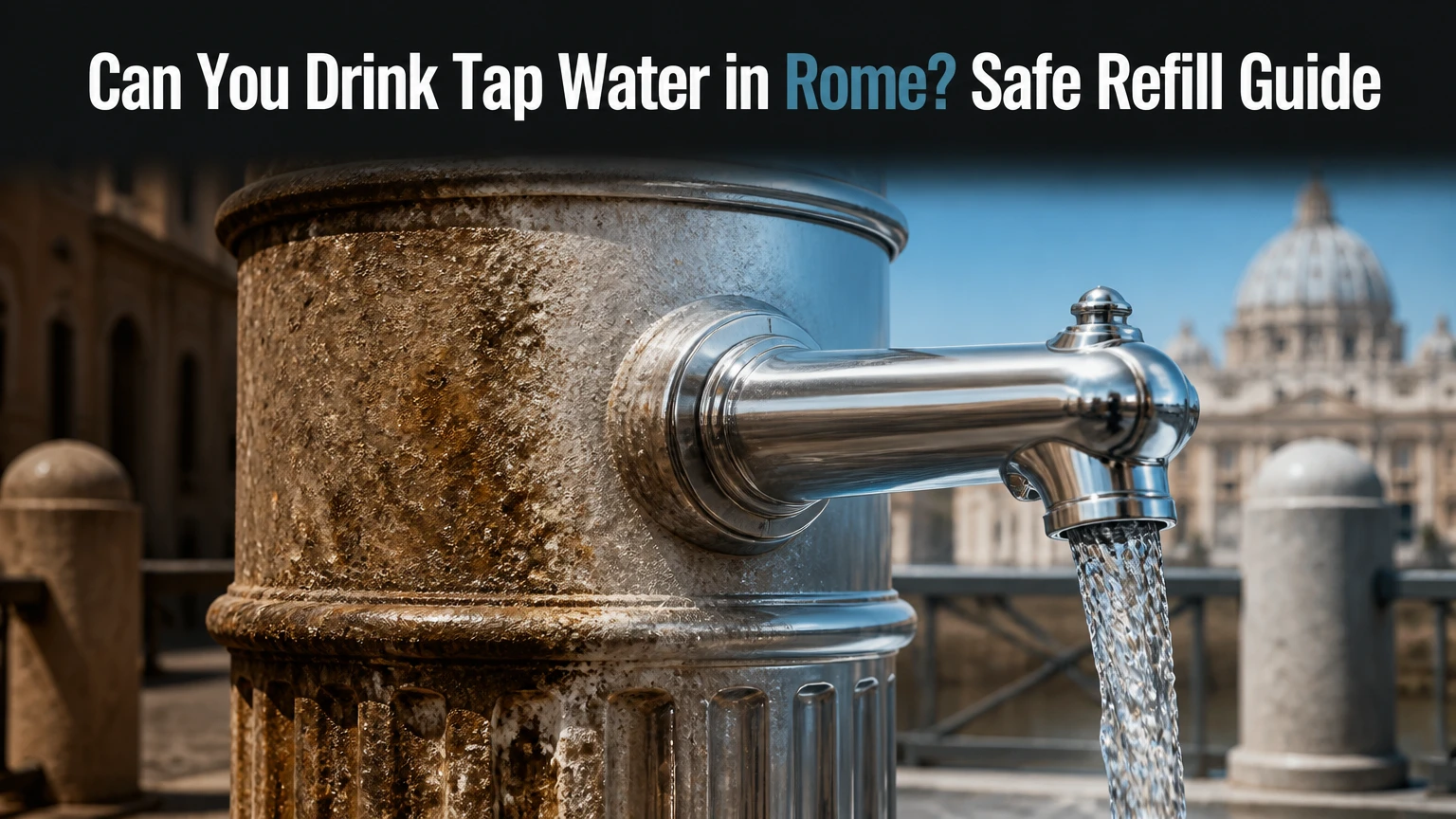
Nasoni are Rome’s small public drinking fountains. The name means “big noses,” referring to the curved metal spout on many traditional designs. Water normally flows continuously, which reduces stagnation at the outlet and allows people to refill bottles without touching the spout.
The city has more than 2,000 nasoni, with commonly cited estimates above 2,500 depending on how fountains are counted. The number changes when fountains are repaired, relocated, or temporarily shut off. ACEA and Roma Capitale are better references than an undated travel map.
To drink without placing your mouth on the metal, block the main outlet with one finger. Pressure sends a small arc upward through the fountain’s upper hole. Refill your bottle from the stream instead if the fountain is crowded or visibly dirty.
Where are case dell’acqua kiosks?
Case dell’Acqua are public water kiosks found at selected transport hubs, neighborhoods, and civic locations. Some provide chilled still and sparkling water, but availability and operating arrangements can change, so travelers should verify the current location before relying on one.
The central practical rule is simple: a functioning nasone is more widely distributed than a kiosk. Carrying a bottle gives you more flexibility than planning a route around a single machine.
What Does Rome Tap Water Taste Like?
Rome’s water often tastes mineral-rich or slightly chalky because dissolved calcium and magnesium contribute to hardness. Hardness is not the same as contamination, and a mineral taste alone does not indicate that water is unsafe.
Published hardness readings vary by source and district. A reasonable travel expectation is roughly 200-300 milligrams per liter as calcium carbonate in many areas, although the value at a specific tap can differ. ACEA’s current locality data is the appropriate source for a precise result.
| Water characteristic | Typical Rome expectation | What it means |
|---|---|---|
| Hardness | About 200-300 mg/L as CaCO₃ in many areas | Mineral taste and possible limescale |
| Temperature at public fountains | Often cool, commonly near 12-15°C | Comfortable for summer refills |
| Chlorine perception | Low to moderate, location dependent | Taste can change after maintenance |
| Visible appearance | Clear under normal conditions | Cloudiness, discoloration, or particles merit caution |
| Mineral residue | Possible on kettles and taps | Cosmetic and maintenance issue, not automatic evidence of danger |
A filter bottle can improve taste, but most carbon filters do not guarantee microbiological safety and do not remove every dissolved mineral. Replace cartridges on schedule. An old, exhausted filter can become its own hygiene problem.
Expert insight: Travelers often misread limescale as pollution. Calcium deposits on a kettle indicate hardness, whereas a sudden brown color, unusual odor, or visible sediment points to a different issue and should not be solved by simply adding a taste filter.
Is Public Fountain Water Free and Safe?
Marked drinking fountains are generally free to use and connected to the public potable-water network. The qualification is important: not every fountain in Rome is a drinking fountain, and a decorative basin can have an entirely different water circuit.
| Location type | Drink from it? | Refill guidance | Main risk |
|---|---|---|---|
| Traditional nasone | Yes, if operating and unmarked | Use the upward jet or bottle | Contact with dirty metal |
| Historic monument fountain | No | Find a nearby nasone | Decorative or recirculated water |
| Fountain marked “acqua non potabile” | No | Follow the sign | Water is not approved for drinking |
| Public restroom tap | Only if clearly potable | Check posted notice | Non-potable or poorly maintained fixture |
| Airport or train water point | Only if labeled potable | Use designated refill stations | Local facility rules may differ |
Do not fill a bottle from the Trevi Fountain, Fontana dei Quattro Fiumi, or another monumental basin. These installations are architectural features, not public drinking outlets. A nearby street fountain may be safe, but distance matters because the two fixtures may use different plumbing.
Keep the bottle opening below the water stream rather than pressing it against the spout. Wash the bottle daily during hot weather, particularly if it contains sugary drinks or if several people share it.
What should you do if a fountain looks unusual?
Do not drink from a fountain with brown water, a strong unfamiliar odor, insects inside the outlet, damaged plumbing, or a closure notice. Wait for the flow to run clear only when the issue appears to be brief discoloration after stagnation, and use bottled water if uncertainty remains.
A short flush can remove water that has been sitting in a building pipe. It cannot correct a contamination notice. When the issue concerns a hotel or rental, ask the host whether the property has received a municipal advisory.
Is Hotel and Apartment Tap Water Safe?
Hotel and apartment tap water is normally safe when the property is connected to Rome’s public supply and no advisory applies. The most relevant variable is often the building’s internal plumbing, especially in older properties with storage tanks, rarely used taps, or corroded fixtures.
Run a cold kitchen tap for 30-60 seconds after arriving if the water has been unused for several hours. Do not use hot tap water for drinking or cooking because hot-water systems can accumulate metals and sediment more readily; heat cold water instead.
| Accommodation situation | Recommended action | Reason |
|---|---|---|
| Modern hotel, clear cold water | Drink and refill normally | Low practical concern |
| Historic apartment, metallic taste | Flush cold tap 30-60 seconds | Clears stagnant internal water |
| Brown or cloudy water | Stop using that tap | Possible plumbing or maintenance issue |
| Private rooftop tank mentioned by host | Ask about cleaning schedule | Storage tanks require maintenance |
| “Non-potable” notice | Use bottled water | The property has restricted that outlet |
Pregnant travelers, infants, and people with weakened immune systems can generally drink compliant public water, but they should follow their clinician’s advice and any current local notice. Bottled water is not automatically safer if the bottle has been stored in heat or opened for days.
Expert insight: The public main can meet drinking-water requirements while a particular apartment tap still has a local problem. The final meter-to-glass section of pipe deserves more attention than the city’s famous aqueduct history.
How Should You Refill a Bottle in Rome?
The safest refill routine takes less than a minute and avoids the two most common mistakes, touching the spout with your mouth and using a decorative fountain.
- Choose a functioning nasone or kiosk labeled for drinking water.
- Inspect the water for unusual color, odor, debris, or a closure notice.
- Let the stream run briefly if the fountain has just restarted.
- Hold the bottle under the stream without touching the outlet.
- Use the upward jet if you need to drink directly.
- Close the bottle and wipe the outside if it contacted the fountain.
- Refill only the amount you can keep cool and consume promptly.
A lightweight bottle of 500-750 milliliters works well for sightseeing. A 1-liter bottle reduces refill frequency but becomes inconvenient on stairs, crowded buses, and museum security checks.
Which tools help locate refill points?
ACEA and municipal tourism resources can identify public fountains, while apps such as Waidy WOW may show refill locations. Treat app listings as useful but non-authoritative because a fountain can be temporarily closed, moved, or omitted after roadworks.
Carry a backup plan. A shop or café is more dependable than an app when you are at the airport, on a train platform, or outside the historic center.
How Does Rome Water Compare With Bottled Water?
Municipal water is usually the lowest-cost and lowest-waste option, while bottled water offers predictable packaging and immediate availability. Filtered water can change flavor, but it adds purchase, maintenance, and disposal considerations.
| Option | Typical traveler cost | Taste profile | Practical limitation |
|---|---|---|---|
| Nasone refill | $0 | Cool, mineral-rich | Requires a clean bottle |
| Hotel tap | $0 included | District and building dependent | Internal plumbing varies |
| Still bottled water | $0.50-$3 per bottle | Often softer | Plastic waste and heat exposure |
| Restaurant bottle | $2-$6 per bottle | Brand dependent | Usually charged with the meal |
| Filter bottle | $20-$70 purchase | Can reduce chlorine taste | Cartridge replacement required |
Restaurant customs differ from home expectations. Many Roman restaurants offer still or sparkling bottled water, and some offer filtered water in reusable bottles. Free carafes of tap water are not guaranteed, so ask clearly: “Acqua del rubinetto, per favore?” The restaurant may decline or charge for service.
Do not assume a restaurant’s filtered water is chemically “better” than municipal water. Its main advantage may be temperature, carbonation, flavor, and reusable presentation.
What Are the Main Problems and Exceptions?
The ordinary answer is positive, but Rome water is not suitable for every use point or every unusual circumstance. Temporary notices, property plumbing, and fountain condition matter more than generalized claims about the city.
| Situation | Drink municipal water? | Safer decision |
|---|---|---|
| Normal hotel cold tap | Yes | Refill after a brief flush |
| Working nasone without warning sign | Yes | Use the upward jet or bottle |
| Local boil-water notice | No without following instructions | Use bottled or boiled water |
| Decorative fountain basin | No | Locate a marked drinking fountain |
| Tap after a building outage | Wait and check | Ask property management first |
| Immunocompromised traveler during an advisory | Follow clinician and authority advice | Use sealed or approved alternative water |
A water outage or repair can temporarily change pressure and disturb sediment. If water becomes discolored after work nearby, stop using it for drinking until the flow clears and the property or utility confirms normal service.
Boiling is not a universal fix. It can kill many microbes, but it does not remove heavy metals, excessive minerals, or chemical contaminants. Follow the exact instructions in any official notice rather than improvising a treatment method.
Can hard water upset your stomach?
Hard water is not generally expected to cause illness in healthy travelers, although a sudden change in mineral content can feel unfamiliar. Diarrhea during a Rome trip is more often linked to food, heat, alcohol, poor hand hygiene, or another infection than to compliant tap water.
If symptoms develop, switch temporarily to sealed water, prioritize oral rehydration, and seek medical help for blood, severe dehydration, persistent vomiting, high fever, or symptoms lasting several days. Children and older adults can dehydrate faster.
Rome Tap Water History and Reliability
Rome’s water infrastructure has ancient roots, but modern safety depends on current treatment and regulation rather than Roman engineering alone. Aqua Appia, built in 312 BC, was Rome’s first aqueduct, while the recognizable public nasone network developed in the nineteenth century.
The first nasoni are commonly associated with Rome’s municipal expansion in the 1870s. Their historical continuity explains why public refilling is part of daily city life, but age does not prove present-day quality. Current testing, maintenance, and signage do.
| Historical reference | Date | Modern relevance |
|---|---|---|
| Aqua Appia | 312 BC | Beginning of Rome’s major aqueduct tradition |
| Aqua Virgo | 19 BC | Still associated with central Rome’s water history |
| Early municipal nasoni | 1870s | Origin of the familiar street-fountain pattern |
| ACEA water operations | Modern era | Current distribution and service management |
| EU Drinking Water Directive 2020/2184 | 2020 | Contemporary safety framework |
Frequently Asked Questions About can you drink tap water in Rome
Can tourists drink water from Rome fountains?
Tourists can drink from a functioning nasone labeled or recognized as a public drinking fountain. Use the water stream without touching the spout, and avoid monumental fountains, restroom fixtures, or any outlet marked “acqua non potabile.” Fountain availability can change during repairs or local maintenance.
Should visitors bring a water filter to Rome?
Most visitors do not need a filter for safety. A carbon filter or filter bottle can improve flavor when hardness or chlorine is noticeable, but it will not reliably remove every contaminant or replace an official advisory. Replace cartridges according to the manufacturer’s schedule and keep the filter clean.
Is Rome tap water safe for brushing teeth?
Rome’s regulated municipal water is normally suitable for brushing teeth, showering, and cooking. Use bottled water instead when a property displays a non-potable notice, local authorities issue an advisory, or the tap produces unusual color, odor, or sediment.
Can babies drink Rome tap water?
Healthy babies can generally use compliant public water, but infant feeding requires extra care with preparation, storage, and advice from a pediatrician. During a local advisory, use the specified alternative. Do not assume bottled water is appropriate for formula unless its labeling and mineral content suit that purpose.
Do Rome restaurants give free tap water?
Restaurants are not universally required to provide free tap water, and many establishments sell still or sparkling bottled water. Ask for “acqua del rubinetto” before ordering. The restaurant may offer filtered water, charge for it, or decline the request according to its service policy.
What if Rome tap water tastes bad?
A mineral or mild chlorine taste does not automatically indicate unsafe water. Chill the water, use a clean carbon filter, or refill from a public nasone. If the taste arrives with discoloration, particles, or an unusual odor, stop drinking from that outlet and ask the property or utility for guidance.
Conclusion: Can You Drink Tap Water in Rome?
Yes, you can drink tap water in Rome in normal conditions. Use hotel and apartment cold taps, marked nasoni, and designated water kiosks; avoid decorative fountains, non-potable outlets, and any location affected by a current advisory. The main trade-off is taste and hardness, not ordinary municipal safety.