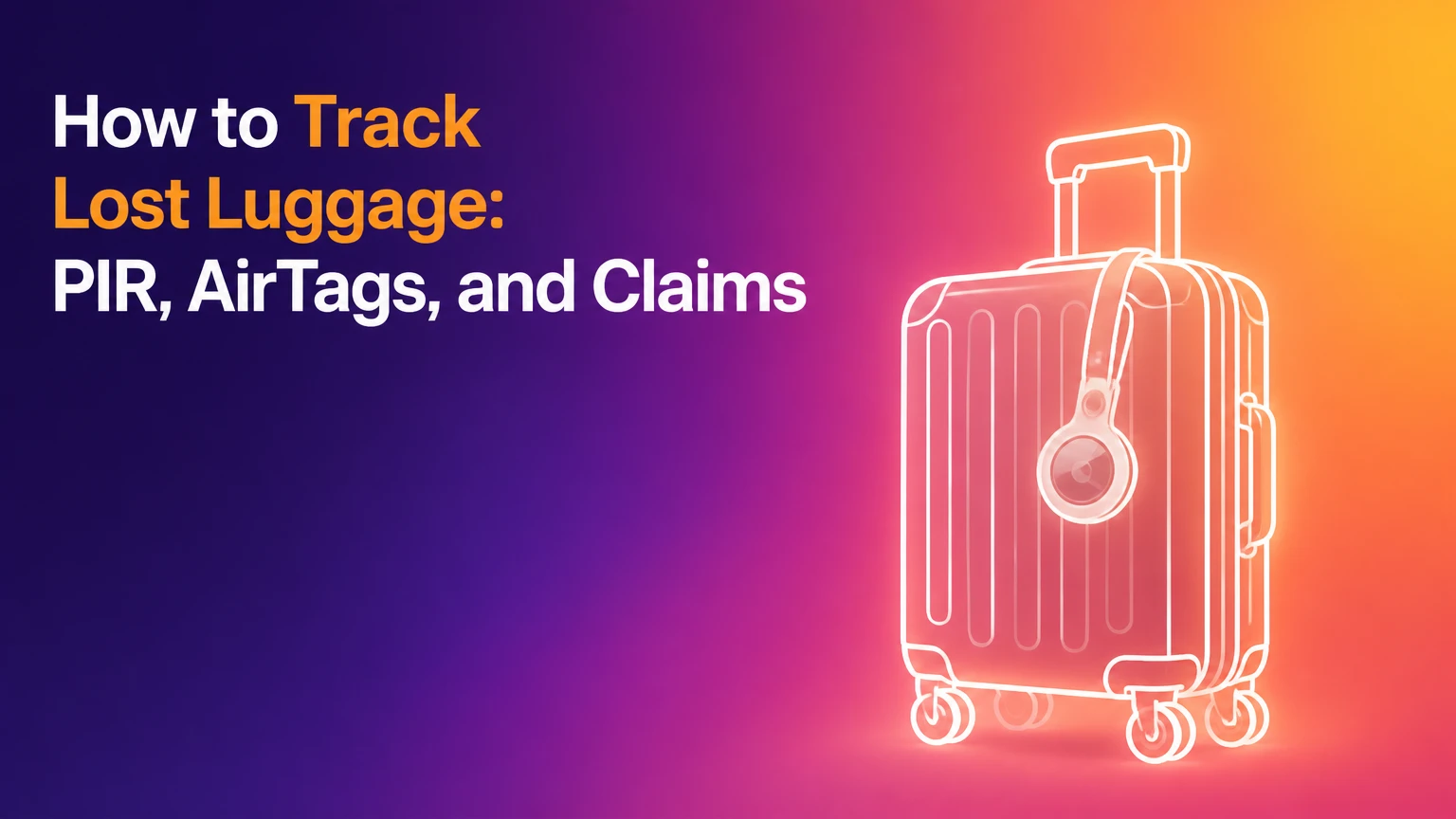
How to track lost luggage depends on whether the bag is delayed, misrouted, damaged, or legally lost. Start with the airline’s baggage desk or online tracing portal, obtain a Property Irregularity Report (PIR), and keep the baggage-tag number. An AirTag or similar tracker can reveal location, but only the airline can release, route, and compensate checked baggage.
Key Facts / Quick Answer
Report a missing checked bag before leaving the airport when possible, and obtain the PIR reference number.
The baggage-tag number identifies the airline’s record, while an AirTag supplies an independent nearby-device location.
Most delayed bags are found within 24-48 hours, but recovery time varies by airline, route, customs, and the last confirmed scan.
Under the Montreal Convention, baggage is generally treated as lost after 21 days, or earlier if the carrier admits the loss. Domestic rules can differ.
Save the claim sticker, bag photographs, receipts, tracker screenshots, boarding passes, and every airline message.
Do not surrender an original receipt or accept a final settlement before checking the claim terms and your insurance rights.
What Does Lost Luggage Mean?
Lost luggage is checked baggage that an airline cannot return within the applicable tracing or legal period. In practice, the first status is usually delayed baggage, because the carrier expects to locate and deliver the suitcase; “mishandled baggage” is the wider operational category covering delayed, damaged, pilfered, and permanently lost bags.
The distinction affects your next action. A delayed suitcase requires tracing and delivery details, while a formally lost suitcase requires a contents inventory, proof of value, and a compensation claim. A bag left at the wrong airport may still be recoverable even when the passenger-facing status says “missing.”


| Status | Operational meaning | Passenger action | Typical next threshold |
|---|---|---|---|
| Delayed | Bag is expected but has not arrived | File a PIR and monitor the case | First 24-48 hours |
| Mishandled | Administrative category for delayed, damaged, or missing baggage | Preserve evidence for the applicable claim | Immediate reporting |
| Damaged | Bag arrived with physical damage or missing contents | Photograph damage before repair | Airline deadline, often 7 days internationally |
| Lost | Carrier cannot locate or return the bag | Submit a detailed valuation claim | Often 21 days internationally |
| Pilfered | Contents are missing from an opened or damaged bag | Report missing items and retain packaging | Airline and police deadlines may apply |
The Montreal Convention states that a carrier is liable for “damage sustained in case of destruction or loss of, or of damage to, checked baggage” when the event occurred while the baggage was in the carrier’s custody. The treaty does not create one universal process for every itinerary, and national consumer rules can add different deadlines.
Delayed Versus Legally Lost
A bag can be practically missing without yet being legally lost. For many international journeys governed by the Montreal Convention, a delay becomes a loss claim after 21 days, although a carrier may acknowledge permanent loss earlier. Domestic US flights do not automatically follow that exact 21-day rule, so the airline’s contract and applicable Department of Transportation rules matter.
Do not wait passively for day 21. Report the absence immediately, submit reasonable interim-expense receipts, and ask the carrier which deadline applies to delayed-baggage, damage, and final-loss claims.
How Do Airlines Track Checked Bags?
Airlines connect a printed baggage tag to a passenger record, flight segment, route, and destination. At selected points, barcode or RFID scans update the carrier’s baggage-management system, allowing staff to identify the last recorded location and search for a bag that missed a transfer.
IATA Resolution 753 requires participating airlines to maintain an inventory of baggage at key points in the journey. The standard does not mean that passengers receive a live map for every suitcase. Scan coverage, airline systems, airport equipment, transfer arrangements, and data-sharing agreements determine how much information appears.
| Tracking point | What the scan can establish | Common failure | Passenger-visible result |
|---|---|---|---|
| Check-in counter | Bag accepted for a flight | Tag printed for wrong destination | “Checked in” or no update |
| Security or sortation | Bag entered airport handling | Barcode unreadable or label detached | Last scan remains at check-in |
| Gate or loading area | Bag associated with aircraft movement | Tight connection or late transfer | Bag travels on a later flight |
| Transfer facility | Bag reached a connecting airport | Customs or interline handoff delay | Airline opens a tracing case |
| Arrival reclaim | Bag unloaded or delivered to carousel | Wrong carousel or similar suitcase taken | Passenger reports nonreceipt |
| Baggage service office | Found bag matched to a report | No external identification | PIR remains open |
SITA WorldTracer is a widely used industry tracing system that matches reports of missing bags with records for found or unidentified baggage. WorldTracer is an airline and airport tool, not a universal public database, so the passenger normally accesses updates through the operating carrier.
Why Transfers Cause Many Missing-Bag Cases
Connections create the highest handling risk because a suitcase must leave one aircraft, pass through the correct transfer process, and reach another aircraft within a shorter ground window than the passenger experiences. A traveler may make a connection while the bag misses it.
A short connection is not the only problem. Terminal changes, separate tickets, customs collection, weather disruptions, ramp congestion, and an interline handoff can each break the chain. A bag may therefore show a valid scan at the origin and no scan at the destination.
Expert insight: The last scan is evidence of the last confirmed handling event, not proof that the bag remains there. If the record says “loaded,” ask whether that means loaded onto the planned flight, loaded onto a later flight, or merely accepted into the departure sortation stream.
How to Track Lost Luggage Step by Step
The fastest recovery path is administrative first and technological second. Create an official case, give the airline a delivery address, and use independent tracker data to refine the search rather than treating a consumer map as a release authorization.
- Check the carousel and adjacent areas. Confirm the flight number, carousel, oversize-baggage area, and neighboring belts. Ask staff whether the airline unloaded bags separately.
- Verify the bag tag. Compare the claim sticker with the itinerary and destination airport code. Photograph the sticker before discarding any travel documents.
- Report the absence at the airport. Visit the operating airline’s baggage service desk, even if a codeshare partner sold the ticket.
- Obtain the PIR. Record the reference number, baggage-tag number, agent’s name, and the exact spelling of your contact information.
- Enter a usable delivery address. Include hotel name, room number if permitted, local phone number, departure date, and a final address if the hotel stay ends soon.
- Use the airline’s tracing portal. Search with the PIR or file-reference number, not only the flight number. Status updates can lag behind physical movement.
- Share tracker evidence. Provide a screenshot with the time, map location, battery level, and device identifier. Tell the agent whether the location is an airport, hotel, residence, or aircraft stand.
- Call at meaningful intervals. Ask what the last confirmed scan was, whether a tracing message was sent, and whether the bag is awaiting customs, delivery, or identification.
- Document necessary purchases. Buy reasonable replacement clothing and toiletries, retain itemized receipts, and record why each purchase was necessary.
- Escalate in writing. If updates stop, contact the airline’s baggage-claims department and then the relevant aviation or consumer regulator.
| Record to preserve | Minimum detail | Why it matters | Best format |
|---|---|---|---|
| Baggage claim sticker | Tag number and destination code | Links the suitcase to the flight record | Photograph plus original |
| PIR | Case reference and filing date | Proves prompt reporting | PDF, email, or paper copy |
| Bag description | Brand, color, size, marks, contents | Helps staff match an unidentified bag | Photos and written inventory |
| Travel record | Ticket, boarding pass, flight segments | Establishes custody and itinerary | Downloaded documents |
| Expense evidence | Date, item, price, reason | Supports delayed-baggage reimbursement | Itemized receipt ledger |
| Tracker evidence | Timestamp, location, battery status | Gives investigators an independent lead | Screenshots and exports |
Leaving the airport without a PIR does not necessarily erase every legal right, but it makes the airline’s investigation harder and can create a serious proof problem. If the desk is closed, use the carrier’s online reporting route, photograph the closed desk and carousel, and contact the airline promptly.
What Tracking Method Should You Use?
Airline barcode or RFID records are the official chain-of-custody system. Bluetooth tags such as Apple AirTag and Samsung SmartTag provide an independent location signal when compatible phones pass nearby. Cellular GPS trackers send their own coordinates through a mobile network, but they cost more and require charging and a service plan.
No consumer tracker replaces a baggage report. An AirTag can show that a suitcase is inside a cargo facility, while only airline or airport personnel can access restricted areas and arrange delivery.
| Method | Typical cost | Power or coverage | Useful evidence | Main limitation |
|---|---|---|---|---|
| Airline barcode | USD 0 | Passive, checked at handling points | Official tag and scan history | No continuous passenger map |
| Airline RFID | Usually included in handling | Passive, radio-readable at equipped points | Higher automated read coverage | Airport and airline adoption varies |
| Apple AirTag | About USD 29 | Replaceable battery, often about 1 year | Nearby location and timestamp | Depends on nearby Apple devices |
| Samsung SmartTag | About USD 25-30 | Replaceable battery, typically months to 1 year | Galaxy-network location | Best performance depends on Galaxy coverage |
| Cellular GPS tracker | About USD 50-150 plus service | Rechargeable, often several days to two weeks | Independent GPS and cellular position | Subscription, charging, and indoor limits |
How AirTags and Bluetooth Tags Locate Bags
Bluetooth tags broadcast a short-range identifier. Nearby compatible phones detect that broadcast and relay an approximate location through the manufacturer’s encrypted finding network. The tag itself usually has no GPS receiver and cannot independently report a position from an empty baggage hold.
Airplane mode does not automatically make an AirTag useless. The tag may continue broadcasting, but nearby devices must detect it, airport network conditions must permit an update, and the case may need to be open before staff can hear or identify it.
Apple’s Find My network and Android’s Find Hub provide location information through their respective ecosystems. Share the item’s location or a temporary link with the baggage agent when the platform supports that function, but avoid posting a live location publicly.
Expert insight: A tracker location at an airport does not prove the airline has possession of the bag. It may indicate a neighboring suitcase, a baggage cart, an airside warehouse, or a location recorded hours earlier. Pair the map with the timestamp and the airline’s last scan.
When a GPS Tracker Is Worth the Cost
A cellular GPS device is most useful for frequent travelers, expensive equipment, long multi-stop itineraries, or bags that must be monitored outside dense phone-network coverage. It is less useful for a single short trip when the tracker is buried under clothing and cannot be recharged.
Check airline and battery-safety rules before packing a tracker. A removable lithium battery or a device with a small coin cell may receive different treatment from a large power bank, and the airline’s current dangerous-goods guidance controls.
What Happens After You File a Baggage Report?
The airline usually searches its own scan records first, then checks unmatched or found-bag records and contacts airport handling partners. If the suitcase is located, the carrier may route it on a later flight, send it to a delivery contractor, or hold it for customs or security inspection.
| Elapsed time | Likely airline activity | Passenger task | Escalation target |
|---|---|---|---|
| 0-45 minutes after reclaim begins | Carousel and oversize-area check | Confirm belt and report absence | Baggage desk |
| Same day | PIR creation and initial tracing | Provide address and description | Operating carrier |
| 24-48 hours | Reconciliation, later-flight search, delivery planning | Check portal and answer calls | Baggage tracing unit |
| Days 3-7 | Partner-airport and WorldTracer searches | Send written expense and delay claim | Airline claims department |
| Day 21 on many international trips | Delayed case may become loss claim | Submit inventory and valuation | Carrier claims department |
| After airline final response | Review settlement or denial | Compare treaty, policy, and evidence | Regulator, insurer, or dispute process |
The often-cited 24-48-hour recovery window is a practical planning benchmark, not a guaranteed service level. Weather events, airport closures, customs controls, strikes, and a missing or unreadable tag can extend the search.
If a tracker shows the bag at a private address, do not confront the occupant or attempt retrieval. Send the evidence to the airline and, if theft is plausible, local law enforcement. A map pin is a lead, not permission to enter restricted or private property.
How Much Can You Claim for Delayed or Lost Bags?
Reimbursement depends on the route, governing law, airline conditions of carriage, proof of value, depreciation, and whether the expense was reasonable. Airlines commonly consider necessary clothing and toiletries during a delay, but luxury purchases, upgrades, and unrelated spending are often rejected.
The Montreal Convention’s baggage liability limit is expressed in Special Drawing Rights (SDR), whose US dollar value changes. The limit is not an automatic payment, and it may not apply in the same way to every domestic itinerary or declared-value arrangement.
| Claim type | Typical supporting proof | Common issue | Practical action |
|---|---|---|---|
| Emergency toiletries | Itemized receipt and delay case | Receipt lacks item detail | Keep the full receipt |
| Replacement clothing | Receipt and reasonable need | Premium or excessive purchases | Choose practical equivalents |
| Delayed baggage damage | Photos and repair estimate | Damage reported too late | Report before repair |
| Lost contents | Inventory, age, purchase proof | No valuation evidence | Use statements and photographs |
| Permanently lost bag | Inventory plus ownership proof | Depreciation or exclusions | Submit a line-by-line schedule |
| Insurance claim | PIR, airline response, receipts | Duplicate recovery prohibited | Coordinate payer and offsets |
Typical interim spending should be proportionate to the delay. A one-night delay may support basic toiletries and a change of clothing, while a week-long trip without a bag may justify additional necessities, subject to the carrier’s policy and local law.
Expert insight: The strongest claim is chronological. Record when the bag failed to arrive, what you needed before the airline delivered it, what each item cost, and whether the item remains usable after delivery. A vague total is easier to challenge than a dated ledger.
How to Build a Lost-Baggage Inventory
Describe each item separately rather than writing “clothes, USD 1,000.” Use the original purchase price when known, purchase date, current condition, and a source of proof such as a receipt, photograph, bank record, product page, or travel photograph.
| Inventory field | Example entry | Evidence |
|---|---|---|
| Item | Black waterproof jacket | Photograph from prior trip |
| Brand and model | Patagonia Torrentshell 3L | Order email |
| Purchase date | March 2024 | Bank statement |
| Original price | USD 179 | Retail receipt |
| Condition | Good, worn six times | Personal declaration |
| Replacement value | USD 149 current price | Retailer listing |
Avoid inflating values. Airlines and insurers can request proof, apply depreciation, exclude cash and certain electronics, or limit categories under the applicable policy.
What If the Airline Cannot Find the Bag?
If the carrier declares the suitcase lost, or the applicable delay period expires, submit a formal loss claim instead of continuing informal tracking alone. Include the PIR, baggage tag, itinerary, detailed inventory, proof of ownership, requested amount, delivery history, and every prior reference number.
A carrier may ask for a baggage-contents form, customs information, identification, or a signed statement. Complete each field accurately and keep a copy before submission. If the airline offers a settlement, ask whether it is full and final, what legal basis it uses, and whether accepting it affects insurance or credit-card benefits.
If the Bag Arrives Damaged
Photograph the exterior, wheels, handles, locks, seams, and interior contents before cleaning or repairing the suitcase. Report damage within the applicable deadline; for many international Montreal Convention claims, written notice is generally required within seven days of receiving checked baggage.
A delivery receipt marked “received in good condition” can complicate a later claim, although it does not always defeat one. Inspect the bag immediately and write a specific exception, such as “right wheel detached and contents missing,” when signing a delivery document.
If Contents Are Missing
Missing contents can indicate theft, accidental opening, customs inspection, or damage in transit. Photograph torn zippers, broken seals, and the bag interior, then ask the airline whether security or customs opened the suitcase.
Report suspected theft to the airline and local police where appropriate. Do not accuse a named person based solely on a tracker location or an unexplained scan.
How Can You Prevent a Future Misroute?
Prevention reduces identification time more reliably than any single gadget. Remove old airline stickers, keep the destination code visible, place identifying information inside the case, and photograph the packed contents before check-in.
Use this preparation checklist:
- Remove previous baggage barcodes and destination stickers.
- Attach a durable exterior tag with a phone number, not a full home address.
- Place a second identification card inside the main compartment.
- Photograph the empty suitcase, packed contents, and current baggage tag.
- Put medication, passports, keys, valuables, and one change of clothes in carry-on baggage.
- Leave connection time that matches the airport’s terminal and transfer process.
- Confirm the destination code printed at check-in.
- Activate the tracker and record its battery status before handing over the bag.
A tracker has greatest practical value when staff can identify the suitcase quickly. Bright luggage, a distinctive strap, and an internal name card reduce the chance that a found bag remains unmatched.
Frequently Asked Questions About how to track lost luggage
Can I track a suitcase with only the baggage-tag number?
Usually, the baggage-tag number lets the airline retrieve the bag record, but it does not provide a public GPS location. Enter the number in the carrier’s baggage portal if supported, or give it to the baggage desk with your PIR and flight details.
What should I do if the airline portal shows no update?
No update can mean that the bag has not received a new scan, the record has not synchronized, or the tracing case is still being processed. Contact the operating carrier, provide the PIR number, and ask for the last physical scan and the next tracing action.
Can an AirTag find a bag with a dead phone battery?
An AirTag has its own replaceable battery and does not rely on the owner’s phone for every detection. A dead iPhone battery may prevent you from viewing the result, while a dead AirTag battery stops its Bluetooth signal. Nearby compatible devices are still required to relay a location.
Does the airline pay for clothes during a baggage delay?
An airline may reimburse reasonable, necessary purchases caused by a documented delay, subject to the route’s law and the carrier’s policy. Keep itemized receipts and avoid luxury or duplicate purchases. Submit the expenses to the airline first, then coordinate any remaining claim with travel insurance.
What happens if my suitcase is found after I receive compensation?
The settlement terms determine whether the airline keeps the bag, returns it, or offsets its value against compensation. Do not sell, discard, or transfer the suitcase before reading the agreement. Notify the airline and insurer promptly if the bag arrives after payment.
Who is responsible when a codeshare flight loses my bag?
Start with the airline operating the flight where you reported the missing bag, because that carrier can open the airport tracing case. The ticketing airline may handle the later claim or coordinate with the operating carrier. Keep both booking references and ask which company owns each stage.
Conclusion
How to track lost luggage successfully requires two parallel channels: the airline’s official tracing system and your own evidence. File the PIR, preserve the baggage tag, provide a reliable delivery address, monitor the carrier portal, and send timestamped AirTag or GPS information when available. Continue documenting expenses and deadlines until the suitcase is delivered or the airline resolves the claim.