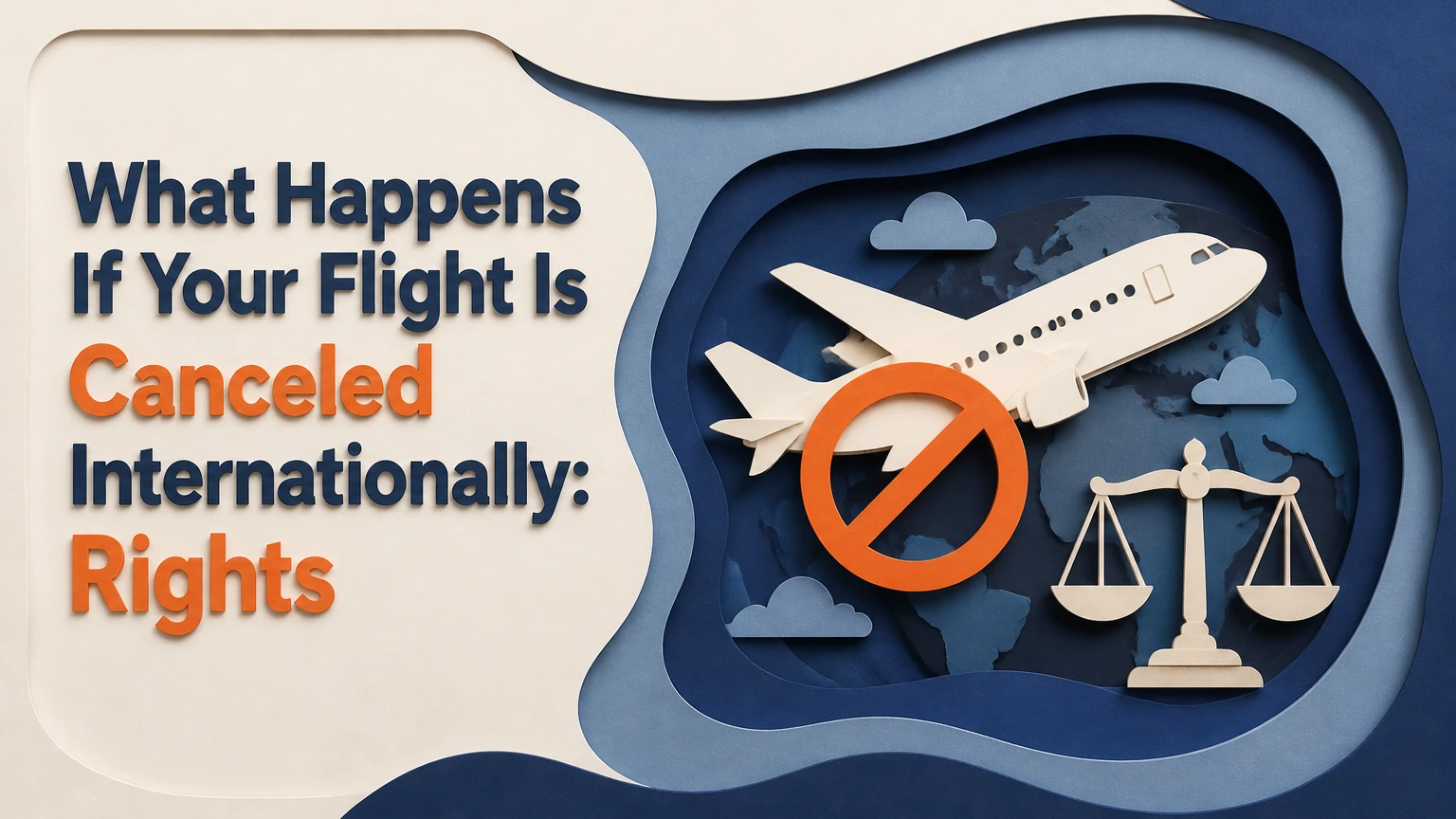
What happens if your flight is canceled internationally depends on the departure country, airline, route, cause, and notice given. The airline normally must offer either transportation to your final destination or a refund for the unused ticket, while meals, hotels, compensation, and replacement-flight costs depend on the governing law and circumstances.
Key Facts / Quick Answer
A canceled international flight usually gives you a choice between rerouting and a refund, but accepting one can affect the other.
EU261 and UK261 may provide care and cash compensation; US federal law generally requires refunds but not delay compensation.
Severe weather, air traffic restrictions, airport closures, and security events usually remove cash-compensation eligibility, but they do not automatically remove refund or rerouting rights.
Do not buy a replacement ticket or hotel room until you ask the airline for written authorization, unless an emergency makes authorization impossible.
Keep the cancellation message, boarding passes, receipts, baggage records, and the airline’s stated reason.
A voucher is not the same as a refund. Accepting a voucher can make it harder to recover cash later.
What Happens Immediately After an International Cancellation?
An international flight cancellation removes the original transportation service, but it does not automatically erase the airline’s obligations. The operating carrier should provide a cancellation notice, explain available options, and protect the unused portion of the itinerary under its contract of carriage and applicable passenger-rights law.
The first operational question is whether the airline has already rebooked you. Check the app, email, text message, airport monitors, and reservation record before joining a service queue. An automated rebooking may preserve your seat, checked-baggage record, and onward connection more effectively than a new booking made independently.


Ask the airline to confirm four facts in writing:
- The cancellation reason and whether the cause was within the carrier’s control.
- Your proposed replacement itinerary, including the final arrival date and time.
- Whether meals, lodging, ground transportation, and communication costs are covered.
- Whether the ticket remains open for rerouting or has been refunded.
The airline that sold the ticket and the airline operating the canceled flight may be different. Under many codeshare arrangements, the operating carrier manages the disruption at the airport, while the marketing carrier controls ticket changes. Contact both if the first representative says the other airline owns the reservation.
What Does the Airline Usually Offer?
The normal choices are rerouting, a refund, or a voluntary travel credit. A carrier may present a limited menu in its app, but airport agents can sometimes access partner flights, manual endorsements, or routes unavailable through self-service tools.
| Option | What you receive | Typical timing | Main financial consequence |
|---|---|---|---|
| Rerouting | A replacement seat to the ticketed destination | Same day to 72 hours | No new fare if the carrier protects the ticket |
| Refund | Money returned for the canceled or unused transportation | 7 business days for card payments under US DOT rules | Original trip may become your responsibility |
| Travel credit | Future-flight credit under stated terms | Often issued immediately | Expiration and restrictions may apply |
| Partial-use settlement | Refund for an unused segment | 7-20 business days, depending on payment method | Remaining travel may need separate booking |
A rerouting offer may arrive before the airline knows whether you qualify for cash compensation. Do not treat a rebooking as a compensation settlement unless the written terms say so.
Why Was the Flight Canceled?
The cancellation reason affects care and compensation more than the basic choice between transportation and a refund. Mechanical problems, crew shortages, scheduling errors, and many airline IT failures are generally within the carrier’s control, while extreme weather and air traffic restrictions usually are not.
The airline’s first explanation may be too general to support a claim. “Operational reasons” does not identify whether the event was a preventable staffing issue, an earlier weather disruption, a maintenance problem, or a legally recognized extraordinary circumstance. Request the specific reason and retain the original message.
Common categories include:
- Carrier-controlled events: aircraft maintenance, crew availability, staffing, aircraft rotation, scheduling, and reservation-system failures.
- External events: severe weather, airport closure, air traffic control limits, war, terrorism risk, and government restrictions.
- Mixed events: weather causes an earlier delay, then the airline lacks an aircraft or crew for the later cancellation.
- Passenger-related events: security restrictions, missing travel documents, and a missed connection caused by the traveler.
A mixed event requires careful analysis. An airline may avoid compensation for the initial weather event but still owe care or compensation for a later staffing failure if the later failure independently caused the cancellation.
Does the Reason Change What the Airline Owes?
The reason can change hotel, meal, and cash-compensation duties, but it does not automatically determine whether a refund is available. A carrier may owe rerouting or reimbursement while owing no fixed cash payment.
| Cancellation cause | Typical control classification | Rerouting or refund | Hotel and meals | Fixed compensation |
|---|---|---|---|---|
| Aircraft maintenance defect | Airline-controlled | Usually available | Often required under EU, UK, or carrier policy | Possible under EU261 or UK261 |
| Severe weather closure | Extraordinary circumstance | Usually available | Depends on governing rule and fare terms | Usually unavailable |
| Air traffic control restriction | External authority | Usually available | Varies by jurisdiction | Usually unavailable |
| Crew scheduling shortage | Airline-controlled | Usually available | Often available under EU or UK rules | Possible under EU261 or UK261 |
| Airport security closure | External event | Usually available | Varies by law and policy | Usually unavailable |
The airline may still offer meals or hotel accommodation during an uncontrollable disruption as a goodwill measure. Goodwill is not the same as a statutory admission of fault.
Which International Passenger Rules Apply?
The departure airport usually provides the strongest starting point for identifying passenger rights. The airline’s home country also matters, especially for flights entering the European Union, United Kingdom, or Canada.
| Governing regime | When it can apply | Refund or rerouting rule | Compensation or care feature |
|---|---|---|---|
| EU261 | Flight departing an EU, Icelandic, Norwegian, or Swiss airport; some arrivals on EU-based carriers | Reimbursement or rerouting | Care and possible fixed compensation, often about USD 275-650 |
| UK261 | Flight departing the United Kingdom; some arrivals on UK carriers | Reimbursement or rerouting | Care and possible fixed compensation, often about USD 275-650 |
| US DOT rules | Flights to, from, or within the United States | Refund when the airline cancels or makes a significant change and the passenger rejects alternatives | No general federal cash payment for ordinary cancellations |
| Canadian APPR | Many flights to, from, or within Canada | Rebooking or refund in specified situations | Care and possible compensation, often about USD 300-750 equivalent |
| Airline contract | Every ticket, subject to applicable law | Contract-specific rebooking and refund terms | May exceed statutory minimums |
The EU and UK systems are separate. A flight from London to Paris may be governed by UK261 at departure and EU261 considerations at arrival, but the exact remedy depends on the operating carrier and itinerary.
EU261 fixed compensation is based on distance and arrival delay, not simply on the fact that the flight was canceled. The law commonly uses approximately USD 275, USD 440, or USD 650 after conversion, but the legal amounts are set in euros and exchange rates change.
What Is the EU and UK 14-Day Rule?
The EU261 and UK261 14-day rules determine whether late cancellation notice may trigger fixed compensation. Notification more than 14 days before departure normally removes compensation, while notification within 14 days requires the airline to prove an acceptable rerouting offer or an extraordinary circumstance.
| Notice before departure | Rerouting result | Compensation position |
|---|---|---|
| More than 14 days | Any reasonable replacement offered | Usually no fixed compensation |
| 7-14 days | Arrival within about 4 hours of schedule may avoid payment | Payment may apply if arrival is later |
| Less than 7 days | Arrival within about 2 hours may avoid payment | Payment may apply if arrival is later |
| Any notice with extraordinary cause | Rerouting or refund still applies | Fixed compensation usually excluded |
The arrival comparison is measured against the original scheduled arrival, not merely the replacement flight’s departure time. A replacement that leaves quickly but arrives the next day can still create a compensation claim.
EU Regulation 261/2004, Article 8, describes the passenger’s choice as “reimbursement … or rerouting … at the earliest opportunity.” That wording matters because an airline’s preferred flight is not always the only lawful rerouting possibility.
Is a Refund Better Than Rebooking?
A refund is usually better when the trip no longer serves its purpose, while rerouting is usually better when reaching the destination remains important and comparable flights are expensive. A voucher is appropriate only when its value, expiration period, and flexibility are better than the available refund.
| Choice | Best for | Main risk | Decision test |
|---|---|---|---|
| Rerouting | Weddings, cruises, work events, fixed hotel dates | Long delay or inconvenient airport | Can you still use the trip after the new arrival? |
| Full refund | Flexible plans or unusable late arrival | Replacement fare may be expensive | Is the trip still worth its total cost? |
| Voucher | Future travel with the same airline | Expiration, blackout dates, restrictions | Is the credit freely transferable and valid for 12 months? |
| Self-purchased replacement | Rare emergencies with no carrier solution | Airline may deny reimbursement | Did the carrier refuse reasonable rerouting in writing? |
A canceled flight does not always produce an automatic refund if the passenger accepts and uses rerouting. A refund normally covers the unused transportation, and a passenger who abandons only one segment may receive a partial amount rather than the whole itinerary.
US Department of Transportation rules require a refund when the airline cancels or significantly changes a flight and the passenger does not accept the alternative. For credit-card payments, the airline must generally transmit the refund within seven business days after the passenger becomes entitled to it; cash and check transactions can take up to 20 calendar days under the federal framework.
Are Hotels, Meals, and Replacement Flights Covered?
Hotel and meal coverage depends on the governing law, the cancellation cause, and the airline’s written policy. EU261 and UK261 generally require reasonable care during qualifying waits, while US federal law does not impose a universal hotel or meal requirement for ordinary cancellations.
Care can include food, refreshments, hotel accommodation when an overnight stay is necessary, and transportation between the airport and hotel. The expense must be reasonable and connected to the disruption. A luxury hotel, alcohol purchase, room upgrade, or unrelated sightseeing expense is unlikely to be reimbursed.
| Expense | Evidence to keep | Typical reasonable range | Reimbursement warning |
|---|---|---|---|
| Airport meal | Itemized receipt and cancellation notice | USD 15-35 per meal | Alcohol and minibar charges are commonly excluded |
| Airport hotel | Invoice showing guest and dates | USD 100-250 per night | Ask for authorization before booking |
| Airport transfer | Taxi or transit receipt | USD 20-80 each way | Use the nearest practical hotel |
| Communication | Call or data receipt | USD 5-30 | Only disruption-related use is persuasive |
Under US rules, an airline may voluntarily promise hotel and meal coverage in its customer-service plan. The US DOT dashboard and the carrier’s contract can show whether the airline has made that commitment. A voluntary promise can be enforceable under the airline’s published policy even when federal law does not require payment.
In practice, obtain a meal voucher before paying personally. If the desk is closed, the line is inaccessible, or the airline instructs passengers to make reasonable arrangements, document the failed attempt with timestamps and screenshots.
Can the Airline Owe the Cost of a Different Carrier?
A replacement flight on another airline is not automatically reimbursable. Ask the operating carrier or ticketing carrier to endorse the ticket, confirm the new routing in writing, and record the agent’s name or reference number before purchasing.
Partner and alliance options can help, but alliance membership alone does not force a seat transfer. A Delta itinerary may involve Air France or KLM, while a United itinerary may connect to Lufthansa or Air Canada; the ticketing carrier still must authorize the transaction.
What Should You Do at the Airport?
The fastest safe response is to secure a documented itinerary before spending money. The airline app often displays seats and routes before airport desks can process the crowd, but self-service changes may not preserve special assistance, baggage, visa, or onward-connection details.
- Screenshot the cancellation alert, original itinerary, and proposed replacement.
- Check the app for same-day rerouting and compare final arrival times.
- Ask the airline to search partner, interline, and nearby-airport options.
- Confirm whether checked bags will transfer or must be collected.
- Request meal, hotel, and transportation authorization in writing.
- Ask whether the ticket remains valid if you reject the first option.
- Record the cancellation reason, agent name, case number, and timestamps.
- Keep every receipt and submit the claim through the correct carrier or regulator.
Do not cancel the entire reservation merely because the app offers an inconvenient flight. Cancellation can convert a protected ticket into a voluntary refund and may remove onward segments.
What If You Have a Connecting Flight?
A single-ticket international itinerary normally gives you stronger protection than separately purchased flights. If the canceled segment causes a missed connection on the same ticket, the carrier generally must reroute you to the ticketed final destination rather than treating the next segment as a new problem.
Separate tickets create a different risk. If Airline A cancels a flight and you miss a separately booked Airline B departure, Airline B may classify you as a no-show and keep the fare. Travel insurance, flexible fares, or a written waiver from Airline B may be your only recovery paths.
| Itinerary structure | Missed-connection responsibility | Baggage treatment | Practical protection |
|---|---|---|---|
| One ticket, one airline | Primary carrier protects final destination | Bag record often transfers | Strongest rerouting position |
| One ticket, multiple airlines | Contracting carrier coordinates itinerary | Interline transfer may continue | Keep all boarding documents |
| Separate tickets | Each carrier handles its own ticket | Recheck may be required | Build 6-12 hours of buffer |
| Award ticket with partner | Program rules and operating carrier both matter | Partner rules can differ | Call the loyalty program and carrier |
A canceled outbound flight can also cancel the return automatically if you do not contact the airline. Tell the carrier whether you intend to use the remaining sectors, especially when the return is on the same booking.
What Happens to Baggage, Visas, and Special Needs?
Checked baggage usually follows the protected replacement itinerary, but a rerouting through a different country can require collection, customs inspection, or a new bag tag. Ask whether the bag is physically loaded, stored at the airport, or available for collection before leaving.
Travel documents can make an otherwise available route unusable. A passenger may need a transit visa, passport validity beyond six months, proof of onward travel, or a vaccination document for the replacement country. The airline should not reroute you through a country where you cannot legally transit without confirming an alternative.
Passengers with wheelchairs, medical equipment, service animals, minors traveling alone, or refrigerated medication should tell the carrier before accepting a replacement. A technically available seat may not meet the original assistance arrangement.
Travel insurance often handles unreimbursed prepaid hotels, tours, and replacement transportation after airline remedies are exhausted. Credit-card insurance varies by issuer, covered reason, payment percentage, notification period, and documentation. A card benefit is not guaranteed merely because the ticket was purchased with that card.
When Does Cancellation Become a Compensation Claim?
A refund claim seeks the ticket price. A care claim seeks reasonable food, lodging, and transport expenses. A compensation claim seeks a separate statutory payment for disruption. These are different claims and can be filed together when the governing law allows.
| Claim type | Trigger | Common evidence | Typical outcome |
|---|---|---|---|
| Refund | Passenger rejects canceled service | Ticket receipt and payment record | Original payment method |
| Care expenses | Qualifying waiting period | Itemized receipts and boarding pass | Reasonable documented costs |
| Fixed compensation | Covered cancellation and late notice | Notice timestamp and final arrival | About USD 275-650 under EU or UK rules |
| Insurance claim | Covered financial loss after carrier remedy | Policy, receipts, denial letters | Policy-specific reimbursement |
EU and UK compensation can be unavailable when extraordinary circumstances caused the cancellation. It can also be reduced when rerouting limits the arrival delay. The airline must establish the qualifying circumstance rather than relying only on a vague operational label.
Canada’s APPR system can provide compensation for airline-controlled disruptions when passengers arrive substantially late and were informed within the applicable period. The amount depends on delay length and carrier classification, so use the Canadian Transportation Agency’s current guidance rather than relying on a generic online chart.
How Do You File the Claim?
File first with the operating airline, then escalate to the relevant regulator if the response is incomplete. Include the booking code, flight number, scheduled and actual times, cancellation notice, replacement itinerary, receipts, and the exact remedy requested.
A concise claim is stronger than a long narrative. State the legal basis, amount, calculation, and payment details. Separate statutory compensation from expense reimbursement so the airline cannot close one request while ignoring the other.
Typical escalation routes are:
- EU member-state national enforcement body for the departure airport.
- UK Civil Aviation Authority guidance and the airline’s complaint process.
- US DOT complaint system for covered flights and refund disputes.
- Canadian Transportation Agency complaint process after contacting the carrier.
Deadlines vary. Submit promptly, because some national systems and airline contracts impose claim periods that differ from the underlying passenger-rights regulation.
Which Mistakes Cost Passengers Money?
The most expensive mistake is accepting a refund before calculating the cost of reaching the destination. A refund may be legally correct but commercially inadequate when a last-minute international replacement costs several times the original fare.
Other avoidable errors include:
- Accepting a voucher without checking expiration, name restrictions, transferability, and refund rights.
- Buying a new ticket without giving the original airline a reasonable chance to reroute you.
- Leaving without written proof of the cancellation reason.
- Assuming a codeshare airline and the ticketing airline have identical authority.
- Allowing the airline to mark you as a no-show on later segments.
- Booking a replacement through a country requiring a transit visa.
- Throwing away receipts for modest meals or ground transportation.
- Filing only for “compensation” when the main loss is a hotel or replacement-flight expense.
Expert insight: A short written refusal from the airline can be more valuable than a verbal promise. If an agent says no partner routing or hotel coverage is available, ask for that conclusion in the reservation notes or by email before spending money.
Expert insight: The first replacement flight is not necessarily the best protected option. A self-rebooked itinerary can split one ticket into multiple contracts, weaken baggage protection, and create a new missed-connection risk.
Expert insight: The cancellation reason at the moment of notification may not be the legally relevant cause. Airlines sometimes assign a weather code to a later crew or aircraft failure, so preserve messages from multiple stages of the disruption.
Frequently Asked Questions About what happens if your flight is canceled internationally
Can I get a refund if my international ticket is nonrefundable?
Yes, a nonrefundable ticket can still qualify for a refund when the airline cancels the flight or makes a legally significant change and you reject the offered transportation. The refund usually covers the unused air transportation and eligible taxes, not unrelated hotels, tours, or prepaid activities.
Can I book another airline after my flight is canceled?
You can buy another airline’s ticket, but reimbursement is uncertain unless the original carrier authorizes it or fails to provide reasonable rerouting. Ask for written authorization first, compare the proposed arrival times, and keep proof that the airline refused or could not provide a workable alternative.
What if the airline cancels my flight after I check in?
Checking in does not remove cancellation rights. The airline should still offer rerouting or a refund, and checked baggage should be located or transferred. Ask whether your bag has been loaded, request retrieval instructions, and do not leave the airport if security or immigration rules require baggage collection.
Does travel insurance pay when an airline cancels?
Travel insurance may pay covered losses that remain after the airline provides a refund, rerouting, or required care. Policies differ on weather, mechanical failure, carrier insolvency, missed connections, and substitute transportation, so read the covered-cause definition and excess before submitting receipts.
Can a canceled international flight affect my visa?
Yes, a new routing can create a transit-visa or entry-document requirement that did not apply to the original itinerary. Before accepting a replacement, verify passport validity, transit rules, visa exemptions, and airport-change requirements with the destination government or an official consular source.
How long should I wait before filing a cancellation complaint?
File after you receive the airline’s final response or once the airline misses a promised deadline, but do not delay collecting evidence. Submit the refund request immediately, preserve receipts during the disruption, and file compensation or regulator complaints within the applicable national or contractual deadline.
Conclusion: What Happens If Your Flight Is Canceled Internationally?
What happens if your flight is canceled internationally is determined by the route, operating carrier, notice period, cancellation cause, and ticket structure. Start with the app and written rerouting options, compare the replacement arrival against the value of a refund, protect baggage and visa requirements, and document every expense. EU261, UK261, US DOT rules, Canadian APPR, the airline contract, and travel insurance may provide separate remedies, so do not accept a voucher before identifying which remedy best protects your trip.