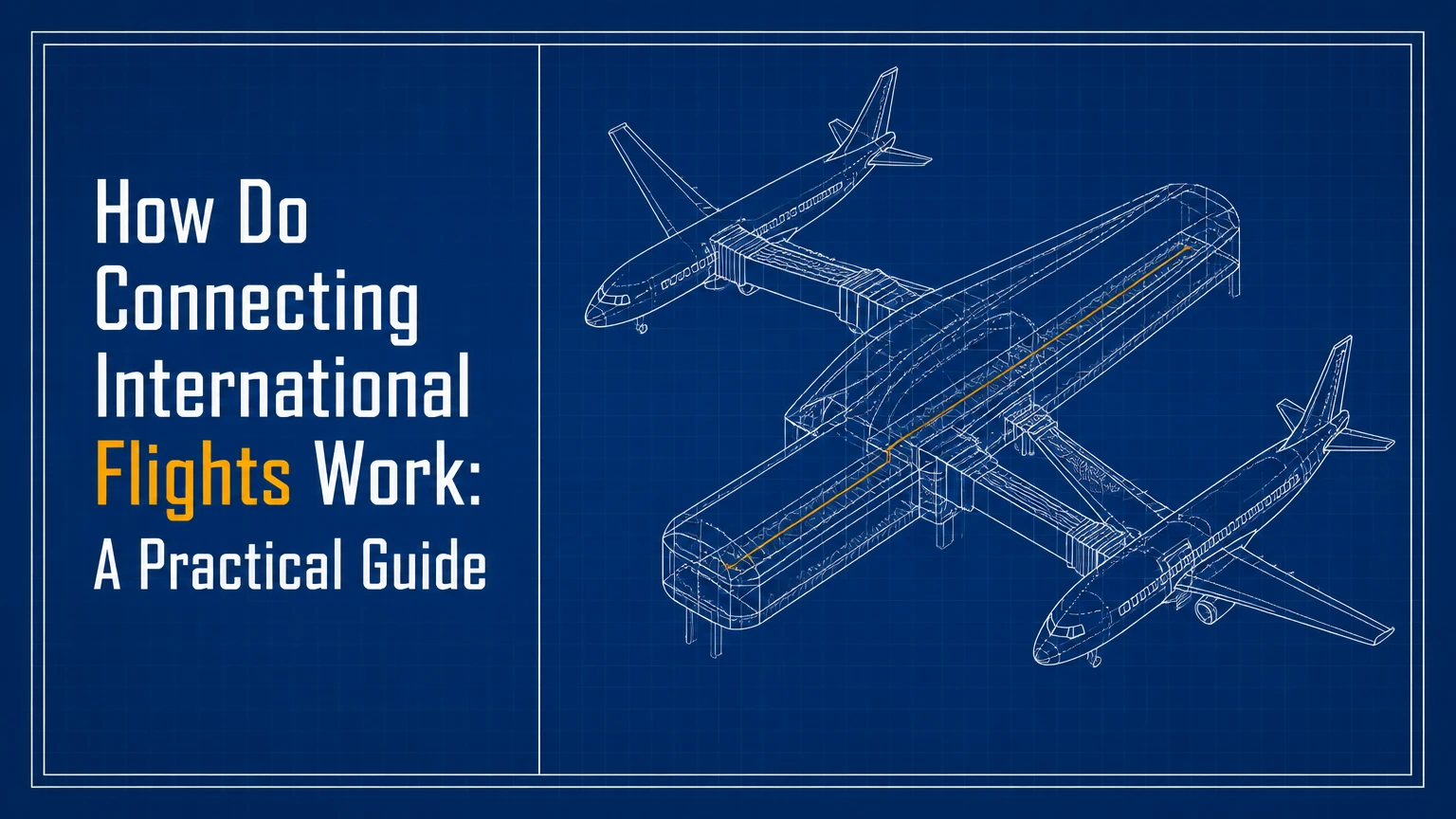
Connecting international flights work by taking you from your origin to an intermediate airport, where you transfer to another aircraft before reaching the final destination. The required steps depend on one ticket or separate tickets, the transit country’s border rules, baggage arrangements, terminal layout, and the time between scheduled flights.
Key Facts / Quick Answer
A single-ticket itinerary normally protects the connection under the airline’s conditions of carriage, but a shared PNR alone does not guarantee every protection.
Checked baggage is usually tagged to the final airport on one ticket, yet customs or border rules can require you to collect and recheck it.
International transfers commonly take 60-120 minutes at major hubs; 2-3 hours is a more practical buffer when terminals or immigration are involved.
The USA requires most arriving international passengers to complete entry processing before continuing, while many airside transfers elsewhere avoid immigration.
Separate tickets create a self-connection: missed flights, baggage handling, visas, and overnight costs become your responsibility.
Verify the airport’s official transfer instructions and the destination government’s transit-visa rules before paying for a ticket.
How Do Connecting International Flights Work?
A connecting international flight has two or more flight segments separated by a transfer at an intermediate airport. You leave the first aircraft, follow signs for “Connections,” “Transfers,” or “Transit,” pass any required security or border checkpoint, find the next gate, and board the following segment.
A connection is different from a nonstop flight because the aircraft changes. “Direct flight” can mean a flight retains the same flight number but makes a stop, so check whether the itinerary says nonstop when avoiding a plane change.


The operating carrier may differ from the airline printed on your booking. A Delta-marketed segment, for example, may be operated by Air France under a codeshare agreement. The operating carrier controls the aircraft, gate process, and onboard service, while the marketing carrier may own the fare and ticket relationship.
The three records that determine responsibility
| Record or label | What it identifies | Why the traveler should care |
|---|---|---|
| Ticket number | Paid transportation contract, usually 13 digits | Shows whether segments belong to one issued itinerary |
| PNR or record locator | Reservation record, commonly 6 characters | Retrieves the booking, but one PNR does not alone prove one ticket |
| Operating carrier | Airline flying the aircraft | Controls check-in desks, gates, baggage acceptance, and onboard service |
| Marketing carrier | Airline selling the flight number | May handle the fare, loyalty credit, and customer communication |
| Minimum connection time | Airport and airline scheduling threshold | Indicates a sellable connection, not a comfortable personal buffer |
The most reliable question is not “Do I have one booking code?” Ask the airline or travel agency whether all segments appear on one ticket number. That distinction becomes important after delays, schedule changes, and baggage problems.
What Happens at the Origin Airport?
At the origin airport, you check in with the operating airline for the first segment and present travel documents for the entire itinerary. When the reservation is eligible, the airline issues boarding passes for both flights, although a second pass may be issued at the transfer desk instead.
The check-in agent also decides how the checked bag is tagged. Look at the printed baggage receipt and confirm that its final airport code matches the place where you intend to collect it.
| Origin-stage action | Typical timing | Traveler verification |
|---|---|---|
| Online check-in opens | 24-48 hours before departure | Confirm names, passport data, and both segments |
| Airport check-in closes | 45-90 minutes before departure | Check the operating carrier’s cutoff |
| Bag drop and tag printing | 10-20 minutes per passenger | Read the final airport code on the tag |
| Departure security | 15-45 minutes at a large airport | Keep liquids, electronics, and documents accessible |
| Exit immigration, where required | 10-60 minutes | Follow signs for departures or passport control |
A boarding pass for the second flight is useful, but it does not eliminate transfer requirements. You may still need a security inspection, passport check, terminal shuttle, or document verification at the intermediate airport.
In practice, the baggage tag is the fastest operational clue. A tag ending in the final destination generally indicates through-checking, while a tag ending at the transit airport means you must collect the bag there. Airport and customs rules can override the tag expectation.
What Happens at the Transit Airport?
At the intermediate airport, the standard process is to leave the aircraft, follow transfer signs, check the flight information screens, complete required screening, and reach the next gate before boarding closes. Do not follow “Exit” or “Baggage Claim” unless the airport or airline instructs you to do so.
- Check the screens immediately. Confirm the next flight number, terminal, concourse, gate, and boarding status.
- Follow the transfer route. Signs may say Connections, Transfer, Transit, or Flight Connections.
- Complete transit security. Many international hubs rescreen arriving passengers even when they remain airside.
- Pass border control if required. Schengen entry, USA entry, and some terminal transfers can require immigration.
- Collect and recheck baggage when instructed. This is common for self-connections and some customs systems.
- Walk or take airport transport. Heathrow, Paris Charles de Gaulle, Frankfurt, Istanbul, and Dubai can involve long corridors, trains, or buses.
- Reach the gate before boarding closes. Boarding often ends 15-30 minutes before scheduled departure.
- Board with the correct document. The gate may reissue a pass if the original segment changed.
| Transfer feature | Same-airport example | Added time, typical | Main risk |
|---|---|---|---|
| Same concourse | Dubai Terminal 3 to Terminal 3 | 20-60 minutes | Transit security queue |
| Airside train | Frankfurt remote concourse | 30-75 minutes | Wrong train or platform |
| Terminal bus | Paris CDG terminal transfer | 45-120 minutes | Traffic and passport control |
| Public-side transfer | London Heathrow separate-ticket move | 90-180 minutes | Immigration, bags, recheck |
| Airport change | Tokyo Narita to Haneda | 3-5 hours | Ground transport delay |
Airport maps can be misleading because walking time begins after the aircraft reaches its parking position, not when the plane touches down. A 75-minute scheduled connection may provide only 35-45 minutes after taxiing, deplaning, and locating the transfer route.
When do you clear immigration during an international connection?
You clear immigration at the first airport where the transit country considers you to have entered its territory, or whenever the airport requires passengers to leave the sterile airside zone. The rule depends on the route, passport, terminal, visa status, and whether the next flight is domestic or international.
| Connection route | Immigration location, typical rule | Baggage action |
|---|---|---|
| New York to Frankfurt to Rome | Frankfurt, first Schengen entry point | Usually collect in Rome if through-checked |
| Singapore to Doha to Madrid | Usually remain airside in Doha | Usually transferred by airline |
| Tokyo to Los Angeles to Lima | Los Angeles entry processing | Usually collect and recheck in the USA |
| London to Toronto to Mexico City | Toronto entry processing | Follow Canadian baggage instructions |
| Bangkok to Istanbul to Paris | Usually remain airside in Istanbul | Usually transferred on one ticket |
The Schengen Area treats many internal flights as journeys within one border zone. A traveler flying from New York to Frankfurt to Rome usually completes passport control in Frankfurt, then takes the Frankfurt-Rome segment as an internal Schengen flight.
The USA has no general airside international transfer system. U.S. Customs and Border Protection normally requires arriving international passengers to complete inspection, collect checked baggage, clear customs, and deliver bags to the recheck facility before the onward flight.
Canada often requires entry processing for international arrivals, but baggage procedures vary by airport, route, airline, and whether the passenger qualifies for a sterile connection. Follow the airport’s posted process rather than assuming the USA and Canada operate identically.
Which Type of Connection Do You Have?
The connection type determines who absorbs the cost of a missed flight. A single ticket normally creates a protected itinerary, while separate tickets create two independent contracts even when a booking website displays them as one trip.
- Single-ticket connection: One ticket covers all segments, possibly using multiple airlines.
- Codeshare connection: The marketing carrier sells a flight operated by another airline.
- Interline connection: Different airlines accept a coordinated itinerary and may transfer bags.
- Self-connection: Separate tickets require you to manage the transfer yourself.
- Airport-change connection: The next flight departs from a different airport in the same city.
- Open-jaw itinerary: You fly into one city and depart from another, often requiring ground transportation.
| Booking arrangement | Bag transfer | Missed-connection response | Typical traveler control |
|---|---|---|---|
| One ticket, same airline | Usually automatic | Airline normally rebooks under fare conditions | Lower |
| One ticket, interline | Often automatic | Ticketing airline or carrier reroutes | Medium |
| Codeshare, one ticket | Usually coordinated | Contract depends on issued ticket | Medium |
| Two separate tickets | Usually collect and recheck | Second ticket can be forfeited | High responsibility |
| Different airports | No automatic airport transfer | Traveler pays ground transport and rebooking | Highest responsibility |
A single ticket does not promise a hotel, cash payment, or unlimited flexibility in every disruption. Rebooking rights depend on the fare contract, cause of the disruption, local law, and available flights. In the European Union, Regulation EC 261/2004 can create rerouting, care, or compensation rights for qualifying journeys, but it does not apply identically to every itinerary.
Expert insight: A shared six-character reservation code is not the protection travelers think it is. Two tickets can be stored under one agency record, while a single ticket can contain segments with different reservation codes after a schedule change. Verify the ticket number and fare conditions.
How does a self-connection work?
A self-connection requires a traveler to complete the first ticket, enter the country if necessary, collect baggage, travel to the second airline’s check-in area, obtain the next boarding pass, recheck baggage, and clear security again. The second carrier generally has no duty to wait for a delayed first flight.
Allow enough time for the slowest step, not the average step. For two separate international tickets, 4-6 hours is a practical daytime buffer, and an overnight stay is safer when the next flight is infrequent or expensive.
How Much Connection Time Do You Need?
Minimum connection time, or MCT, is the shortest interval an airport and airline system permits for a specific combination of flights. MCT is a scheduling standard, not a guarantee that an ordinary traveler can make the transfer comfortably after a delay.
| Connection condition | Published MCT, typical | Practical booking buffer | Recommended action |
|---|---|---|---|
| Same terminal, airside | 45-75 minutes | 90-120 minutes | Accept only with one ticket |
| International to international | 60-90 minutes | 2-2.5 hours | Check transfer security |
| Terminal change | 90-120 minutes | 2.5-3.5 hours | Study train or bus route |
| Immigration during transfer | 90-150 minutes | 3-4 hours | Avoid tight evening connections |
| Self-connection with bags | Not protected | 4-6 hours | Prefer overnight if possible |
| Reduced mobility or young children | Airport-specific | Add 60-90 minutes | Request assistance in advance |
Airlines can sell a connection that meets the official MCT even when the route includes a long walk, a crowded security checkpoint, and a gate that closes 20 minutes early. The booking engine calculates eligibility; it does not measure your walking speed, familiarity with the airport, or passport queue.
A connection-risk calculation can improve decisions:
Available transfer time = scheduled layover minus taxiing, deplaning, transfer, and boarding time.
For example, a 100-minute layover minus 20 minutes to reach the terminal and 25 minutes before boarding closes leaves about 55 minutes for security, immigration, and walking. That is a tight transfer at a large hub.
Expert insight: The printed arrival time is not the time you become available to transfer. At busy airports, add 15-25 minutes for taxiing and deplaning before judging a connection.
What Do Connecting Flights Cost?
Connecting itineraries are often cheaper than nonstop flights because airlines price routes according to competition, aircraft capacity, corporate demand, and network strategy. There is no universal discount percentage, but a connecting fare can be USD 50-400 lower than a comparable nonstop itinerary on popular international routes.
| Cost component | Typical USD amount | When it applies | How to control it |
|---|---|---|---|
| Standard checked bag | USD 0-100 per direction | Fare and airline dependent | Compare total fare, not base fare |
| Seat selection | USD 10-150 per segment | Basic or restricted fares | Select only the long or tight segment |
| Airport transfer | USD 15-100 | Different terminal or airport | Avoid airport changes when possible |
| Overnight hotel | USD 80-250 per night | Long layover or missed self-connection | Book refundable lodging |
| Rebooking after separate-ticket miss | USD 150-1,500 | Second ticket forfeited or repriced | Buy protection or add time |
| Transit visa | USD 0-200 | Passport and country dependent | Check government sources before purchase |
Airfare includes many airport charges and passenger facility fees, but optional services, baggage, meals, hotels, and ground transport can turn a cheap fare into an expensive journey. Compare the total trip cost and time.
A stopover usually means spending more than 24 hours at the intermediate city, although airline fare rules may define the threshold differently. A long layover can become a stopover without changing flights if the fare permits it, while a stopover program may bundle a hotel or discounted accommodation.
Airlines such as Qatar Airways, Emirates, and Icelandair have offered stopover products at different times and under changing eligibility rules. Confirm current conditions, transit-visa eligibility, hotel location, and minimum-stay requirements directly with the carrier.
Connecting Versus Nonstop International Flights
Nonstop flights usually minimize elapsed time and transfer risk, while connecting flights can reduce fare cost and offer more destination choices. The better option depends on the value of time, the cost of a missed event, baggage needs, and the reliability of the transfer airport.
| Factor | Connecting itinerary | Nonstop itinerary |
|---|---|---|
| Typical fare difference | USD 50-400 lower | USD 50-400 higher |
| Total travel time | Adds 2-8 hours | Shortest scheduled path |
| Aircraft changes | 1 or more | 0 |
| Baggage handoffs | 1 or more | 0 at a connection point |
| Missed-flight exposure | High when the buffer is short | Lower, no connection to miss |
| Route availability | More city pairs and departure times | Limited to nonstop markets |
| Recovery options | Possible alternate hub or carrier | Usually waits for the same route |
| Physical demand | More walking and screening | Fewer airport processes |
A connection can be the sensible choice when the nonstop costs USD 300 more, the layover is four hours, and the trip has no fixed arrival deadline. A nonstop is often worth the premium for a wedding, cruise departure, medical appointment, or travel with checked specialist equipment.
Connecting flights are also unsuitable for travelers who cannot tolerate repeated security screening, have a passport requiring difficult transit visas, or face a high financial consequence from late arrival.
What Can Go Wrong During a Connection?
Most connection problems involve time, documents, baggage, or an incorrect assumption about responsibility. The remedy depends first on whether all segments are on one ticket.
| Problem | Single-ticket response | Separate-ticket response | Immediate step |
|---|---|---|---|
| First flight arrives late | Contact transfer desk for rerouting | Contact second airline before no-show cutoff | Photograph delay and booking details |
| Bag misses onward flight | File delayed-baggage report | Airline handling the bag investigates | Keep baggage tag and receipts |
| Gate changes | Airline or airport updates may help | Traveler monitors every carrier | Check screens after security |
| Immigration queue causes miss | Request protected rebooking | Second fare may be lost | Ask border staff for assistance |
| Terminal closes overnight | Carrier may provide instructions or care | Traveler arranges hotel and transport | Confirm operating hours |
| Flight cancellation | Rerouting depends on contract and law | Each ticket handled separately | Do not cancel the second ticket yourself |
If the first flight is delayed on a single ticket, go to the airline’s transfer desk or app before leaving the secure area. Do not buy a replacement ticket immediately unless the airline confirms that the original itinerary cannot be protected, because a self-purchased replacement may not be reimbursed.
If the first flight is delayed on separate tickets, contact the second airline as soon as possible. Some carriers offer a discretionary same-day change or reduced missed-flight fee, but no general rule requires them to do so.
What happens to checked baggage?
Checked baggage normally moves automatically between aircraft when all segments are on one ticket, the airlines have an interline arrangement, and local customs rules permit through-checking. Baggage may still arrive later because a short connection gives handlers insufficient time to load it.
You must usually collect and recheck bags when:
- The flights use separate tickets.
- The transit country requires customs collection at the first entry airport.
- The baggage tag ends at the connecting airport.
- You change airports or leave the sterile area.
- An airline agent instructs you to collect the bag for inspection.
- A through-check agreement does not exist between the carriers.
Pack medication, travel documents, chargers, valuables, and one change of clothes in your cabin bag. Keep the baggage receipt until the final bag arrives. If the bag is delayed, file the report before leaving the airport and retain receipts for reasonable necessities.
Which Documents and Visa Rules Matter?
A transit passenger may need a visa even without planning to leave the airport. Visa requirements depend on nationality, airport, terminal, passport type, onward destination, ticket structure, and whether the traveler passes immigration.
Check these sources before booking:
- The destination and transit country’s immigration authority.
- The airline’s document-checking service, such as Timatic access through the carrier.
- The airport’s official international-transfer page.
- The U.S. Department of State for U.S. travel.
- UK Visas and Immigration for UK transit.
- The European Union’s official immigration and visa information.
A Direct Airside Transit Visa can apply to some nationalities transiting UK or Schengen-area airports, with exemptions that depend on residence permits, visas, and destination documents. A transit visa is not the same as permission to enter the country, and an airport transit exemption may disappear when a terminal change requires landside movement.
Carry the passport used for booking, valid onward boarding documentation, entry visas for the final destination, proof of accommodation when relevant, and any vaccination or health documents required by the route. Airlines can refuse boarding at the origin if a transit document is missing.
Expert insight: “I am only changing planes” describes an intention, not an immigration status. The legal trigger is often crossing a border-control zone or changing from an international to a domestic flight.
How Should You Prepare for a Smooth Transfer?
The best preparation reduces decisions during the layover. Save the airport map, confirm the operating carrier, and keep documents accessible before leaving the first aircraft.
Use this preflight checklist:
- Confirm every segment is on one ticket, not merely one shopping-cart itinerary.
- Check the baggage tag destination at the origin airport.
- Search the transit airport’s official connection process.
- Verify visa and entry requirements for every country on the route.
- Identify whether the next gate is in another terminal or concourse.
- Add at least 90 minutes beyond the published MCT when the route is unfamiliar.
- Put medication, documents, chargers, and essentials in cabin baggage.
- Download airline apps and save reservations offline.
- Choose a seat near the front only when the fare difference is reasonable.
- Tell the airline about wheelchair, medical, or child-assistance needs before departure.
Front-cabin seating can save 5-15 minutes after landing, but it cannot compensate for a passport queue or a terminal bus. Paying for priority boarding does not guarantee faster immigration.
If the layover exceeds 8-12 hours, compare an airport hotel, an airline stopover program, and a landside city visit. A city visit requires legal entry, enough time for transport, luggage arrangements, and a return buffer of at least 3 hours before the next departure.
Frequently Asked Questions About how do connecting international flights work
Do I need to check in again for my connecting flight?
You usually do not check in again when both segments are on one ticket and you already have the second boarding pass. You may need to visit a transfer desk if the pass was not issued, your documents require verification, the airline changed aircraft, or the transit airport requires a new security or baggage process.
Can I leave the airport during an international layover?
You can leave the airport only if you are legally permitted to enter the transit country and have enough time to return. Immigration, transport, security, and boarding typically require at least 3-5 hours beyond the city excursion itself. A transit visa or visa waiver may be necessary even for a short visit.
What if my connecting flight is in another terminal?
Follow the airport’s airside transfer signs before going toward baggage claim. Some terminal changes use trains or buses and add 30-90 minutes. If the move requires exiting the secure zone, you may need immigration clearance, a transit visa, baggage collection, and a new security screening.
Do airlines wait for passengers from delayed flights?
Airlines rarely hold a scheduled international flight for individual passengers because gate, crew, and air-traffic constraints affect departure. On a single ticket, the airline normally handles a missed connection through rerouting under its ticket conditions. On separate tickets, the second airline can treat the passenger as a no-show.
Is a two-hour international layover enough?
A two-hour layover can work for a same-terminal, airside transfer on one ticket, especially when the first flight arrives on time. It is less suitable when immigration, customs, a terminal bus, airport changes, children, mobility assistance, or separate tickets are involved. In those cases, choose at least 3-6 hours.
How do I know whether my bags will go to the final destination?
Read the baggage receipt printed at the first airport. If the tag shows the final airport code and the airlines accept through-checked baggage, the airline normally transfers the bag. If the tag ends at the transit airport, or staff tell you to collect it, retrieve and recheck it during the connection.
Conclusion
Connecting international flights work through a sequence of aircraft transfer, security screening, border control, baggage handling, and gate boarding. The safest plan uses one ticket, verifies the baggage tag, checks transit-visa rules, and allows 2-3 hours for a normal hub connection or 4-6 hours for a self-connection.