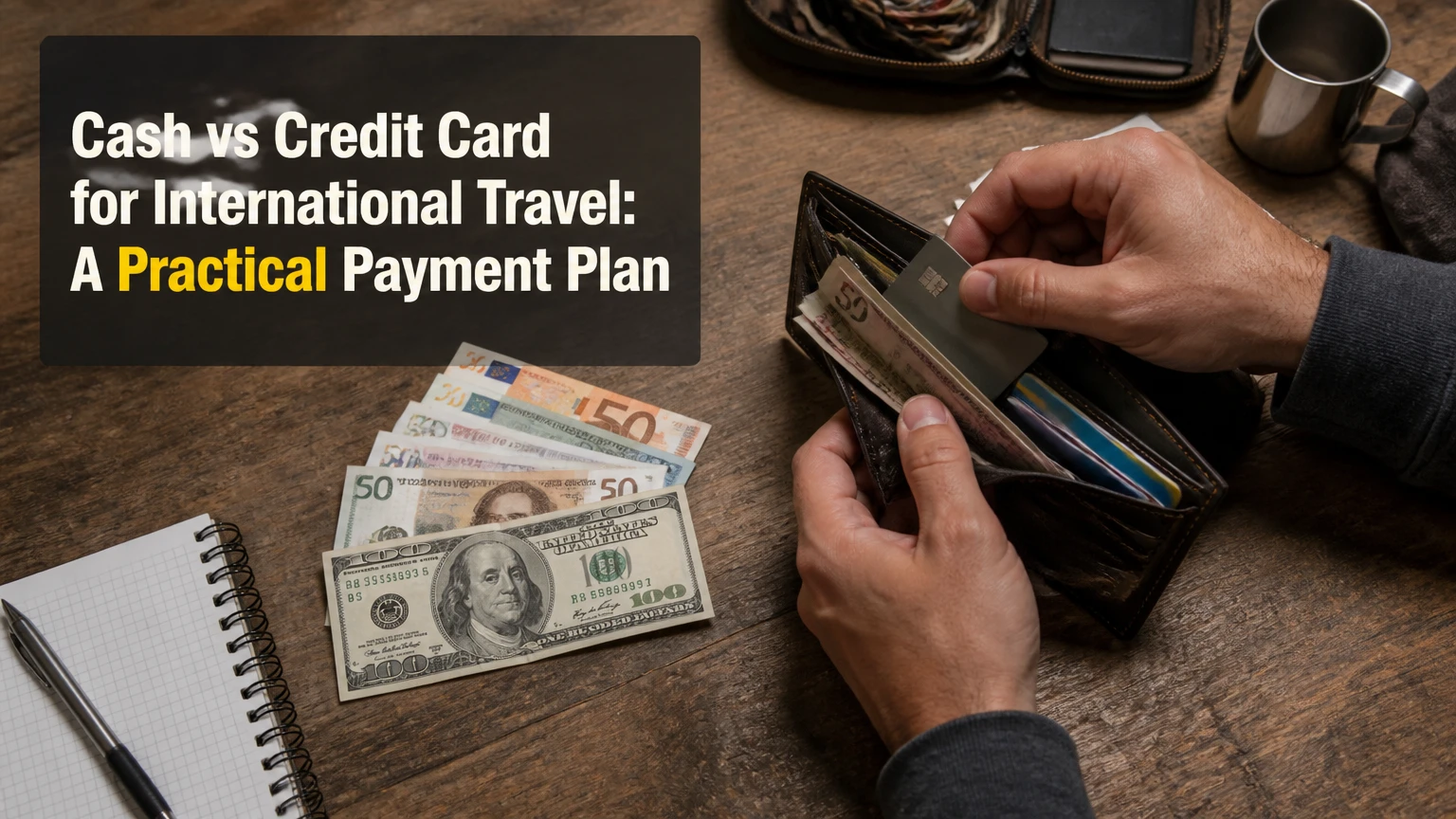
Cash vs credit card for international travel is a choice between physical local currency and electronic borrowing through a global payment network. Credit cards usually provide better exchange rates, fraud protection, rewards, and travel benefits, while cash remains essential for tips, transit, small merchants, emergencies, and places with unreliable connectivity. The strongest plan uses both.
Key Facts and Quick Answer
- Use a credit card with a documented 0% foreign transaction fee for most hotels, restaurants, transport bookings, and larger purchases.
- Carry local cash for approximately 10-20% of planned spending, adjusting upward for rural areas, cash-oriented countries, and small daily purchases.
- Choose the destination’s local currency at terminals and ATMs. Home-currency conversion is Dynamic Currency Conversion, or DCC, and commonly adds a 5-12% markup.
- Use a debit card, not a credit card, for routine ATM withdrawals. Credit-card cash advances generally begin accruing interest immediately.
- Carry two cards from different issuers or networks, store them separately, and keep an emergency reserve of approximately $100-$200.
- Airport exchange counters can impose typical markups of 5-15%; a bank ATM often costs less, but the issuer and local operator determine the final charge.
How Do Cash and Credit Cards Work Abroad?
Cash is destination-country currency exchanged before departure, purchased from a bank, or withdrawn from an ATM after arrival. Payment settles when banknotes and coins change hands, so cash does not depend on a card network, merchant terminal, mobile signal, or account authorization.
A credit card sends a purchase request from the merchant terminal through a network such as Visa or Mastercard to the issuing bank. The network or issuer converts the local-currency amount, the bank places an authorization against available credit, and the completed transaction later posts to the account. A pending charge can therefore appear immediately while the final amount changes slightly after settlement.


What Happens During a Card Purchase?
The merchant first requests authorization for the local amount. Hotels, rental-car agencies, and fuel stations may place a temporary hold that exceeds the eventual purchase, reducing available credit even though the final bill is smaller.
The card network applies its exchange rate according to its processing rules. Your issuer may then add a foreign transaction fee, usually 1-3% unless the account waives it. Selecting local currency normally lets the network process the conversion; selecting US dollars allows the merchant or ATM operator to set its own rate.
Credit cards create a billing record and a dispute channel. Cash creates neither. That difference matters when a hotel claims damage, a restaurant duplicates a charge, or a card number is copied.
What Happens When Cash Is Lost?
Lost cash normally cannot be traced, frozen, or disputed. A traveler may recover value only through insurance, a companion’s assistance, an emergency transfer, or replacement funds from a bank or family member.
Cash also creates a denomination problem. A $100 equivalent note may be difficult to use at a rural bus station or small café, while a stack of small notes increases handling and theft risk. In practice, a mixture of low-value notes and a small emergency reserve is more useful than one large bundle.
Which Payment Method Should Travelers Pack?
The best international payment setup contains a primary no-foreign-transaction-fee credit card, a separate backup card, a debit card for ATM access, and a modest amount of local cash. Prepaid multi-currency services and digital wallets can reduce conversion friction, but they should supplement rather than replace independent access to funds.
| Payment method | Typical direct cost | Protection and acceptance | Best use |
|---|---|---|---|
| No-foreign-fee Visa or Mastercard | 0% issuer fee; 0.5-1% network-rate spread is typical | Strong dispute rights; broad acceptance | Hotels, restaurants, bookings, purchases |
| Premium travel credit card | $0 fee abroad; annual fee often $95-$795 | Rewards, travel insurance, rental benefits | Large purchases and protected bookings |
| Debit card at bank ATM | $0-$5 issuer fee; local fee may add $2-$8 | Direct account access; weaker purchase protection | Obtaining modest local cash |
| Prepaid multi-currency card | 0.4-2% conversion fee; plan limits vary | App controls; limited credit-law protection | Budgeting and secondary spending |
| Physical local cash | 0% at point of sale; exchange markup often 1-15% | No chargeback; immediate settlement | Tips, transit, small vendors |
| Apple Pay or Google Pay | Usually card’s normal fee schedule | Tokenized device payment; phone-dependent | Contactless urban purchases |
Credit Cards for Major Purchases
A no-foreign-transaction-fee card is usually the lowest-friction option for flights, hotels, restaurants, tours, and purchases above approximately $25. Visa and Mastercard generally have wide international acceptance, although a merchant may accept only one network or may reject foreign-issued cards.
American Express can provide valuable rewards and protections, but acceptance is less consistent in some destinations and smaller businesses. Discover has improved international reach through network partnerships, yet travelers should not rely on it as their only card.
Premium benefits require a terms review. Trip cancellation coverage may require paying the full fare with that card, rental-car coverage may be secondary, and medical exclusions can apply to pre-existing conditions or adventure activities.
Debit Cards for Cash Access
A debit card connects directly to a bank account and avoids the credit-card cash-advance category. It is the practical tool for withdrawing local currency, provided the account has reasonable international ATM terms and daily withdrawal limits.
A debit card still carries risks. A compromised card can expose the linked account, and an incorrect PIN or offline ATM can cause access failure. Use a travel account with a limited balance when possible, and keep the primary checking account separate from the card used at unfamiliar machines.
Prepaid Cards and Mobile Wallets
Wise and Revolut can hold several currencies and display conversion costs before a transaction. Their value is transparency and budget control, not necessarily universal acceptance. Account verification, weekend pricing, plan limits, regional restrictions, and merchant offline requirements can affect use.
Apple Pay and Google Pay tokenize the underlying card number, reducing exposure when a merchant never receives the actual account number. They fail when a phone battery dies, a terminal requires a physical card, a device is lost, or the traveler cannot complete account verification.
What Does International Travel Spending Cost?
The cheapest method depends on the complete transaction path, not the advertised exchange rate alone. A card with a 0% foreign transaction fee can still become expensive through DCC, while a “free” ATM withdrawal may include a local operator charge and a poor conversion choice.
| Cost source | Typical amount | Who sets it | How to reduce it |
|---|---|---|---|
| Foreign transaction fee | 0-3% of purchase | Card issuer | Use an account with an explicit 0% fee |
| Card-network conversion spread | About 0.5-1% over market rate | Visa, Mastercard, issuer rules | Pay in local currency |
| Airport exchange markup | About 5-15% | Exchange-counter operator | Use a bank ATM or local bank |
| Bank ATM operator fee | About $2-$8 per withdrawal | Destination ATM owner | Use institutional ATMs and fewer withdrawals |
| Out-of-network issuer fee | $0-$5 per withdrawal | Home bank | Select an account with reimbursement or low fees |
| Credit-card cash advance | $10 or 3-5%, often with a minimum | Card issuer | Never use except for a genuine emergency |
| Cash-advance interest | Often 25% or more APR | Card issuer | Avoid cash advances entirely |
| DCC markup | Commonly 5-12% | Merchant or ATM acquirer | Select local currency |
A $1,000 Spending Example
Assume a traveler spends the equivalent of $1,000 and uses a card with a 3% foreign transaction fee. The fee alone is $30. If the traveler accepts a 7% DCC conversion instead, the conversion cost could be approximately $70, before any issuer fee.
A cash strategy can also vary widely. Exchanging $1,000 at a counter with a 10% markup costs roughly $100 in value, while withdrawing $300 at a bank ATM with $5 in combined fees costs about $5 plus the account’s conversion spread. These are typical illustrations, not guaranteed quotes.
| $1,000 equivalent scenario | Conversion or issuer cost | Approximate value received |
|---|---|---|
| 0% fee card, local currency selected | $5-$10 typical network spread | $990-$995 |
| 3% fee card, local currency selected | $35-$40 total typical cost | $960-$965 |
| Card with 7% DCC | About $70 | $930 |
| Airport exchange with 10% markup | About $100 | $900 |
| Bank ATM, $300 withdrawal, $5 fee | About $8-$12 including spread | $988-$992 |
An exchange rate can move between authorization and final posting. That movement may be only a few dollars on a normal trip, but a hotel deposit or large purchase can produce a more visible difference.
When Is Cash Better Than a Card?
Cash is better when the merchant accepts only notes, the payment terminal is offline, the purchase is too small for card processing, or the traveler needs a resilient backup. Cash is also useful when a destination has a strong cash culture, such as small-town markets, local buses, informal food stalls, and some service businesses.
Cash should not automatically be the primary method. Carrying a week’s budget in one wallet creates a single-point loss, and exchanging large amounts before knowing the local rate can lock in an unnecessary markup.
| Travel situation | Recommended payment mix | Reason |
|---|---|---|
| Major European city | 85-95% card, 5-15% cash | Contactless acceptance is usually high |
| Rural Southeast Asia | 50-75% card, 25-50% cash | Smaller vendors and connectivity vary |
| Japan outside major stations | 60-80% card, 20-40% cash | Cash remains useful for local businesses |
| Multi-day trekking trip | 40-70% card, 30-60% cash | Terminals, power, and signal may be unavailable |
| Resort and rental-car itinerary | 90-95% card, 5-10% cash | Deposits and major charges require cards |
| Cash-oriented local market | 20-50% card, 50-80% cash | Sellers may not accept international cards |
The 80-90% card guideline works best for connected urban travel. It is not a universal rule. Rural transport, border crossings, island travel, festivals, and extended power outages justify more physical currency.
How Can Travelers Prepare a Reliable Payment System?
Preparation should reduce three separate risks: payment rejection, unauthorized access, and lack of emergency liquidity. Complete the following sequence at least one week before departure when possible.
- Audit every card agreement. Confirm the foreign transaction fee, ATM terms, cash-advance rate, daily limit, network, travel insurance conditions, and replacement process.
- Choose two independent cards. Prefer different issuers, and use Visa and Mastercard if both are available. Do not keep both in the same wallet.
- Notify or monitor accounts. Some issuers no longer require travel notices, but transaction alerts, app access, and fraud controls still need testing.
- Set up wallet backups. Add the primary card to a mobile wallet, then carry the physical card because offline or verification-restricted terminals may reject the phone.
- Obtain a modest cash amount. Carry enough local currency for the first 12-24 hours, including transport, food, and a small emergency payment.
- Test account access. Sign in while abroad may require a US phone number, authenticator, or SMS code. Arrange an alternative before departure.
- Record emergency contacts. Store issuer phone numbers outside the wallet and keep a secure copy of card details, passport information, and travel insurance contacts.
- Withdraw strategically. Use a bank-owned ATM, inspect the machine, decline DCC, and withdraw an amount that reduces repeat fees without carrying excessive cash.
The Consumer Financial Protection Bureau states, “If you report the loss or theft of your card before it is used, you aren’t responsible for unauthorized charges.” Reporting rules differ by card type and timing, so contact the issuer immediately rather than assuming a charge will disappear.
How Should Travelers Use ATMs and Avoid DCC?
Use a debit card at a bank-owned ATM during normal branch hours when practical. Check the machine for tampering, shield the PIN, decline conversion into US dollars, and review the displayed fee before confirming the withdrawal.
The ATM may ask whether it should “guarantee” a rate or charge the account in dollars. Choose the local currency. That choice normally sends conversion through the card network or issuer rather than allowing the ATM operator to add its own exchange markup.
Avoid standalone machines in airports, nightlife districts, convenience stores, and tourist corridors unless no safer option exists. A branded ATM can still charge a fee, but a bank branch provides a clearer owner, better visibility, and a practical place to request help.
Withdraw larger, reasonable amounts less often if the fee is flat. For example, four $50 withdrawals with a $5 local fee cost $20, while one $200 withdrawal costs $5, assuming the account and daily limits permit it.
What Problems Do Travelers Often Miss?
The most expensive mistakes are often not ordinary purchase fees. They are authorization holds, forced currency conversion, account lockouts, and reliance on one payment channel.
Hotel and Rental-Car Holds
Hotels may authorize $50-$200 per night for incidentals, while rental-car agencies can reserve several hundred dollars or more for a deposit. The hold can remain pending for several business days after checkout or vehicle return.
A card with a low credit limit may fail even when the traveler has enough money in a bank account. Ask the property how much it will authorize, keep sufficient available credit, and avoid using the same card for every large deposit.
Offline and No-Signal Transactions
Some transit gates, aircraft systems, ferries, and rural terminals process payments offline or intermittently. A mobile wallet may fail if it needs a live verification, and a foreign card may be rejected even when domestic cards work.
Carry small local notes for the first journey, keep the physical version of at least one card, and download issuer contact details before leaving connectivity.
Fraud, Skimming, and Account Lockout
A card can be frozen by fraud controls, skimmed at a compromised terminal, or declined because the issuer cannot verify the transaction. Cash avoids electronic fraud at the point of sale but can be stolen without recovery.
Expert insight: separating the backup card from the primary wallet is more valuable than carrying two cards side by side. A pickpocket who takes the wallet should not obtain every payment route.
Currency and Denomination Errors
Count cash before leaving the exchange counter or ATM. At a busy terminal, confirm the amount and currency on the screen before tapping, because a rushed traveler may approve a DCC transaction without reading the conversion choice.
Expert insight: pay attention to the merchant’s currency symbol. A “$” symbol can represent a local dollar currency rather than US dollars, and a terminal’s language setting does not prove that the transaction is priced in USD.
Which Option Is Safest and Cheapest?
A no-foreign-fee credit card is generally safest for purchases because unauthorized transactions can be reported, disputed, and investigated. A low-fee debit card is generally cheapest for obtaining cash, while local banknotes are the most reliable option when electronic infrastructure fails.
| Objective | First choice | Backup choice | Main limitation |
|---|---|---|---|
| Lowest purchase cost | 0% foreign-fee credit card | No-fee prepaid card | Rewards terms and network acceptance vary |
| Lowest cash cost | Reimbursing debit card at bank ATM | Low-fee debit card | Account access and ATM limits matter |
| Strongest dispute path | Credit card | Debit card dispute process | Documentation and deadlines apply |
| Highest outage resilience | Local cash | Second physical card | Cash cannot be recovered when lost |
| Best budget control | Prepaid multi-currency account | Separate travel checking account | Verification and service restrictions |
| Best contactless security | Tokenized mobile wallet | Physical card | Phone battery and terminal compatibility |
Credit cards are poor tools for routine cash withdrawals. A cash advance often has a 3-5% fee, a minimum charge, immediate interest, and no normal purchase grace period. A debit card links to existing funds instead, although the traveler should limit exposure with account controls.
Cash is also a poor tool for large, refundable bookings. A card provides a receipt, merchant record, and dispute pathway, while cash paid to an unfamiliar operator may be difficult to recover.
Destination and Trip-Type Rules
Payment infrastructure differs by country, city, merchant category, and traveler profile. National averages are useful starting points, but the itinerary matters more than the passport stamp.
Europe
Large hotels, rail operators, supermarkets, and restaurants often accept contactless Visa and Mastercard. Keep cash for public toilets, small bakeries, local markets, tips, and rural transport. Germany can be more cash-oriented than Sweden, especially among smaller businesses, so a Europe-wide assumption can fail.
Japan
Cards work widely in major hotels, department stores, chain restaurants, and convenience stores. Cash remains useful for small restaurants, rural transport, temples, vending machines, and businesses that accept only domestic payment methods. Keep yen in small denominations rather than relying on one large note.
Developing or Rural Destinations
Carry more local currency when traveling beyond major cities, particularly where mobile coverage, electricity, or card terminals are inconsistent. Withdraw at a reputable bank before leaving the city, but avoid carrying the full trip budget in one location.
Luxury Hotels and Car Rentals
Use a credit card with sufficient available limit for deposits, incidentals, and insurance documentation. A debit card may place a direct hold on bank funds, potentially affecting food, transport, or emergency access for several days.
Backpacking and Long Trips
Use multiple smaller withdrawals, a low-balance travel account, and two physical cards. Divide cash between a money belt, locked luggage, and a day wallet, while keeping only the day’s expected amount accessible.
Frequently Asked Questions About cash vs credit card for international travel
Should I exchange money before leaving the United States?
Exchange enough local currency for the first transport fare, meal, and emergency purchase, typically $50-$150 equivalent. Buying a large supply before departure can be expensive when a bank or airport counter applies a wide spread. Compare the delivered amount, not merely the advertised commission.
Can a foreign merchant charge my card in US dollars?
Yes. A terminal may offer Dynamic Currency Conversion and display a US-dollar amount. Decline that option and select the local currency, because the merchant’s conversion rate commonly includes a markup that is higher than the card network’s normal rate.
How much cash should I carry while traveling?
Carry roughly $50-$150 equivalent for an urban arrival and approximately $100-$300 for rural or cash-oriented travel, then replenish as needed. Keep daily spending money separate from the emergency reserve, and do not store all cash in the same wallet.
Is a debit card or credit card better for an overseas ATM?
A debit card is usually better because the withdrawal comes from the bank account rather than becoming a cash advance. Choose a debit account with low international fees, use a bank-owned ATM, decline DCC, and check both the ATM fee and your issuer’s fee.
Will my credit card work if I do not set a travel notice?
It may work, because many issuers use real-time fraud models instead of travel notices. Check the issuer’s current policy, enable transaction alerts, and maintain app access. A travel notice does not guarantee approval, so a separate card and cash backup remain necessary.
What should I do if every payment method is declined?
Stop repeated attempts, check whether the account is locked, and contact the issuer through its official international number or app. Use emergency cash for transport, move to a staffed bank or hotel, and ask whether the merchant accepts another network. Never share a full card number with an unsolicited caller.
Conclusion: Build Redundancy, Not a Cash-or-Card Bet
Cash vs credit card for international travel is not a contest with one winner. Use a 0% foreign-transaction-fee credit card for most purchases, a debit card for low-cost ATM withdrawals, local cash for small or offline transactions, and a physically separate backup card for account failures. Start with an 80-90% card and 10-20% cash mix, then increase cash for rural routes, cash-oriented destinations, and unreliable infrastructure. Always choose local currency, avoid credit-card cash advances, and preserve a $100-$200 emergency reserve.