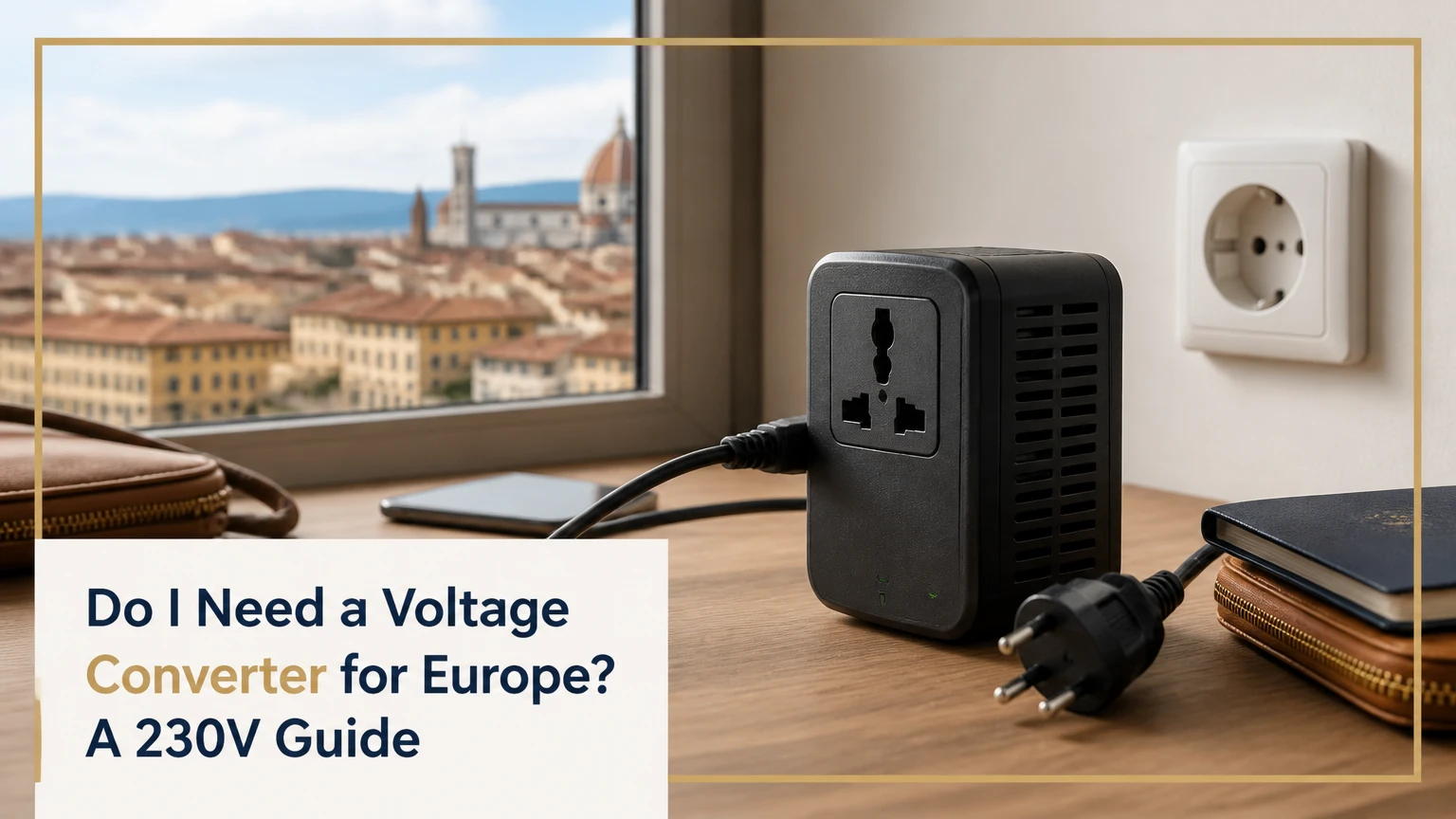
You only need a voltage converter in Europe when an appliance is rated for 110-120 volts only. A converter changes Europe’s approximately 230-volt supply to a lower voltage, while a plug adapter changes only the connector shape. Most phone, laptop, camera, and tablet chargers accept 100-240 volts and need an adapter, not a converter.
Key Facts and Quick Answer
- Continental European outlets generally provide 230V AC at 50Hz; North American outlets generally provide 120V AC at 60Hz.
- A label reading Input: 100-240V, 50/60Hz indicates dual-voltage operation. Use a compatible plug adapter only.
- A label reading 120V, 60Hz indicates a North American single-voltage device. It needs a step-down transformer or converter, if the manufacturer permits use.
- Hair dryers, curling irons, straighteners, clothes irons, and some heated brushes often draw 1,000-2,000 watts, making travel conversion inconvenient and potentially unsafe.
- A basic plug adapter typically costs USD 5-$15. A suitable high-wattage converter or transformer commonly costs USD 30-$100 or more.
- The United Kingdom and Ireland use Type G outlets. Most continental European destinations use Type C, E, or F outlets, with Switzerland and Italy requiring special attention.
What Voltage Does Europe Use?
European household electricity is generally 230 volts AC at 50 hertz, whereas standard household electricity in the United States and Canada is generally 120 volts AC at 60 hertz. The European Union harmonized nominal household voltage around 230V, although a device may show a permitted range such as 220-240V. Frequency and voltage are separate specifications.
The phrase “Europe” covers several plug systems, but the supply voltage is relatively consistent across most destinations. The UK, Ireland, France, Germany, Italy, Spain, Portugal, Switzerland, and the Netherlands all operate household systems around 230V, with local outlet designs and tolerances varying.


European Voltage and Frequency by Destination
| Destination | Typical household voltage | Frequency | Common plug types |
|---|---|---|---|
| France | 230V AC | 50Hz | Type C, E |
| Germany | 230V AC | 50Hz | Type C, F |
| Italy | 230V AC | 50Hz | Type C, F, L |
| Switzerland | 230V AC | 50Hz | Type C, J |
| United Kingdom | 230V AC | 50Hz | Type G |
| Ireland | 230V AC | 50Hz | Type G |
| Portugal | 230V AC | 50Hz | Type C, F |
A North American 120V-only appliance connected to a 230V outlet receives nearly twice its intended voltage. For resistive heating elements, power rises approximately with the square of voltage. A 1,200W US heater connected directly to 230V could theoretically attempt about 4,400W, although the element may fail before reaching that output.
The International Electrotechnical Commission, or IEC, identifies household plug and socket systems by Type designations. Voltage does not determine physical compatibility. A device can have the correct voltage rating and still require a plug adapter.
What Device Do You Actually Need?
A plug adapter changes the physical prongs. A voltage converter or transformer changes electrical voltage. A frequency converter changes hertz, which ordinary travel converters usually do not do. These devices solve different problems and should not be treated as interchangeable.
Electrical Safety First explains the distinction plainly: “A travel adaptor only changes the shape of the plug.” That organization’s safety guidance is consistent with the practical rule used by electricians and appliance manufacturers: verify voltage before connecting an adapter.
Adapter, Converter, and Transformer Compared
| Device | Electrical function | Typical load | Typical USD price |
|---|---|---|---|
| Plug adapter | Changes prong shape only | 100-240V chargers | $5-$15 |
| Electronic converter | Reduces voltage with electronic circuitry | Short heating-tool use | $15-$50 |
| Step-down transformer | Reduces voltage through magnetic coils | Compatible continuous loads | $30-$100+ |
| Frequency converter | Changes 50Hz or 60Hz frequency | Specialized motors or equipment | $100-$500+ |
| Local replacement | Avoids conversion entirely | Hair dryers, irons | $15-$60 |
“Voltage converter” is often used as a broad retail term. Product listings may call a small electronic unit a converter and a heavy coil-based unit a transformer, but the label alone does not prove that either device can safely operate a particular appliance.
A converter’s wattage rating must exceed the appliance’s running wattage. A motor, compressor, or switching power supply may also draw a short startup surge, so matching the printed wattage exactly leaves little safety margin.
How Can You Check Your Device?
Read the input label on the appliance, charger, power brick, or manufacturer’s specification sheet before buying travel equipment. The decisive information is the input-voltage range, followed by frequency, wattage, amperage, and plug configuration.
Use this process:
- Find a line marked Input, Input Voltage, or Rated Voltage.
- Identify whether it says 100-240V, 110-120V, or a single value such as 120V.
- Check whether the frequency says 50/60Hz or only 60Hz.
- Record wattage, written as W, or calculate it from volts multiplied by amps.
- Compare the appliance’s plug with the outlet type at your destination.
- Check the converter manufacturer’s approved appliance categories and maximum continuous load.
- Test the complete setup briefly while remaining present, especially with heating equipment.
Label Examples and Required Equipment
| Label on device | Voltage status | Frequency status | Europe requirement |
|---|---|---|---|
| Input: 100-240V~ 50/60Hz | Dual-voltage | Both frequencies | Plug adapter |
| 120V, 60Hz, 1,500W | Single-voltage | 60Hz only | Suitable converter, if allowed |
| 120/240V, 50/60Hz | Selectable voltage | Both frequencies | Set to 240V, plug adapter |
| 120V, 50/60Hz, 2A | Single-voltage | Both frequencies | Converter rated above 240W |
| Output: 5V USB, input 100-240V | Charger is dual-voltage | Usually both frequencies | Plug adapter |
A USB-C cable does not determine voltage compatibility. The wall charger determines the input rating, while the device receives regulated low-voltage DC from that charger. Most Apple, Samsung, Google, Lenovo, Dell, and similar modern chargers accept 100-240V, but the printed label remains the authority.
Which Appliances Need Conversion?
Single-voltage heating appliances are the most common devices that need voltage conversion. Hair dryers, curling irons, straighteners, heated brushes, clothes irons, and some hot rollers often use 120V-only heating elements with loads between 800W and 2,000W.
High wattage makes these products poor travel-converter candidates. A converter that can continuously support a 1,600W hair dryer is larger, hotter, and more expensive than the small adapter used for a laptop charger.
Device Categories and Practical Advice
| Device category | Typical power range | Common voltage label | Practical travel choice |
|---|---|---|---|
| Phone charger | 5-35W output system | 100-240V | Plug adapter |
| Laptop charger | 45-240W | 100-240V | Plug adapter |
| Camera battery charger | 5-30W | 100-240V | Plug adapter |
| Hair dryer | 800-2,000W | 120V or dual-voltage | Hotel dryer or local model |
| Curling iron | 25-200W | Often 120V only | Dual-voltage model or converter |
| Clothes iron | 1,000-1,800W | Often 120V only | Hotel service or local purchase |
| Electric shaver | 5-20W | Often dual-voltage | Adapter, or shaver outlet |
| CPAP machine | 30-100W typical | Model-specific | Confirm manufacturer requirements |
A dual-voltage curling iron marked 120/240V may require manual switching before use. The voltage selector must be set to 240V before connection. A plug adapter cannot perform that selection.
Many hotel bathrooms provide a shaver socket with a limited output, often around 20-50VA, and that outlet may not support a hair dryer or iron. A hotel’s regular wall outlet may be suitable for a dual-voltage charger but still have a different physical socket from the traveler’s plug.
When Should You Avoid a Converter?
Avoid carrying a converter for a high-wattage heating tool when the accommodation supplies one or when a local replacement costs less than a safe, properly rated device. Avoid any converter that does not clearly state its continuous wattage rating, supported appliance types, thermal protection, and input or output voltage.
A typical basic electronic converter costs USD 15-$50 and may be marketed for short operation, such as 10-20 minutes. That time limit is product-specific, not a universal electrical rule. A heavy transformer may support longer operation, but its rating, ventilation requirements, and appliance compatibility still control safe use.
Typical Converter Limits
| Appliance load | Minimum practical converter rating | Typical operating concern | Better option |
|---|---|---|---|
| 25W curling iron | 50W or higher | Heat cycling | Dual-voltage iron |
| 100W heated brush | 150W or higher | Thermal buildup | Local or dual-voltage tool |
| 1,200W hair dryer | 1,500W or higher | Heat and surge | Hotel dryer |
| 1,600W clothes iron | 2,000W or higher | Continuous heating | Local iron or hotel service |
| 80W CPAP system | 120W or higher | Medical-device compatibility | Manufacturer-approved transformer |
The practitioner rule is to leave at least 20-25% headroom above the appliance’s stated continuous wattage, and more for motors or compressors. A 1,000W converter is not appropriate for a 1,000W appliance when the appliance can surge or when the converter’s rating is a brief maximum rather than a continuous value.
Do not place a converter under clothing, on bedding, or against luggage. Transformers dissipate heat, while electronic converters can heat quickly when a load approaches their limit.
Converter Types Compared
Electronic step-down converters are compact and may suit simple resistive heating loads for short periods. Magnetic step-down transformers are heavier and often produce a cleaner voltage waveform, but neither category automatically handles frequency differences or makes every appliance safe.
The product manual matters more than the retail category. Some electronic converters alter the waveform rather than delivering a smooth sine wave, which can cause buzzing, excess heat, unreliable control electronics, or poor motor performance.
| Converter type | Typical weight | Suitable use | Main limitation |
|---|---|---|---|
| Compact electronic unit | 0.5-2 lb | Short heating-tool sessions | Waveform and thermal limits |
| Portable transformer | 2-8 lb | Compatible low-to-medium loads | Heavy and less efficient |
| Heavy transformer | 8-15+ lb | Higher continuous loads | Bulky, hot, expensive |
| Frequency converter | Varies widely | Specialized 50Hz/60Hz equipment | Rarely needed for chargers |
A transformer changes voltage through electromagnetic induction. Its output frequency normally remains 50Hz when the input is 50Hz. Therefore, a transformer cannot correct a 60Hz-only clock, turntable, fan, or motor.
Modern chargers usually rectify incoming AC and regulate it electronically, so they commonly tolerate both 50Hz and 60Hz. Older clocks and synchronous motors depend more directly on frequency and may run approximately 17% slower on 50Hz than on 60Hz.
Which Plug Adapter Fits European Outlets?
The required adapter depends on the country and the device’s plug, not on the voltage alone. Type C plugs fit many continental European sockets, while Type E, F, G, J, and L systems create important exceptions.
Common European Plug Types
| Plug type | Common destinations | Grounding design | North American plug compatibility |
|---|---|---|---|
| Type C | France, Germany, Spain, Portugal | Two round pins, ungrounded | Adapter required |
| Type E | France, Belgium, Poland | Two round pins, socket earth | Adapter required |
| Type F | Germany, Austria, Netherlands | Side earth clips | Adapter required |
| Type G | United Kingdom, Ireland, Malta | Three rectangular pins | Adapter required |
| Type J | Switzerland | Three round pins | Adapter required |
| Type L | Italy | Three inline round pins | Adapter often required |
A Type C Europlug may fit many Type E and Type F receptacles because its two-pin design is narrow, but compatibility is not universal. Grounded North American appliances need an adapter that preserves protective grounding when the appliance requires it.
Universal adapters are convenient, but low-cost models can have loose contacts, exposed live parts, or insufficient current ratings. Choose a model with shutters or a fuse where appropriate, secure strain relief, and a current rating suitable for the connected load.
What Happens If You Use the Wrong Voltage?
A 120V-only appliance connected directly to a 230V outlet can overheat, fail immediately, trip a protective device, or create a fire hazard. A 230V appliance connected to a 120V supply may run weakly, fail to start, or produce inadequate heat rather than simply operating normally.
A plug adapter does not reduce voltage. Plugging a 120V hair dryer into a 230V socket with only a physical adapter can destroy the heating element and motor rapidly.
Frequency creates a separate risk. A 60Hz-only motor may run at the wrong speed on 50Hz, while a clock designed to count mains cycles can lose approximately 20 minutes per day when operated on 50Hz instead of 60Hz. A voltage transformer does not repair that timing error.
Failure Modes by Mismatch
| Mismatch | Likely result | Risk level | Corrective action |
|---|---|---|---|
| 120V device on 230V | Immediate overheating or failure | High | Disconnect; use approved step-down equipment |
| 230V device on 120V | Low output or failure to start | Medium | Use correct supply or avoid device |
| 60Hz motor on 50Hz | Wrong speed, heat, or stalling | Medium-high | Verify frequency compatibility |
| Dual-voltage device on 230V | Normal operation | Low | Use correct plug adapter |
| Adapter overloaded | Hot contacts, fuse trip, melting | High | Reduce load and replace adapter |
If smoke, burning odor, crackling, unusual vibration, or excessive heat occurs, disconnect power if safe and stop using the equipment. Do not repeatedly reset a tripped breaker with the same appliance attached.
Best Option by Device, Cost, and Duration
The best solution is usually a plug adapter for low-power electronics, a dual-voltage replacement for personal-care tools, and no travel converter for large heating appliances. Buying a local appliance can cost less than transporting a heavy transformer and avoids waveform, thermal, and frequency problems.
| Travel item | Adapter only | Converter needed? | Typical alternative cost |
|---|---|---|---|
| Phone and tablet charger | Yes | No | USB charger, $15-$40 |
| Laptop power brick | Usually | No | Universal charger, $30-$80 |
| Camera charger | Usually | No | Replacement charger, $20-$60 |
| 120V hair dryer | No | Technically, yes | Hotel or local dryer, $20-$60 |
| 120V curling iron | No | Sometimes | Dual-voltage tool, $25-$80 |
| CPAP machine | Usually, if label allows | Model-dependent | Manufacturer accessory, $30-$150 |
| Electric toothbrush | Often | Usually no | Dual-voltage charger, $15-$50 |
In practice, a USD 5-$15 adapter is the lowest-risk purchase for modern electronics. A USD 50-$100 transformer can be sensible for a specific low-wattage device used every night, but its size and heat output make it unattractive for a short holiday.
Do not assume that “universal” means every voltage, frequency, wattage, or plug combination. Universal adapters generally refer to physical plug coverage.
Situational Answers for Common Trips
Do hotels in Europe provide hair dryers?
Many hotels provide hair dryers, but availability and power vary by property. Confirm before leaving a 1,500W US hair dryer at home, because a bathroom shaver socket may not support it and a converter may be unsuitable for continuous high heat.
Can you charge a phone in Europe?
You can charge a phone in Europe when the charger input accepts 100-240V and 50/60Hz. The phone itself does not connect directly to mains electricity; the charger converts AC to the low-voltage DC required by the handset.
Can a CPAP machine work in Europe?
A CPAP machine can work in Europe only when its power supply accepts approximately 230V and 50Hz, or when the manufacturer specifies an approved transformer. Check the CPAP manufacturer’s manual, humidifier requirements, local plug adapter, and any airline or medical-equipment guidance before departure.
Do e-bike and camera chargers need a converter?
Many e-bike, camera, and battery chargers accept 100-240V, but high-power charging equipment can have different input requirements. Check the charger brick rather than the battery label, and use a grounded adapter when the charger’s plug includes a ground connection.
Safety Checklist Before Departure
- Photograph each device label and record its voltage, frequency, and wattage.
- Separate dual-voltage electronics from 120V-only appliances.
- Buy destination-specific adapters for the UK, Ireland, Switzerland, or Italy when required.
- Select a converter with continuous wattage above the appliance rating.
- Add at least 20-25% capacity for simple loads and more for motors.
- Confirm whether the converter supports electronic controls, motors, or medical equipment.
- Keep transformers ventilated and dry.
- Never use a converter inside bedding, luggage, or a crowded power strip.
- Do not connect a power strip unless the converter manufacturer permits it.
- Test unfamiliar equipment while awake and nearby.
- Replace adapters with cracked housings, loose contacts, or damaged cords.
The most common mistake is shopping by plug shape first. Voltage compatibility must be established before the connector is considered.
Frequently Asked Questions About do I need a voltage converter for Europe
Will a US power strip work in Europe?
A US power strip can be used only with an appropriate voltage solution and a correctly grounded adapter. Most US power strips are designed for 120V loads, so connecting one directly to a 230V outlet can exceed its rating. A dual-voltage charger plugged into a properly rated destination adapter is safer.
Can I use a US laptop charger in France or Italy?
You can use a US laptop charger in France or Italy when its input label says 100-240V and 50/60Hz. You need the appropriate Type E, F, or L plug adapter, depending on the outlet. A separate voltage converter is unnecessary for a compliant dual-voltage charger.
Does a European voltage converter change 50Hz to 60Hz?
A standard European voltage converter does not change 50Hz electricity into 60Hz electricity. The converter changes voltage only. Devices that depend on mains frequency, including some clocks and motors, require explicit 50Hz compatibility or a specialized frequency converter.
Is a travel adapter the same as a voltage converter?
A travel adapter and voltage converter perform different functions. A travel adapter changes the plug’s physical shape without changing voltage. A voltage converter changes electrical voltage, but it may not change frequency, provide a clean sine wave, or support the appliance’s wattage.
Can I use a dual-voltage hair dryer without a converter?
You can use a dual-voltage hair dryer without a converter after confirming that its selector is set to 220-240V. You still need a destination plug adapter. A single-voltage 120V hair dryer requires a suitable conversion device, although a hotel or local replacement is usually safer.
Should I buy a converter at the airport?
Airport converters and adapters can cost more and may provide limited wattage information. Check device labels before travel and buy a properly rated adapter or transformer in advance. For a high-wattage hair tool, buying a local replacement or using the hotel’s appliance usually offers better value.
Conclusion
For most travelers, the answer to do I need a voltage converter for Europe is no. Check for 100-240V, 50/60Hz on each charger, pack the correct plug adapter, and leave 120V-only high-wattage appliances at home when possible. Use a converter only after confirming voltage, frequency, wattage, grounding, and the manufacturer’s operating limits.