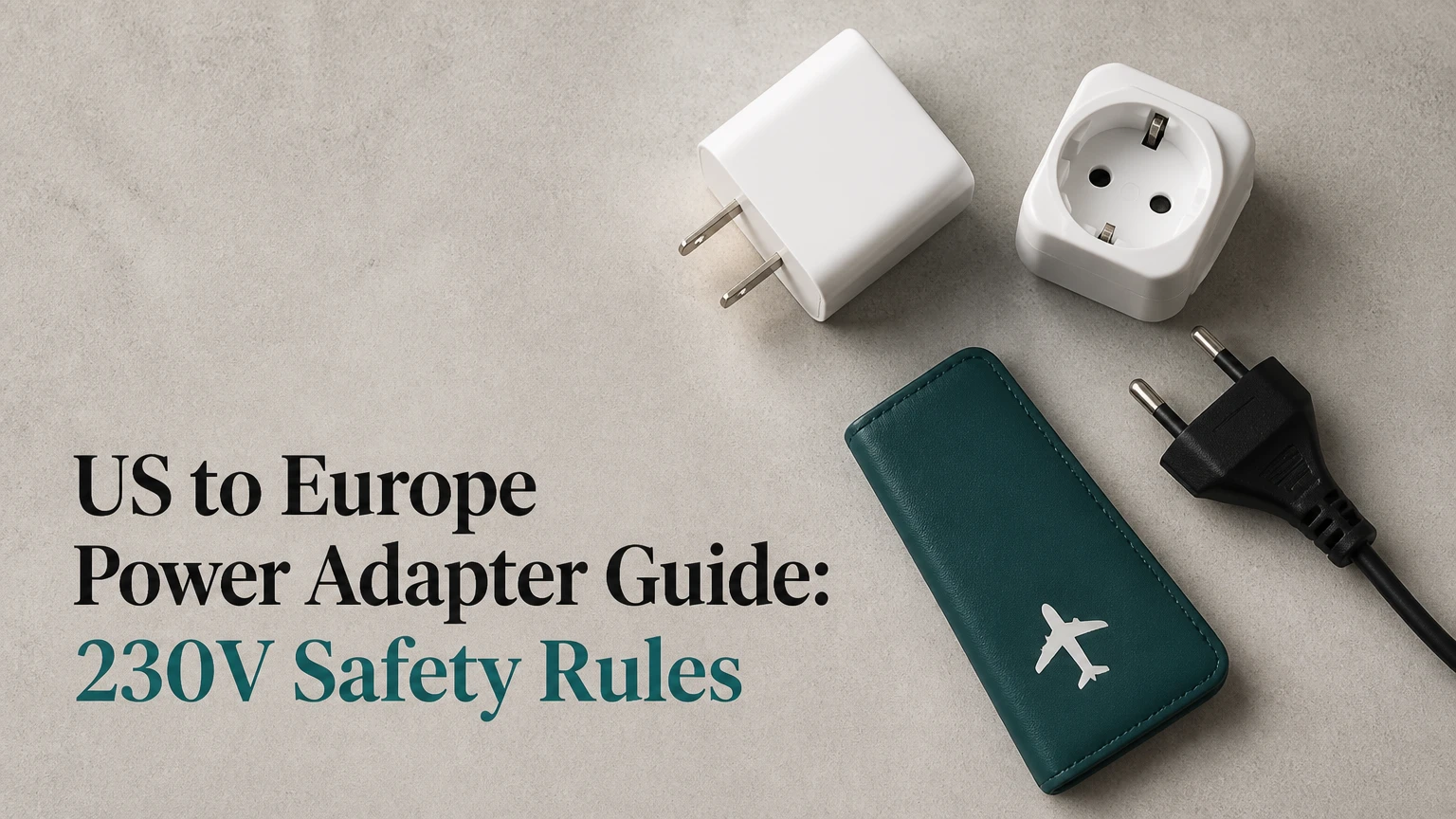
A US to Europe power adapter is a passive plug-shape converter that lets American plugs connect to European wall sockets, but it does not change electricity. Continental Europe generally supplies 230V at 50Hz, compared with 120V at 60Hz in the United States, so travelers must check voltage compatibility before connecting each device.
Key Facts / Quick Answer
Phones, tablets, laptops, cameras, and most modern chargers usually accept 100-240V, 50/60Hz and need only a physical adapter.
Continental European sockets commonly accept Type C, Type E, or Type F plugs; the United Kingdom and Ireland require Type G.
A basic regional adapter typically costs $3-$5, while a quality universal model usually costs $20-$35.
A plug adapter does not reduce 230V to 120V. A single-voltage US appliance requires a properly rated converter, although high-heat tools are safer to leave at home.
Check the device label, not the country where the device was purchased. The wording Input: 100-240V ~ 50/60Hz is the key compatibility signal.
Grounded appliances require an adapter that preserves grounding. A two-pin travel plug is not an acceptable substitute for a grounded connection.
What Does a US to Europe Power Adapter Do?
A travel plug adapter changes the arrangement of pins so a US plug can enter a European socket. The adapter contains no transformer in its simplest form, so the electricity remains approximately 230V and 50Hz after the plug is connected.
US household plugs are commonly Type A, with two flat parallel blades, or Type B, with two flat blades and a grounding pin. European sockets use round-pin systems, and their recessed openings often require a plug body that reaches farther into the wall than a thin square adapter can.


A voltage converter is a different product. A step-down converter reduces European voltage for a compatible 120V-only appliance, while a transformer-based device may add considerable weight and heat. Electrical Safety First summarizes the distinction in direct terms: “A travel adaptor only changes the shape of the plug on your appliance.” That statement describes a passive adapter, not a converter.
The adapter therefore solves a mechanical problem. The device label determines whether an electrical problem remains.
Adapter, Converter, and Transformer Compared
| Product | Electrical action | Typical price | Suitable example |
|---|---|---|---|
| Type C regional adapter | Changes US blades to round pins | $3-$5 | Dual-voltage phone charger |
| Universal travel adapter | Provides several plug interfaces | $20-$35 | Phone, laptop, camera, and watch |
| Step-down converter | Reduces 230V toward 120V | $30-$50 | Rated single-voltage shaver |
| Travel transformer | Reduces voltage with transformer coils | $40-$100+ | Selected motor or heating appliance |
| USB-C wall charger | Converts mains electricity internally | $15-$60 | 65W laptop and phone charging |
Which Plug Types Are Used in Europe?
European countries do not use one universal wall-plug standard. Type C is widespread across continental Europe, while Type E and Type F add different grounding arrangements; the United Kingdom, Ireland, Cyprus, and Malta use Type G instead.
The country labels below describe common socket systems, but hotels and older buildings can vary. A Type C Europlug often fits Type E and Type F receptacles because its two small round pins are narrow and ungrounded. That compatibility does not mean every appliance is safe, because the adapter may not provide the protective earth required by a high-power or metal-bodied device.
| Plug or socket type | Physical design | Common locations | Grounding and fit |
|---|---|---|---|
| Type C | Two 4.0 mm round pins | France, Germany, Italy, Spain, Portugal, Netherlands | Ungrounded; common for low-power chargers |
| Type E | Two round holes with a socket-side earth pin | France, Belgium, Poland, Czechia, Slovakia | Requires compatible earth clearance for grounded plugs |
| Type F | Two round pins with side grounding clips | Germany, Austria, Spain, Sweden, Norway, Finland | Grounded Schuko system; accepts many Type C plugs |
| Type G | Three rectangular blades with fuse in the plug | United Kingdom, Ireland, Cyprus, Malta | Not compatible with continental Type C adapters |
| Type L | Three round pins in a line | Italy, parts of Chile and Libya; some Italian buildings | Italian sockets may accept Type C, but not universally |
| Type J | Three round pins in a triangular arrangement | Switzerland, Liechtenstein | Swiss sockets can reject ordinary universal plugs |
Continental Europe Versus the British Isles
A traveler visiting Paris, Berlin, Rome, and Barcelona can generally use a continental adapter designed for Type C, E, and F sockets. The same adapter will not fit a London or Dublin wall outlet, because Type G uses three rectangular contacts and commonly includes a fuse.
Switzerland and Italy deserve separate attention. Italian accommodations may have Type L outlets or combination sockets, while Swiss outlets use Type J and can have recessed or narrow openings. A universal adapter with explicit Type L and Type J support is more reliable than assuming a generic European slider covers every location.
How Do Voltage and Frequency Affect US Devices?
Voltage is the first electrical compatibility test. Continental Europe nominally uses 230V, while the United States uses 120V; frequency is usually 50Hz in Europe and 60Hz in the US, and some equipment reacts to both differences.
The International Electrotechnical Commission identifies 230V as the nominal supply voltage used across much of Europe under IEC household-voltage standards. Actual utility voltage can vary within permitted limits, so a device rated only for 120V should not be connected directly through a passive plug adapter.
Read the smallest print on the charger or appliance. A label that states 100-240V AC, 50/60Hz accepts both common voltage and frequency ranges. A label stating 120V, 60Hz does not.
Frequency usually matters less for electronic chargers because the charger rectifies incoming AC before producing low-voltage DC. Frequency matters more for clocks, turntables, induction motors, fans, pumps, and some heating controls. A converter can correct voltage while leaving a 50Hz frequency mismatch unresolved.
Device-Label Decision Table
| Label wording | Voltage decision | Adapter needed | Converter needed |
|---|---|---|---|
| Input: 100-240V, 50/60Hz | Dual-voltage and dual-frequency | Yes | No |
| Input: 120V, 50/60Hz | Single-voltage, frequency-flexible | Yes | Yes, if used in Europe |
| Input: 120V, 60Hz only | Single-voltage and frequency-limited | Yes | Voltage conversion may not solve frequency |
| Output: 5V USB, charger input 100-240V | Charger handles mains conversion | Yes | No |
| 120V, 1,500W hairdryer | High-power single-voltage appliance | Yes | Technically possible only with large rated equipment |
| 120V, 10W electric clock | Low-power single-voltage device | Yes | Voltage conversion, plus possible frequency correction |
The input line matters more than the output line. A laptop power brick may output 20V DC, but its safety on a European wall depends on the AC input rating printed on the brick.
Which Devices Usually Need Only a Plug Adapter?
Most modern consumer electronics need only a mechanical plug adapter because their external power supplies accept a broad input range. Phones, tablets, laptops, mirrorless cameras, electric toothbrushes, and smartwatches commonly fall into this category, provided the printed rating confirms dual-voltage operation.
USB-C chargers introduce a second specification: power delivery. A 65W charger may run a laptop alone at full speed, but its output can drop when it simultaneously charges a phone and earbuds. The travel adapter remains electrically safe when the charger is properly rated, yet the charging time may increase.
| Device | Common input label | Typical power draw | Practical travel choice |
|---|---|---|---|
| iPhone or Android charger | 100-240V, 50/60Hz | 5-30W | USB-C charger plus plug adapter |
| Ultrabook charger | 100-240V, 50/60Hz | 45-100W | 65W or 100W USB-C PD charger |
| Mirrorless camera charger | 100-240V, 50/60Hz | 5-20W | Small adapter and spare battery |
| Electric toothbrush base | 100-240V or 120V only | 1-5W | Verify label before packing |
| Smartwatch charger | USB input, charger dependent | 2-5W | Share a multi-port charger |
| Gaming laptop brick | 100-240V, 50/60Hz | 180-330W | Original brick, not a low-watt USB substitute |
In practice, one 65W or 100W USB-C power-delivery charger can replace several small charging bricks, but only when its total output and port-sharing rules match the devices. Check whether the advertised wattage applies to one port or the entire charger.
When Is a Voltage Converter Necessary?
A voltage converter is necessary when a device is rated for 120V only and lacks an internal circuit capable of accepting 230V. The converter must support the device’s maximum wattage, startup surge, and, where relevant, motor or frequency requirements.
A converter rating should exceed the appliance’s continuous wattage rather than merely equal it. A 1,200W appliance can demand more at startup, and a converter operating close to its limit may become hot, trip its thermal protection, or fail prematurely.
High-heat tools are the worst candidates. Hairdryers, curling irons, and straighteners draw hundreds or thousands of watts, so a compact universal adapter cannot safely carry their load. A heavy step-down transformer may be rated for the wattage, but its bulk, ventilation needs, and heat output make a hotel bathroom a poor operating environment.
Converter Suitability by Appliance
| Appliance | Typical wattage | Converter practicality | Safer recommendation |
|---|---|---|---|
| Electric shaver | 5-20W | Often practical if 120V only | Use a dual-voltage shaver |
| Small clock | 2-10W | Usually practical | Replace with a battery or USB clock |
| Curling iron | 40-100W | Possible with correct rating | Pack a dual-voltage model |
| Hair straightener | 40-150W | Possible but heat-sensitive | Use hotel equipment or dual-voltage tool |
| Hairdryer | 1,000-1,875W | Bulky and high-risk | Leave US model at home |
| 120V coffee maker | 900-1,500W | Heavy converter required | Use hotel or local appliance |
A converter does not automatically make a device internationally compatible. The most reliable approach is replacement with a dual-voltage travel model, especially for heating appliances that can remain hot after a converter trips.
How Should You Choose an Adapter?
Choose the smallest adapter that matches every destination, preserves grounding for grounded devices, and carries the required current. A single-country Type C adapter is economical for a continental itinerary, while a universal model is more convenient when the route includes Type G, J, or L sockets.
Use this selection process before departure:
- List each destination, including airport hotels, business stops, cruises, and overnight rail routes.
- Read every device input label and separate dual-voltage electronics from 120V-only appliances.
- Identify plug standards, especially Type G for the United Kingdom and Ireland, Type J for Switzerland, and Type L for some Italian outlets.
- Calculate charging demand, adding laptop, phone, camera, and watch loads if one USB charger will serve them together.
- Choose grounded protection for three-prong equipment and metal-bodied appliances.
- Inspect the adapter rating, fuse, shutters, thermal protection, and maximum wattage before purchase.
- Pack a backup cable or small adapter, because one lost or broken adapter can stop every charging plan.
A good universal travel adapter should expose only one regional plug at a time, include an internal fuse or overcurrent protection, and remain stable when a heavy charger is attached. Sliding mechanisms that partially extend are a common failure point in inexpensive models.
Option Comparison for Different Trips
| Travel situation | Recommended adapter | Typical cost | Main trade-off |
|---|---|---|---|
| France only, phone and camera | Type E or C adapter | $3-$8 | Limited to one socket family |
| Germany, Italy, and Spain | Continental universal adapter | $8-$20 | Italian Type L support varies |
| London and Dublin only | Type G adapter | $5-$12 | No continental socket access |
| Europe plus United Kingdom | Universal adapter with C, E, F, G | $20-$35 | Larger and heavier |
| Europe, Switzerland, and Italy | Model listing C, E, F, G, J, L | $25-$45 | More moving parts |
| Family with many USB devices | Adapter plus 65W-100W USB-C charger | $35-$90 total | Charger and adapter are separate |
An all-in-one adapter with USB ports is not automatically a USB charger. Some units provide sockets only, while others include low-power USB-A or USB-C electronics. Treat the USB output rating as a separate specification.
What Does a European Adapter Cost?
A basic single-region plug adapter typically costs $3-$5, a three- or four-pack costs about $10-$15, and a quality universal adapter with USB ports commonly costs $20-$35. Voltage converters generally cost $30-$50 for smaller loads, with high-wattage transformer models costing more.
Prices vary by brand, certification, USB power, and grounding design. Airport shops often charge more for convenience, while a local electronics store may offer a basic adapter at a reasonable price after arrival. Buying locally can still be inconvenient because the available model may cover only the country where it is purchased.
| Purchase option | Typical USD cost | Availability | Best use |
|---|---|---|---|
| One basic Type C adapter | $3-$5 | Online, supermarkets | One continental destination |
| Pack of three or four adapters | $10-$15 | Online retailers | Multiple bags or family members |
| Universal plug adapter | $20-$35 | Travel and electronics stores | Several plug regions |
| Universal adapter with 65W USB-C | $35-$70 | Electronics retailers | Laptop and phone charging |
| Small voltage converter | $30-$50 | Specialty and online stores | Low-wattage 120V devices |
| Airport replacement | $15-$45 typical | Airport convenience shops | Forgotten or damaged adapter |
Certification marks such as UL, ETL, CE, or the applicable national conformity marking indicate that a product was made for a stated market, but a mark does not prove that the adapter is suitable for every wattage. Rating, grounding, and construction still require inspection.
What Safety Problems Do Travelers Commonly Miss?
The most serious mistake is confusing physical fit with electrical compatibility. A US hairdryer can enter a European socket through a $5 adapter, receive roughly twice its designed voltage, and fail immediately or become a fire hazard.
Travelers also underestimate socket access and load. European wall sockets are often recessed, and a wide adapter may not reach the contacts or may pull downward under the weight of a laptop charger. A universal adapter that accepts a grounded US plug but provides no earth connection can create a shock risk if used with a grounded appliance.
Follow these operating rules:
- Never connect a 120V-only device directly to a 230V supply.
- Do not use a high-wattage heater, iron, or hairdryer through a small plug adapter.
- Keep ventilation openings clear on converters and charger bricks.
- Insert the regional plug fully before switching on a connected device.
- Stop using an adapter that smells hot, buzzes, discolors, or trips repeatedly.
- Do not chain adapters, extension blocks, or multi-plug converters.
- Confirm hotel, hostel, and cruise restrictions before packing a converter.
- Keep liquids away from bathroom sockets and charging equipment.
Expert insight: the wattage printed on a converter is not a universal safety guarantee. Resistive heaters often behave predictably, but motors and compressors can draw two to seven times their running current during startup, so a converter that appears large enough may still trip.
Expert insight: a two-pin Europlug is appropriate for many low-power, double-insulated chargers, but it does not replace the earth path on a three-pin appliance. Grounding is an electrical function, not a shape preference.
Expert insight: the adapter is often not the limiting component in a modern charging setup. A 100W USB-C charger may share output across four ports, reducing one laptop port to 65W or less, which can produce slow charging even though the wall connection is safe.
What Happens After a Wrong-Voltage Connection?
A 120V-only electronic device connected directly to 230V may blow an input fuse, damage capacitors, overheat wiring, or destroy its power supply within seconds. A motor may run abnormally fast, overheat, or suffer insulation damage, while a simple heating element can reach an unsafe temperature.
Disconnect the appliance immediately if you notice smoke, odor, crackling, unusual heat, or a flash. Do not reconnect it through another adapter, and do not open a mains-powered device in a hotel room. A qualified repair technician must inspect the equipment, and replacement is often safer for inexpensive chargers or hair tools.
Some chargers survive brief overvoltage because they include surge protection, but survival cannot be assumed from the absence of visible damage. Internal components may have weakened without producing an immediate symptom.
What Are the Best Alternatives to Bringing US Appliances?
The safest alternative for a single-voltage, high-wattage appliance is not a larger adapter. Leave the appliance at home, use hotel equipment, borrow a dual-voltage model, or purchase a local device with the correct European rating.
Hotels in Europe frequently provide hairdryers, but availability and quality vary. Front desks may have a limited number of units, and hostels may provide none. Travelers who need a specific styling tool should buy a dual-voltage model before departure and verify that its selector is set correctly.
For a forgotten adapter, a supermarket, pharmacy, department store, railway-station shop, or electronics retailer may sell a basic local replacement within minutes. Typical replacement time is 15-60 minutes in a city, compared with several hours or a full day in a rural area or during a Sunday closure.
| Alternative | Typical cost | Typical time to obtain | Limitation |
|---|---|---|---|
| Hotel hairdryer | Included or $0 | Immediate to 30 minutes | May be unavailable or low power |
| Local European hair tool | $20-$80 | 30 minutes to one day | Extra purchase and luggage space |
| Hotel USB charging | Included or $5-$15 | Immediate | Often slow or limited sockets |
| Local plug adapter | $5-$20 | 15-60 minutes | May cover one plug type |
| Portable power bank | $20-$80 | Immediate if packed | Cannot replace mains power indefinitely |
| Borrowed adapter from hotel desk | Usually free | 5-20 minutes | Limited stock and uncertain quality |
Cruise ships impose additional restrictions on heating devices, extension cords, and converters. A ship may confiscate a hairdryer or power strip even when the same item is permitted in a hotel, so the carrier’s current prohibited-items list takes precedence.
How Can You Pack for Several European Countries?
Pack for the least compatible destination, not the most common one. A trip through Paris, Berlin, and Rome may need continental coverage plus Italian Type L support, while adding London requires a Type G adapter that cannot be replaced by a Type C model.
For most travelers carrying only dual-voltage electronics, this setup is efficient:
- One certified universal adapter supporting Type C, E, F, G, and preferably J and L.
- One 65W or 100W USB-C PD charger with enough simultaneous output.
- One short extension lead only if the adapter manufacturer permits it and the accommodation allows it.
- Spare USB-C, Lightning, or camera charging cables.
- A small power bank for transit days and airport waits.
- No US-only hairdryer or high-wattage heating appliance.
Charge strategically when outlets are scarce. Connect the laptop directly to the highest-power USB-C port, charge the phone from a secondary port, and use a power bank for a watch or earbuds rather than adding another wall charger.
The adapter should remain in carry-on luggage because electronics and lithium power banks may have transport restrictions. A passive plug adapter has no battery, but a USB power bank must follow airline rules, including common limits around 100Wh unless the carrier approves otherwise.
Frequently Asked Questions About US to Europe power adapter guide
Can I charge my phone in Europe without a converter?
Yes, most phone chargers accept 100-240V at 50/60Hz and need only a plug adapter for the local socket. Confirm that rating on the charger itself before connecting it. The phone receives low-voltage DC from the charger, while the charger handles the 230V AC input.
Will a US three-prong plug work with a European adapter?
A US three-prong plug works only with an adapter designed to accept its grounding pin and provide a compatible earth path. Many compact two-pin adapters accept only ungrounded Type A plugs. Never defeat or remove the grounding connection from a laptop, medical device, or metal-bodied appliance.
Can I use a power strip with a European plug adapter?
A power strip can be used only when its voltage rating, current rating, grounding, and plug configuration are compatible with the destination and adapter. Avoid daisy-chaining adapters, and do not connect high-wattage heaters. A USB charger with several ports is usually safer and lighter for ordinary electronics.
Does a European outlet charge devices faster?
A European outlet does not automatically charge a device faster because voltage alone does not determine USB charging speed. Charging speed depends on the charger’s wattage, USB Power Delivery profile, cable rating, and the device’s acceptance limit. A 100W charger can be faster than a 20W charger on either continent.
Are European hotel sockets different from household sockets?
Hotel sockets usually follow the national plug standard, but their location and availability differ. A room may have only one accessible outlet, a bathroom shaver socket with a low power limit, or a switched socket hidden behind furniture. Do not use a shaver outlet for laptop or hair-tool charging unless its rating explicitly permits it.
Should I buy an adapter before leaving the United States?
Buy an adapter before departure when your itinerary includes multiple countries, a weekend arrival, rural lodging, or devices needed immediately. A local replacement is possible in many cities, but airport and hotel options commonly cost $15-$45 and may not support Type G, J, or L sockets.