How to pack liquids in checked luggage means sealing each container against pressure, impact, and temperature changes, then isolating it inside waterproof bags and cushioning it in the suitcase center. Ordinary toiletries generally have no 100 ml checked-bag limit, but alcohol, aerosols, medicines, airline weight rules, and destination customs restrictions still apply.
Key Facts / Quick Answer
Checked luggage does not use the carry-on 100 ml or 3-1-1 liquid rule for ordinary shampoo, lotion, or cosmetics.
Leave about 20% empty space in rigid bottles, tighten the closure, and place every container in two leak-resistant bags.
Wrap bottle openings with plastic film only when the cap design permits it, then tape pumps and flip-tops closed.
Keep liquids away from suitcase edges, corners, electronics, and clothing that cannot tolerate stains.
FAA rules generally limit 24%-70% alcoholic drinks to 5 liters per passenger in checked baggage; drinks above 70% ABV are forbidden.
Personal-care aerosols generally have a 2 L or 2 kg total limit and a 500 ml or 0.5 kg limit per container.
What Rules Apply to Liquids in Checked Bags?
Liquids in checked bags are regulated mainly by dangerous-goods rules, airline baggage limits, and destination customs rules rather than the carry-on liquid-screening limit. Shampoo and body lotion can usually travel in full-size bottles, while flammable aerosols, high-proof alcohol, fuels, paints, and some chemicals remain restricted or prohibited.
The Transportation Security Administration (TSA) applies the 3-1-1 rule to liquids brought through the passenger checkpoint, not to ordinary liquids packed in checked baggage. A 750 ml bottle of shampoo can therefore be legal in checked luggage even though the same bottle cannot pass through the standard carry-on screening process.


That distinction does not make every fluid acceptable. The Federal Aviation Administration (FAA) and International Air Transport Association (IATA) classify some liquids as dangerous goods because they are flammable, corrosive, toxic, pressurized, or capable of reacting dangerously during transport.
Airlines can also impose stricter policies. A checked bag commonly has a 23 kg, or 50 lb, maximum in economy class, but the exact allowance may be 20 kg, 23 kg, 25 kg, or 32 kg depending on the fare, route, and carrier. Check the operating airline, especially when codeshare flights are involved.
Standard Toiletries and Cosmetics
The following products are usually acceptable in checked baggage when they are sealed and intended for personal use:
- Shampoo, conditioner, shower gel, and liquid soap
- Lotion, sunscreen, facial cleanser, and makeup
- Perfume, cologne, and aftershave
- Toothpaste, hair gel, and shaving cream
- Nail polish, subject to flammability limits
- Contact-lens solution and saline products
A full-size bottle can still create a weight problem. Water-based liquid weighs approximately 1 kilogram per liter, so ten 500 ml bottles add roughly 5 kilograms before packaging and the suitcase itself are counted.
Medical, Baby, and Dietary Liquids
Prescription medicine, medically necessary liquids, and baby feeding products may receive special treatment at airport security, but checked-bag packing is still not always the safest choice. Medication can be lost, frozen, overheated, or delayed with the suitcase.
Pack essential medicine, a prescription copy, and a short reserve in your carry-on. Put backup quantities in checked luggage only when the product label and temperature requirements permit it. Insulin, biologic medicines, and some compounded liquids require specific temperature control that a cargo hold may not provide.
Alcoholic Drinks and Aerosols
| Product category | Typical checked-bag rule | Container or quantity limit | Practical example |
|---|---|---|---|
| Beer, wine, and drinks at 24% ABV or less | Generally permitted under FAA dangerous-goods rules | Airline weight and destination import limits still apply | 6 bottles of 750 ml wine |
| Alcohol from 24% to 70% ABV | Generally permitted in unopened retail packaging | Maximum 5 L per passenger | 6 bottles of 750 ml whisky |
| Alcohol above 70% ABV | Forbidden in checked and carry-on baggage | No permitted passenger quantity | 80% grain alcohol |
| Nonflammable personal-care aerosol | Generally permitted | 2 L or 2 kg total; 500 ml or 0.5 kg per container | 200 ml deodorant cans |
| Flammable industrial aerosol | Usually prohibited | Carrier and FAA dangerous-goods restrictions apply | Spray paint or camping fuel |
| Fuel, lighter refill, and solvent | Prohibited or heavily restricted | Do not pack without specific authorization | Butane canister |
Alcohol restrictions involve more than aviation safety. The destination country, state, or province can limit the amount you may import without declaration, charge duty, or prohibit a particular product. The 5 L aviation allowance is not a tax-free customs allowance.
FAA passenger guidance states that alcoholic beverages “with more than 70% alcohol by volume … may not be carried in checked or carry-on baggage.” The quoted threshold concerns transport safety, while local customs authorities determine whether a permitted amount may enter the country.
Why Do Liquid Bottles Leak in the Cargo Hold?
Liquid bottles leak when pressure, temperature, impact, or a weak closure pushes fluid through the cap or seal. Aircraft cargo compartments are pressurized, but the pressure is lower than at ground level, and baggage handling adds forces that a bathroom shelf never applies.
A bottle does not need to burst for a leak to occur. A small channel around a flip-top, pump stem, threaded cap, or damaged gasket can release liquid once the container is squeezed under luggage weight.
Rigid containers need headspace because trapped air expands as ambient pressure falls. Leave about one-fifth of the container empty, especially for glass or hard plastic bottles. Flexible silicone bottles behave differently: expel excess air gently, then close the valve without deforming the seal.
Temperature matters too. A bottle filled in a cool room can expand when exposed to warmer conditions on the ground, while freezing can make water-based contents expand and split a rigid container. Cosmetics with volatile ingredients can also build pressure if the cap is loose.
Expert insight: The most common packing error is treating pressure as the only leak risk. In practice, impact and cap activation cause more failures than a properly closed bottle suddenly opening because of altitude. Protect the closure first, then protect the container from compression.
How Should You Prepare Each Bottle?
Prepare liquids at least one day before departure so a failed seal can be detected before the suitcase is closed. The reliable sequence is to reduce the quantity, inspect the closure, seal the opening, test the container, and isolate it from everything else.
The Seven-Step Packing Method
- Check whether the product belongs in checked baggage. Remove fuel, paint, strong solvents, oxidizers, and alcohol above 70% ABV. Confirm aerosol and airline rules for unusual products.
- Reduce unnecessary volume. Transfer shampoo, lotion, or cleanser into a smaller compatible bottle when the original packaging is not required. Do not decant prescription medicine unless a pharmacist confirms the container remains suitable.
- Leave 20% headspace. Do not fill rigid bottles to the brim. For a 500 ml bottle, leaving about 100 ml empty provides useful expansion room.
- Inspect the closure. Tighten threaded caps, lock pump heads, and examine gaskets for cracks, dried product, or distortion. Replace damaged travel bottles.
- Seal the opening. Place a small square of plastic wrap over a threaded bottle mouth before replacing the cap. Do not use this method to obstruct a pressure-relief valve or alter an aerosol can.
- Tape moving parts. Use painter’s tape or electrical tape on flip-tops, pump collars, and trigger locks. Avoid tape that leaves adhesive on labels needed for customs inspection.
- Bag, test, and bag again. Put the closed bottle in a strong zip-top bag with absorbent material, squeeze out excess air, seal it, and place that bag in a second waterproof bag. Turn the package upside down for 10 minutes before packing.
A leak test catches poor caps, but it cannot prove that a bottle will survive compression. If the container leaks during the test, replace it rather than adding more tape.
Which Packing Materials Work Best?
| Material or method | Typical cost | Preparation time | Protection supplied | Main limitation |
|---|---|---|---|---|
| Heavy-duty zip-top bag | $1-$5 per pack | 1-2 minutes | Contains liquid after a small leak | Seams can split under sharp glass |
| Plastic wrap under cap | Less than $1 | 2 minutes | Improves threaded-cap seal | Unsuitable for pumps and relief valves |
| Painter’s or electrical tape | $3-$8 per roll | 1 minute per bottle | Stops accidental opening | Does not protect against broken glass |
| Absorbent towel or diaper | $0-$5 | 1-2 minutes | Holds and reveals leaked fluid | Adds bulk and may become saturated |
| Silicone travel bottle | $5-$15 each | 5 minutes to fill and clean | Flexible body, reusable closure | Some formulas weaken silicone |
| Padded bottle sleeve | $8-$20 each | 1-3 minutes | Reduces impact on glass | Does not provide waterproof containment |
| Dedicated toiletry case | $10-$30 | 5-10 minutes | Organizes multiple small containers | A zipper is not automatically leakproof |
Use a bag with a wide seal and thick film for oils, perfume, and alcohol. Thin produce bags provide almost no reliable containment because their seams and openings are not designed for transport.
Where Should Liquids Go Inside a Suitcase?
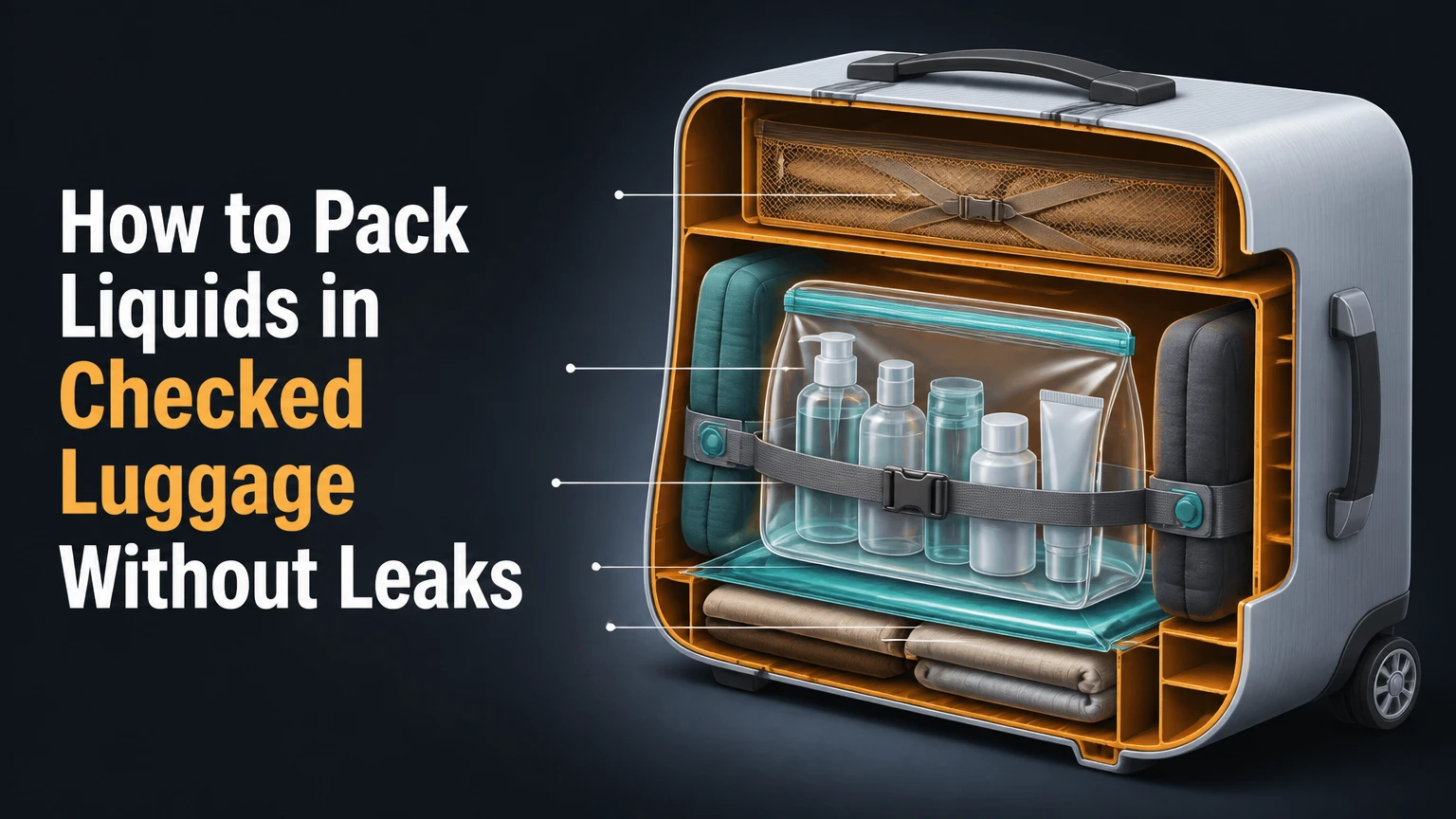
Place bagged liquids in the geometric center of the suitcase, surrounded on all sides by soft clothing. The center reduces direct impact from conveyor belts, corners, and hard suitcase shells, while surrounding fabric limits movement and absorbs minor shocks.
A suitcase compartment is not equally protective at every point. Wheels, handles, corners, and the outer lid receive concentrated force when bags are dropped or stacked. Keep glass bottles away from those zones even when a hard shell is used.
| Suitcase zone | Impact exposure | Suitable contents | Packing instruction |
|---|---|---|---|
| Center of main compartment | Low to moderate | Bagged shampoo, lotion, sealed wine | Surround with 5-10 cm of clothing |
| Near wheels and corners | High | Shoes and durable accessories | Never place glass or unprotected liquids here |
| Outer lid or front pocket | Moderate to high | Empty toiletry case or dry items | Avoid bottles and leak-sensitive products |
| Beside electronics | Moderate | Only separately sealed low-risk items | Keep liquids in a different compartment |
| Between rigid objects | High compression | No fragile liquid containers | Move bottles into soft clothing layers |
| Under compression straps | High | Flat clothing layers | Do not strap directly across bottles |
Pack the container in a towel, place it in the first sealed bag, and then position it in the center. Fill empty spaces around the package so it cannot slide into a corner during handling.
Hard-sided luggage offers better resistance to crushing, but it does not make a glass bottle unbreakable. A rigid shell can transmit a sharp impact directly to a bottle, so a padded sleeve and leakproof inner bag remain necessary.
Expert insight: Do not rely on a “Fragile” label. The label may communicate intent, but it cannot change how checked baggage is loaded, dropped, or compressed. A $10 bottle sleeve and two sealed bags provide more physical protection than a sticker.
How Much Liquid Can a Checked Bag Hold?
A checked bag can hold as much ordinary liquid as the airline weight allowance and the container’s safe capacity permit. There is no universal total-volume allowance for shampoo or lotion, but liquids add weight quickly and may trigger an overweight fee.
Typical checked-bag limits range from 20 kg to 32 kg. A common economy allowance is 23 kg, or 50 lb, including the suitcase. A 1 L bottle of water-based product weighs approximately 1 kg, while glass packaging can add 300-700 grams per bottle.
| Planning example | Liquid volume | Approximate liquid weight | Approximate packaged weight |
|---|---|---|---|
| Four 250 ml toiletry bottles | 1.0 L | 1.0 kg | 1.3-1.6 kg |
| Six 500 ml bottles | 3.0 L | 3.0 kg | 4.0-5.0 kg |
| Six 750 ml wine bottles | 4.5 L | 4.5 kg | 7.5-9.0 kg |
| Two 100 ml perfume bottles | 0.2 L | 0.2 kg | 0.5-0.8 kg |
| Ten 200 ml aerosol cans | 2.0 L nominal capacity | Product-specific | Often 3.0-4.5 kg |
Weigh the completed suitcase with a luggage scale before leaving home. Allow at least 0.5 kg of margin because the airport scale may differ from a household scale and packaging weight is easy to underestimate.
Typical overweight fees range from $50 to $200 per bag, but some airlines charge more on particular routes. Paying for a second bag can cost less than exceeding the first bag’s limit, so compare the carrier’s published fee schedule before packing dense liquids.
Checked Luggage Versus Carry-On Liquids
Checked luggage provides more capacity for ordinary liquids, while carry-on baggage provides access, temperature awareness, and lower loss risk. The correct choice depends on whether the liquid is replaceable, legally restricted, medically necessary, fragile, or needed during the journey.
| Feature | Checked baggage | Carry-on baggage |
|---|---|---|
| Ordinary bottle size | No standard 100 ml limit | Usually maximum 100 ml per container |
| Total ordinary liquid volume | Controlled by weight and space | Usually one 1-quart clear bag under TSA rules |
| Access during flight | None | Available before and during travel |
| Loss consequence | Bag can be delayed or misrouted | Remains with passenger |
| Glass-bottle risk | Higher from handling | Lower, but screening still applies |
| Temperature control | Limited | Passenger can monitor conditions |
| Best use | Toiletries, extra cosmetics, sealed wine | Medicine, essential liquids, travel necessities |
Never check all of a critical medication, a valuable serum, or a product that cannot tolerate temperature variation. A delayed bag can take one or more days to reach you, and a damaged container can contaminate unrelated belongings.
Carry-on rules vary by country and airport, especially for duty-free liquids purchased after security. Keep receipts and use the sealed security bag when required. On a connecting itinerary, a new screening checkpoint may apply.
What Happens When a Liquid Leaks or Breaks?
A leak can stain clothing, damage electronics, weaken suitcase fabric, and create an odor that persists after the trip. A broken glass bottle can also spread shards through the bag, making every item unsafe to handle.
If you discover a leak at baggage claim, keep the bag closed until you can move it to a washable surface. Photograph the container, affected contents, suitcase exterior, baggage tag, and damage before discarding anything.
Separate the response into four actions:
- Put on gloves or use a thick towel before handling broken glass.
- Place wet clothing and contaminated items in new sealed bags.
- Report significant damage to the airline baggage desk before leaving the airport.
- Retain receipts for damaged belongings and the original product when possible.
Airlines commonly impose deadlines for damaged-baggage reports, and international journeys can involve different claim rules under the Montreal Convention. The airline’s baggage office can explain the applicable process, but a report does not guarantee reimbursement for a poorly packed or prohibited item.
For a small shampoo leak, wash fabric promptly with cool water and detergent. For perfume, oil, or dye, avoid heat until the stain has been treated because heat can set some compounds into fibers.
Which Liquids Should You Pack as Solids Instead?
Solid alternatives remove most leakage risk and reduce suitcase weight. Shampoo bars, conditioner bars, toothpaste tablets, solid sunscreen sticks, deodorant sticks, and wax-based fragrances work well when the traveler does not need a specific liquid formula.
| Liquid product | Solid or dry alternative | Approximate weight difference | Best reason to switch |
|---|---|---|---|
| 250 ml shampoo | 60-80 g shampoo bar | About 170-190 g less | No cap or pressure leak |
| 200 ml conditioner | 60-80 g conditioner bar | About 120-140 g less | Smaller packing footprint |
| 100 ml toothpaste | 60-90 g toothpaste tablets | About 10-40 g less | Avoids tube compression |
| 100 ml perfume | 10 g solid fragrance | About 90 g less | Lower breakage and spill risk |
| 75 ml deodorant spray | 50-75 g deodorant stick | Similar or lower | Avoids aerosol restrictions |
Solid products are not universally better. A shampoo bar can soften in humidity, toothpaste tablets may taste unfamiliar, and a solid sunscreen may not provide the same application or regulatory labeling as a liquid sunscreen. Pack solids in a ventilated case and follow the manufacturer’s storage instructions.
How Do You Pack Wine, Perfume, and Special Containers?
Wine requires impact protection, leak containment, and customs planning because glass is heavy and the bottle shape concentrates stress around the neck. Perfume requires the same protection in miniature, while pump bottles need extra attention because the pump stem can activate or loosen.
Wine and Spirits
Use a purpose-made bottle sleeve with an absorbent interior and a sealed closure. Put the sleeved bottle inside a second waterproof bag, then cushion it in the middle of the suitcase with clothing.
Check these points before departure:
- The bottle is unopened and clearly labeled.
- The alcohol percentage is at or below the permitted aviation threshold.
- The total amount does not exceed 5 L for drinks from 24% to 70% ABV.
- The destination allows the quantity without a permit or additional declaration.
- The suitcase remains under its weight limit after adding glass.
A wine sleeve contains a leak if the glass fails, but no sleeve eliminates all breakage risk. A hard-sided suitcase, central placement, and separation between bottles provide layered protection.
Perfume and Pump Bottles
Perfume bottles are often made of thick glass with narrow necks, so they are more resistant than thin decorative glass but still vulnerable at the atomizer. Replace the cap, lock the sprayer if possible, wrap the neck, and isolate each bottle rather than placing several glass containers together.
Keep perfume away from white clothing, leather, passports, and electronics. Alcohol-based fragrance can stain, discolor, or damage finishes even when the amount spilled is small.
Frozen or Temperature-Sensitive Liquids
Frozen gel packs, cosmetics, and food products can change state during travel. A sealed frozen product may thaw and expand inside a bag, while a rigid container can crack if its contents freeze.
Use an insulated pouch only when the product label permits it and the pouch does not conceal a prohibited chemical. For medication, follow the pharmacist’s temperature guidance rather than assuming the cargo hold is temperature controlled.
What Should You Check Before Leaving for the Airport?
A short preflight check prevents most liquid-related failures because it catches weight, closure, and eligibility problems before airport staff or baggage handlers encounter them.
| Checkpoint | Target value or condition | When to verify | Consequence if missed |
|---|---|---|---|
| Bag weight | At least 0.5 kg below airline limit | After final packing | Overweight charge or repacking |
| Rigid bottle fill | About 80% full | During preparation | Higher pressure and spill risk |
| Zip bags | Two sealed layers per bottle group | Before suitcase placement | Clothing contamination |
| Aerosol total | Maximum 2 L or 2 kg typical limit | Before packing | Removal at screening |
| Aerosol container | Maximum 500 ml or 0.5 kg typical limit | Before packing | Noncompliant container |
| Alcohol strength | 70% ABV or lower | From product label | Prohibited item |
| Essential medicine | Carry-on reserve included | Before leaving home | Treatment interruption |
| Customs allowance | Destination-specific quantity checked | Before departure | Duty, seizure, or declaration issue |
Check the airline’s dangerous-goods page on the day you pack, since carrier rules can change and codeshare operators may apply different procedures. For international travel, check both the departure and arrival authorities.
Frequently Asked Questions About how to pack liquids in checked luggage
Can I pack a 1-liter bottle of shampoo in checked luggage?
Yes, a 1-liter shampoo bottle is usually allowed in checked baggage because the 100 ml carry-on limit does not normally apply to ordinary checked-bag toiletries. Seal the cap, leave headspace, use two waterproof bags, and confirm that the added weight remains within the airline’s allowance.
Can I check liquid medication in my suitcase?
You can often check backup liquid medication, but essential doses should remain in your carry-on. Temperature changes, delays, and lost baggage can interrupt treatment. Keep medicine in its labeled container, carry prescription documentation, and verify storage requirements with a pharmacist before placing any supply in the cargo hold.
Can I pack olive oil or other cooking oil in checked luggage?
Olive oil is generally permitted in checked baggage when it is commercially sealed and properly contained, but destination customs rules may limit food imports. Place the bottle in a leakproof sleeve or bag, protect the cap, and keep it upright inside the suitcase center rather than near a corner.
How do I pack liquids without plastic bags?
Use refillable leak-resistant bottles inside a rigid toiletry case with a sealed liner, then wrap each container in absorbent clothing. A waterproof case reduces the need for disposable bags, but it should not replace individual containment when carrying perfume, oil, wine, or any product that could damage belongings.
Can I pack nail polish and nail-polish remover in checked luggage?
Small quantities of nail polish are commonly allowed, while nail-polish remover may contain flammable solvents and requires carrier-specific review. Keep products in their original labeled containers, protect the caps, and do not pack industrial solvent, paint thinner, or large quantities of flammable liquid.
What should I do if airport staff remove a liquid from my checked bag?
Ask the airline or screening officer to identify the rule and record the product description if possible. Do not argue for a prohibited hazardous material. If the item is a permitted product removed in error, request the applicable baggage or screening appeal process and retain your receipt.