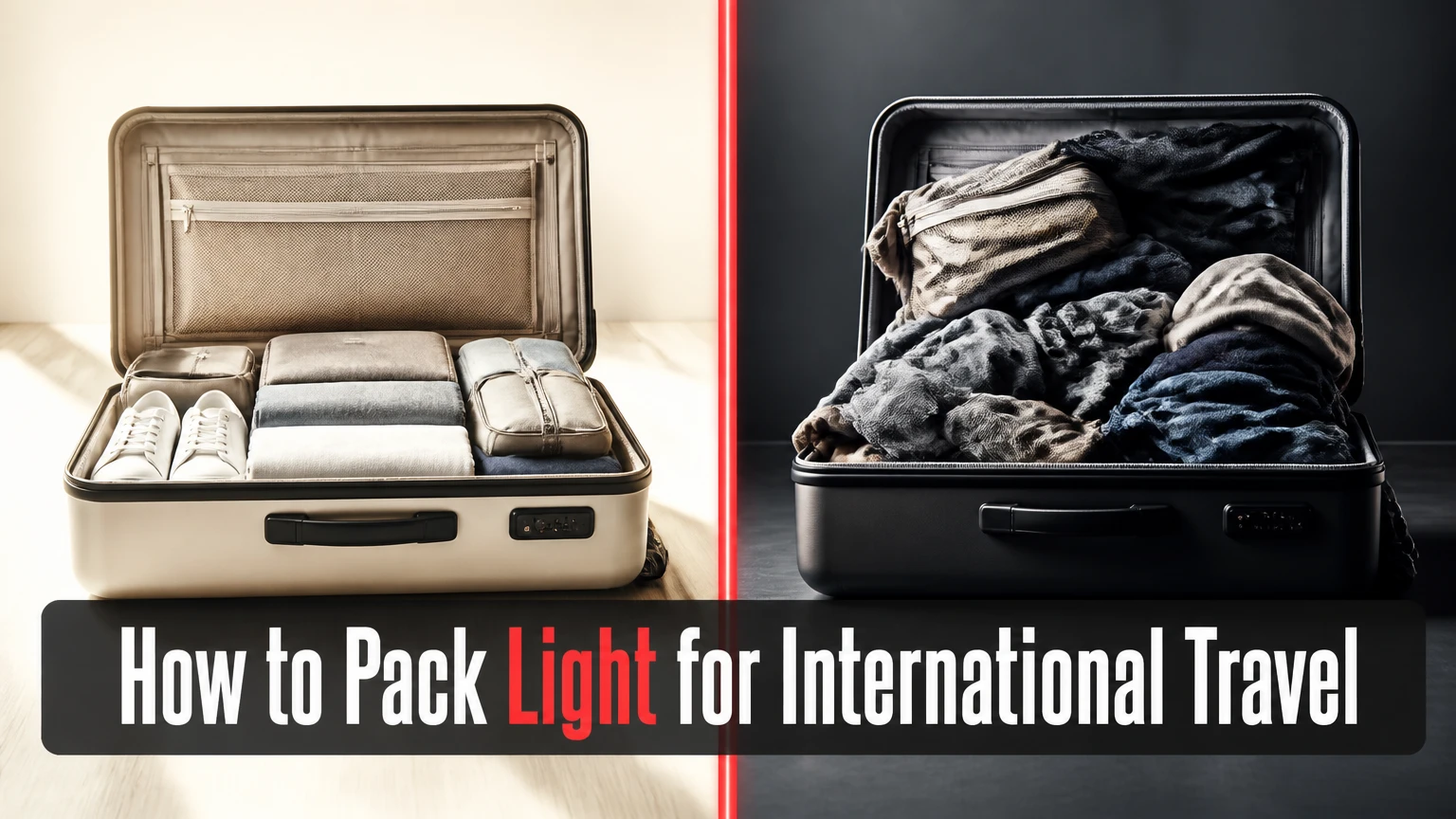
How to pack light for international travel means building a small, versatile travel system that fits the airline’s size and weight limits while covering the trip’s likely weather, activities, and laundry opportunities. The practical target is usually one carry-on and one personal item, with enough clothing for 5-7 days rather than the entire journey.
Key Facts / Quick Answer
Pack for 5-7 days, then schedule laundry instead of matching clothing to every calendar day.
Check the operating airline’s exact limit because international carry-on allowances commonly range from 7-10 kg and vary by route and fare.
A 35-45 L backpack usually maximizes mobility, while a lightweight rolling case reduces shoulder strain on smooth surfaces.
Keep liquid containers at 100 ml or less and place them in the security bag required at your departure airport.
Wear the heaviest shoes and outer layer, but do not wear uncomfortable clothing solely to reduce bag weight.
Build a 1-2 kg reserve below the airline limit for souvenirs, scale differences, and gate scrutiny.
What Does Packing Light Mean?
Packing light is a constraint-based method for carrying only versatile items that solve several predictable needs. The best setup minimizes duplicates, uses a laundry cycle, and preserves enough empty capacity to handle weather changes, purchases, and airline enforcement.
The goal is not the smallest possible bag. The goal is the smallest bag that remains comfortable and reliable when a trip includes transit, changing temperatures, ordinary social situations, and one or two unplanned changes.


A useful rule is one item, two functions. A lightweight overshirt can work as sun protection, a dinner layer, and an extra warm layer. A smartphone can replace paper maps, boarding passes, reading material, and a camera, although it should not replace offline backups for essential documents.
Packing light is less effective when the trip has fixed equipment requirements. Ski boots, diving gear, climbing hardware, medical supplies, and formal clothing can consume the space and weight budget before ordinary clothes are added.
The Weight Budget Comes Before the Packing List
Calculate the usable weight before choosing items:
Airline weight limit – empty bag weight – safety reserve = packing allowance
For example, a 7 kg airline limit minus a 1.2 kg backpack and a 0.5 kg reserve leaves 5.3 kg for clothing, toiletries, electronics, and other contents. A 3.5 kg suitcase under the same limit leaves only 3.0 kg, which makes a two-bag setup difficult.
Typical target budgets look like this:
| Setup | Empty bag weight | Practical contents target | Best use |
|---|---|---|---|
| 20-25 L personal item | 0.6-1.0 kg | 3.5-5 kg | 2-4 day urban trip |
| 35-40 L backpack | 1.0-1.5 kg | 5.5-7.5 kg | Rail travel and mixed cities |
| 7 kg rolling carry-on | 2.0-3.0 kg | 4.5-5 kg | Smooth pavements and short transfers |
| 10 kg rolling carry-on | 2.2-3.5 kg | 6.5-7.5 kg | Longer trips with regular laundry |
The reserve matters. Home scales, airport scales, and airline scales may disagree, and a bag packed exactly to the stated maximum has no tolerance for a wet garment or a small purchase.
How Much Clothing Should You Pack?
Most travelers need five to seven days of clothing, not one outfit per day. The 5-4-3-2-1 rule is a starting framework, but travelers should reduce or expand each category according to climate, laundry access, and required activities.
A practical seven-day capsule often contains:
- Five pairs of underwear and socks
- Four tops, including one long-sleeve layer when temperatures vary
- Three bottoms, adjusted for skirts, shorts, or activity trousers
- Two pairs of shoes, with the heavier pair worn in transit
- One flexible extra, such as a swimsuit, hat, cardigan, or light jacket
The rule is not a command to bring five pairs of socks on every trip. A hot-weather traveler who washes clothing every second night may need three pairs, while a hiker in wet conditions may need six or seven.
Choose a color palette that permits most tops to work with most bottoms. Neutral colors reduce the number of specialized pieces, but the clothing still needs to fit the destination’s social norms. A sleeveless top may be useful in a beach hotel and inappropriate for religious sites, government buildings, or rural communities.
A Climate-Based Clothing Matrix
| Destination condition | Base clothing | Warm layer | Weather layer | Typical laundry interval |
|---|---|---|---|---|
| 25-35°C, humid | 3-4 quick-dry tops, 2 shorts, 1 trousers | Thin overshirt | Compact rain shell | 2-3 days |
| 15-25°C, variable | 3 tops, 2 trousers, 1 adaptable bottom | Merino sweater or fleece | Packable shell | 3-4 days |
| 5-15°C, wet | 3 base layers, 2 trousers, thermal layer | Fleece or wool sweater | Waterproof shell | 4-5 days |
| Below 5°C, urban | 2-3 base layers, 2 trousers | Insulated midlayer | Worn winter coat | 5-7 days |
| Beach and formal event | 3 casual tops, 1 swimwear, 1 formal outfit | Light cardigan | Small rain layer | 2-4 days |
Merino wool resists odor and manages temperature well, but it costs more and can dry more slowly than thin nylon. Polyester and nylon dry quickly and usually cost less, although some travelers notice odor sooner. Cotton feels comfortable but absorbs water and may remain damp overnight in humid rooms.
Expert insight: the item that determines a capsule’s success is often the drying environment, not the fabric label. A synthetic shirt washed at night in a poorly ventilated room may still be wet in the morning, so test the actual wash-and-dry routine before relying on a three-shirt wardrobe.
Which Luggage Setup Fits Your Trip?
The best international luggage setup depends on transport, airline rules, physical comfort, and the weight of the bag itself. A backpack is usually better for stairs and transfers, while a rolling carry-on is better for travelers who carry less comfortably but use trains, taxis, and paved streets.
| Configuration | Typical capacity | Typical empty weight | Suitable itinerary | Main limitation |
|---|---|---|---|---|
| Personal item only | 20-30 L | 0.5-1.0 kg | 2-4 days, warm weather | Little room for shoes and layers |
| One-bag backpack | 35-45 L | 1.0-1.6 kg | Multi-city rail travel | Shoulder and back load |
| Rolling carry-on plus daypack | 35-45 L plus 12-20 L | 3.0-5.0 kg combined | Hotels, taxis, smooth streets | Two-piece handling and stricter total weight |
| Checked suitcase plus personal item | 60-90 L plus 12-20 L | 5.0-8.0 kg combined | Winter, equipment, long stays | Baggage fees, claim time, delay risk |
One-Bag Backpack
A 35-45 L travel backpack provides high mobility because the load stays attached to the traveler while navigating stairs, cobblestones, buses, and crowded stations. Choose a model with a padded hip belt, a clamshell opening, and a frame that transfers weight to the hips.
A 45 L bag can exceed many airline dimensions when overfilled. Capacity printed by manufacturers is not the same as permitted external dimensions, so measure the packed bag rather than trusting the volume number.
Carry-On and Personal Item
A lightweight overhead case plus a small under-seat bag suits travelers who prefer wheels and need separate access to electronics or medication. The trade-off is significant: a 2.5 kg suitcase and a 1 kg daypack may consume 3.5 kg before clothing is packed.
Use the personal item for items needed during transit, including passport, medication, charging cable, glasses, headphones, one layer, and valuables. Do not assume that a purse or daypack will be accepted as a personal item if the fare permits only one cabin bag.
Personal Item Only
A 20-30 L under-seat setup works best for short, warm-weather trips with laundry access and no formal footwear. It becomes uncomfortable when travelers need a jacket, second shoe, work equipment, or destination-specific clothing.
Budget airlines may measure or weigh personal items more consistently than full-service carriers. Verify the fare’s dimensions immediately before departure because allowance changes, route exceptions, and priority packages can alter the permitted bag.
How Do Airline Rules and Liquid Limits Affect Packing?
Airline rules determine whether a light packing plan succeeds at the gate. International overhead limits commonly fall near 56 x 36 x 23 cm, while weight allowances often range from 7-10 kg, but each operating carrier and fare can impose different dimensions, weight, and personal-item rules.
Use the airline’s official baggage page for the exact itinerary. A codeshare booking may display one airline’s flight number while another airline operates the aircraft, and the operating carrier’s cabin rules may control at check-in.
| Requirement | Common range or rule | What to verify | Failure consequence |
|---|---|---|---|
| Overhead dimensions | About 55-56 x 35-40 x 20-25 cm | Operating carrier and fare | Gate-check or repacking |
| Cabin weight | 7-10 kg | Whether personal item counts | Fee, removal of items, or gate-check |
| Personal item | About 40 x 30 x 15-20 cm | Under-seat dimensions | Additional cabin fee |
| Liquid container | 100 ml maximum | Departure airport security policy | Disposal at screening |
| Liquid bag | Approximately 1 L clear bag | One-bag requirement | Repacking or disposal |
The widely used 100 ml liquid rule concerns the container’s capacity, not merely how much liquid remains inside. A half-full 150 ml bottle can still fail screening. Rules may differ for prescribed medicines, infant supplies, duty-free liquids, and medical equipment, so carry supporting documentation when relevant.
Security agencies also restrict sharp objects, spare lithium batteries, and certain tools in cabin baggage. The Transportation Security Administration, or TSA, publishes United States screening rules, but departure-country authorities and transfer airports may apply additional procedures.
Expert insight: never make a packing plan that depends on an officer overlooking a borderline item. A small nail clipper may pass in one airport and receive scrutiny in another, so place questionable tools in checked luggage or buy inexpensive replacements after arrival.
What Is the Most Efficient Packing Process?
The most efficient packing process is a sequence of selection, testing, weighing, and removal. Packing light works better when travelers lay out every item, test the complete load, and remove low-frequency items before adding organizers or accessories.
- Confirm the rules 14 days before departure. Record the operating airline, cabin allowance, personal-item dimensions, and liquid policy.
- Build a trip profile. Note destination temperatures, rain probability, laundry access, religious or formal clothing needs, planned activities, and accommodation type.
- Lay out the complete capsule 7 days before departure. Include worn clothing, electronics, toiletries, medication, documents, and items carried in pockets.
- Create a combination test. Every top should work with at least two bottoms, and every shoe should support a defined activity.
- Wash-test one outfit. Hand-wash the garment, press out water with a towel, and measure drying time in a normal indoor room.
- Pack the bag three days before departure. Use a luggage scale and check the dimensions after filling all compartments.
- Walk for 10 minutes. A backpack that causes shoulder pain at home will be worse after a full day of transfers.
- Remove the least-used 10 percent. Take out the item with the lowest probability of use, not the smallest item.
- Recheck the bag the evening before travel. Add chargers, documents, and medication only after the final weight is known.
- Wear practical heavy items. Use the heaviest shoes and jacket in transit only if they remain comfortable during airport walking.
A two-week preparation period allows replacement purchases without forcing a heavier emergency solution. A final test pack should finish at least 0.5 kg below a 7 kg limit and 1 kg below a 10 kg limit.
The Laundry Cycle
Laundry makes a small bag viable because it changes the clothing quantity from trip length to wash interval. Pack five to seven days of clothing, wash small loads every two or three nights, and avoid waiting until every garment is dirty.
Typical sink washing takes 10-15 minutes, while indoor drying takes 6-24 hours depending on fabric, humidity, airflow, and garment thickness. A laundromat often takes 60-120 minutes and may cost USD 6-15 per load in major cities.
| Laundry method | Time commitment | Typical cost | Drying reliability | Best situation |
|---|---|---|---|---|
| Hotel sink wash | 10-15 minutes | USD 0.25-1.00 | 6-24 hours | Quick-dry clothing and private rooms |
| Hotel laundry service | 12-48 hours | USD 2-8 per item | High | Business trips and delicate garments |
| Local laundromat | 60-120 minutes | USD 6-15 per load | High | Longer stays and heavy clothing |
| Travel wash bag | 5-10 minutes | USD 20-60 equipment | 6-24 hours | Hostels and shared bathrooms |
Use a small amount of liquid detergent or a detergent sheet, rinse thoroughly, and roll garments in a towel to remove excess water. Hang items where air circulates, not inside a closed bathroom, and check hotel policies before washing in a sink.
What Toiletries, Electronics, and Documents Belong in a Small Bag?
Small travel systems work when consumables are replaced by compact, refillable, or solid alternatives. Toiletries should cover the first 24-48 hours, electronics should support navigation and communication, and documents should remain available offline if a device fails.
Toiletries
Choose solid shampoo, bar soap, toothpaste tablets where comfortable, and a compact deodorant. Keep only the liquids that are difficult to replace or medically necessary, such as prescription products, contact-lens solution, sunscreen for sensitive skin, or a preferred moisturizer.
A typical toiletries load can fit within 0.5-0.9 kg, excluding specialized medical products. Decanting 30-60 ml is usually more efficient than carrying commercial travel bottles filled to 100 ml.
Do not assume every destination offers the same formulations or sizes. A traveler with allergies, textured hair, or specific skin treatment should pack enough for the full trip rather than depending on a replacement purchase.
Electronics and Documents
A phone, dual-voltage charger, short cable, and destination plug adapter cover most leisure itineraries. Add a lightweight laptop only when work requires it, because a 1.2 kg computer plus charger can equal several days of clothing.
| Item | Typical weight | Packing decision | Backup method |
|---|---|---|---|
| Smartphone | 170-240 g | Essential for maps and communication | Offline maps and printed address |
| USB-C charger | 70-150 g | One multi-port unit | Hotel or local replacement |
| Power bank | 180-300 g | Use for long transit days | Charge before departure |
| E-reader | 170-220 g | Optional for frequent readers | Phone reading app |
| Laptop and charger | 1.2-2.0 kg | Work requirement only | Cloud files and web access |
| Plug adapter | 50-150 g | Match destination socket | Confirm voltage compatibility |
The International Air Transport Association advises passengers to carry spare lithium batteries and power banks in cabin baggage, not checked luggage. Check the watt-hour rating and airline policy before carrying a high-capacity power bank.
Store passport scans, insurance details, prescriptions, accommodation addresses, and emergency contacts offline. Digital storage reduces paper bulk, but one printed emergency page remains useful when a phone is lost or uncharged.
What Does a Light Trip Cost?
A light travel setup can cost about USD 100-250 when existing clothing and electronics are reused, or USD 350-850 when a traveler buys a premium backpack, packing accessories, and specialized garments. The largest cost difference usually comes from the bag and clothing system, not detergent or packing cubes.
| Equipment category | Budget cost | Typical mid-range cost | Premium cost | Weight concern |
|---|---|---|---|---|
| 35-45 L backpack | USD 60-100 | USD 120-220 | USD 250-400 | 1.0-1.6 kg |
| Lightweight rolling case | USD 80-150 | USD 170-300 | USD 350-600 | 2.0-3.5 kg |
| Packing cubes | USD 15-25 | USD 25-40 | USD 40-60 | 150-500 g |
| Toiletry kit | USD 5-15 | USD 15-30 | USD 30-50 | 80-250 g |
| Laundry supplies | USD 5-10 | USD 10-20 | USD 20-60 | 20-300 g |
| Quick-dry clothing capsule | USD 100-250 | USD 300-600 | USD 700-1,200 | 1.5-3.5 kg |
Compression cubes reduce volume, not mass. They can make a bag appear to have more capacity while leaving the traveler unable to meet a 7 kg scale limit, and tightly compressed clothing may also wrinkle more.
A lightweight bag can cost more than a basic suitcase but preserve additional weight allowance on strict routes. If a checked-bag fee is USD 30-70 per flight segment, avoiding several segments may repay a durable carry-on system, although the calculation depends on the airline and itinerary.
When Is Checked Luggage the Better Choice?
Checked luggage is the better choice when required equipment, medical supplies, extreme weather, or a long stay exceeds a safe cabin weight. Carry-on-only travel is not inherently superior when forcing essential items into an uncomfortable or noncompliant bag creates greater risk.
Check a bag when the itinerary includes:
- Ski, diving, climbing, or professional camera equipment
- More than 10-14 days without reliable laundry
- Multiple formal events requiring separate shoes or tailored clothing
- Cold-weather travel requiring insulated boots and a substantial coat
- Medical supplies that cannot be replaced at the destination
- Family travel where one shared checked bag reduces duplicate items
Carry-on travel also has limitations. Liquids, tools, sporting equipment, and oversized souvenirs may require checking, and a small bag offers less resilience when flights are disrupted or accommodation lacks laundry facilities.
The comparison below describes typical operational differences rather than guarantees.
| Factor | Carry-on only | Checked luggage | Practical consequence |
|---|---|---|---|
| Airport departure | 15-40 minutes faster when online check-in works | 30-90 minutes for bag drop | Arrive according to airline rules |
| Baggage claim | 0 minutes | 15-45 minutes typical | Carry-on helps during short connections |
| Typical added fee | USD 0-70 | USD 30-150 per bag segment | Compare fare bundles |
| Delay exposure | Bag remains with traveler | Bag may arrive later | Pack medication and one outfit in cabin |
| Liquid capacity | Security restrictions apply | Larger containers permitted | Check noncompliant toiletries |
| Physical burden | Lower volume, higher selection discipline | More capacity, more lifting | Match luggage to mobility needs |
If checking luggage, keep medication, travel documents, valuables, electronics, one change of clothes, and essential toiletries in the personal item. A checked suitcase solves capacity problems but should not contain anything that would make the first day fail if delivery is delayed.
How Should You Handle Weather and Special Activities?
Weather planning should use layers and forecast flexibility rather than duplicate outfits. Special activities deserve dedicated gear only when the item is unsafe, unavailable, or substantially more expensive to rent or buy at the destination.
For a variable climate, use a base layer, a warm midlayer, and a thin waterproof shell. Wear the largest layer during transit, but pack a lightweight alternative if the arrival climate is substantially warmer than the departure airport.
Formal clothing can often be reduced to one dark, wrinkle-resistant outfit with interchangeable accessories. Hiking shoes should replace city shoes only when the itinerary includes sustained trails, uneven terrain, or wet conditions that ordinary walking shoes cannot handle.
Expert insight: shoes are often the real packing limit. Two pairs can weigh 1.5-2.5 kg and occupy 20-30 percent of a small bag, so define the exact activity that justifies the second pair before placing it in the luggage.
A destination replacement rule helps with low-probability items: pack an item when replacement is difficult, unsafe, medically unsuitable, or likely to cost more than carrying it. Buy locally when the item is common, inexpensive, and needed only because of an uncertain forecast.
Umbrellas, basic toiletries, inexpensive clothing, and ordinary adapters are often replaceable. Prescription medication, corrective lenses, specialty footwear, and required documentation are not.
What Common Packing Mistakes Cause Problems?
The most damaging packing mistakes are planning for every possible event, ignoring bag weight, and treating volume as the only constraint. A bag can close easily and still fail at the gate, strain the traveler, or leave no room for wet laundry.
Avoid these errors:
- Packing fourteen outfits for a fourteen-day trip
- Bringing full-size shampoo, lotion, or shaving products
- Choosing a 3.5 kg suitcase under a 7 kg cabin limit
- Packing shoes for hypothetical events
- Using cotton as the only fabric in humid conditions
- Forgetting prescription refills, documentation, or destination restrictions
- Filling every pocket before checking the packed dimensions
- Relying on compression to solve a weight problem
- Wearing a heavy coat through a warm airport and becoming uncomfortable
- Packing a camera, laptop, and e-reader when one device would work
The “just in case” category deserves a separate review. Divide uncertain items into three groups: unsafe or hard to replace, useful but locally available, and unlikely to be used. Pack the first group, purchase from the second when needed, and remove the third.
A practical final audit asks four questions: Will I use this? Can another item perform the same function? Can I buy it within 24 hours? Does its weight justify its probability of use?
Frequently Asked Questions About how to pack light for international travel
Can I pack light for a two-week international trip?
Yes. Pack five to seven days of versatile clothing and schedule one or two laundry sessions during a two-week trip. Bring additional medication, underwear, or activity-specific gear only when replacement or washing is impractical. The trip length changes the laundry plan more than it changes the number of ordinary outfits.
How do I pack light for international travel in winter?
Use one worn insulated outer layer, one compact midlayer, two or three base layers, two trousers, and weather-appropriate footwear. Winter clothing is bulky, so a checked bag may be sensible when boots, formal clothing, or subzero equipment exceed a 7-10 kg cabin allowance.
Are packing cubes necessary for light travel?
Packing cubes are optional because they organize clothing but do not reduce its weight. Compression cubes can save volume, while ordinary cubes make inspection and laundry sorting easier. Use one or two lightweight cubes rather than a complete set when the bag is under 30 L.
How many shoes should I bring overseas?
Most travelers should bring one comfortable walking pair and pack a second pair only for a defined requirement, such as formal dress, water activities, or technical hiking. The packed pair should be lightweight and flat. Wear the heavier pair during transit if it remains comfortable for several hours.
What should I do if my carry-on is overweight at the airport?
Move dense items into the permitted personal item only if that bag also complies with its size and weight rules. Wear a practical heavy layer, remove nonessential items, or pay for checked baggage rather than risking a forced gate-check with medication or valuables inside.
Can I bring medication in a carry-on bag?
Keep necessary medication in cabin baggage, preferably in original labeled packaging, with prescriptions or physician documentation for controlled or injectable medicines. Check the destination country’s import rules before departure because airline security clearance does not guarantee permission to enter a country with a particular drug.
Final Packing Rule
How to pack light for international travel is a decision system, not a race to own the smallest bag. Choose the airline-compliant setup, pack a 5-7 day capsule, test the laundry cycle, protect a weight reserve, and keep irreplaceable items in the personal item. The best bag is the lightest one that supports the actual itinerary without creating avoidable discomfort or risk.