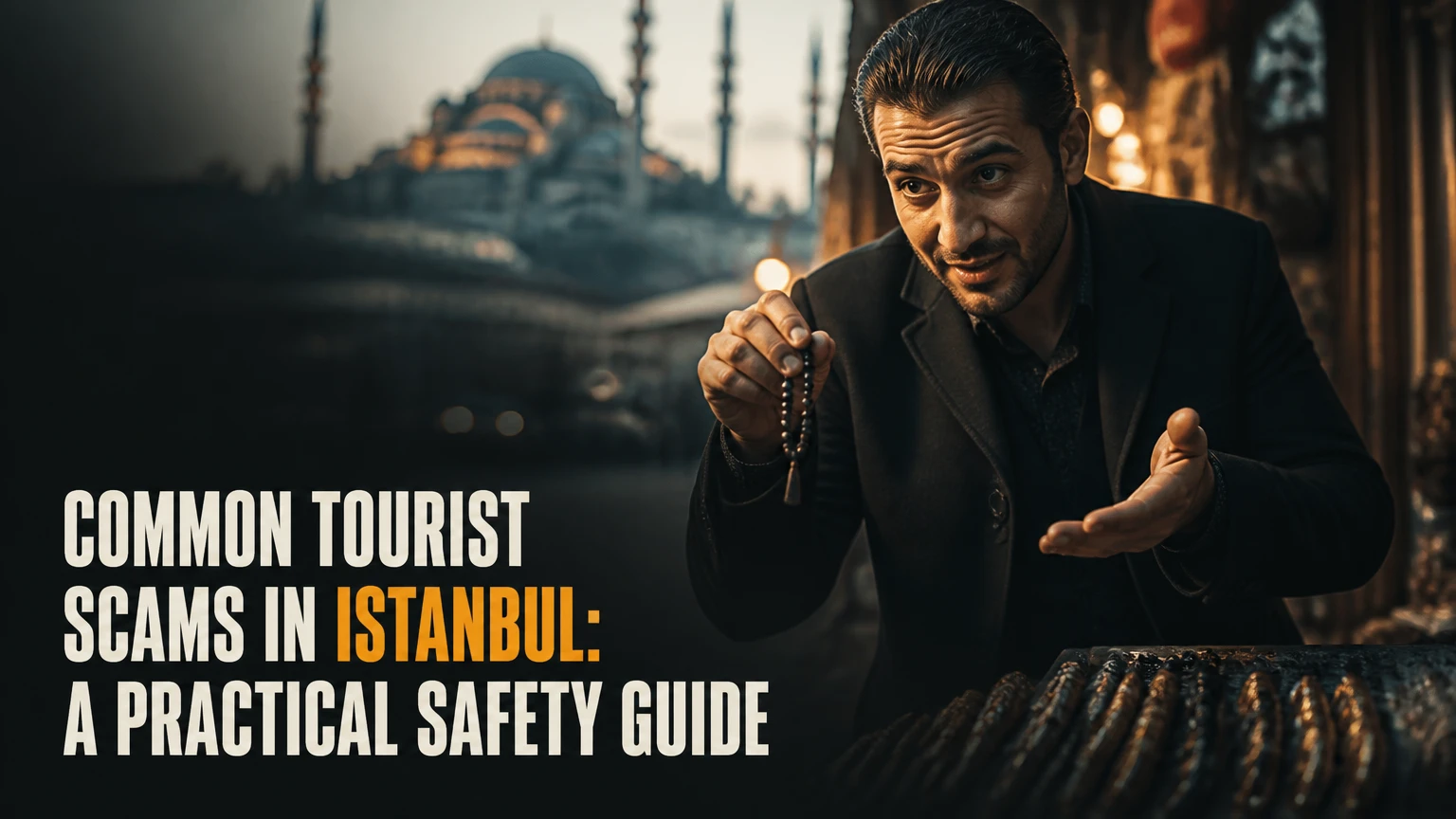
Common tourist scams in Istanbul are opportunistic overcharging and social-engineering schemes that exploit politeness, confusion, urgency, or unfamiliarity with Turkish prices. The most reported patterns involve taxis, nightlife, dropped shoe brushes, bazaars, landmark diversions, unsolicited gifts, and restaurant bills. Most are avoidable when you control the interaction, price, route, and payment.
Key Facts
The highest-cost pattern is the unsolicited nightlife invitation, where reported bills can reach roughly $300-$2,500 or more.
Taxi risk falls when the vehicle plate, route, and fare are recorded through a reputable app or official taxi receipt.
A “free” shoe polish, flower, bracelet, drink, or photograph is not free once a price is demanded.
At bazaars, confirm the total price, currency, weight, and product quality before accepting a bag or card terminal.
A stranger claiming that Hagia Sophia or the Blue Mosque is closed should not replace an official ticket desk, website, or staff member.
For immediate danger in Türkiye, call 112. For municipal complaints and Istanbul services, 153 is the relevant city contact.
What Are Common Tourist Scams in Istanbul?
The most common tourist scams in Istanbul use a friendly opening, create a small obligation, and then demand money under pressure. Visitors encounter them most often around Taksim and Beyoğlu nightlife, Sultanahmet landmarks, Galata Bridge, Eminönü, transport hubs, and the Grand Bazaar, although no neighborhood is automatically unsafe.
The key distinction is between ordinary tourist pricing and fraud. A shop may charge more because it is in a historic district, but a concealed currency change, false claim, fabricated service, or threat crosses into deceptive conduct. Prices also change rapidly with inflation and seasonality, so old online figures are useful as warning examples rather than current tariffs.


How the Three-Stage Pattern Works
A typical street scam follows three stages:
- The hook: An unsolicited person offers help, companionship, a gift, a service, or urgent information.
- The obligation: The visitor accepts a drink, enters a venue, hands over an item, or follows the person away from the original route.
- The extraction: The scammer changes the price, adds services, invokes supposed authority, or uses embarrassment and intimidation to obtain payment.
The safest intervention is early. You do not need to prove deception before declining an invitation. A brief “No, thank you,” continued movement, and refusal to enter a private venue usually prevent the costly stage.
Expert insight: The most useful risk signal is not an accent, appearance, or nationality. It is unsolicited assistance combined with urgency and a request to change location.
| Signal | Typical setting | Likely next step | Safe response |
|---|---|---|---|
| “The attraction is closed” | Sultanahmet, 10:00 AM-5:00 PM | Diversion to shop or guide | Check official staff or ticket office |
| “Come to my bar” | Beyoğlu, 8:00 PM-4:00 AM | Large drinks bill | Decline and choose your own venue |
| Dropped brush | Galata Bridge, Eminönü | Unrequested shoe service | Do not pick it up; keep walking |
| “You gave me the wrong note” | Taxi or shop counter | Immediate cash replacement | Keep the note visible and request a receipt |
| “Free” flower or bracelet | Tourist squares and promenades | Fee demanded afterward | Return it immediately and state no purchase |
Common Tourist Scams in Istanbul by Situation
The schemes below share a mechanism, but the practical response differs by location, time, and payment method. Treat the figures as typical reported exposure ranges in U.S. dollars, not official prices. Exchange rates, inflation, venue type, and the number of people ordering can change the final amount.
Nightlife and Drink Invitation Scams
The nightclub or bar trap begins with a stranger asking where you are from, requesting a lighter, or offering a local recommendation. The person then leads a solo traveler or small group to a venue where additional companions order drinks, and the bill may reach approximately $300-$2,500 or more.
The danger is the controlled setting. Once inside a poorly identified bar, arguing over a bill can trigger guards, blocked exits, or pressure to use an ATM. Do not follow an unsolicited promoter to a venue you did not independently select.
| Warning sign | Exposure | Better decision | Verification step |
|---|---|---|---|
| Unsolicited invitation | $300-$2,500+ | Decline | Search the venue independently |
| “One quick drink” | $100-$500 | Ask for a printed menu | Photograph prices before ordering |
| New people join your table | $200-$1,500 | Stop ordering | Request the bill immediately |
| Security staff pressure | Safety risk, not merely cost | Prioritize exit | Call 112 if threatened |
If a bill is already disputed, avoid physical confrontation. Ask for an itemized receipt, pay only if necessary to leave safely, note the venue name and plate numbers, and report the incident afterward. A bank dispute may help when a card transaction was misrepresented, but it is not guaranteed.
Practitioner rule: Never let a street acquaintance choose both the venue and the people who join your table. That removes your ability to compare prices or leave comfortably.
Shoeshine Brush and Free-Service Scams
In the dropped-brush scam, a shoe shiner walks ahead, drops a brush, and waits for a helpful visitor to return it. The shiner then insists on polishing the visitor’s shoes and demands a fee that can be several times a clearly posted local price, with reported demands around $15-$50.
A legitimate shoe service explains its price before work begins. Refusing the service is enough. If the polishing has started, say clearly that you did not request it, ask the person to stop, and move toward a busy public area rather than debating on an isolated pavement.
| Feature | Street trap | Safer service |
|---|---|---|
| Initiation | Dropped brush | Customer requests service |
| Price | Unstated or changed | Written before work |
| Location | Busy route or bridge approach | Fixed, identifiable shop |
| Typical reported demand | $15-$50 | Posted local price |
| Payment proof | Often absent | Receipt or visible tariff |
Do not assume every shoe shiner is dishonest. The defining problem is the unrequested service and retroactive price, not the occupation itself.
Taxi Meter, Route, and Banknote Tricks
Taxi disputes commonly involve an unstarted meter, an inflated flat fare, a longer route, an alleged note swap, or a claim that the passenger has not paid. Typical reported overcharges range from a normal fare of about $10-$20 becoming $40-$75, depending on distance, traffic, tolls, and exchange rates.
Istanbul taxi fares are regulated, but the amount varies with municipal tariff changes and traffic. No article can responsibly promise a universal fare for every route. Ask for the meter, photograph the plate, keep your cash visible, and retain the receipt or digital transaction record.
| Taxi issue | What happens | Preventive control | Evidence |
|---|---|---|---|
| No meter | Driver demands flat fare | Enter only after meter confirmation | Plate photo, pickup time |
| Detour | Route becomes unnecessarily long | Follow route on phone map | Screenshot of route |
| Note swap | Driver says a larger note was smaller | State denomination aloud | Note, receipt, terminal record |
| Unlicensed pickup | Vehicle is difficult to identify | Use rank or app booking | App trip and plate |
| Card surcharge | Terminal amount exceeds expectation | Check screen before PIN | Bank notification |
Apps such as BiTaksi and Uber can improve traceability where service is available, but an app does not guarantee a correct fare or courteous behavior. Check that the plate on the vehicle matches the booking and never enter a car whose details differ.
If a driver refuses the meter before departure, leave the vehicle. If a dispute begins after arrival, remain in a public location, request the receipt, and avoid handing over your phone or card. For immediate threats, call 112 rather than trying to recover a small amount through confrontation.
Bazaar Currency, Weight, Quality, and Card-Terminal Tricks
Shopping scams at the Grand Bazaar and Spice Bazaar often rely on ambiguity rather than a single fake product. A seller may quote “100” without stating the currency, switch from a 100-gram price to a kilogram total, substitute a lower-grade product, or present a card terminal amount that the buyer does not read.
A $3-looking purchase can become $100 if the unit or currency was never confirmed. Saffron, tea, spices, leather, jewelry, and carpets deserve extra caution because quality is difficult to judge quickly and tourist-market prices vary widely.
| Product or service | Ambiguity to resolve | Typical high-risk exposure | Required confirmation |
|---|---|---|---|
| Tea or spices | Currency and weight | $20-$100 | Total price per stated weight |
| Saffron | Authenticity and grade | $90-$150+ | Product label and receipt |
| Carpet | Handmade, age, origin | $500-$5,000+ | Written description and return terms |
| Leather | Material and warranty | $100-$1,000 | Itemized invoice |
| Card purchase | Currency conversion | Variable | Terminal currency and total |
Use this sequence before payment:
- Ask, “What is the total price in U.S. dollars?” Then confirm the seller’s local-currency total on the calculator.
- Ask whether the price is per gram, 100 grams, kilogram, item, or meter.
- Weigh packaged goods while watching the scale and check the label.
- Inspect the card terminal before tapping or entering a PIN.
- Request an itemized receipt showing the product, quantity, currency, and total.
- Leave without buying if the seller changes any material term.
Dynamic currency conversion can make a card terminal offer to charge in U.S. dollars. That convenience may use a less favorable exchange rate. Compare the displayed amount and currency, then choose the option your card issuer recommends.
Expert insight: Bargaining is not the same as protection. A negotiated price remains unsafe when the seller has not specified weight, currency, grade, or return conditions.
Closed Landmark and Carpet-Shop Diversions
A stranger near Hagia Sophia, the Blue Mosque, or the Basilica Cistern may claim that an attraction is closed for prayer, renovation, a VIP visit, or a private event. The proposed solution is often a “hidden viewpoint,” local shop, or carpet showroom where hospitality creates pressure to buy.
Religious sites can have genuine prayer closures, security restrictions, and changing entry arrangements. The reliable test is the source. Verify at the official entrance, ticket office, current official website, or uniformed staff member, and do not follow an unknown person to obtain replacement access.
| Claim | Possible reality | Unsafe action | Reliable check |
|---|---|---|---|
| Mosque closed | Prayer or security restriction | Follow a stranger | Ask official site staff |
| Museum closed | Schedule or maintenance change | Enter a shop instead | Check ticket office |
| Secret viewpoint | Ordinary commercial stop | Accept a guided diversion | Use a map and reviews |
| Carpet workshop | Sales showroom | Sit for tea without price | Decline private invitation |
A carpet can be expensive without being fraudulent. The risk increases when the seller claims a machine-made or modern item is antique, handmade, or investment-grade without independent documentation. Do not buy under time pressure, and be wary of shipping arrangements you cannot independently verify.
Other Overcharging and Distraction Schemes
Smaller schemes are less expensive individually but use the same social pressure. They can also become useful distractions for pickpocketing, especially in crowds, tram platforms, ferry approaches, and busy restaurant entrances.
Common examples include:
- A rose, bracelet, postcard, or “free” souvenir placed in your hand, followed by a demanded payment.
- A stranger offering to take a photograph, then requesting money or attempting to retain the phone.
- A fake charity collector using a clipboard, petition, or emotional story.
- An alleged plain-clothes official asking to inspect passports, cash, or cards.
- An unrequested restaurant item, such as bread, water, mezze, or a table-cover charge.
- A person creating a spill, bump, argument, or sudden question while an accomplice approaches your bag.
A genuine police officer may request identification, but a visitor should not surrender cash or a payment card to an unknown person on the street. If uncertain, move toward a staffed police point, hotel reception, transport office, or official attraction entrance and call 112 if the interaction becomes threatening.
Restaurant and Menu Bill Problems
Restaurant overcharging usually comes from omitted prices, added covers, duplicate items, or an exchange-rate misunderstanding. Before sitting down, photograph the menu, ask whether bread and water cost extra, and inspect the final bill line by line before paying.
| Bill item | Typical issue | Prevention | Dispute evidence |
|---|---|---|---|
| Water | Automatic bottle service | Ask price before opening | Menu photo, bottle |
| Bread or mezze | Placed without request | Ask for removal | Table photograph |
| Kuver | Cover charge omitted verbally | Check menu heading | Printed menu |
| Tip | Added twice | Calculate separately | Itemized bill |
| Card total | Wrong currency or amount | Read terminal screen | Bank alert |
The Turkish phrase “Bu ikram mı?” means “Is this complimentary?” Use it before accepting an unsolicited item. If the restaurant refuses an itemized bill, move the dispute to a manager and document the business name.
Where Visitors Should Be Most Alert
Istanbul is a large city, and scam concentration follows visitor flow rather than a simple safe-versus-dangerous neighborhood boundary. Historic squares, nightlife streets, ferry approaches, major transit points, and market entrances create the combination of unfamiliar visitors, crowding, and quick transactions that scammers prefer.
| Area | Higher-risk interaction | More cautious period | Practical control |
|---|---|---|---|
| Sultanahmet | Fake closure, guide, carpet diversion | 10:00 AM-5:00 PM | Use official entrances |
| Taksim and Beyoğlu | Bar invitation, taxi pressure | 8:00 PM-4:00 AM | Choose venue in advance |
| Galata Bridge | Dropped brush, fishing-service pitch | 9:00 AM-7:00 PM | Decline unrequested work |
| Eminönü | Taxi and market overcharging | Ferry arrival periods | Confirm fare and unit |
| Grand Bazaar | Currency, weight, carpet claims | Opening hours | Get written total |
| Airport and stations | Transfer and luggage pressure | Arrival and departure | Use official rank or booking |
These are attention zones, not automatic no-go zones. Millions of ordinary transactions occur in the same places every day.
How to Prevent Problems Before They Start
The strongest prevention method is to reduce ambiguity before movement, service, and payment. Plan your first airport transfer, save your accommodation address in Turkish, carry two payment methods, and keep a small emergency reserve separate from your wallet.
Before Leaving Your Hotel
- Save the hotel name, address, and phone number offline.
- Download an offline map and confirm the destination spelling.
- Check the current exchange rate without treating it as a guaranteed merchant rate.
- Photograph your passport identification page and travel insurance details.
- Agree with companions that nobody follows an unsolicited “local guide.”
- Select nightlife venues from independent reviews and verify the address.
During an Unsolicited Approach
Use a short script rather than an explanation:
- “No, thank you.”
- “I already have a booking.”
- “I will check with the official entrance.”
- “Please remove it. I did not order it.”
- “I need the itemized bill.”
Do not disclose your hotel, itinerary, budget, or whether you are traveling alone. Politeness is useful, but continued conversation gives a practiced solicitor more opportunities to create obligation.
While Paying
Keep the item, price, currency, and quantity visible at the same time. Never surrender a banknote, card, or phone until the amount is agreed and the transaction is complete.
Practitioner rule: The safest payment posture is slow and observable. Scammers benefit from speed because victims cannot remember which note, currency, or menu item was accepted.
Public Transport and Safer Alternatives
Public transport is often easier to audit than an improvised cash negotiation. Istanbul’s Metro, Tram T1, ferries, and other municipal services have published routes, fixed entry systems, and identifiable stations, although service changes and crowding still require normal attention.
| Need | Higher-risk choice | Safer alternative | Verification |
|---|---|---|---|
| Airport transfer | Unsolicited driver | Official taxi rank or prebooked transfer | Vehicle and booking details |
| Sultanahmet to Taksim | Negotiated street taxi | T1 tram plus metro or licensed app | Route map |
| Market shopping | Unmarked bulk product | Supermarket or labeled retailer | Package and unit price |
| Evening drink | Street invitation | Self-selected venue | Menu and recent reviews |
| Landmark visit | Stranger’s tour | Official ticket or licensed guide | Badge, booking, receipt |
Ride-hailing availability, pricing, and dispatch rules can change. Confirm the final vehicle details in the app, and do not assume an app-linked car is permitted to stop everywhere. For a long route, compare the app estimate with the meter and keep the trip record.
Public transport is not a perfect substitute for a taxi. Families with luggage, visitors with mobility limitations, and late-night travelers may reasonably choose a car. The safety improvement comes from traceability and agreed terms, not from avoiding every taxi.
What to Do If You Are Already Being Scammed
If the interaction includes threats, blocked exits, assault, or forced ATM use, treat it as a safety emergency rather than a customer-service disagreement. Call 112, move toward other people, and ask hotel staff, police, transport personnel, or security for help.
For a nonviolent dispute, follow this order:
- Stop ordering, signing, or tapping the card.
- Ask for an itemized receipt and photograph the venue or shop.
- State the specific disagreement, such as wrong currency, quantity, or unrequested item.
- Move to a public, staffed area and avoid physical contact.
- Contact your card issuer immediately if the charge is unauthorized or duplicated.
- Report the business, taxi plate, time, location, and amount to the relevant authority.
- Write down the event while details remain fresh.
Expert insight: A receipt is more valuable than an argument. It identifies the merchant, amount, currency, tax details, and transaction time, which gives a bank or authority something actionable to investigate.
For municipal complaints, Istanbul’s 153 service may direct residents and visitors to the appropriate city department. Emergency numbers and procedures can change, so confirm current contact information through official Turkish government, police, airport, or municipal channels rather than relying on an unverified travel blog or social-media number.
What These Warnings Do Not Mean
Istanbul is not defined by tourist fraud, and high prices alone do not prove a scam. A busy restaurant may charge more than a neighborhood lokanta, a taxi fare may rise because of traffic, and a shop may negotiate aggressively without misrepresenting the goods.
The practical boundary is transparency and freedom to leave. A legitimate seller states the price and product terms, a legitimate driver uses an identifiable vehicle and fare system, and a legitimate venue does not require an unknown visitor to surrender a card under intimidation.
Travelers should also avoid stereotyping people by clothing, language, or ethnicity. Judge the transaction by behavior: unsolicited contact, secrecy, sudden urgency, unclear pricing, location changes, and resistance to a receipt are stronger indicators.
Frequently Asked Questions About common tourist scams in Istanbul
Is Istanbul safe for solo travelers?
Istanbul is manageable for solo travelers who use ordinary urban precautions and avoid unsolicited nightlife invitations, isolated negotiations, and unverified guides. Keep your accommodation address private, choose your own venues, use traceable transport, and share your route with someone you trust. If anyone blocks movement or threatens you, call 112.
Should I use cash or a card in Istanbul?
Use both, while keeping transactions controlled. Cards create a bank record and reduce note-swapping risk, but inspect the terminal currency and amount before approval. Cash helps with small legitimate purchases, yet count it privately, state the denomination, and never let a driver or seller handle your wallet.
How can I tell whether a tour guide is legitimate?
Verify the guide through the attraction, a reputable booking platform, or a licensed tour company before meeting. Ask for the guide’s name, company, itinerary, total price, and inclusions in writing. A stranger who claims special access, announces a sudden closure, or demands entry into a shop is not a reliable guide.
What should I do if my passport or wallet is taken?
Move to a safe public place, cancel payment cards, and contact your bank. Report theft to local police and contact your country’s embassy or consulate for replacement-document procedures. Keep digital copies of your passport and insurance details separately from the physical originals.
Are taxis from Istanbul Airport safe?
Official airport taxis can be used, but verify the vehicle, plate, meter, and receipt before and during the journey. A prebooked transfer or traceable app may make the trip easier to document. Reject unsolicited offers inside the terminal and never accept a vehicle whose details do not match the booking.
Can I get my money back after a tourist scam?
Recovery depends on the payment method, evidence, and nature of the transaction. Contact the card issuer quickly, preserve receipts and messages, and report fraudulent or threatening conduct to the relevant authority. Cash recovery is less certain, which is why documenting the merchant, plate, time, amount, and witnesses matters.
Conclusion
Common tourist scams in Istanbul are usually preventable when visitors refuse unsolicited diversions, confirm prices and units, verify taxi details, and preserve payment evidence. Use official entrances, self-selected venues, labeled retailers, traceable transport, and 112 for immediate danger. The goal is not to distrust Istanbul, but to keep every transaction transparent and voluntary.