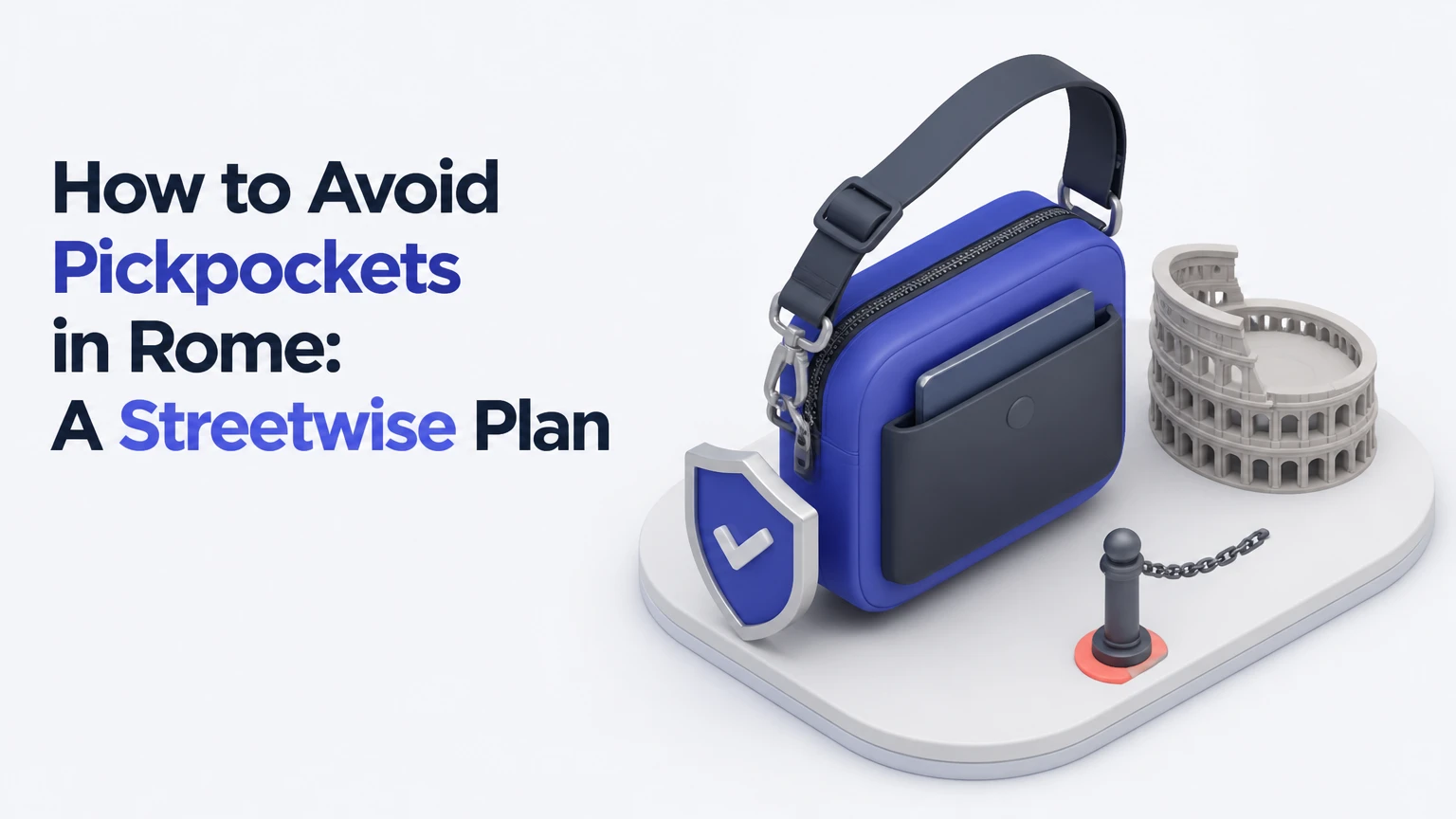
To understand how to avoid pickpockets in Rome, treat crowded tourism and public transport as the main risk environments, not the entire city as dangerous. Roman pickpocketing is usually opportunistic, nonviolent theft that depends on distraction, accessible belongings, and a few seconds of divided attention. Secure valuables before entering crowds, keep bags visible, and leave immediately when a situation feels staged.
Key Facts / Quick Answer
Keep your phone, wallet, and passport out of all trouser pockets, especially back pockets.
Wear a backpack on your chest in crowded buses, Metro cars, queues, and station entrances.
Put one hand over bag zippers when boarding transit or responding to an unexpected distraction.
Carry only the cards and cash needed for that day, with backups secured separately.
Do not place a phone on a café table or hang a bag over a chair.
If property disappears, block cards and the phone first, then report the theft through Italy’s emergency and police channels.
Why Pickpocketing Happens in Rome
Pickpocketing in Rome is stealth theft: a person removes property while the victim is distracted, physically compressed, or focused on a landmark, ticket machine, meal, or phone. The crime usually seeks speed and low confrontation rather than force, so the most effective defense is reducing access and ending suspicious interactions quickly.
Rome remains a major city with ordinary urban risks, including theft around crowded visitor routes. The U.S. Department of State’s Italy travel information has consistently warned travelers about petty crime in tourist locations and on public transportation. That warning does not mean every crowded street is unsafe. It means valuables should not be left exposed.


In practice, the risk comes from an access chain:
- A spotter notices an open bag, phone, wallet, or distracted traveler.
- A distraction or bottleneck divides the target’s attention.
- A thief reaches a pocket or zipper from close range.
- An accomplice may take the item away immediately.
- The group leaves before the victim identifies what happened.
This pattern explains why physical force is not required. A tourist looking down at spilled gelato, wrestling with a suitcase, or concentrating on a Metro map may provide enough access for a fast theft.
Places Where Attention Commonly Breaks
The following locations combine crowds, transitions, and visual distractions:
- Termini station, especially ticket areas, escalators, and bus connections
- Metro Line A stations near Spagna, Ottaviano, and Vatican routes
- Bus 64 and other busy routes serving central attractions
- Entrances and exits near the Colosseum and Roman Forum
- Spanish Steps, Trevi Fountain, and crowded piazzas
- Airport and station transfer points
- Outdoor restaurant terraces and café seating
- Queues at ticket machines, museums, and transport platforms
| Environment | Why access increases | Better positioning |
|---|---|---|
| Metro doorway | Passengers compress during boarding | Stand away from the door until the first rush passes |
| Ticket machine | Traveler looks down and handles payment | Use one hand for the wallet and keep the bag closed |
| Landmark queue | Slow movement reduces awareness | Keep valuables on the front side of the body |
| Café terrace | Phone and bag remain stationary | Place bags between your feet and phone in a closed pocket |
What Are the Common Pickpocket Distractions?
Common Roman theft setups include crowd pressure, unsolicited assistance, petitions, bracelets, spills, and objects placed over a phone. None of these approaches proves that a person is a thief, and nationality, age, gender, clothing, or disability cannot identify criminal intent. The useful signal is unexpected proximity combined with pressure, distraction, or an attempt to touch your belongings.
Transit Squeezes and Doorway Pressure
A transit squeeze occurs when several people crowd a traveler at a bus or Metro doorway. The pressure may happen as passengers board, exit, or argue about movement. The traveler’s hands are often occupied with a suitcase, rail, phone, or ticket.
The safest response is to pause rather than force your way through. Let the first wave board, move your bag to your chest, close every zipper, and keep your phone inside the bag until you are seated or standing clear of the doorway.
Bus 64 is frequently mentioned in traveler warnings because it connects busy central areas with Vatican routes. The practical lesson applies to every packed route, not only Bus 64. A quiet vehicle can become crowded at the next stop.
Petitions, Bracelets, and Unwanted Help
A clipboard, petition, friendship bracelet, flower, or “free” item can occupy both hands and block your view of a bag. Near ticket machines, a stranger may offer help before you request it, creating a reason to stand close while you handle cash or a card.
Use a short refusal and continue moving:
- “No, grazie.”
- “I do not need help.”
- “Please step back.”
- “Ladro,” if you have actually seen an attempt to take property.
Do not debate the person’s story. The goal is distance, not proving whether the petition or gift is legitimate.
Spills and the Map Trick
A staged or accidental spill can produce the same vulnerability. When someone points at a stain and begins wiping your clothing, your attention goes down and your hands may leave your bag. A large map or cardboard sign can cover a phone on a table and leave with it.
Move your own hands to your valuables before checking the stain. Say no to assistance, step away, and inspect your belongings in a private place. At a restaurant, keep the phone in a closed pocket rather than beside a cup, plate, or wallet.
How Should You Carry Valuables in Rome?
The best everyday arrangement is a closed crossbody or sling bag worn high and in front, with the openings facing inward or upward. Store a backup card and passport separately, preferably in secured accommodation, because carrying every financial and identity document outside increases the consequence of one theft.
A money belt is useful for backup documents but inefficient for routine spending. Repeatedly lifting clothing to pay at a register exposes the storage location and encourages awkward handling. Use a small daily wallet instead.
An anti-theft bag can help, but locking zippers and slash-resistant fabric do not replace awareness. A thief needs only an unlocked opening, an exposed phone, or a moment when the bag is behind you.
| Carrying method | Protection | Access time | Best use |
|---|---|---|---|
| Front-worn sling | High when held closed | 3-8 seconds | Phone, daily cash, one payment card |
| Neck pouch under clothing | Very high | 15-30 seconds | Backup card, emergency cash, document copy |
| Anti-theft backpack on chest | High | 8-20 seconds | Camera, water, light clothing, transit days |
| Back-worn standard backpack | Low in crowds | 2-5 seconds | Low-value items only |
| Trouser back pocket | Very low | Under 3 seconds | Do not use for valuables |
The Two-Layer Storage Method
Use two layers rather than one “perfect” hiding place:
- Accessible layer: Carry roughly $20-$40 worth of euros for small purchases, one payment card, and a phone in a closed front-facing compartment.
- Protected layer: Keep backup cash and a second card separately, ideally locked in the hotel safe.
- Document layer: Carry the original passport only when required, and keep a paper or encrypted digital copy elsewhere.
- Digital layer: Back up photographs, travel bookings, contact details, and authentication recovery information before departure.
The amounts above are practical limits, not official requirements. Adjust them for your group, planned cash-only purchases, and access to cards.
Phone Tethers and RFID Features
A phone wrist strap can reduce a snatch while walking or photographing, but tethering a phone to a bag may create a trip hazard or allow a thief to pull the entire bag. Attach the strap securely to a reinforced phone case, never to a weak decorative loop.
RFID-blocking fabric may reduce unauthorized contactless reads, but it does not prevent a thief from taking the wallet. Zipper control, storage position, and attention matter more for ordinary Roman street theft.
How Do You Protect Belongings on Public Transport?
Protect belongings before entering a vehicle, because prevention becomes harder once bodies compress around you. Keep the bag in front, place a hand over the zipper, avoid holding the phone near the doorway, and move away from the entrance after boarding when possible.
The most vulnerable moments are transitions: buying a ticket, descending stairs, boarding, exiting, and checking whether you are on the correct route. Travelers often relax after the vehicle begins moving, but stops can recreate the same crowding.
| Transit moment | Common mistake | Safer action | Typical time |
|---|---|---|---|
| Ticket purchase | Wallet remains open | Prepare payment before reaching the machine | 20-45 seconds |
| Boarding | Backpack stays behind the body | Rotate it to the chest | 5 seconds |
| First stop | Phone is used beside the door | Step inward before checking directions | 10-20 seconds |
| Exit | Traveler rushes with open pockets | Close the bag before the doors open | 5-10 seconds |
If a stranger presses against you without a clear reason, turn your body so the bag is between your forearms and torso. If the crowd becomes aggressive, step off and take the next vehicle. Losing five minutes is cheaper than losing a phone, cards, and travel documents.
Termini Station and Metro Line A
Termini is a transport interchange, shopping area, and arrival point for travelers carrying luggage. Keep documents and electronics inside your clothing or a front-worn bag while moving between platforms, buses, and station exits.
Line A links several high-traffic visitor areas, including Spagna and Ottaviano. The risk is situational, not a permanent condition of the line. Travel with a closed bag, avoid displaying a route map at the doorway, and ask uniformed staff for help when you need directions.
Which Anti-Theft Option Fits Your Trip?
A front-worn sling usually provides the strongest balance between security and access for sightseeing. A hidden pouch suits backup assets, while a chest-worn backpack is better for heavier equipment. No bag is “impossible to pickpocket,” because theft can involve distraction, forceful snatching, or taking an unattended item.
| Option | Typical USD cost | Weight or capacity | Limitation |
|---|---|---|---|
| Basic crossbody bag | $20-$60 | 1-3 liters | Fabric and zipper quality vary |
| Secure sling bag | $40-$120 | 2-6 liters | Limited space for cameras and layers |
| Travel money belt | $15-$45 | Passport and cards | Hot and slow to access |
| Anti-theft backpack | $70-$220 | 15-25 liters | Less comfortable when worn in front |
| Phone tether and case | $10-$35 | One phone | Does not protect cards or bags |
Choose based on behavior rather than branding. A $25 crossbody worn in front and kept closed can outperform a $150 anti-theft backpack worn loosely behind you.
Clothing, Jewelry, and Cameras
Do not make valuables easy to identify. A large camera hanging loosely from a neck strap, visible cash, expensive jewelry, and an open designer bag increase the value signal to a spotter.
That does not mean dressing poorly or hiding every object. Use a compact camera bag, keep jewelry modest during crowded transit, and return the phone to its compartment after taking a photograph.
What Should You Do If You Are Targeted?
If you notice a hand, open zipper, unusual crowding, or a person refusing to give you space, protect the bag, create distance, and avoid a physical struggle. Use a firm voice, move toward staff or a populated business, and call for help if the situation becomes threatening.
A useful response sequence is:
- Put both hands on the bag or pockets.
- Step away from the group or leave the vehicle.
- Say “No, grazie” or “Please step back.”
- Alert nearby staff or companions.
- Shout “Ladro” only when you believe a theft attempt is occurring.
- Check every compartment and identify what is missing.
- Move to a secure location before opening accounts or bags.
The mistake most tourists make is arguing with the suspected thief while still surrounded. A confrontation can create a second distraction, increase physical risk, or give an accomplice time to take another item.
What Happens After a Phone, Wallet, or Passport Is Stolen?
After theft, protect accounts and identity documents before trying to recover property. Use another device to suspend cards, lock the phone, change important passwords, and contact your carrier; then make a police report for insurance, replacement documents, and evidence of the incident.
| Priority | Action | Typical completion time | Information needed |
|---|---|---|---|
| 1 | Freeze debit and credit cards | 5-15 minutes | Bank phone number or app login |
| 2 | Lock or erase the phone remotely | 5-20 minutes | Apple ID or Google account |
| 3 | Suspend the SIM or eSIM | 10-30 minutes | Carrier account details |
| 4 | File a police report | 30-120 minutes | Passport copy, IMEI, theft details |
| 5 | Contact insurer or embassy | 30-90 minutes | Report number and policy details |
For emergencies in Italy, call 112, the European emergency number. For a non-emergency theft report, ask hotel staff, local police, or Carabinieri personnel where to file it. Keep the report number and obtain written documentation before leaving.
If a passport is stolen, contact your country’s embassy or consulate. A passport copy can speed identification, but it does not replace the original travel document. Airlines and border authorities may require an emergency travel document before your return journey.
Digital Recovery Before Departure
A stolen phone can expose email, banking, cloud storage, and two-factor authentication. Before traveling, record the phone’s IMEI, enable device tracking, save recovery codes offline, and ensure a trusted person can access essential booking information.
Do not store a passport scan as an unprotected image in a shared photo feed. Use encrypted storage or a password-protected account, and keep one paper copy separate from the original.
Typical Financial Consequences
The total cost varies widely by phone model, cash, insurance, replacement timing, and document requirements. A typical incident may cost $300-$1,200 when device replacement, lost cash, emergency transport, document fees, and missed activities are combined.
| Loss category | Typical USD range | Main variable | Immediate control |
|---|---|---|---|
| Smartphone | $250-$1,200 | Model and replacement location | Remote lock and carrier block |
| Cash and wallet contents | $20-$300 | Daily spending amount | Carry a limited amount |
| Emergency document travel | $50-$200 | Nationality and consular process | Keep passport copy |
| Transport and missed bookings | $20-$250 | Time spent reporting and replacing items | Use travel insurance |
| Replacement cards | $0-$75 | Bank and courier policy | Carry one backup separately |
These are planning ranges, not official fee schedules. Consular charges, card replacement fees, and phone prices differ by nationality, insurer, and provider.
How Should Families, Solo Travelers, and Photographers Adapt?
Travel groups should assign one person to navigation and another to belongings, while solo travelers should stop inside a shop or hotel lobby before checking maps or handling documents. Photographers need a closed camera bag and a deliberate rule for where the phone goes after every photograph.
Families With Children
Children can be separated from a bag or become the focus of an adult’s attention during boarding. Give older children a simple rule: nobody touches their bag or wrist, and they must tell an adult immediately if someone offers a gift or asks them to sign something.
Keep passports and backup cards with an adult, not in a child’s loose daypack. In a stroller, place valuables in a closed compartment under clothing rather than an exposed side pocket.
Solo Travelers
Solo travelers cannot use a companion as a second set of eyes. Wear the bag in front, avoid putting belongings down while ordering, and use staffed locations for route questions.
If you suspect a theft attempt, enter a pharmacy, hotel, museum desk, or café and check your possessions there. A brief pause in a controlled space is safer than inspecting your wallet in the middle of a crowd.
Travelers With Mobility Limitations
A front-worn bag may not work with every wheelchair, mobility aid, or balance requirement. Choose a bag that can be secured to the body or chair, keep zippers in direct reach, and ask a trusted companion or transport staff for boarding assistance.
Do not allow an unsolicited helper to handle your wallet, phone, or luggage. Accessibility needs justify requesting help, but the traveler should choose the helper and retain control of valuables.
What Are the Most Common Prevention Mistakes?
The most damaging mistakes are predictable: storing essentials together, placing phones on tables, wearing bags behind the body, and treating politeness as more important than personal space. Good prevention reduces both access and the consequences of a successful theft.
| Mistake | Exposure created | Corrective rule | When to apply |
|---|---|---|---|
| One wallet contains every card | One theft causes total payment loss | Split cards between locations | Every sightseeing day |
| Phone lies on a table | Map or hand can remove it | Use a zipped pocket | Every meal or coffee |
| Bag hangs on chair | Strap is behind your body | Place it between your feet | Outdoor dining |
| Passport travels everywhere | Identity document is exposed | Carry it only when required | Tours, check-ins, flights |
| Traveler stops in doorway | Crowd surrounds a stationary target | Move aside before navigating | Stations and vehicles |
Expert insight: The best security habit is often a movement rule, not a product. Travelers who step away from doorways and ticket machines create distance before opening a wallet, reducing the opportunity window more reliably than buying specialized hardware.
Expert insight: Keeping a small amount of cash accessible can be safer than repeatedly displaying a full wallet. The rule works only when the backup money and cards are genuinely separate, not in another pocket of the same exposed purse.
Frequently Asked Questions About how to avoid pickpockets in Rome
Is Rome safe for tourists traveling alone?
Rome is commonly visited by solo travelers, but crowded transport, queues, and tourist landmarks require the same precautions as other large European cities. Solo visitors should keep valuables in front-facing closed storage, ask staff for directions, and enter a staffed business before checking documents or accounts.
Should I carry my passport while sightseeing in Rome?
Carry the original passport when an airline, hotel, tour operator, or official process requires it; otherwise, secure it in your accommodation if that arrangement is reliable. Keep a paper copy and a protected digital copy separately, because a copy supports reporting but cannot substitute for the original at borders.
Are pickpockets active at the Colosseum and Trevi Fountain?
Crowded areas around the Colosseum, Roman Forum, and Trevi Fountain create conditions favorable to opportunistic theft because visitors stop, photograph, queue, and handle phones. Keep the bag in front, avoid open pockets, and return the phone to a closed compartment after taking photographs.
What bag is best for Rome’s Metro?
A small crossbody or sling worn high on the chest is usually the most practical choice for Rome’s Metro because the opening remains visible and reachable. A backpack can work when worn in front during crowding, but a standard backpack behind the body offers poor protection.
Can I recover a stolen phone in Rome?
Recovery is possible but should not be your primary plan. Use Apple Find My or Google Find My Device to lock the phone, never meet a suspected location alone, suspend the SIM, change passwords, and give the IMEI and tracking information to police.
How much emergency cash should I carry?
A typical daily reserve of $20-$40 worth of euros covers small purchases without exposing all available cash. Carry more only when a planned payment requires it, and keep the remainder, backup cards, and important documents in separate secure locations.
Final Rome Pickpocket Routine
The simplest way to avoid pickpockets in Rome is to prepare before entering each crowded setting: move valuables to a closed front-facing bag, separate backup funds, secure the phone, and keep one hand over the zippers. Treat unsolicited contact, sudden crowding, and objects covering your belongings as reasons to create distance. If theft occurs, lock accounts and devices first, then report it.