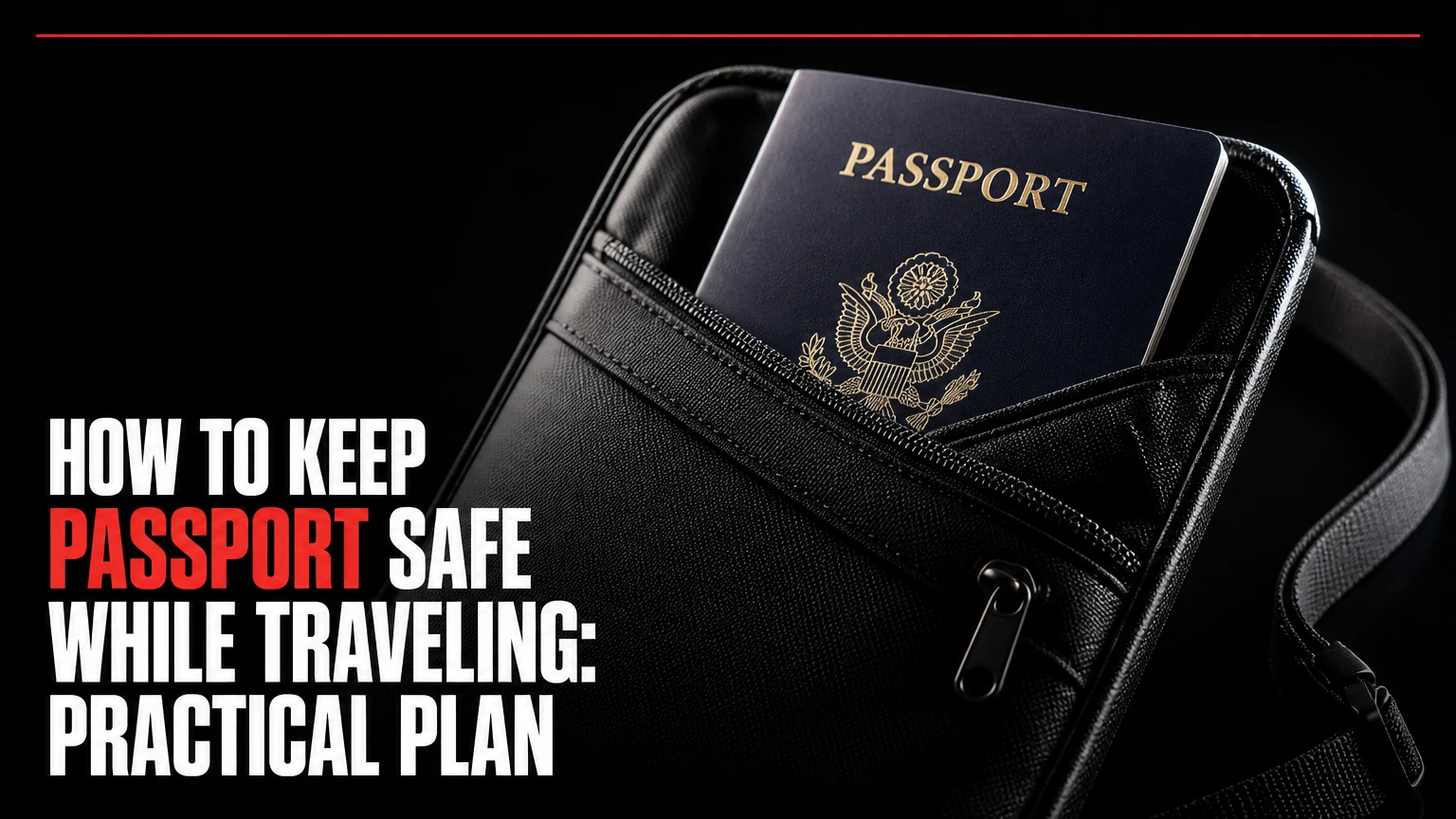
How to keep passport safe while traveling means controlling access to the original document, carrying it only when required, and maintaining separated paper and digital backups. A secure routine uses a concealed pouch during transit, a verified accommodation safe when permitted, and immediate reporting if the passport disappears.
Key Facts / Quick Answer
Keep a passport in carry-on luggage or a concealed body-worn pouch, never in checked baggage.
Use the original passport for international border crossings, immigration checks, airline verification, and any situation where local law requires it.
Store the passport in a hotel safe only after testing the safe, checking local rules, and setting a checkout reminder.
Keep a paper copy separate from the passport, plus encrypted digital copies in offline phone storage and secure cloud storage.
A typical passport pouch costs $10-$40; replacement fees and processing times vary by nationality, embassy, urgency, and destination.
An RFID sleeve can reduce casual wireless reading attempts, but it cannot stop theft, visual copying, phishing, or unauthorized use of a photocopy.
What Passport Security Protects
Passport security is a layered system for preventing loss, theft, unauthorized inspection, and identity misuse. The layers are physical control, situational awareness, document redundancy, and careful digital handling. No pouch, hotel safe, or RFID sleeve protects against every failure, so the strongest plan assigns each risk a separate control.
The passport booklet contains identifying information and, for biometric passports, a contactless integrated circuit. The International Civil Aviation Organization’s Doc 9303 standard defines machine-readable travel-document specifications, including the machine-readable zone and electronic document features used by border systems. A passport chip does not make the paper booklet disposable.


The U.S. Department of State advises travelers to “Keep your passport in a safe place” on its lost and stolen passport guidance. In practice, that means reducing the number of times the original leaves your direct control, rather than carrying it casually in an outer pocket throughout the day.
Passport protection covers four distinct risks:
- Loss: leaving the booklet in a taxi, aircraft seat pocket, hotel room, or restaurant.
- Theft: pickpocketing, bag snatching, room burglary, or unattended luggage access.
- Unauthorized exposure: allowing strangers to photograph the identity page or visa pages.
- Digital and administrative misuse: exposing scans, passwords, booking records, or personal data that can support impersonation attempts.
A passport copy helps an embassy identify your citizenship and document number, but it is usually not a substitute for the original at a border. A phone image can support a replacement application, yet an airline or immigration officer can still require the physical booklet.
How to Keep Passport Safe While Traveling on Transit Days
The safest transit routine keeps the passport concealed until a legitimate checkpoint requires access, then returns it to the same controlled location immediately afterward. A two-pocket system works well: use a concealed inner pouch for transport and a temporary front-access pocket only during airport or border processing.
Follow this sequence:
- Before leaving the room, confirm the passport, phone, wallet, and required visa are present.
- Place the passport in a zipped inner compartment of a body-worn pouch or a bag carried in front of you.
- Keep the bag closed in queues, especially on escalators, public transport, curbside check-in, and crowded station platforms.
- Move the passport to a temporary access pocket only when approaching airline check-in, security screening, immigration, or a document inspection.
- Put it back into the concealed compartment as soon as the officer or staff member returns it.
- Perform a spoken or written count after every inspection: passport, phone, wallet, and boarding document.
Checked baggage is the wrong location because the passenger cannot monitor it after handover, while baggage routing, delays, and unauthorized access remain possible. The U.S. Transportation Security Administration permits passports in carry-on baggage, and airlines may request the document before boarding even when the destination uses electronic travel authorization.
Why airport security creates a common failure point
Airport screening separates travelers from their belongings at precisely the moment they are distracted. A passport placed in a plastic tray, left in a jacket, or transferred to a companion’s bag can disappear without a theft occurring.
Use a dedicated passport slot rather than a loose tray. If security requires the passport to be removed, keep one hand on it until the officer directs you otherwise, then return it before collecting secondary items. Families should designate one adult as the document holder instead of distributing passports among several bags.
What to carry in a crowded destination
A passport pouch should sit beneath clothing or inside a closed inner compartment, not visibly around the neck. Neck wallets can expose their straps and create a predictable access point, while waist pouches become less effective when worn over clothing.
In hot climates, a moisture-resistant sleeve or pouch protects paper pages from sweat. Do not place the booklet directly against wet swimwear, an ice pack, or a leaking toiletry bag. Water damage can make machine-readable pages fail even when the identity page remains legible.
Where Should a Passport Stay at a Hotel or Hostel?
A passport should remain in a verified room safe when the traveler does not need the original and local rules do not require possession. If no reliable safe exists, keep the document concealed in a locked personal bag that stays under the traveler’s control, rather than leaving it in an unlocked drawer or shared dormitory locker.
Before using a hotel safe, inspect the door, battery compartment, hinge, and mounting. Set a temporary code, lock the safe, open it again, and confirm the display or mechanism works. A safe that accepts a code but is loose, damaged, or unanchored offers limited protection against removal.
| Accommodation option | Typical security | Access time | Main failure risk |
|---|---|---|---|
| Anchored electronic room safe | High, if functioning | 30-60 seconds | Checkout forgetfulness or master-code access |
| Locked personal bag in room | Medium | 10-20 seconds | Room entry or bag removal |
| Hostel locker with personal padlock | Medium-high | 20-45 seconds | Locker tampering or exposed spare key |
| Reception deposit box | High administrative control | 2-10 minutes | Limited hours or retrieval delay |
| Unlocked drawer or suitcase | Low | Immediate | Casual theft or housekeeping exposure |
Place a shoe, charging cable, or written reminder at the room exit when the passport enters the safe. Set the reminder for checkout time, not the night before. The most common hotel-safe failure is abandonment on departure, not technical defeat.
Accommodation policy also matters. Some countries or lodging operators register guest passports temporarily and may retain them for a legally defined period. Ask when the document will be returned and inspect it before leaving reception. Never surrender the passport to an unverified person who cannot explain the legal or administrative purpose.
Which Passport Protection Gear Actually Helps?
Passport gear is useful when it reduces access, visibility, or environmental damage without making retrieval so difficult that the traveler leaves the document exposed. The best choice depends on transit frequency, climate, clothing, mobility, and whether the traveler must present the passport repeatedly.
| Gear type | Typical USD price | Best feature | Access time | Limitation |
|---|---|---|---|---|
| RFID passport sleeve | $5-$20 | Blocks many casual NFC reads | 5 seconds | Does not prevent physical theft |
| Neck wallet | $10-$30 | Conceals document under a shirt | 10-20 seconds | Strap and outline can be visible |
| Under-clothing money belt | $15-$40 | Low visibility during transit | 30-60 seconds | Uncomfortable in heat and queues |
| Hidden clothing pocket | $15-$80 garment premium | Integrates with clothing | 20-40 seconds | Limited capacity and laundering concerns |
| Locking travel backpack | $40-$180 | Closed compartments and structure | 10-30 seconds | Still vulnerable when set down |
| Waterproof document pouch | $8-$25 | Limits water and sweat damage | 5-15 seconds | Adds little theft resistance alone |
RFID protection and passport chips
An RFID-blocking sleeve can prevent or reduce contactless communication while the passport remains inside it. The benefit is narrow: a sleeve blocks a signal path, but it does not secure the identity page, stop a person from photographing the booklet, or prevent disclosure of a digital scan.
Modern electronic passports use access-control mechanisms specified through ICAO standards, which means a nearby reader generally cannot treat the chip like an unrestricted payment card. Travelers may still use a sleeve for a low-cost privacy layer, especially in dense public transport, but should prioritize concealment and physical control first.
Anti-slash bags and locking zippers
Anti-slash fabric adds resistance to cutting, while lockable zipper pulls delay rapid access. Those features help when a bag remains on the traveler’s body, but they have little value if the bag is left on a café chair, under a bus seat, or in an unlocked hotel room.
A practical backpack has an inner passport compartment positioned against the back, a zipper that closes fully, and enough structure to prevent the booklet from being crushed. Avoid placing the passport in the exterior bottle pocket or a laptop sleeve that must be opened repeatedly.
Passport Storage Strategies Compared
No single storage method is safest in every setting. Body-worn storage is strongest during movement, an anchored accommodation safe is usually better for a passport left behind, and a normal daypack is acceptable only when the document sits in a closed inner compartment under continuous control.
| Storage strategy | Security level | Access time | Best use | Specific drawback |
|---|---|---|---|---|
| Concealed body-worn pouch | Very high during transit | 30-60 seconds | Airports, trains, border crossings | Heat, discomfort, visible retrieval |
| Anchored hotel safe | High when verified | 30-60 seconds | Day trips and beach visits | Passport can be forgotten |
| Locked inner backpack pocket | Medium-high | 10-20 seconds | Guided excursions and city travel | Bag remains a theft target |
| Front trouser pocket | Medium | 5-10 seconds | Brief controlled transfers | Skilled pickpocket access |
| Exterior daypack pocket | Low | 2-5 seconds | Avoid for passports | Easy access and visibility |
| Checked suitcase | Very low | Unavailable | Never use | Lost, delayed, or inaccessible baggage |
Use the original passport outside the accommodation when a border, airline, police authority, visa condition, or local law requires it. Carrying only a copy can create a legal problem in countries that require foreigners to show identification on request. Check the destination’s embassy, immigration authority, or official travel advice before deciding to leave the original behind.
How to Create Reliable Passport Backups
A passport backup system should preserve identity details without placing every copy in the same theft path. Keep one paper copy in a separate bag, one encrypted offline copy on a phone, and one secure cloud copy accessible through a strong password and multifactor authentication.
| Backup location | Format | Separation rule | Offline access | Main use |
|---|---|---|---|---|
| Secondary luggage | Paper copy | Different bag from passport | Yes | Embassy intake and identity reference |
| Phone secure folder | Photograph or PDF | Screen lock and encrypted storage | Yes | Immediate document number lookup |
| Encrypted cloud drive | PDF or image | Separate account password | Usually | Recovery after total luggage loss |
| Trusted contact | Encrypted file | Different household and device | No | Access if phone and bags disappear |
| Printed emergency sheet | Contact details only | Kept separately | Yes | Embassy, insurer, and family contact |
Photograph the identity page in bright, even light, with all four corners visible. Do not post the image to messaging groups, public photo storage, or travel forums. Redact unnecessary personal data before sharing a copy with a hotel, tour operator, or transportation provider.
A copy generally cannot board an international flight or replace a passport at immigration. Its value is operational: it gives consular staff the passport number, issuing authority, date of birth, expiration date, and name spelling needed to begin verification.
Passport Validity, Visas, and Blank Pages
Passport safety includes preventing a document from being rejected before theft becomes relevant. Many destinations require six months of validity after entry or departure, while others require three months, a valid passport for the stay, or a specified number of blank visa pages.
| Pre-departure check | Typical threshold | Who determines it | Consequence of failure |
|---|---|---|---|
| Remaining validity | 3-6 months | Destination immigration authority | Airline boarding or entry denial |
| Blank visa pages | 1-2 pages | Destination visa authority | Visa application delay |
| Transit validity | Often same as destination rule | Transit country | Transit refusal |
| Name consistency | Exact passport spelling | Airline and border system | Manual correction or boarding delay |
| Visa or electronic authorization | Destination-specific | Immigration authority | Denied boarding or entry |
The six-month rule is common, not universal. Confirm the requirement for every country on the itinerary, including transit countries, because an airline may apply document checks before departure. The U.S. Department of State recommends checking passport validity and visa requirements for each destination before travel.
Inspect the booklet for torn pages, detached covers, water damage, or unauthorized marks. A passport that is technically unexpired can still be considered damaged and unusable. Do not laminate pages, attach unofficial stickers, or repair a torn page with household tape.
What to Do If a Passport Is Lost or Stolen
A lost or stolen passport becomes an administrative and identity-security incident. First secure your immediate safety, then retrace the last confirmed location, report theft when useful, contact the issuing country’s embassy or consulate, and protect exposed accounts and travel bookings.
| Response stage | Typical target time | Required action | Useful evidence |
|---|---|---|---|
| Secure the traveler | 0-15 minutes | Move to a safe public or staffed location | Location and companions |
| Confirm disappearance | 15-60 minutes | Call hotel, airline, taxi, and venue | Booking or receipt records |
| Report theft | Same day | Contact local police if stolen or required | Police report number |
| Contact consular office | Same day | Ask about replacement or emergency document | Passport copy and ID |
| Rebuild travel plan | 1-3 days | Rebook only after document timing is known | New itinerary and fee receipt |
Do not wait until the airport departure gate if the passport is missing. An airline cannot normally accept a photograph as a replacement travel document, and an emergency document may have destination or transit restrictions.
For a U.S. citizen abroad, contact the nearest U.S. embassy or consulate and follow its current instructions. The U.S. Department of State states that a lost or stolen passport must be reported, and reporting makes the document invalid for travel. Once reported, finding it later does not normally restore its usability.
Typical replacement costs vary. A U.S. consular service may charge a passport replacement fee, and the amount can differ by service, age, document type, local currency, and fee rules. The often-quoted $130-$165 range should not be treated as a universal overseas price. Confirm the current amount directly with the embassy or consulate.
Routine replacement may take several business days or longer. An emergency passport can sometimes be issued within 24-48 hours when urgent travel, identity verification, staffing, printing capability, and destination acceptance align. Contacting the office before buying a new flight reduces the risk of paying for an itinerary the emergency document cannot support.
Identity protection after exposure
A stolen booklet is one risk; exposed scans are another. Change passwords if the same files were stored in an exposed account, activate multifactor authentication, review airline and accommodation accounts, and watch for messages requesting additional identity documents.
Tell the issuing authority if the passport image was uploaded to a compromised service. Do not send a replacement scan through an unverified social-media account or an email address copied from a suspicious message.
Common Passport Security Mistakes
The most damaging mistakes combine convenience with misplaced trust. Travelers often secure the passport against pickpockets but then leave it in a taxi, store every backup beside it, or forget that a destination requires the original document.
Avoid these failures:
- Putting the passport in checked baggage: the traveler loses physical control before reaching the destination.
- Using the outer backpack pocket: the location is fast to access for both the owner and a thief.
- Keeping every copy together: one stolen bag removes the original and the recovery evidence.
- Showing the identity page in public: a nearby camera can capture the same data needed for a fraudulent copy.
- Handing over the passport without tracking it: record when a hotel, rental company, or authority receives it and when it should return it.
- Leaving it in a room safe at checkout: attach the passport reminder to the departure routine and inspect the safe before leaving.
- Assuming RFID protection solves identity theft: wireless shielding cannot protect visible data or leaked scans.
- Ignoring local carry rules: a photocopy may be inadequate where authorities require the original or a certified copy.
- Failing to check transit requirements: a document can satisfy the destination but fail the rules of an intermediate country.
An expert rule of thumb is to make passport retrieval deliberate but not difficult. If accessing the booklet requires unpacking the entire bag, travelers tend to place it temporarily on counters, seats, or trays. A secure inner slot that opens in seconds is safer than an inaccessible compartment that encourages improvisation.
A Practical Passport Safety Checklist
Complete these checks before departure and repeat the physical count at each transfer point:
- Check expiration, damage, blank pages, visas, and electronic travel authorizations.
- Photograph the identity page and store the file in a secure offline location.
- Print a copy and place it in luggage that will not hold the original passport.
- Save the embassy or consulate address, phone number, and appointment page offline.
- Choose a concealed pouch or inner bag compartment for transit.
- Confirm that the passport stays in carry-on baggage.
- Set an accommodation checkout reminder before locking the passport away.
- Keep the original document separate from cash, medication, and electronics when possible.
- Record the last confirmed location after each airline, border, hotel, or police inspection.
- Carry only the documents needed for the day, while following local identification rules.
For families, use a labeled document sleeve inside one adult’s controlled carry-on, then keep each child’s copy in a separate parent’s bag. Never write a child’s full itinerary or home address on the outside of the passport holder.
Frequently Asked Questions About how to keep passport safe while traveling
Can I leave my passport in a hotel room?
You can usually leave a passport in a verified, anchored hotel safe when no authority requires you to carry the original. Check destination rules first, test the safe, set a checkout reminder, and keep a paper copy in a different location. An unlocked drawer or suitcase provides substantially weaker protection.
Is a passport copy accepted at an airport?
A passport copy is generally not accepted as a replacement for the original on international flights or at immigration. A copy helps staff verify identity and supports a consular replacement application, but the airline and border authority normally require the physical passport or an officially issued emergency travel document.
Should I carry my passport or use a money belt?
Use a concealed money belt or inner pouch during transit, then store the passport in a verified accommodation safe when local rules permit leaving it behind. A money belt provides strong concealment but reduces convenience, while a front pocket is faster and more exposed to skilled pickpockets.
How many passport photos should I bring?
Carry two recent passport photos that meet your issuing authority’s specifications, stored separately from the original booklet. Some consulates can photograph applicants locally, but photo availability, format, background, and cost vary. Photos can reduce preparation time for an emergency replacement, but they do not guarantee same-day issuance.
What should I do if a hotel asks to keep my passport?
Ask why the hotel needs it, how long it will retain it, and when it will return it. Some jurisdictions permit accommodation registration, while others require only inspection or a copy. Use an official reception desk, note the handover time, and retrieve the booklet before leaving the property.
Can an RFID wallet prevent passport identity theft?
An RFID wallet can block some contactless communication between a reader and a passport chip while the booklet remains enclosed. It cannot stop physical theft, identity-page photography, phishing, malware, or misuse of a stored scan. Concealment, controlled access, and separated backups provide broader protection.
Conclusion: Build Layers, Not a Single Passport Trick
How to keep passport safe while traveling is a routine-design problem, not a product-shopping problem. Keep the original in carry-on luggage, conceal it during movement, use a verified safe when permitted, separate paper and digital backups, and contact the issuing embassy immediately after loss or theft. That layered system limits both travel disruption and identity exposure.