Common tourist scams in Rome are opportunistic tactics that use distraction, urgency, unsolicited services, or unclear prices to obtain cash or payment details. The most frequent problems involve fake gifts, costumed photo operators, unauthorized taxis, ticket resellers, inflated restaurant bills, and pickpocketing near crowded transport and landmarks.
Key Facts / Quick Answer
An unsolicited bracelet, flower, petition, or photo invitation is a sales approach, not a free service.
Official Rome taxis are white and display municipal markings and a license number.
Fiumicino airport has an official fixed city-center fare, but travelers should confirm the current amount at the taxi rank before departure.
A menu price may exclude the cover charge, drinks, service, or food sold by weight.
On crowded transit, keep phones and wallets in closed compartments positioned in front of your body.
The safest response to pressure is a clear “No, thank you,” physical distance, and no argument over a small disputed amount.
Rome is generally safe for visitors, but theft and tourist-targeted overcharging concentrate where crowds, luggage, queues, and language uncertainty make people easier to pressure. The practical rule is simple: do not accept unsolicited objects, do not follow strangers to tickets or vehicles, and confirm every price before service begins.
Where Tourist Scams Usually Happen
Rome’s tourist traps cluster around transport interchanges, attraction approaches, and busy public spaces where a scammer can leave quickly or blend into a crowd. The highest-risk settings include Termini station, Metro Line A, airport arrivals, the Colosseum perimeter, the Vatican Museums approach, the Spanish Steps, Trevi Fountain, and crowded restaurant squares.


| Setting | Common approach | Typical exposure | Best prevention |
|---|---|---|---|
| Fiumicino arrivals | Unofficial taxi solicitation | First 15 minutes | Follow airport taxi signs |
| Termini station | Distraction, luggage help, ticket confusion | Arrival and departure | Keep bags closed and refuse unsolicited help |
| Metro Line A | Pickpocketing and crowding | Rush hour, 8:00-10:00 and 17:00-19:00 | Hold phone and bag in front |
| Colosseum approach | Gladiator photos and ticket sellers | Daylight, 9:00-18:00 | Use prebooked entry and ignore street agents |
| Vatican Museums approach | Ticket and guided-tour pressure | Morning queues | Check the official entrance and booking record |
| Piazza Navona and Trevi area | Restaurant pressure and unsolicited gifts | Lunch, dinner, and evening crowds | Inspect prices before sitting down |
A location is not automatically unsafe because sellers are present. The stronger warning sign is a combination of unsolicited contact, urgency, physical proximity, and an unclear price. Legitimate vendors can explain the product, price, and terms without blocking your route.
Why Crowds Increase the Risk
Crowds reduce personal space and make a brief distraction difficult to reconstruct. A person who bumps you, spills something, or places a clipboard near your face may be creating a moment for an accomplice rather than making an innocent mistake.
Expert insight: the first defensive movement should protect your valuables, not identify the person who caused the distraction. Put one hand over your phone and wallet, step sideways out of the group, and check your belongings only after you have created distance.
How the Free Bracelet and Rosemary Scam Works
The bracelet or rosemary scam begins with an unsolicited conversation and ends with a demand for money after an object has been tied to your wrist or placed in your hand. The vendor may mention friendship, luck, religion, or your nationality, then use embarrassment and public pressure to make a small payment seem easier than refusal.
Typical demands range from $5 to $22, although the opening request may be higher. The object itself has little value. The tactic depends on implied consent, not the cost of the item.
Common signals include:
- A stranger asking where you are from before offering anything.
- A bracelet being tied without permission.
- Rosemary, flowers, or a religious token being called a gift.
- A second person joining the conversation after the object is attached.
- Loud complaints, accusations of disrespect, or claims that you promised payment.
Do not say “thank you” while accepting the item, because the vendor may treat that interaction as agreement. Keep your hands away from the object, say “No, thank you,” and continue walking. If a bracelet is dropped onto you, remove it calmly or let it fall, then leave without negotiating.
If the vendor follows you, enter a staffed shop, hotel, museum entrance, or police post. Do not let concern about appearing rude override physical boundaries. A genuine gift does not require immediate payment from a stranger who becomes aggressive.
Are Gladiator Photos in Rome a Good Deal?
Gladiator and centurion photo operators near ancient monuments often invite tourists to pose before revealing a fee. The common demand is $22-$55 per photo or per person, and the total may increase when an operator claims that several people, cameras, or poses are charged separately.
The risk is not only the price. An operator may take your phone, put an arm around a child, stand in front of your group, or block your path while demanding cash. Costumed performers near historic sites are not the same as an attraction’s official photographer.
| Warning behavior | What it signals | Safer response |
|---|---|---|
| “Photo?” before any price | Consent is being separated from payment | Decline immediately |
| Operator takes your phone | Control of the device and interaction | Do not hand over the phone |
| Costume placed on a child | Emotional pressure after participation | Remove the child and leave |
| Fee announced after posing | No informed agreement | Refuse, move toward staff |
| Several operators surround you | Escalation or intimidation | Enter a public venue |
The safest option is to photograph the architecture or ask another traveler to take your picture. If you deliberately want a costume photograph, agree on the complete price, number of people, currency, and payment method before touching a costume or handing over a device. Avoid the interaction if the operator will not state the total clearly.
Expert insight: negotiating after a pose rarely restores control because the operator already considers the service delivered. Negotiation works, if at all, only before participation begins and only when the seller remains calm and transparent.
How to Avoid Fake and Overpriced Rome Taxis
Unauthorized airport drivers approach travelers inside terminals or near baggage exits, while rogue licensed drivers may refuse the meter, deny a regulated fare, or take an unnecessarily long route. Official Rome taxis are white, display municipal identification, and wait at designated ranks rather than soliciting passengers inside the terminal.
At Fiumicino, the city-center airport fare is regulated, but fares and coverage details can change. Confirm the current posted fare at the official rank before loading luggage. A driver who claims the fare is unavailable, asks for a large cash deposit, or refuses a receipt should not receive your business.
| Airport transfer | Typical price in USD | Typical time | Scam exposure |
|---|---|---|---|
| Official Fiumicino taxi to central Rome | About $54, fare subject to current regulation | 40-50 minutes | Low at the official rank |
| Leonardo Express to Termini | About $15 per person | About 32 minutes | Low, use station ticket channels |
| Airport coach to Termini | About $7-$10 per person | 45-60 minutes | Low, verify operator and destination |
| Prebooked private transfer | About $65-$130 per vehicle | 40-60 minutes | Medium, verify company and name board |
| Solicited unofficial car | Often $110-$165 or more | Variable | Very high |
What Official Taxi Verification Looks Like
Check the vehicle before entering. Look for a white body, a roof taxi sign, a municipal emblem, a license number, and a visible fare meter where applicable. The driver should identify the destination and explain whether a fixed airport fare or metered fare applies.
Use these steps:
- Ignore anyone asking “Taxi?” inside the terminal.
- Follow signs to the official outdoor taxi rank.
- Photograph the taxi license number if practical.
- Confirm the destination and applicable fare before luggage enters the trunk.
- Request a printed or electronic receipt after payment.
- Pay through the vehicle’s authorized terminal when available.
- Record the route, time, plate, and receipt if a dispute arises.
Roma Capitale’s taxi information describes the municipal fare system as a regulated service, which is why a driver’s personal quote should not replace the posted or metered fare. A fixed fare does not authorize arbitrary extras for ordinary luggage or passengers.
If a driver refuses the agreed fare before departure, exit with your luggage and return to the rank. If the dispute appears only after arrival, pay by card when possible, request a receipt, and document the license and payment record rather than arguing in traffic.
How Fake Attraction Tickets Trap Visitors
Street ticket agents near the Colosseum and Vatican Museums use urgency to move travelers away from official entrances or booking pages. They may claim that the public line is closed, that tickets are sold out, or that only their “skip-the-line” group can enter immediately.
A legitimate guided tour can cost more than an individual admission because it includes a guide and reserved access. The problem is misrepresentation, an invalid ticket, or a price that was not disclosed. A typical street offer may rise from roughly $17-$24 for a basic Colosseum admission to $55-$90 for a pressured reseller package.
| Purchase type | Typical price in USD | What should be included | Main risk |
|---|---|---|---|
| Basic Colosseum admission | About $17-$24 | Entry and specified areas | Wrong date or unofficial page |
| Vatican Museums admission | About $20-$30 before optional fees | Museum entry and time slot | Fake confirmation or inflated fee |
| Authorized guided tour | About $55-$130 | Guide, entry, and stated itinerary | Hidden exclusions |
| Street reseller package | About $55-$90 typical | Varies by seller | Misleading claims and poor refund terms |
| Unverified “last ticket” offer | $100 or more | Often unclear | Invalid or nonexistent booking |
Buy from the attraction’s official website or a clearly identified authorized operator. Check the domain, cancellation conditions, entry date, named venue, and whether the product is a ticket, a tour, or merely an escort to the entrance.
The main ticket mistake is comparing only the headline price. A reseller may advertise “skip the line” while selling a guided group that still waits for security, or charge a service fee that appears only at checkout. Save the confirmation email and payment receipt offline before leaving the hotel.
How Restaurants Add Unexpected Charges
Restaurant overcharging usually depends on a verbal recommendation, an unread menu condition, or a bill that the customer reviews too late. The most expensive examples involve seafood, meat, or daily specials priced by weight, followed by a cover charge, drinks, bottled water, and an unexplained service fee.
A meal advertised at approximately $43 for two can become $160-$325 when a fish portion is priced per 100 grams and the final weight is not confirmed. The presence of a cover charge is not automatically a scam, but the amount should appear on the menu before ordering.
| Bill item | Typical amount in USD | Where it should appear | Verification step |
|---|---|---|---|
| Coperto or cover charge | About $1-$3 per person | Menu or posted terms | Check before sitting |
| Table water or bottled water | About $3-$8 | Menu | Specify tap or bottled |
| House wine | About $8-$18 per glass | Drinks menu | Ask size and label |
| Fish priced by weight | About $35-$90 per kilogram | Menu or verbal quote | Confirm grams and total |
| Service charge | About 10%-15% where used | Menu and bill | Do not assume it is optional |
| Tourist-area dinner for two | About $65-$160 | Full receipt | Compare menu prices first |
What to Check Before Ordering
Read the menu at the table, including small print at the bottom. Ask for the exact price of any “special,” the portion size, whether the price is per kilogram, and whether service is already included.
Avoid entering solely because a staff member is waving a menu outside. A prominent photograph is not evidence of poor quality, but a menu without visible prices makes budgeting impossible. Restaurants beside Piazza Navona, Trevi Fountain, and other major sights deserve the same scrutiny as any other venue.
If the bill is wrong, point to the menu and ask for an itemized correction. Pay the undisputed amount, request a receipt, and use a card rather than handing over extra cash during a confrontation. Do not sign a blank card receipt or allow a server to take your card away unnecessarily.
How Distraction Pickpocketing Works on Transit
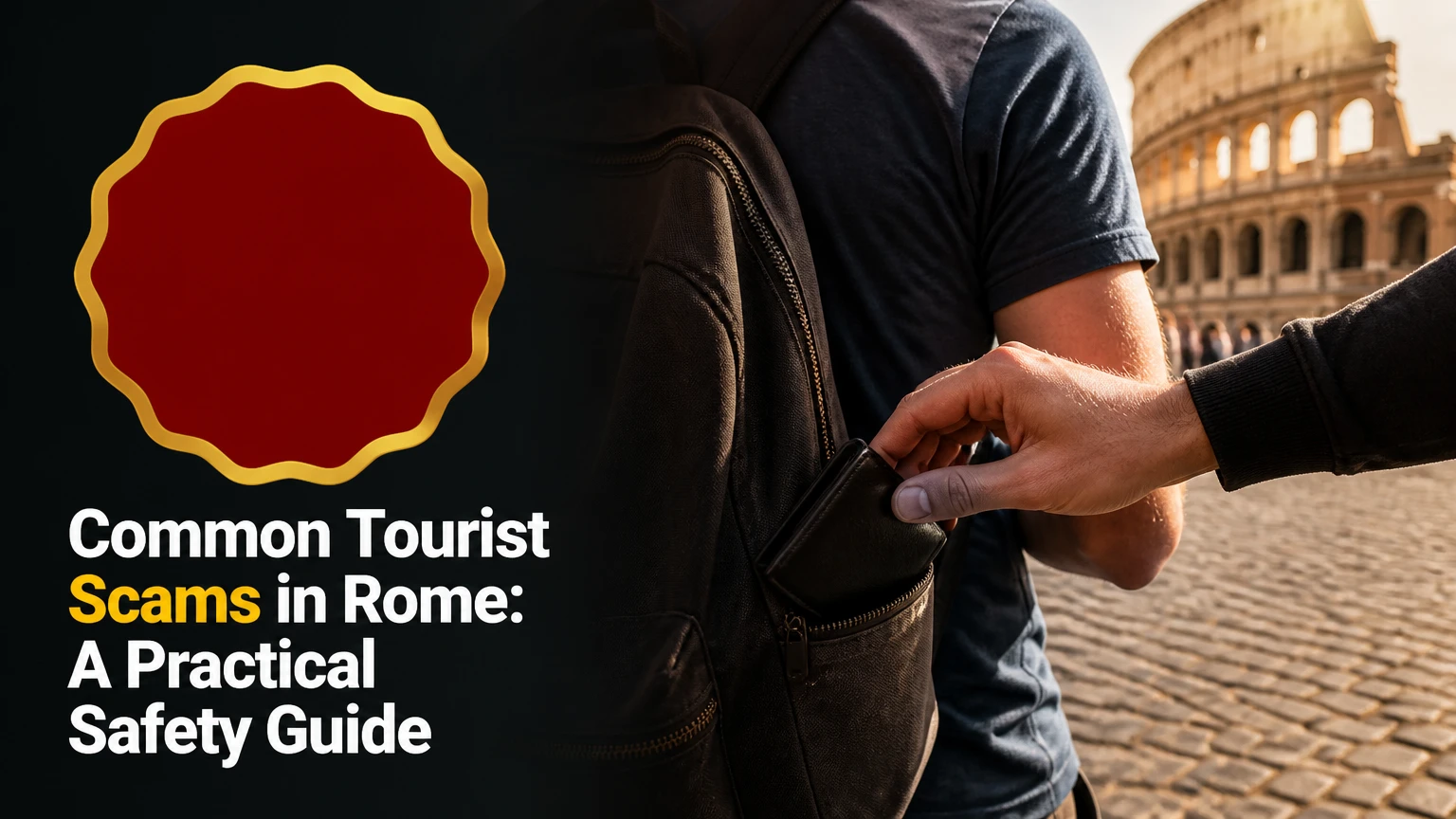
Distraction pickpocketing uses a staged spill, bump, petition, crowding event, or request for help to redirect attention from a bag or pocket. The theft often happens within seconds, especially when a phone is in a loose trouser pocket or a purse is open behind the body.
Metro Line A, Termini, bus boarding areas, and crowded approaches to landmarks are practical targets because passengers are compressed and focused on maps, doors, or luggage. A petition clipboard can block the view of a bag while a second person reaches underneath.
| Distraction | Typical target | Immediate protective action | Follow-up |
|---|---|---|---|
| Ketchup or mustard spill | Phone and wallet | Step away before cleaning | Check every compartment |
| Dropped coins | Front or back pocket | Ignore the ground and secure valuables | Leave the group |
| Petition or clipboard | Open handbag | Close bag and move away | Warn nearby travelers |
| Sudden bump at train doors | Phone in hand | Grip phone and exit the crowd | Check pockets immediately |
| Luggage assistance | Passport and wallet | Keep documents on your body | Refuse unsolicited handling |
Use a zippered crossbody bag across the chest, with the opening facing inward. Put passports, spare cards, and excess cash in separate locations, and never store a phone in a back pocket.
Expert insight: a money belt protects documents but makes frequent access awkward, so many travelers repeatedly expose it in public. Keep daily spending money in a small closed compartment and reserve the hidden belt for backup funds and identification.
What to Do After a Scam or Theft
A scam does not always require police intervention, but theft, threats, unauthorized card use, and identity-document loss should be documented quickly. The first priority is safety, followed by payment protection, evidence preservation, and an official report.
- Move into a staffed hotel, shop, station office, or museum entrance.
- Check whether your passport, phone, wallet, and cards are present.
- Freeze or cancel payment cards through the issuer’s app.
- Change banking and email passwords if a phone or device was taken.
- Record the time, location, description, vehicle license, receipt, and witnesses.
- Contact Italian police through 112 for an emergency or immediate threat.
- File a theft report and ask for a written copy for insurance or replacement documents.
| Problem | First contact | Useful evidence | Typical urgency |
|---|---|---|---|
| Immediate threat | 112 in Italy | Location and description | Immediate |
| Stolen wallet | Card issuer and police | Transaction alerts and report | Within minutes |
| Lost passport | Local police and consulate | Passport copy and ID scan | Same day |
| Taxi overcharge | Taxi authority or operator | Receipt, plate, route, time | Within 24-48 hours |
| Invalid attraction ticket | Seller and card issuer | Confirmation and advertisement | Same day |
| Unauthorized card transaction | Bank or card issuer | Alert screenshot and receipt | Immediately |
A card dispute is stronger when the traveler has the merchant name, transaction amount, receipt, and a concise explanation of what was promised versus delivered. Do not exaggerate the facts. Banks and insurers rely on consistent records.
Are Rome’s Scams Worse at Night or in Certain Areas?
Rome’s scam exposure is usually higher in crowded daytime zones, while nighttime risk depends more on isolation, alcohol, poor lighting, and reduced transport options. The Colosseum and Vatican approaches generate more solicitation during sightseeing hours, whereas Termini and nightlife routes require stronger attention after dark.
| Traveler situation | Higher-risk moment | Main concern | Practical adjustment |
|---|---|---|---|
| Solo arrival | First 30 minutes at airport | Unofficial transport | Use rank, train, or prebooked ride |
| Family with children | Attraction queues | Photos and distraction | Assign one adult to bags |
| Older traveler | Station transfers | Luggage and unsolicited assistance | Use staffed information points |
| Nightlife visitor | After midnight | Isolation and payment disputes | Use a licensed taxi or known app |
| First-time transit user | Train boarding | Phone distraction | Download directions before travel |
| Mobility-limited traveler | Uneven crowded approaches | Pressure and blocked routes | Prearrange accessible transport |
Families should teach children not to accept objects from strangers and should designate a meeting point before entering a crowded attraction. Travelers with limited mobility should avoid being separated from companions by aggressive sellers or narrow queues.
Rome is not well served by treating every stranger as dangerous. Ask uniformed staff, museum employees, hotel receptionists, or official transport personnel for help. Those channels are slower than a street offer, but they provide accountability.
How to Protect Money, Cards, and Phones
The safest payment setup combines limited daily cash, a primary card, a backup card stored separately, and transaction alerts. Contactless payment reduces the need to hand over a card, but travelers should still check the amount on the terminal before tapping.
Use these rules:
- Carry only the cash needed for the day plus a modest reserve.
- Keep one backup card outside the main wallet.
- Enable instant bank notifications and low travel spending limits.
- Photograph passports and card details in encrypted storage.
- Keep the phone locked with a strong passcode rather than a simple pattern.
- Do not unlock banking apps while surrounded by strangers.
- Inspect every card-terminal total before approving payment.
- Refuse a request to pay on a personal phone or an unrelated account.
A stolen phone can create a larger loss than a stolen wallet if it provides access to email, banking, travel documents, and password reset messages. Set up remote lock and erase functions before departure, and keep your hotel address available offline.
What Rome Visitors Commonly Get Wrong
The most common mistake is trying to be polite after the interaction has become physically intrusive. A brief refusal at the first approach is safer than a long explanation that gives the seller time to attach an object, take a phone, or summon companions.
Travelers also misread low prices. A restaurant’s inexpensive pasta does not establish the price of fish, wine, service, or cover. Likewise, a cheap “ticket” may be an escort service rather than admission.
A practical pre-trip checklist includes:
- Save official attraction booking pages and airport transport instructions.
- Download an offline map and keep the hotel address in Italian.
- Separate passport, cards, and daily cash.
- Learn the appearance of official white taxis.
- Set card alerts and prepare a bank contact method.
- Agree on a family meeting point.
- Keep emergency number 112 accessible.
Rome’s limitation for hurried visitors is not a lack of legitimate services. The difficulty is that official transport, tours, restaurants, and informal sellers can appear side by side, so travelers must verify the provider rather than judge by confidence or appearance.
Frequently Asked Questions About common tourist scams in Rome
Is it safe to carry a camera in Rome?
Carrying a camera is generally reasonable, but crowded transit and attraction queues require extra control. Use a secured strap, keep the device in front of your body, and avoid placing it on restaurant tables near walkways. A camera should never be handed to an unsolicited costumed performer.
Should I carry cash or use a card in Rome?
Carry a small amount of cash for minor purchases, while using a card at established businesses where the terminal shows the amount clearly. Keep a backup card separately. Cash is harder to recover after theft, while card transactions can usually be frozen and disputed quickly.
Can a Rome taxi charge extra for luggage?
The applicable fare structure can include regulated supplements in specific circumstances, but a driver should not invent a price after the journey. Ask which fare applies before departure, use an official vehicle, and request an itemized receipt. Check current municipal taxi rules because fares and supplements can change.
What if a restaurant refuses to correct an inflated bill?
Ask calmly for the itemized bill and identify the disputed menu price. Pay the amount you agree is valid, request a receipt, and record the restaurant name and payment details. If unauthorized card charges follow, contact the card issuer immediately and provide the receipt, menu, and transaction record.
Are people asking for signatures always pickpockets?
No. Some petition collectors may be legitimate, but an unsolicited clipboard placed over a bag creates a preventable risk. Decline without signing, keep belongings closed, and move away. Legitimate charitable activity does not require blocking your view or pursuing you after refusal.
Is Rome safe for solo travelers after dark?
Many central areas remain busy after dark, but solo travelers should avoid isolated streets, poorly lit shortcuts, and accepting unsolicited rides or invitations. Plan the return route, keep the phone secured, and use a licensed taxi, public transport, or a reputable prebooked transfer when needed.
Conclusion: The Simple Rule Behind Rome Scam Prevention
Common tourist scams in Rome work through speed, distraction, assumed consent, and unclear pricing rather than sophisticated deception. Protect your valuables before investigating a disturbance, verify taxis and tickets through official channels, read restaurant prices, and leave immediately when a seller becomes aggressive. These habits preserve both your budget and your time.