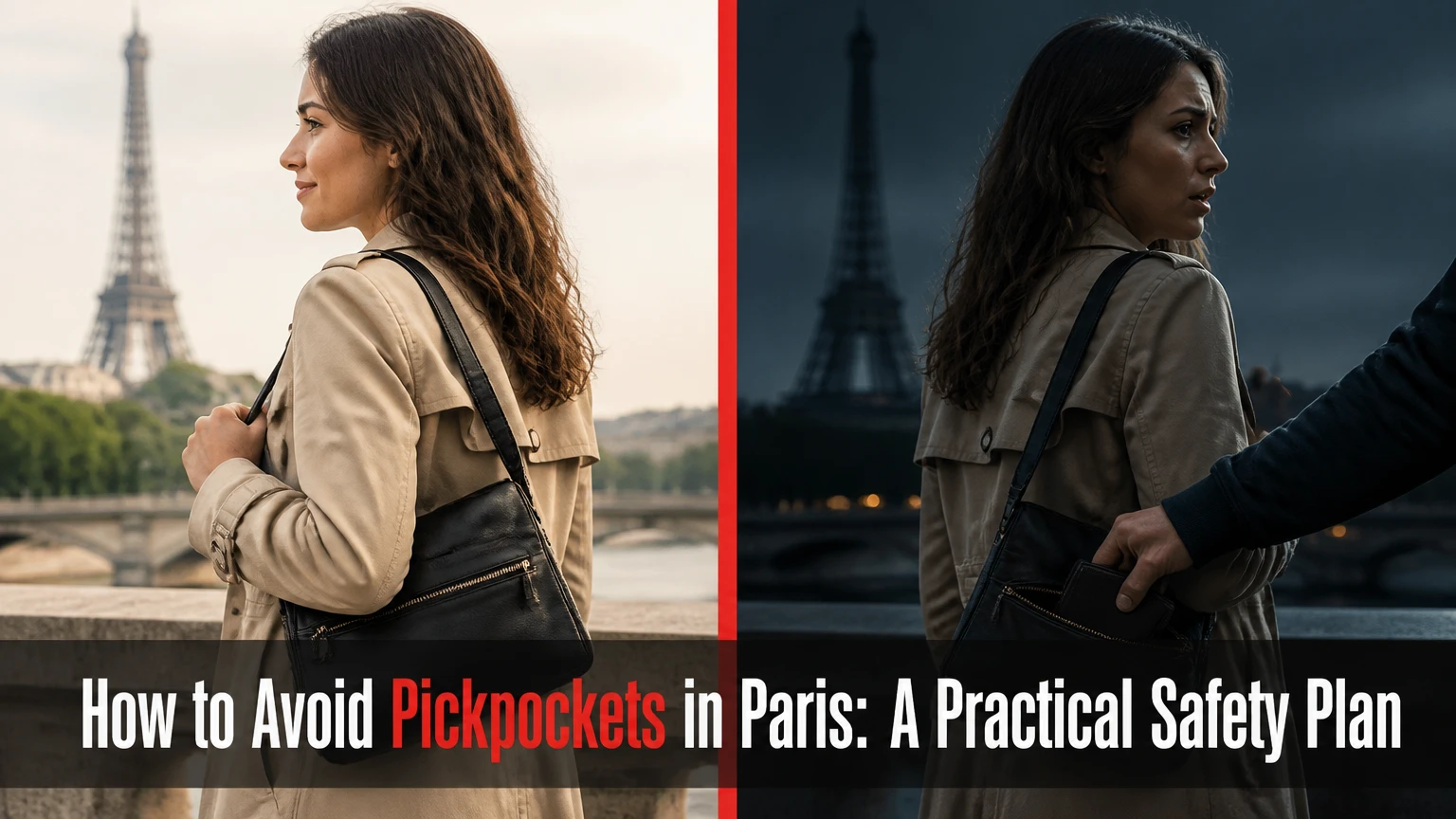
How to avoid pickpockets in Paris is mainly a matter of controlling access to your valuables, refusing distraction-based contact, and changing behavior in dense crowds. Pickpocketing is usually a non-violent, opportunistic theft that succeeds when attention is diverted, bags are out of sight, or phones and wallets are temporarily left unsecured.
Key Facts / Quick Answer
Keep your phone, cards, and passport in a zipped bag positioned in front of your body.
Treat sudden approaches, crowding at Metro doors, spilled-liquid incidents, petitions, rings, and unsolicited bracelets as prompts to move away.
Carry one payment card and roughly $40-$55 equivalent in daily cash, while storing backups separately.
Do not keep a phone in a back pocket or on a café table, even when you are seated.
If theft occurs, lock the device, freeze payment cards, contact your insurer, and file a police report the same day.
Why Pickpocketing Happens in Paris
Pickpocketing in Paris happens when a thief exploits a short attention gap in a crowded, predictable setting. The most exposed moments include boarding a train, reading directions outside a landmark, paying at a counter, or responding to an unexpected person who enters your personal space.
The theft often follows a simple division of labor. One person creates the interaction or blocks movement, another reaches into a pocket or bag, and a third person may carry the item away. Travelers do not need to identify every participant; recognizing the distraction is enough to end the opportunity.


“Inattentional blindness” describes the attention problem behind many incidents: the brain concentrates on a question, map, argument, or physical disturbance and registers less information from the surrounding area. A stranger does not need to overpower you. The person only needs you to look somewhere else for several seconds.
The behavioral warning signs
Watch for combinations rather than isolated actions. A tourist asking a genuine question is not automatically suspicious, and crowded public transport is not evidence of a coordinated theft. Risk rises when an unusual approach is paired with touch, blocking, urgency, or a request to handle an object.
Common warning combinations include:
- A person stands unusually close while another person speaks to you.
- Someone places a paper, clipboard, map, or jacket over your belongings.
- A group compresses around a train door immediately before departure.
- A stranger touches your wrist, clothing, bag, or phone.
- A person insists that you stop, sign, pay, or explain yourself immediately.
- Someone points toward your clothing or claims that you dropped something.
The safest response is brief and physical: close the bag, recover your hands and belongings, create distance, and continue toward staff or a populated business. Arguing about the person’s intention keeps your attention inside the distraction.
Which Paris Scams Should You Recognize?
The most common tourist theft setups use a sudden request, object, or crowd to move your attention away from your valuables. Paris visitors should recognize the setup without assuming that every petitioner, street seller, or person asking for help is a thief.
| Setup | Typical location | Vulnerable item | Immediate response |
|---|---|---|---|
| Petition or clipboard | Landmark approaches, busy sidewalks | Front pocket or open bag | Say “Non, merci,” close the bag, keep walking |
| Café paper or map | Outdoor terraces and tables | Phone or wallet on table | Put your hand on the item and remove it from view |
| Found ring | Tourist walking routes | Wallet during the conversation | Do not touch the ring; continue without negotiating |
| Bracelet tying | Sacré-Cœur stairs and approaches | Wrist, pocket, or companion’s bag | Keep both hands free and step toward staff or a shop |
| Metro crowding | Train doors during boarding | Phone, rear pocket, open backpack | Move inside, face the bag inward, and check belongings |
| Liquid or clothing claim | Stations, sidewalks, café entrances | Wallet while cleaning yourself | Decline assistance and inspect possessions privately |
Petition and clipboard approaches
A clipboard can block your view of your waist or bag while the operator speaks quickly. Some people genuinely solicit donations, but a visitor does not need to determine the person’s motive in the moment.
Use a neutral sentence such as “Non, merci,” without stopping to explain. Keep your bag closed, do not sign, and do not take out a wallet to provide a donation. If the person follows you, enter a staffed shop, hotel, museum desk, or transit office.
Ring, bracelet, and forced-contact scams
The ring approach turns curiosity into a negotiation. The person may claim the ring is valuable, offer it to you, and then demand money; the conversation also gives an accomplice time to approach from the side.
At Montmartre, unsolicited bracelet tying creates a similar problem because physical contact limits your movement. Keep your hands near your bag, refuse before anyone touches your wrist, and move toward the Sacré-Cœur entrance, a staffed venue, or a group of uniformed personnel.
Café table theft
A phone left beside a coffee cup is exposed because the tabletop gives the thief a clear target and the visitor’s attention naturally turns toward the menu, companion, or street. Put the phone in a zipped compartment before eating, not under a napkin or beside a plate.
If somebody places paper over the table, cover the phone with your hand and say “Non, merci.” Do not lift the paper for them. A table edge, chair back, or adjacent seat is not a secure storage location.
How Should You Use the Metro and RER?
The safest public-transport habit is to secure belongings before approaching the platform and keep the bag in front of you throughout boarding, travel, and exit. Train doors create special risk because a phone or bag can be taken just before departure, leaving the victim inside while the thief remains outside.
| Transit situation | Main exposure | Safer position | Checkpoint |
|---|---|---|---|
| Boarding a crowded Metro | Rear pocket and open backpack | Bag across the chest | Check zipper before entering |
| Waiting by train doors | Phone snatch at departure | Stand away from the doorway | Put phone away before the chime |
| Riding with luggage | Open outer compartments | Case between feet, handle secured | Check passport and wallet at transfer |
| Exiting at a landmark | Crowd compression | Let the first wave pass | Inspect belongings after the platform clears |
| RER airport transfer | Fatigue and luggage distraction | Sit away from doors when possible | Keep documents in an internal compartment |
| Late-night transfer | Reduced attention and fewer open businesses | Travel with companions | Use staffed areas if approached |
Boarding and exiting procedure
- Stop beside a wall or station fixture before opening your bag.
- Put the phone away and close every zipper.
- Move the bag to your chest, with the opening facing inward.
- Keep one hand on the main compartment during boarding.
- Step away from the doorway after entering.
- Let a dense group exit before you follow.
- Check your phone, wallet, and passport only after reaching a less crowded area.
The Metro is not uniformly dangerous, and rush hour does not mean theft is inevitable. Crowding simply reduces your ability to detect access to a pocket or zipper. The practical rule is to treat doorways as transition zones, not as places to stand while using a phone.
Airport and late-night travel
Travelers arriving from Charles de Gaulle often carry luggage, passports, and fatigue at the same time. The RER B and station interchanges can therefore create more exposure than a normal daytime ride, especially when a visitor is searching for a hotel address.
Keep the passport in an interior compartment, use official route information, and decide the destination before boarding. At night, avoid opening a suitcase or wallet on the platform. If you need help, ask a uniformed transport employee or use a staffed information point rather than accepting unsolicited assistance.
Where and When Is Theft More Likely?
Pickpocketing risk increases wherever tourist density, distraction, and restricted movement overlap. High visitor numbers around the Louvre, Eiffel Tower, Notre-Dame, Sacré-Cœur, major department stores, and central transport hubs create opportunity, but no arrondissement can be classified as risk-free or risk-proof.
| Context | Exposure level | Typical duration | Best adjustment |
|---|---|---|---|
| Landmark queue | High | 20-90 minutes | Keep bag zipped and phone away |
| Packed Metro, 08:00-10:00 | High | 10-35 minutes | Use front carry and avoid doors |
| Packed Metro, 17:00-19:30 | High | 10-40 minutes | Delay nonessential transfers |
| Outdoor café stop | Medium | 30-75 minutes | Keep valuables off the table |
| Nightlife transfer, 22:00-02:00 | Medium-high | 15-45 minutes | Travel with a charged phone and companion |
| Residential street in daytime | Lower | 10-30 minutes | Maintain normal awareness |
| Major event crowd | High | 30 minutes or more | Carry fewer valuables and plan exits |
Travel safety reporting frequently identifies the 1st, 2nd, and 8th arrondissements because those districts contain major attractions, shopping areas, and transport routes. That pattern describes concentration of opportunity, not a judgment about every street or resident. The 15th and 16th may feel quieter, yet a crowded bus, station, or attraction can still produce the same exposure.
The highest-risk personal situations
Your own condition matters as much as the location. Jet lag, alcohol, children, heavy shopping bags, and a delayed itinerary all make distraction easier.
Expert insight: the most vulnerable traveler is often not the person in the busiest crowd, but the person who stops immediately after leaving it to check a phone, reorganize a wallet, or search for a hotel. Move several minutes away first, then unpack or navigate.
What Is the Safest Way to Carry Valuables?
A zipped crossbody or sling worn across the chest is the best general compromise between security and access. An under-clothing pouch offers greater concealment for backup documents, while a standard backpack becomes safer only when it stays in front of the body in crowded settings.
| Carry method | Access time | Capacity | Main failure point |
|---|---|---|---|
| Back pants pocket | 1-2 seconds | 1 wallet | No visual or tactile protection |
| Loose front pocket | 1-3 seconds | 1 phone | Exposed when seated or crowded |
| Standard backpack on back | 2-5 seconds | 15-30 liters | Zippers remain out of sight |
| Front-worn crossbody | 2-4 seconds | 2-8 liters | Unzipped main compartment |
| Locking anti-theft sling | 3-6 seconds | 2-6 liters | Overloading slows closure |
| Money belt under clothing | 10-30 seconds | Cards and documents | Awkward public access |
A practical three-layer carry system
Use separate locations for daily access, emergency backup, and identity documents.
- Daily layer: one card, a small amount of cash, transit access, and the phone in a front-worn zipped bag.
- Backup layer: a second card and additional cash stored separately from the day bag.
- Document layer: passport and spare identification secured at the accommodation unless a specific border or identity requirement makes carrying them necessary.
Do not place every valuable in one anti-theft bag. A slash-resistant bag can prevent one type of loss, but losing that single bag would still remove every card, device, and document at once.
Expert insight: a security feature that slows access can cause unsafe behavior. If a lock is frustrating to open, travelers often leave the compartment unlatched or repeatedly expose the contents in public. Choose a closure you can use consistently with one hand.
Phone and payment setup
Enable device tracking, a strong screen lock, and remote erase before departure. Store emergency contact information in the phone’s locked-screen medical or emergency section, and record the device’s serial number separately.
Use contactless payment where practical, but do not rely on one payment method. Carry a physical backup card, keep bank emergency numbers in a password manager accessible from another device, and set transaction alerts before traveling.
What Should You Leave at the Hotel?
Leave anything that is expensive, difficult to replace, or unnecessary for the next few hours. The physical passport, backup cards, spare cash, extra jewelry, and duplicate electronics should normally remain in a properly secured room safe or other accommodation security arrangement.
| Item | Carry during sightseeing? | Typical replacement cost | Better arrangement |
|---|---|---|---|
| Physical passport | Only when required | $135-$300 in fees and travel | Secure storage, encrypted scan |
| Primary phone | Yes | $400-$1,200 | Wrist or bag tether, screen lock |
| Backup credit card | No | $0 fee, high disruption | Separate locked location |
| Daily cash | Yes | $40-$55 equivalent | Divide between two compartments |
| Spare camera lens | Usually no | $200-$1,500 | Carry only for planned photography |
| Jewelry | Usually no | $100-$5,000+ | Leave at home or secure storage |
Photograph the identification page of your passport, but remember that a photograph does not replace the original document for travel. Store copies in encrypted cloud storage and keep the account protected with multifactor authentication.
A hotel safe is useful but not infallible. Confirm that the safe is locked, avoid announcing its contents, and retain the accommodation’s contact details separately. On checkout day, inspect the safe, closet, bathroom, and charging points before leaving.
What If You Notice an Attempt?
If you notice a hand near your bag or a coordinated distraction, protect the item and leave rather than confronting the suspected thief. Pickpockets may work in groups, and an argument can create the second distraction that allows an accomplice to act.
- Close or remove the exposed bag from reach.
- Move toward staff, a ticket office, a hotel desk, or a busy shop.
- Check your phone, wallet, passport, and cards in private.
- Do not chase, grab, or search a person’s clothing.
- Record the time, line, station, direction, and physical description.
- Freeze cards and activate device tracking if anything is missing.
- File a police report and obtain the report number.
- Contact your insurer, bank, mobile carrier, and embassy if needed.
French emergency services use 17 for police assistance and 112 as the European emergency number. Use emergency services for immediate danger, injury, threats, or a crime in progress. For a completed theft without immediate danger, go to a police station, known in France as a commissariat, and request a theft report.
The U.S. Embassy’s France safety guidance advises victims to report crimes to French police and contact the embassy for consular assistance when documents are lost. Police may not recover the property, but the report can support insurance claims, replacement documents, and disputes over unauthorized transactions.
If the phone or cards are gone
Remote-lock the phone first if possible, then contact the card issuer. Do not wait until returning home because contactless transactions and in-app payment access can create losses before statements arrive.
| Action | Recommended deadline | Information needed | Result |
|---|---|---|---|
| Freeze payment cards | Within 15 minutes | Issuer app or phone number | Stops new transactions |
| Mark phone lost | Within 30 minutes | Account credentials | Locks device and displays message |
| Change key passwords | Within 1 hour | Backup device | Limits account takeover |
| File police report | Same day | ID and incident details | Creates official record |
| Contact insurer | Within 24-72 hours | Report number and receipts | Starts claim review |
| Contact embassy | Same day if passport lost | Citizenship proof and report | Begins emergency-document process |
Typical direct losses vary widely. A stolen phone may cost $400-$1,200 to replace, while emergency travel documents, transport to an embassy, missed reservations, and time spent resolving fraud can add another $100-$500. These are planning ranges, not official fixed prices.
How Can Families and Older Travelers Reduce Risk?
Families should assign one adult to manage navigation and another to monitor children and bags. Older travelers and visitors with mobility limitations should prioritize stable positioning, accessible bags, and staff assistance over trying to move quickly through a crowd.
Before leaving the accommodation, agree on four rules:
- Children do not carry passports, room keys, or the family’s payment cards.
- Everyone stops inside a shop or against a wall before checking directions.
- A child who becomes separated stays in place or approaches uniformed staff.
- One adult carries the daily bag while another keeps the backup card.
A stroller can increase exposure because adults focus on maneuvering wheels and boarding gaps. Keep valuables in a front-worn bag rather than a stroller basket, and board elevators or less crowded train sections when available.
Wheelchair users and travelers with balance limitations should avoid being rushed through train doors. Ask a station employee for assistance, keep valuables secured before the platform, and choose a position where the bag remains visible without interfering with mobility equipment.
A Ten-Minute Paris Security Setup
A short preparation routine removes most preventable exposure before the first attraction. Complete it before leaving the accommodation rather than on a pavement beside a station.
- Enable phone tracking, screen lock, and remote erase.
- Photograph passports and payment cards without storing full card numbers in an unprotected file.
- Put one card and $40-$55 equivalent in the front-worn day bag.
- Store backup cards, extra cash, and passports separately.
- Close every bag compartment and test each zipper one-handed.
- Save the accommodation address and emergency numbers offline.
- Tell companions the agreed phrase for leaving a suspicious interaction.
- Check the planned route before reaching the station.
- Put the phone away before entering a Metro doorway.
- Recheck belongings after every transfer, crowd, café stop, and landmark queue.
The purpose is not to look fearful or avoid public transport. The purpose is to remove repeated decisions, because rushed decisions are where phones land on café tables and wallets remain in open pockets.
Frequently Asked Questions About how to avoid pickpockets in Paris
Is Paris safe for tourists traveling alone?
Paris is generally navigable for solo visitors, but dense tourist areas and public transport require deliberate bag and phone habits. Solo travelers should avoid handling valuables during street navigation, keep a charged phone secured, use staffed locations for help, and tell accommodation staff their daily route when traveling late.
Should I carry my passport while sightseeing in Paris?
Carry the original passport only when a specific travel, identification, or administrative need requires it. For ordinary sightseeing, secure it at your accommodation and carry a protected copy or stored scan, remembering that copies cannot replace the original for international travel.
Are anti-theft bags worth buying for Paris?
An anti-theft bag can reduce slash and zipper access, but it cannot prevent theft if left open, placed behind the body, or overloaded. A simple zipped crossbody worn in front often works better than a complex bag whose locking system causes repeated public unpacking.
What should I say to a Paris street scammer?
Use a brief, firm “Non, merci,” do not stop, and keep walking toward a staffed or populated location. Avoid eye-level negotiation, touching offered objects, signing papers, or opening a wallet to prove that you do not want the service.
Can pickpockets steal from a zipped front bag?
A zipped front bag is harder to access, not impossible to attack. Risk remains if the bag hangs below your hand, the zipper faces outward, a stranger creates prolonged contact, or the bag contains every valuable you own. Keep one hand near the closure in crowded places.
What should I do if my passport is stolen in Paris?
Move to a secure location, file a French police report, contact your country’s embassy or consulate, and follow its emergency-document procedure. Bring proof of identity, a copy of the passport if available, passport photographs if required, and evidence of onward travel.
Conclusion: The Best Way to Avoid Pickpockets in Paris
The most reliable way to avoid pickpockets in Paris is to keep valuables consolidated in a zipped front-worn bag, carry only what the day requires, and leave every unexpected interaction without stopping. Secure the phone before Metro doors, keep belongings off café tables, separate backup documents, and report theft promptly if prevention fails.