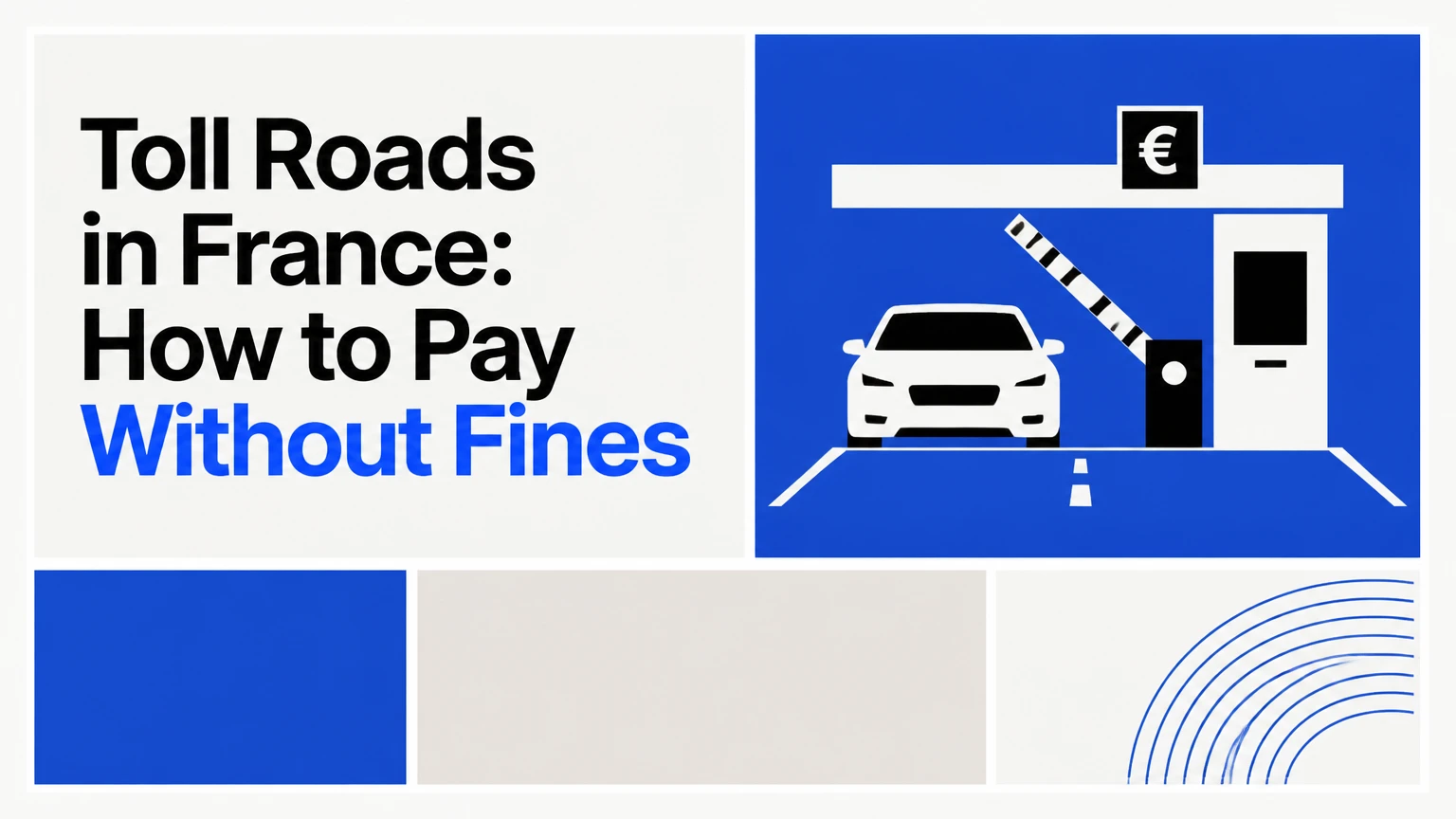
Toll roads in France are distance-priced autoroutes where drivers pay at a barrier, through an electronic télépéage tag, or online after passing a barrier-free gantry. France does not require a motorway vignette for ordinary light vehicles, but charges depend on the route, vehicle class, concession operator, and whether the road uses traditional or free-flow collection.
Quick answer
Traditional péage roads issue a ticket at entry and collect payment at exit.
Visa and Mastercard generally work in card lanes, but carry a second card or cash backup.
An orange t lane requires a télépéage tag, while a green arrow lane accepts several payment methods.
Free-flow sections record the number plate and normally require payment within 72 hours.
Typical Class 1 motorway pricing is about $0.11-$0.17 per mile equivalent, with bridges and tunnels often costing more.
A standard car from Paris to Lyon commonly requires about $44-$49 in toll planning allowance, depending on the route and current tariff.
Toll Roads in France, How to Pay
The correct payment method depends first on the toll system, not on the road number. At a conventional péage, take a ticket when entering and pay at the exit; with télépéage, the tag is charged automatically; on a flux libre section, use the operator’s website or an approved retail payment point after the journey.
French motorways are marked with an A, usually on a blue sign. Most are operated by concession companies such as VINCI Autoroutes, Sanef, APRR, AREA, and Aliaé. Those companies set route tariffs under the French concession framework, so two motorways covering similar distances can have different charges.


The road network also includes free national roads marked N and departmental roads marked D. A navigation application may combine all three types unless “avoid tolls” is selected.
Which payment method should you choose?
| Driver profile | Best method | Typical setup time | Main risk |
|---|---|---|---|
| One short motorway trip | Physical Visa or Mastercard | Under 1 minute | Card authorization failure |
| Several long driving days | Télépéage tag | 3-10 days if ordered in advance | Monthly or trip-related service fees |
| Rental-car user on flux libre | Operator website | 5-10 minutes after travel | Plate or rental dates entered incorrectly |
| Cash-dependent traveler | Cash lane with green arrow or coins | 2-5 minutes per barrier | Longer queues and exact-change delays |
| Frequent France visitor | Personal tag linked to account | One-time registration | Wrong vehicle plate on account |
The most dependable practical setup is a physical payment card plus a backup card stored separately. A tag is convenient, but it is not mandatory.
How French Motorway Tolls Are Calculated
French motorway charges usually combine the distance traveled with the vehicle category assigned by sensors at the toll point. The final amount is determined by the concession operator and route, so a mileage estimate cannot replace an official route quote.
The vehicle category is based mainly on total height, weight, and axle count. Height is measured for classification purposes, which makes roof boxes, bicycles, and tall vans relevant even when the underlying car is small.
French vehicle classes
| Class | Typical vehicle | Height or weight rule | Planning consequence |
|---|---|---|---|
| Class 1 | Car, small SUV, standard estate | Up to 2 meters and under 3.5 tonnes | Lowest ordinary car tariff |
| Class 2 | Large SUV, high van, caravan combination | Over 2 meters and up to 3 meters, under 3.5 tonnes | Often about 1.5 times Class 1 |
| Class 3 | Two-axle heavy vehicle or tall motorhome | Over 3 meters or over 3.5 tonnes | Substantially higher charge |
| Class 4 | Truck or vehicle with more than two axles | More than 3 axles or heavy commercial specification | Commercial tariff structure |
| Class 5 | Motorcycle, sidecar, or trike | Two-wheel or qualifying three-wheel vehicle | Separate motorcycle tariff |
A car with a roof-mounted bicycle may remain Class 1 if its measured height stays at or below 2 meters. If the total height crosses the threshold, the toll system can assign Class 2 automatically.
Expert insight: The most common classification dispute involves a vehicle that is physically close to 2 meters. Measure the highest fixed or loaded point before departure, because a toll-booth correction is easier before payment than after leaving the plaza.
Typical route budgets in USD
The following figures are practical planning estimates for a standard Class 1 car. They are not live quotes, and exchange rates or annual tariff changes can alter the final charge.
| Example route | Approximate distance | Typical toll budget, USD | Likely motorway corridor |
|---|---|---|---|
| Paris to Lyon | 460 km | $44-$49 | A6 |
| Paris to Bordeaux | 585 km | $67-$74 | A10 |
| Paris to Calais | 290 km | $28-$33 | A1 and A26 |
| Lyon to Marseille | 315 km | $30-$35 | A7 |
| Paris to Lille | 225 km | $17-$23 | A1 |
Tolls are often more expensive around major engineering structures. A bridge, alpine tunnel, or special urban crossing can add a charge that does not resemble the ordinary per-distance rate.
The concession tariff is commonly revised annually, with many changes taking effect in February. For an exact amount, enter the departure, destination, vehicle class, and route into the official autoroutes.fr route and payment resources or the relevant concession operator’s calculator.
What Happens at a Traditional Péage?
A closed toll system records where a vehicle enters and calculates the charge when the vehicle exits. The driver normally takes a paper ticket at the entry plaza, keeps it accessible, and inserts it into the payment machine at the destination exit.
The process is predictable:
- Slow before the toll plaza and identify the lane symbol overhead.
- Choose a green-arrow lane unless the car carries a télépéage tag.
- Stop at the entry machine and press the ticket button.
- Take the ticket and keep it inside the vehicle.
- At the exit, insert the ticket with the barcode facing the indicated direction.
- Confirm the displayed vehicle class and charge.
- Pay by card, cash, or tag according to the lane equipment.
- Wait for the barrier to rise, then collect the receipt if needed.
Do not follow a vehicle through a télépéage lane without a tag. The barrier may remain closed, and reversing at a busy plaza creates a safety problem.
Reading toll-lane signs
| Sign or symbol | Meaning | Accepted payment | Action |
|---|---|---|---|
| Orange t | Télépéage lane | Active toll tag | Use only with a compatible tag |
| White card marked CB | Card-only lane | Usually Visa or Mastercard | Insert or tap as instructed |
| Green arrow | Open mixed-payment lane | Card, cash, and often tag | Best general-purpose choice |
| Blue coins | Cash lane | Coins and banknotes | Allow extra handling time |
| Red cross | Closed lane | None | Move to another open lane |
French toll machines may ask for the card before returning the ticket, or display instructions in French only. “Carte” means card, “espèces” means cash, and “reçu” means receipt.
Expert insight: Keep the entry ticket in the center console rather than on the dashboard. Sunlight, spilled drinks, and a folded barcode can make the exit reader fail, even when the ticket is technically valid.
What if the toll machine does not accept your card?
Insert the physical card again only when the terminal requests it. Repeated attempts can create temporary authorization holds, particularly with prepaid and debit products.
If the card fails:
- Try a second physical Visa or Mastercard.
- Move to a green-arrow lane when available.
- Use cash if the machine accepts it.
- Press the assistance button, usually marked with an intercom symbol.
- Do not abandon the ticket or drive around the barrier.
Maestro, some Visa Electron products, disposable virtual cards, and certain prepaid cards can be unreliable at unattended French terminals. Contactless payment availability also varies by machine, so a physical chip-and-PIN card remains the safer choice.
How Does Free-Flow Tolling Work?
Free-flow tolling, called péage en flux libre, removes the payment barrier and uses overhead gantries to identify the vehicle by télépéage tag or number plate. The absence of a booth does not mean the road is free; the charge is recorded electronically and must be settled after the trip if no tag is attached.
The major operational examples include the A13 and A14 corridor between Paris and Normandy, the A79 in the Allier area, and selected free-flow sections associated with the A4, A10, and A837. Coverage can change as projects open, so follow signs and check the operator named on the payment notice or website.
Free-flow payment options
| Payment route | When to use it | Normal deadline | Information required |
|---|---|---|---|
| Télépéage account | Tag is active and correctly installed | Automatic | Registered plate and account |
| Operator website | No tag or pay-as-you-go preference | Usually 72 hours | Registration number and payment card |
| Approved Nirio point | Cash or in-person payment needed | Usually 72 hours | Registration number and journey details |
| Automatic plate account | Repeated trips on a known vehicle | Operator-defined account cycle | Plate, email, and card mandate |
Sanef, Aliaé, and other operators may use different portals. Check the operator’s own payment page rather than relying on an unaffiliated payment link.
A concise instruction attributed to Sanef’s free-flow customer guidance is: “You have 72 hours to pay your toll.” Treat 72 hours as the practical deadline unless the operator gives a different instruction for the specific crossing.
How to pay online after driving
- Identify the operator from the gantry, road sign, rental documentation, or route.
- Open the operator’s official payment portal.
- Enter the vehicle registration number exactly as displayed.
- Select the relevant journey or unpaid passage.
- Check the date, time, vehicle image or route details where shown.
- Pay with a card and save the confirmation page.
- Keep the payment reference until the rental or personal account is closed.
Some systems allow a plate to be registered in advance for automatic billing. That option can prevent missed deadlines on return journeys, but verify that the vehicle registration is removed after a rental ends.
Free-flow penalties after missed payment
Penalty values are established in French law and operator procedures. The approximate USD figures below are conversions for budgeting, not replacement legal amounts.
| Payment status | Approximate additional charge | Approximate total effect | Recommended response |
|---|---|---|---|
| Paid within stated window | $0 | Original toll only | Save receipt |
| Late but settled during early notice period | About $10 | Toll plus modest surcharge | Pay immediately |
| Notice unpaid after roughly 15 days | About $95 | Toll plus major surcharge | Use the notice reference |
| Extended nonpayment after roughly 2 months | About $400 | Formal fine process may apply | Contact the issuing authority |
A rental company may first receive the notice and charge the driver’s card for the toll, penalty, and an administration fee. That private administration fee is separate from the French toll penalty and may be higher than the road charge itself.
Expert insight: The best evidence in a dispute is a payment confirmation tied to the registration number and journey date. A bank statement alone may show a payment but not prove which free-flow passage it settled.
Is a Télépéage Tag Worth Buying?
A télépéage tag is a small electronic transponder linked to a payment account. It opens compatible barriers, records free-flow passages, and produces one consolidated billing trail, which makes it useful for long trips, repeated crossings, and drivers who dislike toll-plaza queues.
A tag is less attractive for a single short journey if delivery, subscription, activation, or minimum-use fees outweigh the time saved. Compare the full provider price rather than the advertising headline.
| Option | Suitable journey | Queue benefit | Cost pattern |
|---|---|---|---|
| No tag, card payment | One or two toll plazas | None | Toll only, subject to card terms |
| Monthly-style tag | Several trips in one month | High | Toll plus monthly service fee |
| Annual or occasional tag | Repeated France visits | High | Toll plus active-use or annual fee |
| Rental-company tag | Short rental with many tolls | High | Toll plus rental daily fee |
| Cross-border provider tag | Multi-country road trip | High | Toll plus account and country fees |
Install the device behind the windscreen according to the provider’s instructions. Metallized windscreens can interfere with radio communication, so use the designated transparent area when the vehicle manufacturer identifies one.
A tag does not remove the need to check the displayed vehicle class. Incorrect plate details, a tag placed in a poor location, or an expired payment method can create account exceptions that require manual settlement.
What Do French Toll Roads Cost Compared With Free Roads?
French autoroutes reduce travel time and provide regular service areas, but national and departmental roads avoid motorway tolls. The free route is not automatically cheaper overall because lower speeds, villages, traffic lights, hills, and detours can increase fuel use and driving time.
| Factor | Autoroute, A-road | National or departmental road | Practical result |
|---|---|---|---|
| Road charge | Route-specific toll | $0 toll | Secondary roads win on direct cash cost |
| Typical speed limit | Up to 130 km/h in dry conditions | Commonly 80-110 km/h | Motorways usually shorten long trips |
| Rain limit | 110 km/h | Lower local limits may apply | Weather changes the time advantage |
| Rest facilities | Aires commonly spaced along corridor | Town services and supermarkets | Motorway stops are easier to plan |
| Route character | Bypasses many settlements | More villages and junctions | D roads suit scenic itineraries |
| Traffic exposure | Queue risk at plazas and cities | Roundabouts and local congestion | Neither network is always faster |
For a trip exceeding about 250 km, compare the toll with the value of the time saved. For a short regional journey, the free route may add only 20-40 minutes and can make financial sense. For a fixed ferry, flight, or hotel check-in, the autoroute’s predictability may justify the charge.
Avoiding tolls can also redirect traffic through residential villages. Drive considerately, obey local speed limits, and do not treat a narrow D road as a substitute motorway.
Rental Cars, Motorhomes, Caravans, and Motorcycles
Vehicle type changes both the price and the payment procedure. Rental drivers must also determine whether the vehicle already has a tag or whether the rental company handles free-flow invoices centrally.
Before leaving a rental depot, record the registration number, photograph the vehicle’s toll device if present, and ask whether the device is active for France. If the company offers a daily toll package, compare its fee with expected toll use and any enrollment charge.
| Vehicle situation | Likely class | Payment issue | Practical check |
|---|---|---|---|
| Compact rental car | Class 1 | Plate may change at pickup | Photograph registration |
| Tall panel van under 3.5 tonnes | Class 2 | Height can exceed 2 meters | Confirm roof height |
| Motorhome above 3 meters | Class 3 | Higher route cost | Use an official class quote |
| Car towing caravan | Usually Class 2 | Combined height affects tariff | Measure loaded combination |
| Motorcycle | Class 5 | Some lanes and machines differ | Use a lane accepting motorcycles |
A trailer can alter classification even when the towing car is Class 1. Heavy motorhomes may also exceed the weight threshold, which can matter independently of height.
Electric vehicles pay the same motorway toll principles as comparable combustion vehicles. Lower energy cost does not reduce the road tariff, and charging stops may make a toll-free route less convenient if it lacks reliable public chargers.
Common Problems and Their Solutions
Most payment errors come from choosing the wrong lane, losing the entry ticket, or assuming a barrier-free passage is free. Each problem has a practical response, but prevention is less expensive than a later administrative dispute.
| Problem | Immediate response | Likely consequence | Prevention |
|---|---|---|---|
| Lost entry ticket | Press assistance button | Operator may assess maximum route fare | Store ticket securely |
| Entered orange t lane without tag | Stop and use intercom | Delay and possible manual intervention | Read lane symbols early |
| Wrong vehicle class displayed | Do not complete payment yet | Overcharge becomes harder to correct | Check height and screen |
| Missed free-flow payment | Visit official operator portal | Surcharge and mailed notice | Set a 72-hour reminder |
| Rental plate entered incorrectly | Recheck contract and portal record | Unmatched passage or duplicate charge | Copy plate exactly |
| Card declined | Use backup card or cash | Queue delay | Carry two payment methods |
Never reverse out of a toll lane unless directed by staff. Toll plazas have short stopping distances and moving traffic in adjacent lanes.
If a receipt shows the wrong class, keep the receipt, note the plaza, date, time, lane, and vehicle height, then contact the concession operator. A clear photograph of the vehicle and roof equipment can support the claim.
How to Plan a Toll Journey
A reliable budget includes tolls, fuel or charging, route time, and the administrative risk of free-flow payment. Navigation apps often provide toll estimates, but those figures can omit a changed route, a special bridge, or a different vehicle category.
Use this planning sequence:
- Enter the exact departure and destination.
- Compare the fastest route with an avoid-tolls route.
- Select the correct vehicle class, including loaded roof equipment.
- Identify concession operators and any flux libre section.
- Add a 10-15% toll contingency to a preliminary USD budget.
- Decide whether a tag’s fees are lower than expected queue and payment costs.
- Save operator links before departure.
- Set a reminder for the evening of the journey and the following day.
- Check the final bank charge or account statement after travel.
The 10-15% contingency is a planning rule, not an official surcharge. It covers route changes and approximate currency conversion, not a legal penalty.
When should you avoid the motorway?
Avoiding tolls is reasonable when the journey is short, the alternative route adds less than about 30 minutes, or the itinerary is designed around villages and scenery. Staying on the autoroute is usually more practical when a journey crosses several regions, includes a time-sensitive arrival, or uses a tall vehicle whose route cost has already been calculated.
A mixed strategy often works best: use free roads near the destination, then rejoin the motorway for the longest uninterrupted section. Check that the navigation app does not send the vehicle through a restricted urban street or low-clearance route.
Frequently Asked Questions About toll roads in France how to pay
Can I pay French motorway tolls with a foreign bank card?
Most French toll terminals accept physical Visa and Mastercard cards issued abroad, but acceptance is not guaranteed for every prepaid, virtual, Maestro, or Visa Electron product. Carry a second physical card and a small cash reserve. For free-flow sections, an online portal may accept a card that an unattended barrier terminal rejects.
Do I need a toll sticker or vignette for France?
Ordinary light vehicles do not need a motorway vignette to use French autoroutes. Drivers pay route-based charges at toll points or through electronic and free-flow systems. Environmental restrictions in some cities are separate from motorway tolls, so a Crit’Air emissions sticker may still be relevant to an urban itinerary.
Can I pay a French toll in cash?
Yes, where the lane displays a cash symbol or green arrow and the equipment accepts cash. Cash lanes may take coins and banknotes and usually return change, but availability varies by plaza. Cash is a useful backup when a foreign card fails, although it can increase queue time during holiday traffic.
What happens if I leave France without paying a free-flow toll?
The vehicle registration remains linked to the unpaid passage, and the operator can issue a payment notice to the registered keeper or rental company. A rental company may add an administration fee. Pay through the official operator portal as soon as possible and retain the confirmation reference.
Are toll roads cheaper for motorcycles?
Motorcycles normally use Class 5 pricing, which is lower than the tariff for a standard car on many routes, although the exact amount depends on the concession and crossing. A motorcycle should use a lane that safely accommodates its size and payment method, and the rider should keep the ticket protected from weather.
How can I estimate tolls for a campervan?
Identify the campervan’s total height, weight, and axle count, then use the official route calculator for the exact itinerary. A vehicle between 2 and 3 meters and under 3.5 tonnes is commonly Class 2, while a vehicle above 3 meters or above the weight threshold can move into Class 3 pricing.
Final Recommendation
For most visitors, the simplest setup is a physical Visa or Mastercard, a backup payment method, and a saved record of the vehicle registration. Use a green-arrow lane at conventional plazas, never enter an orange t lane without a tag, and treat every barrier-free gantry as a charge requiring prompt action.
If a long journey includes the A13, A14, A79, or another flux libre section, identify the operator before driving and pay online within 72 hours unless a télépéage account handles the passage automatically. For toll roads in France how to pay decisions, calculate the route by vehicle class, compare the time cost of N and D roads, and reserve a modest USD contingency for tariff or route changes.